

The dedicated legal team of Caputo & Mariotti
X Most Common Workplace Injuries in Pennsylvania You Need to Know
September 28, 2026
The Most Common Workplace Injuries Pennsylvania Workers Face
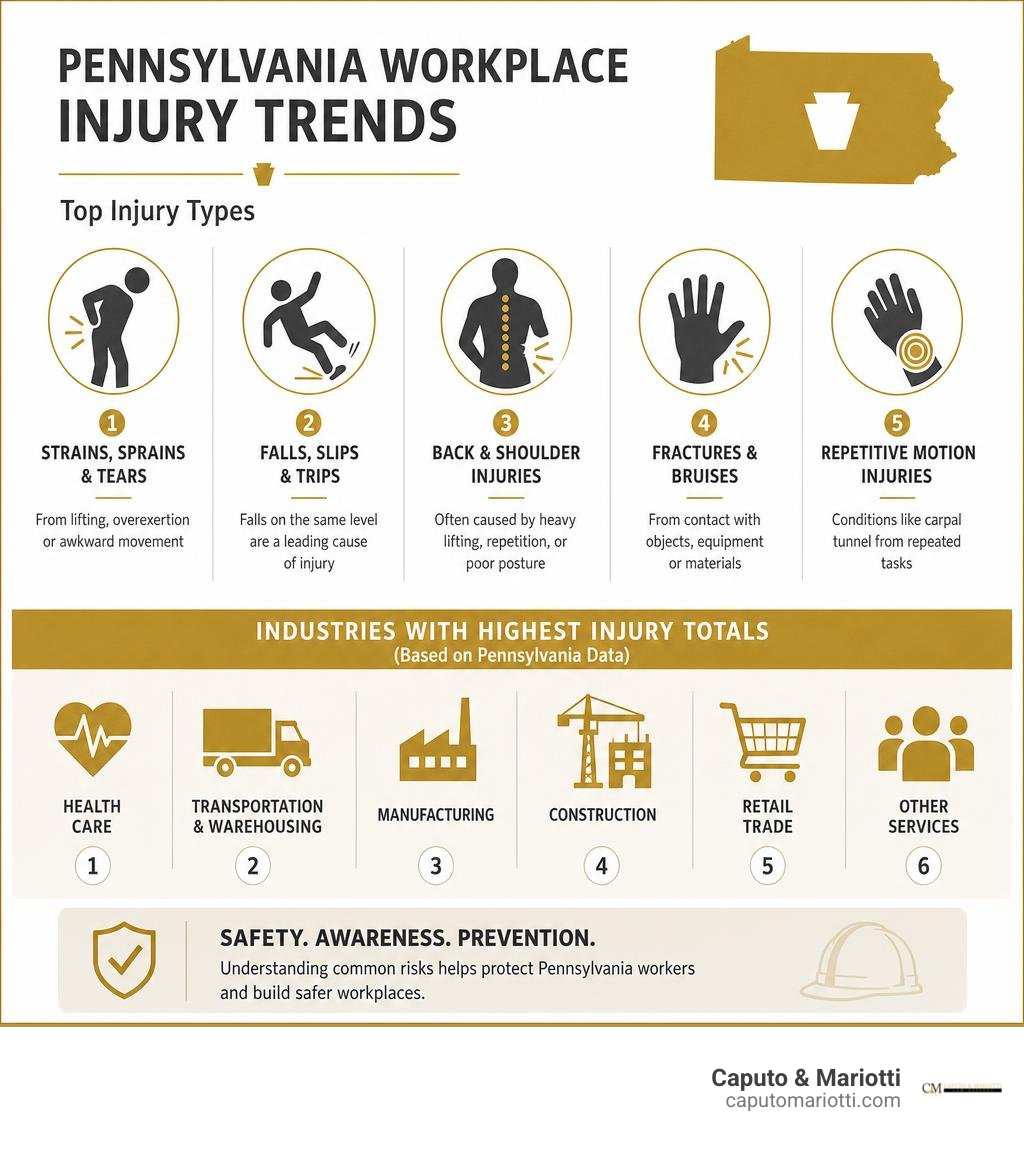
The most common workplace injuries in Pennsylvania include strains and sprains from lifting or overexertion, slip-and-fall injuries, back and shoulder injuries, fractures and bruises from contact with objects, and repetitive-motion conditions such as carpal tunnel syndrome.
Pennsylvania data shows that sprains, strains, and tears are a leading cause of injuries serious enough to keep people out of work. Falls, slips, and trips are also a major source of harm, especially falls on the same level. The highest injury totals often occur in health care, transportation, warehousing, manufacturing, construction, and retail-related work.
A work injury is not always one sudden accident. Under Pennsylvania law, a condition may be work-related when it results from a fall, repeated motions, or work that worsens an existing medical condition. Prompt medical care, notice to an employer, and clear records of what happened can matter after an injury.
I am Chris Caputo, a Pennsylvania attorney who has represented seriously injured people for decades, including people dealing with the most common workplace injuries Pennsylvania workers suffer. My experience litigating injury claims helps me explain the legal issues that can follow a serious job-related injury.
Analyzing the Most Common Workplace Injuries Pennsylvania Workers Suffer
Every work shift should end with an uninjured return home. Unfortunately, across Northeastern Pennsylvania—from industrial hubs in Scranton, Moosic, and Dickson City to commercial corridors in Wilkes-Barre, Pittston, and Hazleton—occupational trauma remains a daily reality.
According to official Pennsylvania Bureau of Labor Statistics injury data, private employers across the Commonwealth reported approximately 117,400 nonfatal workplace injuries and illnesses, generating an overall incidence rate of 2.7 cases per 100 full-time equivalent workers. This exceeds the national private industry average of 2.3 cases per 100 workers. Furthermore, over 57% of these reported incidents (67,700 cases) were severe enough to result in days away from work, job transfer, or work restriction (DART cases).

When an accident occurs, understanding work site injuries what you need to know after an accident is essential to safeguarding physical health and statutory legal remedies. Below is an in-depth analysis of the leading physical trauma classifications sustained by the Commonwealth’s workforce.
Strains, Sprains, and Overexertion: The Most Common Workplace Injuries Pennsylvania Employees Face
Soft tissue trauma—specifically severe ligament sprains, muscle strains, and tendon tears—represents the single largest category of job-related harm resulting in lost time. State statistical compilations show that sprains, strains, and tears account for over 24,000 cases involving days away from work in Pennsylvania private industry over multi-year reporting cycles.
Overexertion and bodily reactions occur primarily during:
- Manual handling of heavy boxes, pallets, and shipping containers
- Awkward lifting, holding, carrying, turning, or lowering of heavy equipment
- Sudden physical resistance encountered during equipment operation
- Patient handling and repositioning in medical or residential care environments
These excessive loads can rupture soft tissue fibers, leading to chronic joint instability, persistent pain, and lengthy periods away from normal occupational tasks.
Slip, Trip, and Fall Trauma
Falls remain the single most common specific incident leading to Pennsylvania workers’ compensation claims. State safety data categorizes slip, trip, and fall occurrences into distinct mechanical events:
- Falls on the same level: Accounting for nearly 13,600 lost-time cases, these incidents stem from wet floors, icy loading walkways, cluttered warehouse aisles, and unsecured cables.
- Falls to lower levels: Generating over 4,200 severe injury cases, these involve falls from ladders, scaffolding, loading docks, elevated platforms, and commercial vehicles.
- Slips and trips without falling: Sudden bodily adjustments made to regain balance can cause severe lumbar and joint torsion.
Such incidents often cause complex fractures, concussions, and severe spinal compromise. For workers navigating the fallout of an impact, the impact of a fall what to know about head and spinal injuries highlights the critical nature of immediate trauma care.
Severe Spinal, Lower Back, and Disc Injuries
The spinal column sustains tremendous structural stress during manual labor. Data from the PCRB workers compensation activity report reveals that lower back injuries comprise 11.8% of all indemnity claims across the Commonwealth, while shoulders account for 11.5% and knees represent 11.3%.
| Injured Body Part / Injury Type | Percentage of Total Claims | Average Claim Severity / Cost |
|---|---|---|
| Lower Back (Lumbar) | 11.8% | $50,163 |
| Shoulder(s) | 11.5% | $60,770 |
| Knee(s) | 11.3% | $42,650 |
| Intervertebral Disc Injuries | High-Severity Classification | $225,922 |
| Spinal Cord Damage | High-Severity Classification | $214,240 |
As detailed in actuarial reviews, spinal disc herniations and spinal cord damage represent the most financially and medically demanding claims in Pennsylvania, frequently exceeding $214,000 to $225,000 per case due to complex surgeries, physical therapy, and extended disability.
Fractures, Contusions, and Object Strikes
Being struck by, caught in, or compressed by equipment and materials causes thousands of traumatic workplace injuries annually. Objects falling from warehouse racking, moving forklifts, malfunctioning industrial tools, and structural materials frequently inflict blunt contusions, deep lacerations, and crushing bone fractures. In Lackawanna and Luzerne counties, where logistics and heavy distribution centers operate continuously, contact-with-equipment events generate high-severity claims requiring immediate orthopedic surgery and prolonged rehabilitation.
Repetitive Stress and Motion Disorders
Not all workplace harm stems from an acute accident. Cumulative trauma develops gradually over weeks, months, or years of continuous physical tasks. Common conditions include:
- Carpal Tunnel Syndrome: Median nerve compression at the wrist due to repetitive assembly, typing, scanning, or tool handling.
- Tendonitis and Tenosynovitis: Chronic inflammation of tendons caused by continuous overhead reaching or assembly line movements.
- Rotator Cuff Tears: Micro-tears that progress into complete ligament tears from repetitive lifting and pushing.
- Cervical and Lumbar Myofascial Strain: Chronic tissue degradation caused by prolonged static posture or driving over rough terrain.
Under the Pennsylvania Workers’ Compensation Act, repetitive stress conditions are compensable work injuries when established with competent medical testimony.
High-Hazard Sectors and the Most Common Workplace Injuries Pennsylvania Reports by Industry
Occupational injury risk varies significantly across industry classifications. According to the Pennsylvania DLI occupational injury summary tables, service-providing sectors account for approximately 76,480 of nonfatal lost-time injuries, while goods-producing sectors account for 18,870.
Two supersectors—trade, transportation, and utilities along with educational and health services—employ roughly 46% of Pennsylvania’s workforce but account for over 56% of all reported occupational injuries and illnesses.

Health Care and Social Assistance
Health care and social assistance records the highest total volume of nonfatal injuries in the Commonwealth, reporting over 31,700 total cases annually (with an overall incidence rate of 3.7 per 100 full-time workers). Within nursing and residential care facilities, the incidence rate climbs to 8.3 cases per 100 workers.
Healthcare staff regularly face acute physical hazards:
- Assisting non-ambulatory patients with transfers and bed repositioning
- Slipping on sanitized or contaminated hospital flooring
- Physical pushback or violent contact during emergency interventions
- Exposure to bloodborne pathogens and aerosolized respiratory conditions
Transportation, Couriers, and Warehousing
The logistics corridor running through Northeastern Pennsylvania—spanning Lackawanna County, Luzerne County, and adjacent transport routes—sees high rates of occupational trauma. Couriers and messengers experience an injury incidence rate of 10.3 per 100 workers, while general warehousing and storage records a rate of 4.9 per 100 workers.
Common hazards in this sector include:
- Strains and disc herniations from lifting heavy packages
- Crushing injuries and fractures involving forklifts and pallet jacks
- Slips and falls on loading docks, trailer beds, and metal ramps
- Motor vehicle collisions involving regional delivery couriers and heavy tractor-trailer operators
Manufacturing and Specialty Construction Trades
Manufacturing accounted for over 17,700 nonfatal recordable cases in Pennsylvania, with specialized sectors like wood product manufacturing reporting incidence rates as high as 6.7 per 100 workers. Construction recorded approximately 8,500 recordable incidents, with specialty trade contractors sustaining the vast majority of severe injuries (4,200 cases).
Workplace hazards in these sectors encompass:
- Amputations and severe lacerations from unguarded industrial machinery
- Falls from roofs, scaffolding, and structural framing
- Crush injuries from shifting building materials and heavy structural components
- Eye and respiratory injuries caused by airborne particulate matter and metal shavings
Pennsylvania Legal Standards for Work Injuries and Occupational Diseases
Understanding the legal framework governing work injuries is critical for ensuring full benefit recovery. Pennsylvania operates a statutory no-fault workers’ compensation system designed to provide medical care and wage-loss replacement without requiring the employee to prove employer negligence.
However, navigating the system requires strict adherence to statutory rules. Retaining a dedicated workers’ compensation lawyer ensures your rights are protected throughout the claims process.
Understanding the Workers’ Compensation Process
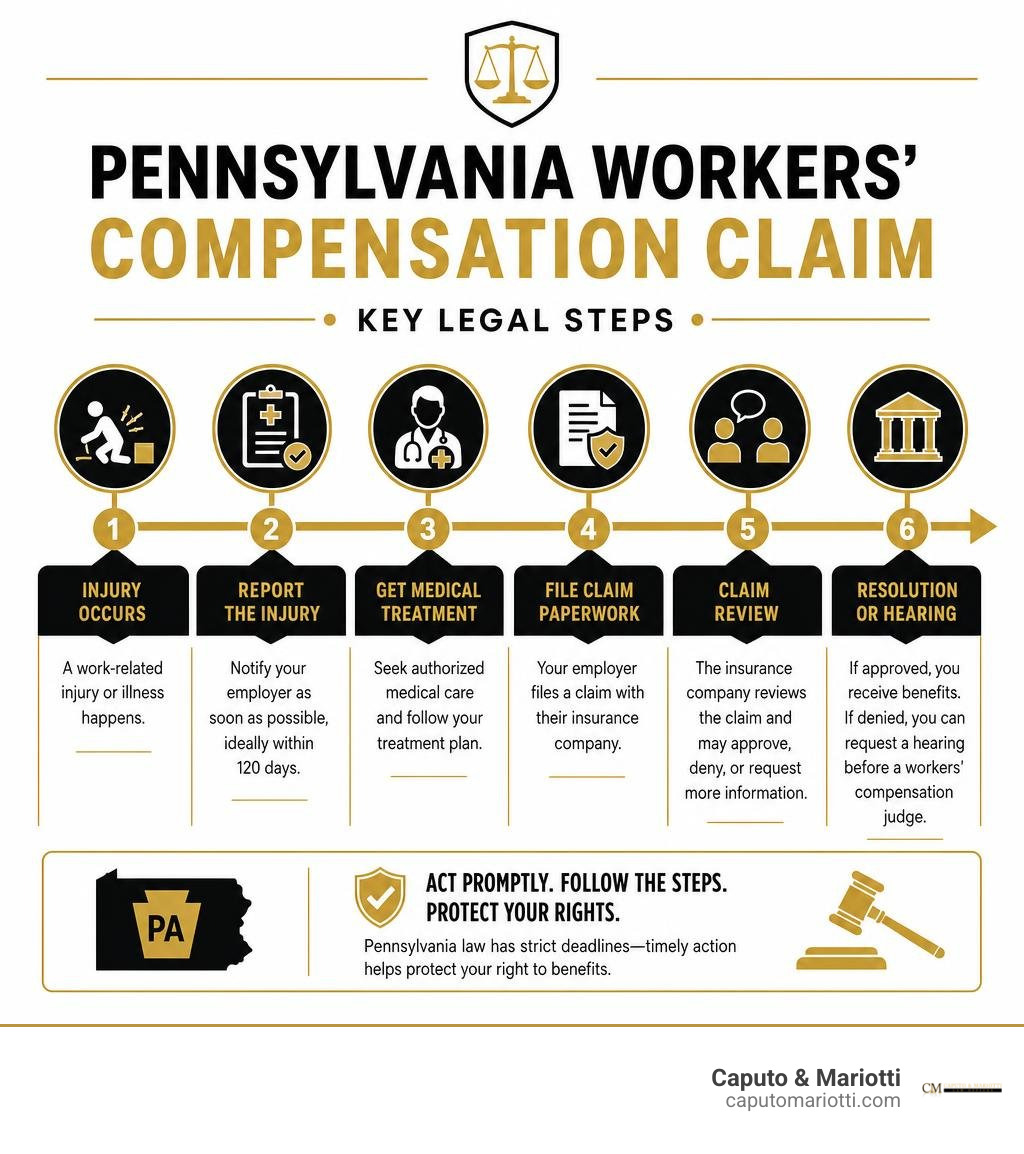
To secure benefits under Pennsylvania law, injured workers and their legal counsel must navigate several essential stages:
- The No-Fault System: Injured workers are entitled to benefits regardless of who caused the accident, provided the injury was not intentionally self-inflicted or caused by illegal drug or alcohol intoxication. In exchange, workers generally forfeit the right to sue their direct employer in civil court.
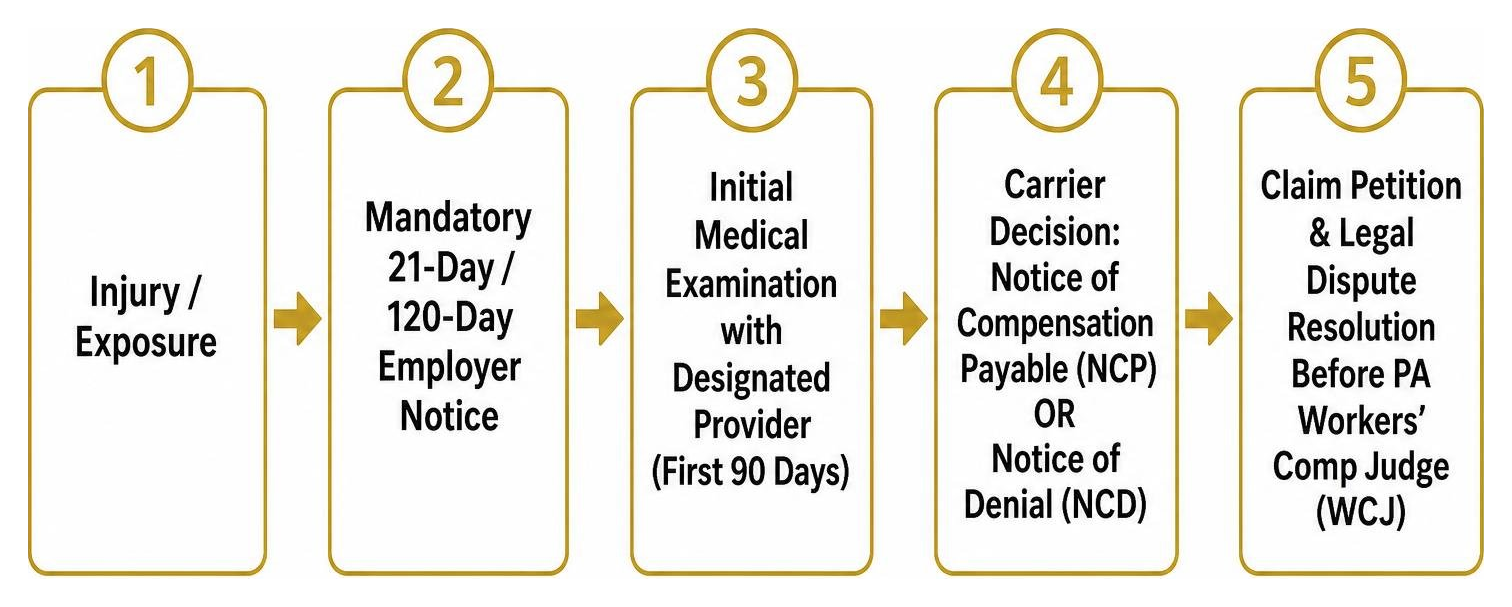
- Statutory Reporting Requirements: An injured worker must give notice of the injury to the employer within 21 days to receive benefits from the date of injury. If notice is not provided within 120 days, the claim is completely barred under Pennsylvania law.
- Medical Treatment Rules: If an employer posts a list of at least six designated healthcare providers in accordance with statutory guidelines, the employee must treat with one of those designated providers for the first 90 days following the initial visit. After 90 days, the worker may seek treatment from a physician of their choice.
- Evidence Gathering & Documentation: Proving a claim requires compiling complete medical records, diagnostic imaging (MRIs, X-rays, CT scans), employer incident reports, formal wage statements (Statements of Wages), and witness statements from coworkers who observed the incident or working conditions.
- Filing Procedures: If an employer or their insurance carrier refuses to accept the injury, the injured worker must file a formal Claim Petition with the Pennsylvania Bureau of Workers’ Compensation within the three-year statute of limitations.
- Legal Appeals: When a Workers’ Compensation Judge (WCJ) issues an adverse decision, appeals must be filed with the Workers’ Compensation Appeal Board (WCAB) within 20 days, followed by potential appellate review before the Commonwealth Court of Pennsylvania and the Pennsylvania Supreme Court.
Compensable Injury Classifications and Pre-Existing Aggravation
Under the Pennsylvania Workers’ Compensation Act, compensable injuries extend beyond sudden, single-event accidents:
- Specific Accidents: Discrete trauma such as a fracture sustained during a fall or a laceration from an operating blade.
- Repetitive Motion Injuries: Physical breakdown caused by cumulative job activities over time.
- Aggravation of Pre-Existing Conditions: Under Pennsylvania law, an employer “takes the employee as is.” If workplace duties or working conditions materially aggravate, accelerate, or flare up a pre-existing condition (such as degenerative disc disease, arthritis, or asthma), the resulting disability is fully compensable.
- Recurrence of Prior Work Disabilities: When a previously healed work-related condition breaks down again during subsequent work activity.
Occupational Disease Criteria and Presumptions
In addition to physical trauma, Pennsylvania law provides compensation for work-related illnesses. For a detailed discussion of disease claims, consult our guide on navigating workers compensation for occupational diseases.
For an unlisted occupational condition to qualify as compensable, it must satisfy Pennsylvania’s statutory three-prong legal test:
- The employee was exposed to the disease by reason of their employment.
- The disease is causally related to the industry or occupation.
- The incidence of the disease is substantially greater in that industry or occupation than in the general population.
Certain professions benefit from statutory legal presumptions:
- Firefighters: Under Pennsylvania law, firefighters with four or more years of continuous service who develop heart or respiratory diseases benefit from a statutory presumption that the condition was caused by job-related toxic exposures.
- Mining Personnel: Coal workers who develop pneumoconiosis (black lung disease) or silicosis through underground mineral extraction receive statutory coverage.
- Healthcare Personnel: Nurses, lab technicians, and hospital workers who contract bloodborne or infectious diseases (such as hepatitis, tuberculosis, or MRSA) through patient care exposure.
Frequently Asked Questions About Workplace Injuries in Pennsylvania
What qualifies as a compensable work-related injury in Pennsylvania?
A compensable work injury in Pennsylvania is any physical injury, repetitive strain disorder, mental trauma resulting from abnormal working conditions, or occupational disease sustained while carrying out work in furtherance of the employer’s business. The condition can stem from a single accident, cumulative daily tasks, or the aggravation of a pre-existing medical issue.
Does a compensable workplace injury have to occur on the employer’s physical premises?
No. An injury does not have to occur on the employer’s physical property to be compensable under Pennsylvania law. As long as the employee was engaged in the furtherance of the employer’s business or affairs at the time of the incident—such as traveling between job sites, making deliveries, or performing off-site client work—the injury is covered.
How are wage loss benefits calculated under Pennsylvania Workers’ Compensation?
Under the Pennsylvania Workers’ Compensation Act, total disability wage-loss benefits are generally calculated at 66.67% (two-thirds) of the worker’s pre-injury Average Weekly Wage (AWW). The AWW is determined using earnings from the four 13-week quarters preceding the injury. Payments are subject to statutory maximum caps and minimum floors tied to the Pennsylvania State Average Weekly Wage (SAWW).
Conclusion
Sustaining a serious job-related injury can disrupt your livelihood, physical health, and financial security. Pennsylvania’s workers’ compensation statutes provide essential protections, but strict deadlines, complex medical rules, and insurance disputes require prompt and careful action.
Preserving your right to complete wage-loss benefits and paid medical care requires timely injury reporting, detailed medical documentation, and experienced legal guidance. At Caputo & Mariotti, our attorneys bring over 55 years of combined legal experience representing injured individuals throughout Northeastern Pennsylvania, including Scranton, Wilkes-Barre, Lackawanna County, and Luzerne County.
If you or a family member has suffered a debilitating injury on the job, do not navigate the legal system alone. Contact Caputo & Mariotti today for a free, confidential case review to protect your legal rights and secure the compensation you deserve.
