

The dedicated legal team of Caputo & Mariotti
Making Your Case: The Medical Negligence Claim Process Explained
January 19, 2026
Understanding Your Rights After Substandard Medical Care
The medical negligence claim process can feel overwhelming after harmful medical treatment. If you suspect a healthcare provider’s error caused you harm, understanding the process is crucial to protecting your rights and securing compensation.
The Medical Negligence Claim Process at a Glance:
- Document Everything – Gather medical records, bills, and evidence of harm
- Consult a Medical Malpractice Attorney – Get expert evaluation of your case
- Investigation Phase – Your lawyer reviews records and consults medical experts
- File the Complaint – Submit required paperwork, including Certificate of Merit
- Findy Process – Exchange information through depositions and interrogatories
- Negotiate Settlement – Most cases resolve here without going to trial
- Trial (if needed) – Present your case in court for a verdict
- Receive Compensation – Recover damages for medical bills, lost wages, and suffering
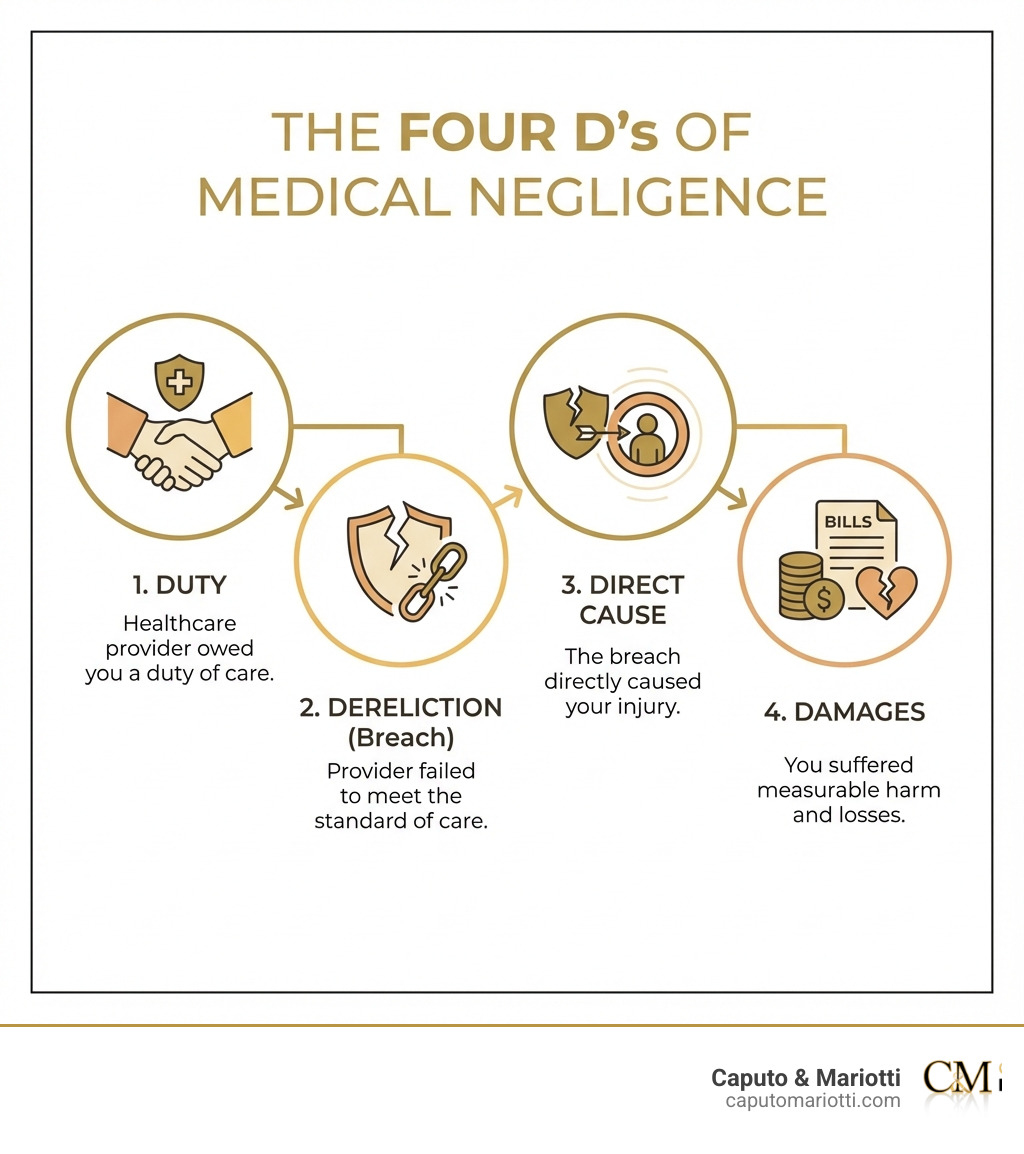
Medical negligence occurs when a healthcare professional fails to provide the accepted standard of care, resulting in harm. Not every bad outcome is negligence. To have a valid claim, you must prove four elements: the provider owed you a duty of care, they breached that duty, this breach directly caused your injury, and you suffered measurable damages.
This distinction is important because medicine has inherent risks. A poor result from a properly performed surgery isn’t negligence. However, a surgeon operating on the wrong body part, a misdiagnosis of a treatable condition, or a premature hospital discharge can be grounds for a claim.
Research shows that doctors win most medical malpractice jury trials, and many claims are dropped without payment. This reality highlights the need for experienced legal representation that understands both medicine and law to steer the medical negligence claim process.
Our firm’s attorneys have decades of experience, including backgrounds as prosecutors handling complex investigations, and now represent clients in medical negligence cases. Understanding the entire medical negligence claim process is essential to building a successful case for those harmed by substandard medical care.
Step 1: What to Do Immediately After Suspecting Medical Negligence
Suspecting medical negligence is frightening and confusing. With your health compromised, confronting the healthcare system feels overwhelming. However, taking immediate, deliberate steps can significantly strengthen your potential medical negligence claim process.
First, your health is the priority. Seek immediate medical attention for any new or worsening symptoms. This is vital for your well-being and for documenting your condition after the suspected negligence.

Next, we cannot stress enough the importance of documentation.
- Document Everything: Keep a detailed journal of your symptoms, pain levels, and life impacts. Note all communications with providers (dates, times, summaries). Take photos or videos of visible injuries. This record is invaluable for recalling details.
- Obtain Medical Records: Your medical records are the backbone of your claim. Under HIPAA, you have the right to request them. Rules vary by state, but rights are similar in our service areas (Pennsylvania, New York, New Jersey). These records contain critical information about your treatment and are essential for uncovering errors. We can help you gather them.
- Seek a Second Medical Opinion: A second medical opinion offers a fresh perspective on your condition and treatment. It can help confirm if the care you received was substandard and provide alternative treatment options.
- Preserve Evidence: Safely store physical evidence related to your treatment, such as medication bottles, medical devices, or lab results.
- Avoid Speaking with Insurance Adjusters: Insurance adjusters for the provider may contact you to minimize payouts. Politely decline to speak or provide a statement until you have consulted an attorney.
We understand that identifying medical malpractice can be challenging. Often, it’s not simply a bad outcome but a deviation from the accepted standard of care that causes harm. If you’re unsure whether your experience constitutes negligence, we encourage you to read our guide: Did I Suffer Medical Malpractice? Here Is How to Identify It.
Step 2: Building the Foundation of Your Claim
After taking initial steps to protect your health and gather information, the next phase in the medical negligence claim process is building the legal foundation of your case. This is where complex medical and legal principles intersect, making experienced legal counsel vital.

To succeed in a medical negligence claim, we must carefully prove the four essential elements of negligence, often referred to as the “Four D’s” as outlined in our introduction:
- Duty of Care: We must establish that the healthcare provider owed you a professional duty of care. A doctor-patient relationship usually establishes this duty. In Pennsylvania, this duty can exist even without direct contact, such as when a radiologist misreads an X-ray. You can learn more about this crucial aspect of the law here: The doctor-patient relationship in law.
- Dereliction (Breach of Duty): We must demonstrate that the healthcare provider breached their duty of care by failing to act as a reasonably prudent medical professional would have under similar circumstances. This involves showing that their actions (or inactions) fell below the accepted medical standard.
- Direct Cause (Causation): This is often the most challenging element. We must prove the provider’s breach directly caused your injury—meaning the injury wouldn’t have happened but for the negligence. For example, if a delayed stroke diagnosis led to greater harm, the delay is the direct cause.
- Damages: Finally, we must prove that you suffered actual, measurable harm or losses as a result of the injury caused by the negligence. This includes both economic and non-economic damages, which we will discuss further below.
Proving these elements requires an in-depth understanding of both medical practice and legal precedent. Our firm has extensive experience navigating these intricate details, as highlighted in our article, The Critical Elements of Medical Negligence Lawsuits.
The Crucial Role of a Medical Expert Witness
Proving breach of duty and causation requires a qualified medical expert witness. These experts, typically physicians in the same specialty as the defendant, review your records to determine if the standard of care was breached and if that breach caused your injury. Their testimony is indispensable for explaining complex medical issues to a judge or jury.
Essential Evidence to Support Your Claim
A strong medical negligence claim is built upon a comprehensive collection of evidence. This evidence serves to illustrate each of the four elements of negligence and substantiate the extent of your damages.
Here’s what we typically gather:
- Medical Records: This includes all hospital charts, physician’s notes, test results, and billing statements. These documents provide a timeline and critical details of your care.
- Medical Bills: All expenses from the injury, including past and future medical costs, rehabilitation, and equipment.
- Expert Testimony: Opinions from medical experts on the standard of care, breach, and causation.
- Witness Statements: Testimony from anyone who observed your care or the impact of your injury.
- Photographs and Videos: Powerful visual evidence of injuries and their impact on your daily life.
- Personal Journals: A personal, chronological account of your pain, suffering, and daily challenges.
- Proof of Lost Wages: Employer records, tax returns, and pay stubs showing lost income.
Common Examples of Medical Negligence
Medical negligence can manifest in various forms, often leading to severe and life-altering consequences for patients. While not an exhaustive list, here are some common types we encounter in our practice across Northeastern Pennsylvania and our other service areas:
- Surgical Errors: These can range from operating on the wrong body part or patient, leaving surgical instruments inside a patient, nerve damage, or improper surgical technique.
- Misdiagnosis or Delayed Diagnosis: A doctor’s failure to correctly identify a condition or a significant delay in diagnosis can lead to a treatable illness becoming advanced or incurable. We dig deeper into this critical issue in our article: Misdiagnosis in Healthcare: What You Need to Know and How to Protect Your Rights.
- Birth Injuries: Negligence during labor and delivery can cause severe and permanent injuries to both the parent and child, such as cerebral palsy, Erb’s palsy, or other neurological damage.
- Medication Errors: Prescribing the wrong medication, incorrect dosage, or failing to check for dangerous drug interactions can have devastating effects.
- Anesthesia Errors: Mistakes by an anesthesiologist, such as administering too much or too little anesthesia, failing to monitor vital signs, or improper intubation, can lead to brain damage, coma, or death.
- Emergency Room Negligence: The and high-pressure environment of an ER can sometimes lead to mistakes, such as failure to diagnose critical conditions, premature discharge, or delays in treatment.
We have a dedicated focus on these and other types of medical malpractice in our region. To learn more about how we can help with specific scenarios, please refer to: 5 Common Types of Medical Malpractice in Scranton, PA, and How a Lawyer Can Help.
Navigating the Formal Medical Negligence Claim Process
Once your claim’s foundation is built, the formal medical negligence claim process begins. This intricate phase involves a series of legal procedures to investigate, evaluate, and resolve your case, requiring a seasoned medical malpractice attorney.
The first crucial step is always to contact a qualified medical malpractice attorney. An experienced lawyer will discuss the strengths and weaknesses of your case, helping you understand your options and plan a course of action. We encourage you to seek legal advice from a medical malpractice attorney. Our team is well-versed in the specific nuances of medical negligence law in Pennsylvania, New York, New Jersey, and Ohio. To learn more about our approach, you can read: Medical Malpractice Lawyers in Scranton, PA: What You Need to Know.
Here’s a breakdown of the typical formal process:
- Investigation Phase: After an initial consultation, your attorney will conduct a thorough investigation. This involves gathering records, consulting experts, and analyzing details to determine if negligence caused your injury. This meticulous preparation is required to build a strong case.
- Filing the Complaint: If the investigation reveals sufficient evidence of negligence, your attorney will draft and file a formal complaint with the appropriate court. This document legally initiates your lawsuit and outlines the allegations against the healthcare provider.
- Certificate of Merit Requirement: In many states, including Pennsylvania, a preliminary step is submitting a “Certificate of Merit.” This document, based on an expert witness’s review of your records, certifies that negligence likely occurred. It ensures that only meritorious claims proceed. You can find more information about this requirement here: What is a certificate of merit?.
- Findy Process: This is a critical information-gathering stage where both sides exchange evidence. It typically involves:
- Interrogatories: Written questions that the opposing party must answer under oath.
- Depositions: Sworn, out-of-court testimony from witnesses. This allows attorneys to gather facts and assess witness credibility.
Key Steps in the Medical Negligence Claim Process
Following the findy phase, the path to resolution usually involves one of two main routes: settlement or trial.
- Settlement Negotiations: The vast majority of medical malpractice cases are resolved through settlement. Both parties, usually with their insurance companies, negotiate a financial settlement. This can happen at any point in the process.
- Mediation: Sometimes, parties agree to mediation, where a neutral third-party mediator helps facilitate discussions and explore potential settlement options. This can be an effective way to resolve disputes without the expense and uncertainty of a trial.
- Going to Trial: If a settlement cannot be reached, the case proceeds to trial. This involves presenting evidence and witness testimonies to a judge or jury. Trials are unpredictable. Studies show that doctors often win at trial, which highlights the importance of having an attorney prepared for litigation.
- Verdict: If the case goes to trial, the judge or jury will issue a verdict, determining liability and, if found negligent, the amount of damages.
- Appeal Process: Either party may have the right to appeal the verdict if they believe legal errors were made during the trial. The appeals process can add significant time to the overall claim resolution.
Understanding Compensation and Potential Problems
One of the most pressing questions for anyone pursuing a medical negligence claim is about the compensation they might receive. The goal is to recover damages to help you cope with the financial, physical, and emotional burdens caused by the negligence.
Types of Compensation
Compensation in medical negligence cases is generally categorized into two main types:
- Economic Damages: These are quantifiable financial losses from the injury, calculated from bills and wage statements.
- Medical Expenses: This includes past and future medical bills, hospital stays, surgeries, medications, rehabilitation, therapy, and specialized equipment.
- Lost Income: Compensation for wages lost due to your inability to work because of the injury.
- Future Earning Capacity: If the injury permanently impacts your ability to work or earn at your previous level, you can seek compensation for projected future lost earnings.
- Non-Economic Damages: These compensate for subjective, intangible losses that impact your quality of life.
- Pain and Suffering: This accounts for the physical pain, discomfort, and emotional distress you have endured and will continue to endure.
- Loss of Enjoyment of Life: Compensation for the diminished ability to participate in activities and hobbies you once enjoyed due to your injury.
- Punitive Damages (State-Specific): In rare cases of egregious or reckless conduct, a court may award punitive damages. These punish the defendant and deter future misconduct. They are rare and often capped in Pennsylvania medical malpractice cases.
The specific amount and types of compensation depend heavily on the unique circumstances of your case, the severity of your injuries, and the long-term impact on your life. For a deeper dive into compensation in our region, see: Medical Malpractice in Pennsylvania: Your Attorney Lifeline.
Challenges in the Medical Negligence Claim Process
While the potential for compensation is a powerful motivator, it’s important to be aware of the significant challenges inherent in the medical negligence claim process. These cases are notoriously complex and can be fiercely contested.
- Burden of Proof: The plaintiff must present compelling evidence to prove every element of the claim. This is a high bar, especially against the defense’s expert testimony.
- Proving Causation: Defense attorneys often argue the injury was due to pre-existing conditions or other factors, not their client’s negligence.
- Combating Insurance Company Tactics: Providers’ insurance companies have vast resources to deny or minimize claims. They are formidable adversaries who fight to avoid large payouts.
- Complex Medical Issues: Medical negligence cases involve highly technical medical terminology and procedures. Translating these complexities into understandable terms for a jury requires skilled legal representation and credible medical experts.
- Cost of Litigation: These cases are expensive, involving extensive findy, expert witness fees, and attorney time. This is why we work on a contingency fee basis—we only get paid if you win.
- Statute of Limitations Deadlines: Strict legal deadlines, known as statutes of limitations, govern how long you have to file a claim. Missing these deadlines can permanently bar you from seeking compensation, regardless of the merits of your case.
Given these challenges, choosing the right legal representation is paramount. An experienced medical malpractice lawyer can steer these problems, giving you the best chance for a successful outcome. Learn more about selecting the right team: Choosing the Right Medical Malpractice Lawyers Near Me: What You Need to Know.
Frequently Asked Questions about Medical Negligence Claims
We understand that you likely have many questions about the medical negligence claim process. Here, we address some of the most common inquiries we receive.
What is the statute of limitations for a medical negligence claim in Pennsylvania?
In Pennsylvania, the statute of limitations is generally two years. This period typically begins on the date you finded, or reasonably should have finded, the injury and its cause (the “findy rule”).
This deadline is strict; missing it can bar your claim.
Exceptions exist, such as for minors, who generally have until their 20th birthday to file. Because these rules are complex, consult an attorney immediately to determine your specific deadline.
What are the consequences for a healthcare provider found negligent?
A negligent healthcare provider faces several consequences beyond paying compensation:
- Disciplinary Action: Medical licensing boards can issue warnings, restrict, suspend, or revoke a license to protect the public. You can find information on reporting a provider here: contact the licensing board.
- Increased Insurance Premiums: A negligence finding often leads to higher malpractice insurance costs.
- Mandatory Training: The provider may be required to undergo additional training or work under supervision.
- Civil Liability: The provider or their insurer is legally obligated to pay damages to the victim.
These measures hold providers accountable and enforce the standard of care.
How long does a medical negligence claim take to resolve?
The timeline for a medical negligence claim varies greatly. While simpler cases may resolve in 18-24 months, most take several years. Complex cases with severe injuries or multiple defendants take longer.
Factors affecting the duration include:
- Willingness to Settle: A fair negotiation leads to a faster resolution than a protracted fight.
- Medical Stability: It may be necessary to wait until your condition stabilizes to fully assess damages.
- Court Schedules: Court backlogs in your jurisdiction can cause delays.
- Findy Process: The time needed for evidence exchange can be lengthy.
Rushing a claim can lead to an undervalued settlement. Our team works to move your case forward efficiently while building the strongest claim possible.
Conclusion: Securing the Justice and Compensation You Deserve
Navigating the medical negligence claim process while recovering from serious injuries is incredibly challenging. It requires understanding complex medical and legal issues and the determination to face well-resourced defense teams.
This guide has walked you through the key steps: immediate documentation, building your case with evidence and experts, and navigating the formal legal process. At Caputo & Mariotti, we believe victims of medical negligence deserve skilled legal representation. With a combined 55+ years of experience, our team is committed to pursuing justice for those harmed by substandard medical care in Northeastern Pennsylvania and our other service areas, including Scranton, Wilkes-Barre, Philadelphia, New York, New Jersey, and Ohio. We have the expertise to investigate your claim, build a powerful case, and fight for you.
If you believe you have a case, contact our experienced medical malpractice attorneys today for a free consultation. We will help you understand your options and guide you through the medical negligence claim process to protect your rights and secure the compensation you deserve. If you believe you have a case, contact our experienced medical malpractice attorneys today for a free consultation.