
The dedicated legal team of Caputo & Mariotti
Need a Forklift Accident Lawyer? Here’s How to Choose
January 22, 2026
Why Finding the Right Forklift Accidents Lawyer Matters
A forklift accidents lawyer helps injured workers and victims secure compensation after workplace accidents involving powered industrial trucks. Here’s what you need to know when searching for legal representation:
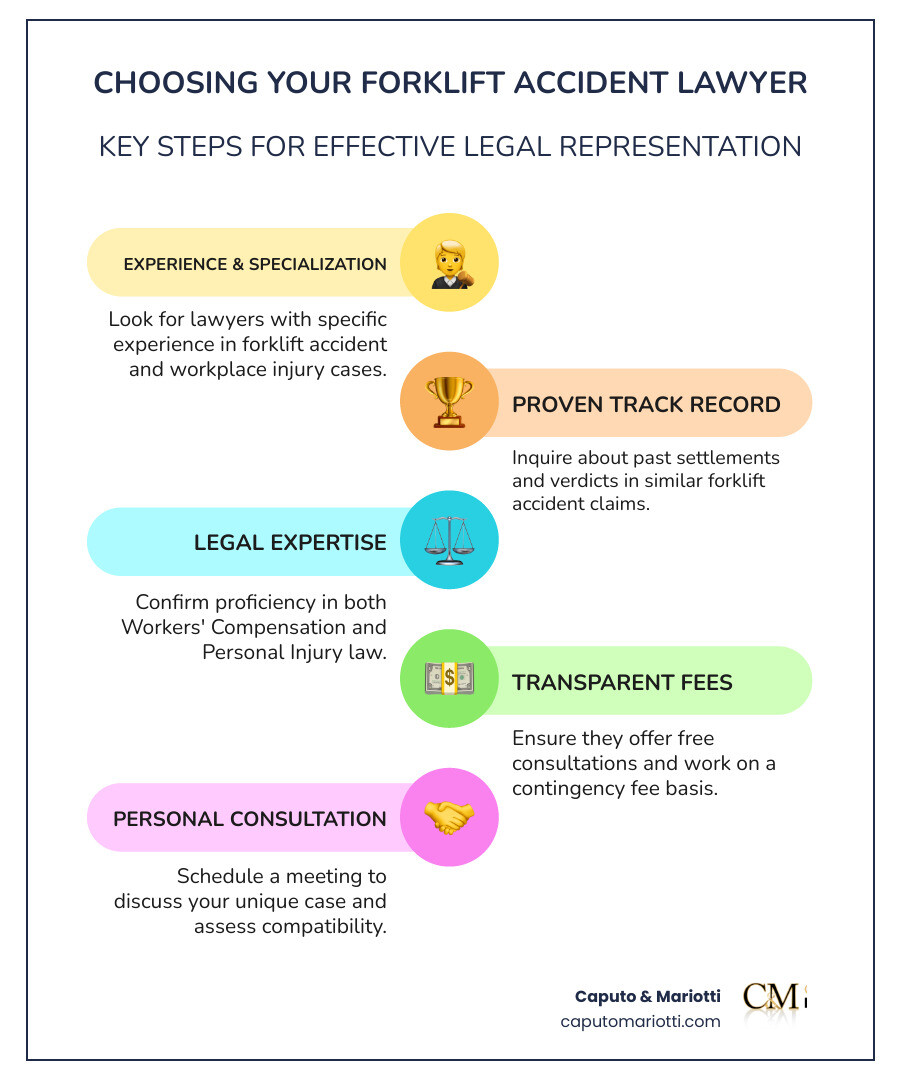
Key Factors in Choosing a Forklift Accidents Lawyer:
- Experience with workplace injury cases – Look for attorneys who have handled forklift accident claims specifically
- Understanding of OSHA regulations – Your lawyer should know federal and state safety standards
- Track record of results – Ask about settlements and verdicts in similar cases
- Knowledge of workers’ comp AND personal injury law – Many forklift cases involve both
- No upfront costs – Most personal injury lawyers work on contingency fees
Forklift accidents are serious. Each year, these powerful machines cause approximately 34,900 serious injuries and 85 fatalities in the United States. The consequences can be devastating – from broken bones and traumatic brain injuries to spinal cord damage and wrongful death.
The legal path forward isn’t always straightforward. While workers’ compensation may cover your medical bills and lost wages, you might also have grounds for a personal injury lawsuit against third parties like equipment manufacturers or maintenance companies. This is where experienced legal guidance becomes critical.
The attorneys at Caputo & Mariotti have spent decades helping injured workers navigate these complex claims, and we understand what it takes to hold negligent parties accountable and secure full compensation for victims of workplace injuries. Our experience as former prosecutors and personal injury attorneys has equipped us to fight effectively for clients facing the aftermath of serious forklift accidents.
Understanding Forklift Accidents: Common Causes and Severe Injuries
Forklifts are essential in warehouses, construction sites, and manufacturing plants, but their utility comes with inherent dangers. Understanding the common causes of forklift accidents is the first step toward prevention and seeking justice when incidents occur.
Common causes often stem from human error and environmental factors:
- Operator Error and Lack of Training: Reckless driving, speeding, and attempting to lift oversized loads are frequent culprits. OSHA requires that only trained and certified individuals operate forklifts, but when employers neglect this, the risk of accidents skyrockets. Transportation incidents involving a moving forklift account for 52% of all accidents.
- Improper Loading and Tip-Overs: Unstable or overly heavy loads can lead to falling materials (15% of accidents) or dangerous forklift tip-overs and rollovers (15% of accidents). These often happen during sudden turns or on uneven surfaces.
- Pedestrian Collisions: Over 20% of forklift-pedestrian accidents involve workers being struck by a forklift, highlighting the need for designated walkways and clear communication in shared spaces.
- Mechanical Failure and Poor Maintenance: When critical components like brakes or steering fail due to neglected maintenance, catastrophic accidents can occur.
- Unsafe Work Environment: Poor lighting, cluttered aisles, and uneven flooring create hazardous conditions for even the most skilled operators.
Statistics underscore the danger: thousands of serious injuries and dozens of fatalities occur annually in the U.S. due to forklift accidents. The service and production industries are most affected. For more information on workplace safety, visit our page on Workplace Injury.
Common Injuries Sustained
The immense weight and force of forklifts mean that accidents often result in severe, life-altering injuries.
- Fractures: Broken bones are the most common injury (29%), often requiring extensive medical care.
- Traumatic Brain Injuries (TBIs): Head injuries from impacts or falls can lead to long-term cognitive and physical impairments.
- Spinal Cord Damage: Trauma to the spine can result in paralysis, chronic pain, and permanent disability.
- Crushing Injuries: Being pinned by a forklift can damage organs and bones, often requiring multiple surgeries.
- Amputations: A tragic outcome (2% of cases) when limbs are crushed beyond repair.
- Wrongful Death: In 2021, forklifts were responsible for 70 work-related fatalities.
- Internal Injuries: Blunt force trauma can cause life-threatening internal bleeding and organ damage.
Recovery from these injuries is often lengthy, leading to significant medical bills, lost wages, and emotional distress. If you’ve suffered such an injury, learning about your rights after a heavy equipment injury on the job is crucial.
Navigating Your Legal Options: Workers’ Comp vs. Personal Injury Lawsuits
When a forklift accident occurs, victims often face a complex legal landscape. Understanding your two main options—workers’ compensation and personal injury lawsuits—is crucial for securing the compensation you deserve. These avenues are governed by different rules, including the “exclusive remedy rule” and the concept of “third-party liability.”

The exclusive remedy rule generally means workers’ compensation is your only recourse against your employer for a workplace injury; you typically cannot sue them for negligence. However, this rule does not protect other parties who may be at fault. This is where third-party liability allows you to file a personal injury lawsuit against another person or company whose negligence contributed to your injuries.
How Workers’ Compensation Works for Forklift Accidents
For an on-the-job forklift injury in Pennsylvania, your first step is likely a workers’ compensation claim. This is a “no-fault” system designed to provide benefits regardless of who caused the accident.
- Medical Bill Coverage: Covers all reasonable and necessary medical treatment for your injury.
- Lost Wage Replacement: Provides payments to replace a portion (often two-thirds) of your lost wages while you are unable to work.
- No-Fault System: You don’t need to prove your employer was negligent to receive benefits.
- Filing a Claim: Strict deadlines apply for reporting the injury and filing a claim. Missing them can jeopardize your benefits.
- Denied Claims: Insurers sometimes deny claims. If this happens, an experienced workers’ compensation lawyer can help you appeal.
While workers’ comp is a vital safety net, it does not cover damages like “pain and suffering,” which is why exploring a personal injury lawsuit is so important.
When Can You File a Personal Injury Lawsuit?
Even while receiving workers’ comp, you may be able to file a personal injury lawsuit if a third party’s negligence caused your forklift accident. This allows you to seek full compensation for all damages, including those not covered by workers’ comp.
Scenarios for a third-party lawsuit include:
- Forklift Manufacturer: If a design or manufacturing defect caused the accident, you could have a product liability claim.
- Maintenance Company: If an outside company’s negligent maintenance led to mechanical failure, they could be held liable.
- Property Owner: If unsafe conditions on a third-party’s property (e.g., a poorly lit warehouse) caused the accident, you may have a premises liability claim.
- Defective Parts: The maker of a faulty component that caused the accident could be sued.
- Gross Employer Negligence: In rare cases of extreme negligence by an employer, some states may permit a lawsuit beyond workers’ comp.
- Other Contractors/Drivers: If another company’s employee caused the accident, they could be named in a lawsuit.
A personal injury lawsuit allows you to seek compensation for medical bills, full lost wages, and non-economic damages like pain and suffering, emotional distress, and loss of enjoyment of life. Consulting a Personal Injury attorney is vital to ensure you pursue all rightful compensation.
Why You Need an Experienced Forklift Accidents Lawyer
Navigating the aftermath of a forklift accident is legally complex, and responsible parties backed by powerful insurance companies will work to minimize their payouts. This is why having an experienced forklift accidents lawyer is essential.
At Caputo & Mariotti, our 55+ years of combined experience in Northeastern Pennsylvania, including Scranton and Wilkes-Barre, have prepared us for these challenges. We offer a free case evaluation to assess your accident, explain your rights, and outline your potential avenues for compensation without any financial commitment.
Once you hire us, we begin gathering evidence like accident reports, witness statements, and medical records to build a robust case. We understand the maze of federal and state laws, including OSHA standards, and are skilled at negotiating with insurance companies that make lowball settlement offers. If a fair agreement isn’t possible, our litigation experience means we are ready to take your case to court. Our goal is to maximize your compensation so you can focus on recovery. Learn more about how to choose the right personal injury lawyer for your needs.
The Role of a Forklift Accidents Lawyer in Your Claim
As your advocate and investigator, we handle every aspect of your claim:
- Investigating the Accident: We conduct a thorough investigation, often with accident reconstruction experts, to determine exactly how the accident occurred.
- Identifying Liable Parties: We identify all potentially liable parties—including operators, employers, manufacturers, or property owners—to ensure you can pursue all available compensation.
- Calculating Damages: We work with experts to calculate the full extent of your damages, including future medical expenses, lost earning capacity, and pain and suffering.
- Handling Legal Paperwork: We manage all filings for workers’ compensation and personal injury claims, ensuring all deadlines and procedures are met.
- Representing You in Court: If a fair settlement cannot be reached, we are prepared to represent you vigorously at trial.
We manage all communications with insurance companies and opposing counsel, allowing you to focus on your recovery. Explore our resources on the accident claims process for more insight.
What Evidence is Crucial for Your Forklift Accidents Lawyer?
Building a strong claim depends on compelling evidence. The more detailed the evidence, the better our chances of proving liability.
Key evidence includes:
- Accident Reports: Official reports from your company, OSHA, or the police.
- Witness Statements: Accounts from coworkers or bystanders who saw the accident.
- Medical Records: Comprehensive records documenting your injuries, treatment, and prognosis.
- Photo and Video Evidence: Images or footage of the scene, the forklift, hazardous conditions, and your injuries. Surveillance footage is especially critical.
- Forklift Maintenance Logs: These records can reveal if negligent maintenance contributed to the accident.
- Operator Training Records: These documents verify if the operator was properly trained and certified per OSHA standards.
- Expert Testimony: In complex cases, testimony from accident reconstructionists, engineers, or medical professionals can provide specialized insight.
Knowing how to handle work injuries, including preserving this evidence, can significantly impact your claim.
Proving Liability and Understanding Relevant Regulations
Proving liability is the cornerstone of a successful forklift accident case. It requires demonstrating the four elements of negligence:
- Duty of Care: The responsible party had a legal duty to act with reasonable care.
- Breach of Duty: They failed to uphold that duty (e.g., an employer failed to provide training).
- Causation: This breach directly caused your injuries.
- Damages: You suffered actual harm and financial losses as a result.
Our legal team carefully investigates each element to build a compelling case.
OSHA Regulations and Forklift Safety
The Occupational Safety and Health Administration (OSHA) sets mandatory safety standards for forklift operation. An employer’s failure to comply with these regulations is strong evidence of negligence.
Key OSHA standards include:
- Regulations for Powered Industrial Trucks (29 CFR 1910.178): This is the core standard covering forklift design, maintenance, and operation.
- Operator Training Requirements: OSHA mandates that all operators receive formal instruction, practical training, and a performance evaluation before certification. Protect Workers Operating and Working Near Forklifts (OSHA Alert. Publication, 2019, 3973) offers further guidance.
- Workplace Safety Protocols: Employers must implement safety measures like designated pedestrian walkways, clear aisles, and proper lighting.
- Safe Forklift Operation. OSHA QuickCard™ (Publication, 2019, 3949): This guide highlights essential safety practices.
- Protecting Young Workers: This rule prohibits underage employees from operating forklifts in most settings.
Our firm has extensive experience with Construction Accidents and understands how to leverage OSHA violations to prove negligence.
Third-Party and Product Liability Claims
In many cases, liability extends beyond the employer, opening the door for claims that can secure full compensation.
- Defective Forklift Design or Manufacturing: If a flaw in the machine’s design or a manufacturing error caused the accident, the manufacturer can be held liable under product liability law.
- Failure to Warn: Manufacturers have a duty to warn users of non-obvious dangers. A lack of adequate warnings can lead to liability.
- Negligent Maintenance Contractors: If an outside company was hired to service the forklift and their negligence led to the accident, they can be held responsible.
- Premises Liability: If the accident was caused by unsafe conditions on property owned by a third party (e.g., a poorly maintained loading dock), the property owner may be liable.
Pursuing these complex claims requires specific legal knowledge. Our Product Liability Lawyer team is experienced in these cases. Learn more about product liability on the job.
Frequently Asked Questions about Forklift Accident Claims
After a forklift accident, it’s natural to have questions. Here are answers to some common inquiries.
What compensation can I recover after a forklift accident?
Compensation depends on your case specifics, including whether you file a workers’ comp claim, a personal injury lawsuit, or both. Potential compensation can cover:
- Medical Expenses: All past and future medical costs, including hospital stays, surgery, physical therapy, and medications.
- Lost Wages: Income lost while you were unable to work.
- Future Earning Capacity: Compensation for diminished earning potential if your injuries are permanent.
- Pain and Suffering: For the physical pain and emotional distress caused by the accident and your injuries.
- Emotional Distress: For trauma-related conditions like PTSD, anxiety, or depression.
- Loss of Enjoyment of Life: If injuries prevent you from participating in activities you once enjoyed.
- Disfigurement and Scarring: For permanent physical changes.
- Loss of Consortium: For the impact of a severe injury on a marital relationship.
An experienced attorney can help you assess the full value of your claim. Learn more about how much your forklift injury compensation claim is worth.
What should I do immediately after a forklift accident?
Your actions immediately following an accident are crucial for your health and any potential legal claim.
- Seek Medical Attention: Your health is the priority. Get checked by a medical professional immediately to diagnose and document your injuries.
- Report the Accident: Notify your supervisor or employer as soon as possible to comply with reporting deadlines.
- Document the Scene: If it’s safe, take photos and videos of the scene, the forklift, and your injuries.
- Gather Witness Information: Get the names and contact information of anyone who saw the accident.
- Do Not Admit Fault: Stick to the facts. Avoid making statements that could be interpreted as admitting fault.
- Contact an Attorney: Speak with an experienced forklift accidents lawyer before talking to insurance adjusters or signing any documents.
How long do I have to file a forklift accident lawsuit in Pennsylvania?
In Pennsylvania, the statute of limitations for personal injury lawsuits is strict. For most forklift accident claims, you have two years from the date of the accident to file a lawsuit.
If you miss this critical deadline, you will likely lose your right to seek compensation in court, no matter how strong your case is. Because evidence can disappear and witnesses’ memories can fade, it is vital to contact a forklift accidents lawyer as soon as possible to protect your legal rights and ensure all deadlines are met.
Get the Legal Support You Deserve
Navigating the aftermath of a forklift accident is challenging, but you don’t have to do it alone. An experienced attorney can handle the legal complexities while you focus on recovery. With over 55 years of combined experience, the dedicated team at Caputo & Mariotti has been fighting for the rights of injured workers in Northeastern Pennsylvania, including Scranton, Wilkes-Barre, and surrounding areas. We are committed to securing the justice and compensation you deserve.
We understand the physical, emotional, and financial toll a serious forklift accident can take. Our firm is dedicated to providing compassionate, effective legal representation, guiding you through every step of the workers’ compensation and personal injury claims process. We work on a contingency fee basis, meaning you pay nothing upfront, and we only get paid if we win your case.
Don’t let the complexities of the legal system prevent you from getting the compensation you need to rebuild your life. Schedule a free consultation today to discuss your forklift accident case. Let us put our experience and dedication to work for you. You can also meet our personal injury attorneys and learn more about our commitment to justice.