

The dedicated legal team of Caputo & Mariotti
Tripped Up? How to File a Successful Slip and Fall Claim
February 4, 2026
Why Personal Injury Lawsuits Matter More Than You Think
Personal injury lawsuits are a critical legal remedy when you’ve been injured due to someone else’s negligence. Accidents are a leading cause of emergency room visits in the U.S., with millions of people seeking treatment each year. These aren’t just statistics—they’re real people facing mounting medical bills, lost wages, and life-altering injuries.
If you’ve been injured due to someone’s negligence, here’s what you need to know:
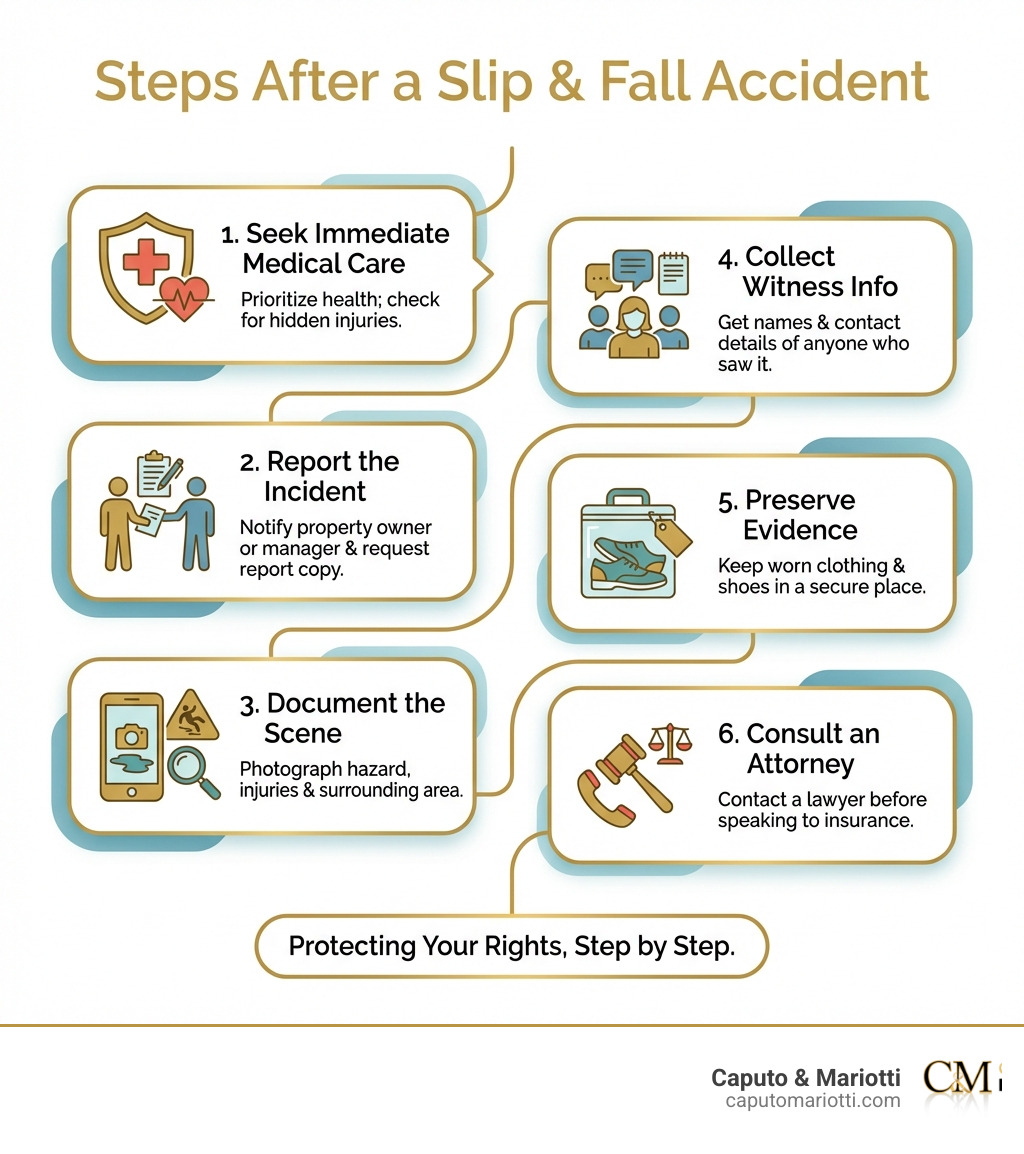
- Seek medical attention immediately – even if you feel fine, injuries may not be apparent right away
- Report the incident to the responsible party and request a copy of any incident report
- Document everything – take photos of the hazard, your injuries, and the surrounding area
- Gather witness information – get names and contact details of anyone who saw what happened
- Preserve evidence – keep any relevant physical items, such as clothing or a defective product
- Contact a personal injury lawyer before speaking to any insurance adjuster
The legal process for personal injury lawsuits can be complex, as at-fault parties and their insurers often try to minimize their liability. Proving your case requires showing the other party was negligent, a process that involves strict rules and deadlines under Pennsylvania law.
Caputo & Mariotti has focused exclusively on representing people seriously injured by negligence across Northeastern Pennsylvania for decades. From extensive trial experience and a deep understanding of how insurers and defendants operate, our firm is dedicated to building strong cases that hold negligent parties accountable and pursuing full, fair compensation for our clients.
In this guide, I’ll walk you through each step of filing a successful personal injury lawsuit, from what to do at the accident scene to how to calculate the value of your case and when it makes sense to settle versus going to court.
Step 1: What to Do Immediately After an Accident
The moments after an accident are crucial for your health and any potential personal injury claim. Adrenaline can mask pain, so even if you feel fine, take these steps to protect your well-being and legal rights.
First, seek immediate medical attention. Visit an ER or your doctor as soon as possible. Medical records are critical evidence linking your injuries to the incident. Delaying care allows insurance companies to argue your injuries aren’t serious or related to the accident.
Next, report the incident to the responsible party. Ensure the manager, owner, or other party in any Scranton or Wilkes-Barre location is aware of your accident. Ask for a copy of an incident report. If none is available, write down the date, time, location, and what happened.
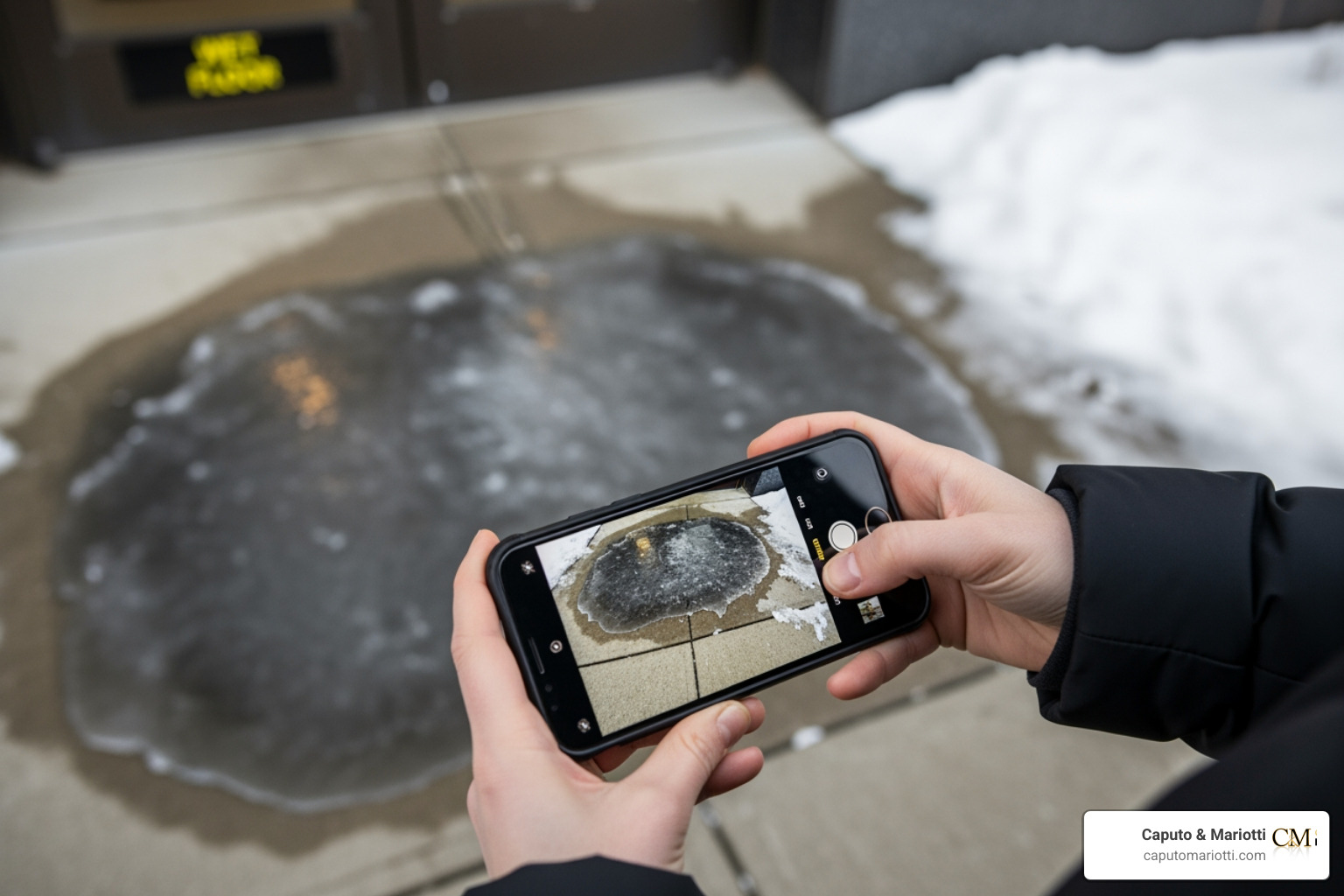
Then, document the scene with photos and videos. Use your phone to capture the exact cause of the accident, the surrounding area, and any warning signs (or lack thereof). Take pictures of your injuries as well. This visual evidence is powerful.
Also, get contact information from any witnesses. Their objective account can corroborate your story and counter claims that you were at fault. Ask for their name, phone number, and email.
Finally, preserve your clothing and other physical evidence. The footwear you wore can be crucial evidence in a fall case, just as a defective product would be in a product liability case. Store any relevant items safely without cleaning them.
Taking these steps can significantly bolster your personal injury claim. For more guidance on what to do after an accident in Northeastern Pennsylvania, see our guide: The Dos and Don’ts After a Personal Injury in Northeastern PA.
Step 2: Understanding Liability and Negligence
At the heart of every successful personal injury lawsuit is negligence. This legal principle holds individuals, companies, or other entities responsible for acting with reasonable care. If they fail and someone gets hurt, they can be held liable.
In Pennsylvania, a claim requires proving the at-fault party was negligent. This means we must show:
- A duty of care was owed to you.
- The at-fault party breached that duty.
- This breach directly caused your injuries.
- You suffered damages as a result.
Proving negligence hinges on showing the at-fault party knew or should have known their actions (or inaction) could cause harm. For example, a property owner should have known about a hazardous spill, or a doctor should have known a certain procedure was not up to the standard of care.
Common types of personal injury cases in our region, from Philadelphia to Wilkes-Barre, include:
- Car, truck, and motorcycle accidents
- Medical malpractice
- Unsafe property conditions (premises liability)
- Defective products
- Workplace accidents
Understanding these elements is key. To learn more, explore our guide: Premises Liability and the Types of Premises Liability Claims.
Who Can Be Held Liable?
Identifying the responsible party can be complex. In Pennsylvania, several parties could be accountable:
- Negligent drivers: The individual who caused a motor vehicle accident.
- Property owners/managers: The individual or company responsible for maintaining a safe property.
- Doctors, hospitals, or healthcare providers: Medical professionals whose substandard care caused harm.
- Manufacturers: Companies that design or sell defective products.
- Government entities: Municipalities can be liable for injuries on public property, though these cases have special rules and immunities.
- Employers: In cases of workplace injuries not covered by workers’ compensation.
Determining fault requires a thorough investigation. Our experience in Scranton personal injury law is invaluable in navigating these complexities. Learn more about the cases we handle: Common Personal Injury Cases in Scranton and How Attorneys Can Help.
Step 3: Building a Strong Case with Crucial Evidence
In personal injury lawsuits, the injured party has the burden of proof. As your legal team, we must present compelling evidence that the other party’s negligence caused your injuries. Without solid evidence, a legitimate claim can fail.

Here’s the crucial evidence we gather:
- Medical records and bills: These document the severity of your injuries, treatment, and costs, establishing the “damages” you suffered.
- Proof of lost wages: Pay stubs or a letter from your employer can document your income and time missed from work.
- Incident reports: A report filed with a property manager, employer, or police officially acknowledges the incident.
- Surveillance footage: Security or traffic camera footage can show how the accident happened and who was at fault. Requesting this quickly is critical before it’s erased.
- Witness testimony: Statements from witnesses can independently verify your account of what happened.
- Maintenance logs or other records: These records can reveal whether a property owner, trucking company, or other entity neglected their duties.
- Photos and videos: Visual evidence of the accident scene, property damage, and your injuries is incredibly persuasive.
Gathering this evidence can be overwhelming while you recover. Our team at Caputo & Mariotti handles this meticulous process for you. For a detailed look at evidence in personal injury claims, visit: The Role of Evidence in Personal Injury Claims: A Comprehensive Guide.
Step 4: Navigating Pennsylvania Personal Injury Lawsuits
When pursuing a personal injury lawsuit in Northeastern Pennsylvania, it’s essential to understand our state’s specific laws, from liability principles to strict filing deadlines.
The most critical deadline is the statute of limitations. For most personal injury claims, you have two years from the date of injury to file a lawsuit. This applies to cases arising from car accidents, falls, and medical malpractice. Missing this deadline usually means losing your right to compensation, so it’s vital not to wait. For more on the statute of limitations, you can review this external resource: What is the statute of limitations?.
The legal process begins with negotiations with the at-fault party’s insurer. If a fair settlement isn’t reached, a lawsuit may be filed, which includes:
- Filing a complaint: Officially starting the lawsuit.
- Discovery: Both sides exchange information through documents and testimony.
- Mediation or arbitration: An attempt to resolve the case with a neutral third party.
- Trial: If no settlement is reached, a judge or jury decides the outcome.
Our team guides you through this complex process. For more details, see our guide: The Legal Process in Personal Injury Cases: A Step-by-Step Guide.
Calculating Damages in Your Personal Injury Claim
A common question is, “How much is my case worth?” The value of your personal injury claim depends on your “damages,” which include:
Economic damages (quantifiable financial losses):
- Medical expenses: All past and future medical care related to your injuries.
- Lost income: Lost wages and diminished future earning capacity.
- Out-of-pocket costs: Expenses like transportation to medical appointments or assistive devices.
Non-economic damages (intangible impacts on your life):
- Pain and suffering: Physical discomfort and emotional distress.
- Emotional distress: Anxiety, depression, or fear from the accident.
- Loss of enjoyment of life: Inability to participate in hobbies and activities you once enjoyed.
There’s no single formula for calculating value, but we fight to recover the full extent of your losses. For a general definition of damages, see this resource: What are damages?. Learn more about maximizing your compensation here: Maximizing Your Personal Injury Compensation in Scranton.
How Pennsylvania’s Comparative Negligence Rule Affects Your Claim
Insurers often try to blame the injured party. This is where Pennsylvania’s modified comparative negligence rule affects your personal injury claim.
Under this rule, your compensation is reduced by your percentage of fault. If your damages are $100,000 but you’re found 20% at fault, you’d receive $80,000. Crucially, you can only recover damages if you are not more than 51% responsible. If your fault is 51% or higher, you are barred from recovering anything.
This rule highlights the need for strong legal representation to counter unfair blame and maximize your recovery. For more on this rule, see this resource: What is modified comparative negligence?. Learn more about personal injury law in our area: Understanding Personal Injury Law in Scranton: A Comprehensive Guide.
Step 5: Deciding Between a Settlement and a Lawsuit
A critical decision in your personal injury claim is whether to accept a settlement or pursue a lawsuit. The best path depends on your specific case. Most claims settle out of court, as insurers prefer to avoid the cost and uncertainty of a trial. However, if an offer is unfair, a lawsuit may be necessary.
Here’s a comparison to help you weigh your options:
| Feature | Settlement (Pros) | Settlement (Cons) | Lawsuit (Pros) | Lawsuit (Cons) |
|---|---|---|---|---|
| Speed | Generally faster resolution (weeks to months). | May feel rushed if you accept a low initial offer. | Can be a lengthy process (1-2 years, sometimes more). | Significant delays in receiving compensation. |
| Cost | Less expensive; avoids court fees, expert witness costs. | May not cover all your long-term damages if underestimated. | Potentially higher legal costs (court, expert, depositions). | Expenses can significantly reduce your net recovery. |
| Certainty | Guaranteed outcome once agreed upon. | You might receive less than what a jury could award. | Potential for a higher award if successful. | Unpredictable outcome (jury decisions, appeals). |
| Stress | Less stressful, avoids public trial and extensive legal procedures. | May involve intense negotiation tactics from insurers. | Can be highly stressful, public, and emotionally draining. | Requires significant time commitment for depositions/trial. |
| Privacy | Typically confidential. | Public record of proceedings. | Personal details become part of public record. | |
| Control | You have direct input in accepting or rejecting offers. | Insurers may attempt to dictate terms. | Less direct control once in the hands of the court. | Judge/jury decides outcome. |
This is a strategic decision we make with you, based on your case’s evidence, your injuries, the insurer’s offers, and your comfort with litigation. Our role is to advocate for your best interests, whether in negotiations or in court.
For more insights, refer to our guide: Mastering the Settlement Process: Maximizing Compensation and Concluding Your Personal Injury Claim.
Frequently Asked Questions about Personal Injury Lawsuits
Here are answers to common questions about personal injury lawsuits in Northeastern Pennsylvania.
How long do I have to file a personal injury lawsuit in Pennsylvania?
In Pennsylvania, the statute of limitations for most personal injury claims is two years from the date of the injury. This is a strict deadline to file a lawsuit. Missing it will likely bar your claim. Exceptions are rare, and some cases (like against government entities) have even shorter notice periods. It’s crucial to act quickly to preserve your rights.
How much is my personal injury case worth?
The value of a personal injury claim is unique to each case and depends on several factors:
- Severity of injuries: More severe, permanent injuries lead to higher compensation.
- Total medical bills: All past, present, and future medical expenses.
- Amount of lost wages: Current lost income and any diminished future earning capacity.
- Strength of evidence: Clear proof of the other party’s negligence increases your claim’s value.
- Impact of comparative negligence: Your compensation will be reduced if you are found partially at fault.
- Non-economic damages: The impact on your quality of life, including pain and suffering.
Our experienced team evaluates these elements to fight for the maximum compensation you deserve. For more on this, read: Understanding Compensation in Personal Injury Cases: A Deep Dive into Damages.
When should I contact a personal injury lawyer?
You should contact a lawyer as soon as possible. Here’s why:
- Immediately: To preserve fresh evidence and witness accounts before they disappear.
- For serious injuries: Complex cases with significant medical treatment and lost work require expert guidance.
- If liability is disputed: An attorney can build a strong case to prove negligence and protect your rights.
- Before speaking to insurers: Adjusters work for the other side. A lawyer can prevent you from harming your claim.
- To evaluate settlements: Initial offers are often too low. An attorney can assess fairness and negotiate for more.
Even if you’re unsure about your claim, a free consultation provides clarity. Learn more about when to consult an attorney: When to Consult a Personal Injury Attorney.
Get the Legal Help You Deserve
Filing a personal injury lawsuit is challenging. While you’re dealing with injuries, medical bills, and lost wages, the legal process adds another layer of stress.
Insurance companies aim to minimize payouts and have legal teams to dispute claims. Without an experienced attorney, you are at a significant disadvantage and may accept a settlement far below what you deserve.
This is where we come in. At Caputo & Mariotti, our team brings over 55 years of combined experience fighting for injured individuals across Northeastern Pennsylvania, including Scranton and Wilkes-Barre. We understand Pennsylvania’s laws, insurance company tactics, and how to build strong personal injury cases.
When you choose us, you gain a dedicated advocate who will:
- Conduct a thorough investigation of your accident.
- Gather all necessary evidence to prove negligence and damages.
- Handle all communication with insurance companies.
- Protect your rights against unfair blame or lowball offers.
- Guide you through every step of the legal process.
- Allow you to focus on your recovery.
You shouldn’t have to shoulder the financial burden of someone else’s negligence. We offer free consultations, so there’s no risk in discussing your case.
If you or a loved one has been injured due to someone else’s negligence in Pennsylvania, don’t wait. Contact us today to understand your rights.
Schedule a free consultation with a Personal Injury Attorney in Scranton, PA