

The dedicated legal team of Caputo & Mariotti
Pennsylvania Motorcycle Accident Attorneys: Riding Towards Justice After a Crash
February 18, 2026
Why Pennsylvania Motorcyclists Need Specialized Legal Help After a Crash
If you’ve been injured in a motorcycle crash, the right motorcycle accident attorney PA can mean the difference between a fair settlement and financial ruin. Here’s a quick guide:
Quick Guide to Hiring a Motorcycle Accident Attorney in PA:
- Act Fast – Pennsylvania gives you only 2 years to file a claim (6 months if a government entity is involved)
- Choose Experience – Look for attorneys who specialize in motorcycle accidents, not just general personal injury
- Free Consultations – Most PA motorcycle accident lawyers work on contingency (no upfront costs)
- Don’t Talk to Insurance First – Contact an attorney before speaking with any insurance adjuster
- Understand Your Rights – PA’s modified comparative negligence means you can still recover damages even if you’re partially at fault (up to 50%)
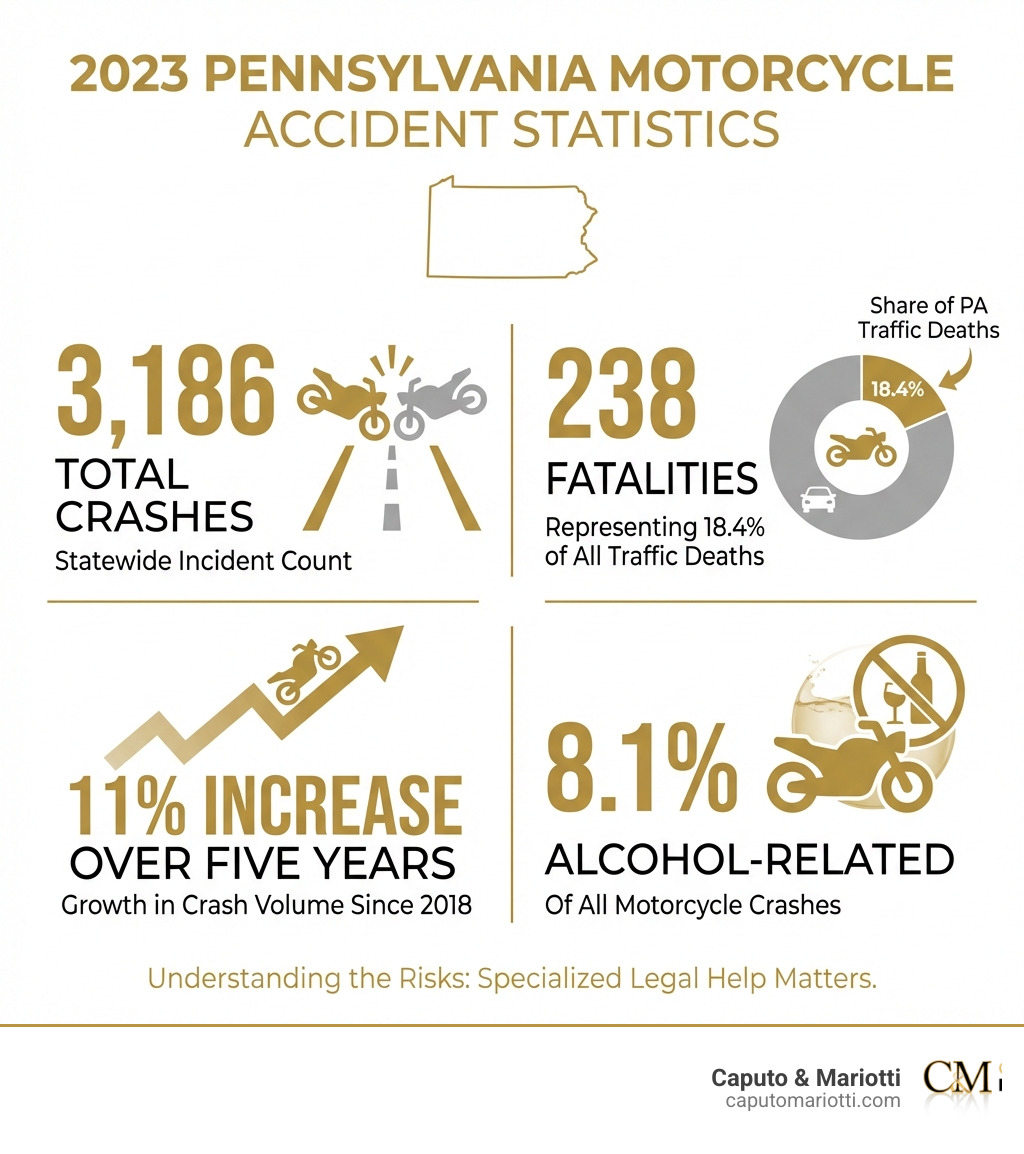
Pennsylvania is one of the most dangerous states for motorcycle riders. In 2023 alone, there were 3,186 motorcycle crashes across the state – an 11% increase over five years. These crashes resulted in 238 fatalities, accounting for nearly one in five of all motor vehicle deaths that year.
The stakes are high. Unlike cars, motorcycles offer no protective frame or airbags. A crash that would be minor for a car can cause catastrophic injuries for a rider, including traumatic brain injuries, spinal cord damage, and severe road rash.
The problem is that insurance companies often exploit stereotypes about riders to minimize or deny claims. They may try to blame you, question your injuries, or pressure you into a lowball settlement.
This is where specialized legal help is critical.
At Caputo & Mariotti, our Pennsylvania personal injury team is dedicated to standing up for injured riders and their families. Backed by decades of combined courtroom and negotiation experience as motorcycle accident attorneys in PA, we have secured substantial recoveries for clients when insurance companies tried to delay, underpay, or deny the justice they deserve.
Understanding Pennsylvania’s Unique Motorcycle Laws and Your Rights
Pennsylvania has specific laws for motorcyclists that define your rights and responsibilities. Understanding these rules on licensing, helmets, and insurance is crucial after an accident, as they can significantly impact a personal injury claim. For more on this topic, explore our guide on More info about Personal Injury Law.

Do I Need to Wear a Motorcycle Helmet in Pennsylvania?
Pennsylvania’s helmet law isn’t universal, but it has specific requirements:
- Riders Under 21: Wearing a helmet is mandatory, with no exceptions.
- Riders 21+: You may ride without a helmet if you have had your motorcycle license for at least two full years OR you have completed a PennDOT-approved motorcycle safety course.
Regardless of helmet use, all riders and passengers must wear mandatory eye protection (goggles or a face shield). Any helmet worn must be DOT-certified. For a comprehensive overview, you can review the Pennsylvania’s Motorcycle Helmet Law Fact Sheet.
Impact on Injury Claims: Even if you’re not legally required to wear a helmet, an insurance company may argue to reduce your compensation if a helmet could have lessened your injuries. Our legal team is experienced in fighting these arguments by focusing on the other party’s negligence as the primary cause of the crash.
Lane Splitting vs. Lane Filtering in Pennsylvania
It’s vital for riders to understand the difference between lane splitting and lane filtering in Pennsylvania, as their legal status is very different.
- Lane Splitting: Riding between lanes of slow-moving or stopped traffic. Lane splitting is illegal in Pennsylvania.
- Lane Filtering: Moving between stopped vehicles to the front of a traffic light. Lane filtering is permitted in Pennsylvania under strict conditions, such as on roads with a speed limit of 45 mph or less where traffic is fully stopped.
Here’s a quick comparison:
| Feature | Lane Splitting | Lane Filtering |
|---|---|---|
| Legality in PA | Illegal | Legal under specific conditions |
| Traffic Speed | Slow-moving or stopped traffic | Only stopped traffic |
| Motorcycle Speed | Can be higher than filtering speed | Max 15 mph |
| Road Type | Any road with multiple lanes (where practiced) | Roads with >= 2 lanes in same direction, speed limit <= 45 mph (not freeways) |
| Safety Risks | High risk of collisions with distracted drivers | Lower risk due to stopped traffic, but still requires caution |
| Legal Impact | Can be cited, liability in accident likely reduced | Permitted, less likely to impact liability if conditions met |
The legal consequences of illegal lane splitting are severe and can negatively affect your ability to claim compensation after an accident.
How Pennsylvania’s Insurance System Affects Motorcyclists
Pennsylvania’s “choice no-fault” insurance system for cars does not apply to motorcycles. This is a critical distinction for injured riders.
- No-Fault Exclusion: Motorcycle accidents are excluded from PA’s no-fault system. This means riders are not entitled to Personal Injury Protection (PIP) benefits for medical bills and lost wages from their own auto policy. You must rely on your health insurance first, and any out-of-pocket costs become part of your claim.
- Full Tort Status: Because they are excluded from the no-fault system, motorcyclists automatically have full-tort status. This gives you the unrestricted right to sue the at-fault driver for non-economic damages like pain and suffering, a major advantage.
- Uninsured/Underinsured Motorist (UM/UIM) Coverage: This coverage is crucial. It protects you if the at-fault driver has no insurance (UM) or not enough insurance (UIM) to cover your damages. We strongly advise all riders to carry as much UM/UIM coverage as possible. Learn more in our guide on understanding insurance claims.
- Hit-and-Run Recovery Options: For a hit-and-run, your UM coverage is your primary path to compensation. We can help you file a claim and investigate if the Victims’ Compensation Assistance Program (VCAP) can offer additional support.
After a Crash: Critical Steps and How Fault is Determined
The moments after a motorcycle crash are chaotic, but the steps you take can significantly impact your personal injury claim.
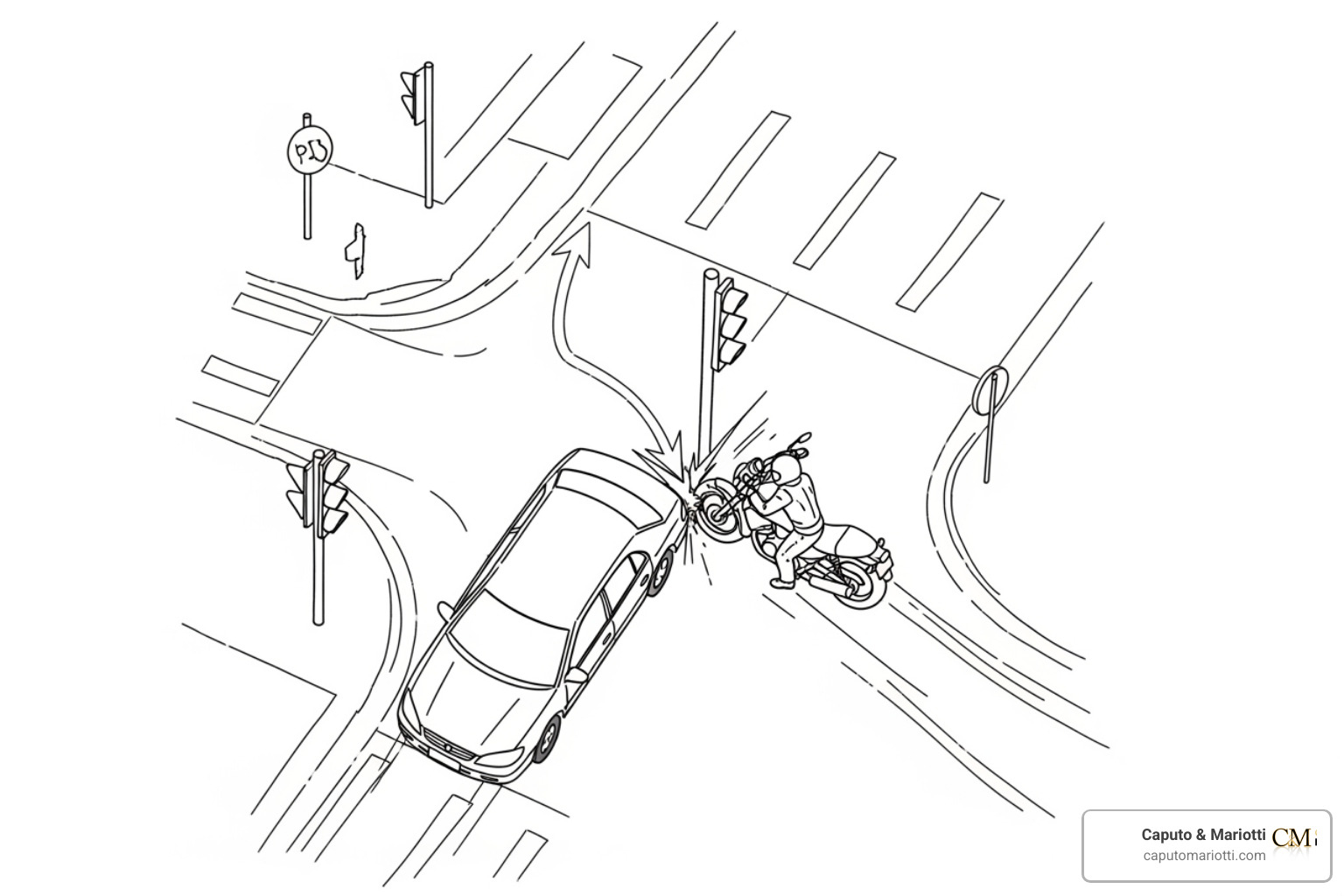
Common causes of motorcycle accidents often stem from other drivers’ negligence.
- Left-Turning Vehicles: A frequent and dangerous cause, where a driver turns left into a motorcyclist’s path, often misjudging their speed or failing to see them at all. This accounts for about a third of multi-vehicle motorcycle crashes.
- Lane Change Crashes: Drivers changing lanes without checking blind spots can easily collide with a motorcyclist.
- Rear-End Collisions: Being rear-ended can cause serious injuries, especially if the motorcyclist is stopped.
- Road Hazards: Potholes, gravel, or poor road maintenance are especially dangerous for motorcycles. If a government entity is responsible, proving liability is complex but possible.
- Drunk or Distracted Driving: Impaired or distracted drivers pose an extreme threat to riders due to poor judgment and slow reaction times. In PA, 8.1% of motorcycle crashes are alcohol-related.
What to Do Immediately After a Motorcycle Accident
Prioritize your safety and take these crucial steps:
- Ensure Your Safety and Others’: Move to a safe location if possible. If seriously injured, do not move.
- Call 911: Report the accident to police and request medical services. An official police report is vital.
- Seek Medical Attention: Get checked by paramedics or go to an ER, even if you feel fine. Adrenaline can mask serious injuries, and this creates a crucial medical record.
- Document the Scene: If able, take photos and videos of vehicles, road conditions, and injuries.
- Gather Witness Information: Get names and contact information from anyone who saw the accident.
- Exchange Information: Get the other driver’s name, contact info, and insurance details.
- Report the Accident to Your Insurance: Notify your insurance company, but be careful what you say.
For more detailed guidance, refer to our Helpful advice for accident victims.
Why You Should Never Admit Fault
After a crash, it’s natural to be disoriented, but never admit fault to anyone—not the other driver, witnesses, or police.
- Admitting Fault Risks: Any admission of blame can be used by insurance companies to deny or reduce your claim.
- Trauma and Clouded Judgment: Shock and adrenaline can impair your judgment. Your initial perception of the accident may not be accurate.
- Complex Crash Dynamics: Accidents are complex. An expert investigation may prove the other driver was at fault, even if it didn’t seem that way initially.
- How Insurers Use Admissions: Adjusters are trained to use your words against you. Stick to the facts and let your legal team handle all communications about fault.
The full picture of an accident often emerges only after a thorough investigation. Learn more about The role of evidence in claims.
How “At-Fault” is Determined in PA Motorcycle Accident Cases
Proving fault is the cornerstone of a personal injury claim. In PA, this means proving the other driver was negligent—that they failed to act with reasonable care, causing you harm. To establish liability, we must prove four elements:
- Duty of Care: The other driver owed you a legal duty to operate their vehicle safely.
- Breach of Duty: The driver violated that duty (e.g., by speeding or being distracted).
- Causation: The driver’s breach directly caused your accident and injuries.
- Damages: You suffered measurable losses (medical bills, lost wages, etc.) as a result.
Common Defense Tactics: Insurers use various tactics to minimize payouts and shift blame, such as claiming you were riding recklessly or that your injuries aren’t severe.
Overcoming Anti-Motorcyclist Bias: A bias against riders exists, with some assuming they are reckless. Our attorneys counter these stereotypes by using accident reconstruction, witness testimony, and hard evidence to focus on the facts and prove the other driver’s negligence. Understanding the legal process can be daunting, but we’re here to guide you. Explore The legal process explained for more information.
Navigating the Legal Maze with a Motorcycle Accident Attorney PA
The legal process after a motorcycle accident is complex and often lengthy, requiring investigation, negotiation, and sometimes litigation. An experienced motorcycle accident attorney PA is your most valuable asset.
Our process begins with gathering evidence (police reports, medical records, photos) to build a strong demand package for the insurance company. If negotiations fail, we file a lawsuit. The litigation process involves several stages:
- Filing a Lawsuit: Formally initiates the legal action.
- Findy Phase: Both sides exchange information through depositions and written questions.
- Negotiations: Settlement discussions continue, often including mediation.
- Settlement vs. Trial: Most cases settle, but we are always ready for trial if a fair offer isn’t made.
Case timelines vary based on injury severity, liability disputes, and the insurer’s willingness to negotiate. Learn more about When to consult a personal injury attorney.
How Pennsylvania’s Comparative Negligence Law Affects Your Claim
Pennsylvania’s modified comparative negligence rule is crucial for riders. It allows you to recover damages even if you’re partially at fault, but only up to a certain point: the 51% bar rule.
- Modified Comparative Negligence Explained: Your total damages will be reduced by your percentage of fault. If your damages are $100,000 and you are 20% at fault, you receive $80,000.
- The 51% Bar Rule: If you are found 51% or more at fault, you are barred from recovering any compensation ($0).
This rule is why skilled legal representation is vital. Insurers will try to assign you more fault to reduce or eliminate their payout. Our team investigates every detail to counter these tactics and protect your claim. You can find the specific legal text for Pennsylvania’s comparative negligence statute for further reference.
How a Top Motorcycle Accident Attorney in PA Calculates Compensation
Calculating a claim’s full value is more than just adding up bills. Our motorcycle accident attorney PA team consults with medical and financial experts to assess all your losses and ensure you receive comprehensive compensation. Types of compensation include:
- Economic Damages (Quantifiable Losses):
- Medical Bills: All past and future medical costs, from emergency care and surgery to rehabilitation and medication.
- Lost Wages: Current income lost and future earning capacity if your injuries are long-term or permanent.
- Property Damage: Costs to repair or replace your motorcycle and gear.
- Non-Economic Damages (Subjective Losses):
- Pain and Suffering: For the physical pain and emotional distress from your injuries.
- Loss of Enjoyment of Life: For the inability to enjoy hobbies and daily activities as you did before the crash.
- Scarring and Disfigurement: For permanent physical alterations like scars or amputations.
- Emotional Distress: For psychological impacts like anxiety, depression, or PTSD.
- Loss of Consortium: Compensation for the impact of your injuries on your marital relationship.
- Punitive Damages: In rare cases of extreme misconduct, these are awarded to punish the wrongdoer.
Common severe injuries include Traumatic Brain Injuries (TBI), spinal cord injuries, broken bones, road rash, internal damage, and amputations. For more details, see our guide on Maximizing your personal injury compensation in Scranton.
Why You Need a Motorcycle Accident Attorney in PA Before Speaking to Insurers
The at-fault driver’s insurer will contact you quickly. Their goal is to minimize their payout, not to help you. Insurers use tactics like offering quick, lowball settlements before you know the full extent of your injuries. They will pressure you for a recorded statement to use your words against you and may try to deny the claim entirely. Never give a recorded statement without consulting an attorney.
An experienced motorcycle accident attorney PA acts as your shield. We handle all communication with insurers, protect you from their tactics, gather evidence, and negotiate aggressively for you. If needed, we are always prepared for court. Learn more about Handling the at-fault party’s insurance company.
Frequently Asked Questions about Pennsylvania Motorcycle Accident Claims
What is the statute of limitations for filing a motorcycle accident claim in Pennsylvania?
In Pennsylvania, you generally have two years from the date of the crash to file a personal injury lawsuit. Missing this deadline means you will likely lose your right to seek compensation.
Key exceptions include:
- Claims Against Government Entities: You have only six months to file a formal notice of claim if a government entity is at fault. This is a strict deadline.
- Minors: The two-year clock typically starts on the minor’s 18th birthday.
Due to these strict deadlines, it’s crucial to contact an attorney quickly. For more details, see Pennsylvania’s statute of limitations law and our guide on Understanding the statute of limitations.
What are my rights if I was the victim of a hit-and-run motorcycle accident?
A hit-and-run is frustrating, but you have rights and options for recovery:
- Using Your Own UM/UIM Coverage: Your Uninsured Motorist (UM) coverage is your primary source of compensation. It covers your damages when the at-fault driver can’t be found.
- Thorough Investigation: A full investigation is critical to try and identify the driver. This includes filing a police report, finding witnesses, and searching for video evidence.
- Victims’ Compensation Assistance Program (VCAP): In some cases, Pennsylvania’s VCAP may offer financial assistance for certain expenses, especially in fatal accidents. This is often a last resort with specific eligibility rules.
Navigating a hit-and-run claim is challenging. Our firm has experience with these complex cases, including those involving catastrophic injuries or wrongful death. For more information, please visit Navigating catastrophic injuries and wrongful death.
When is the best time to contact a lawyer after a crash?
The best time to contact a motorcycle accident attorney PA is immediately after seeking medical care. The sooner you call, the better we can protect your claim.
- Preserving Evidence: Evidence like skid marks, witness memories, and video footage disappears quickly. An attorney acts fast to preserve it.
- Protecting Your Rights: We handle all insurance communications from the start, protecting you from their tactics and preventing you from making statements that could harm your case.
- Preventing Costly Mistakes: Delaying can lead to missed deadlines, poor documentation, and accepting a lowball settlement.
Contacting us early allows us to build the strongest possible case. Learn How to prepare for your first consultation.
Get the Justice You Deserve with an Experienced PA Legal Team
Motorcyclists in Pennsylvania face unique challenges on the road and in the courtroom. From the heightened risk of severe injuries to the subtle biases that can affect a claim, navigating the aftermath of a motorcycle accident requires specialized legal expertise. You deserve a legal team that understands these intricacies and is fiercely committed to your recovery.
At Caputo & Mariotti, we bring over 55 combined years of experience to the table, fighting for injured riders and their families across Northeastern Pennsylvania, including Scranton, Wilkes-Barre, Hazleton, Dickson City, and Pittston. We understand the physical, emotional, and financial toll a motorcycle accident can take, and we are dedicated to securing the maximum compensation you deserve. We’re not just lawyers; we’re advocates who believe in justice for every rider.
Don’t let insurance companies dictate your future. If you or a loved one has been injured in a motorcycle accident in Pennsylvania, reach out to us for compassionate, skilled, and unwavering legal support. Schedule your free consultation today to discuss your case and learn how we can help you hit the road to recovery.