

The dedicated legal team of Caputo & Mariotti
The MMI Milestone: When Your Medical Journey Reaches Its Max
March 3, 2026
Understanding Maximum Medical Improvement: A Critical Turning Point in Your Injury Lawsuit
Maximum medical improvement is the point in your recovery when your treating physician determines that your condition has stabilized and is unlikely to improve further with additional treatment. This doesn’t mean you’re fully healed—it means your body has reached a medical plateau where no significant change is expected in the near future.
Key Facts About Maximum Medical Improvement:
- Definition: The stage when your medical condition stabilizes and further significant improvement is unlikely
- Who Decides: Typically your treating physician, though insurance companies may request an Independent Medical Examination (IME)
- What It Means: The focus shifts from recovery to calculating the full value of your claim, including future medical costs and permanent impairment
- Why It Matters: MMI directly impacts the value of your personal injury claim
- Not Final: In some cases, MMI status can be challenged or changed if your condition significantly worsens
Reaching MMI is often confusing and overwhelming. You may still be in pain, still need treatment, and still unable to return to your normal life. Yet this medical milestone triggers major changes in how your lawsuit is handled and how much compensation you may be entitled to.
The reality is that MMI represents a legal and financial turning point as much as a medical one. Insurance companies often use MMI as an opportunity to minimize their obligations. They may pressure you to accept a settlement before you fully understand the long-term impact of your injuries. They might dispute your need for ongoing treatment or claim you reached MMI earlier than your doctor stated.
I’m Chris Caputo, and over my decades representing accident victims in personal injury and medical malpractice lawsuits, I’ve seen how critical the maximum medical improvement determination is to securing fair compensation for my clients. Understanding MMI is essential when you are pursuing damages after a serious accident or due to a medical error.
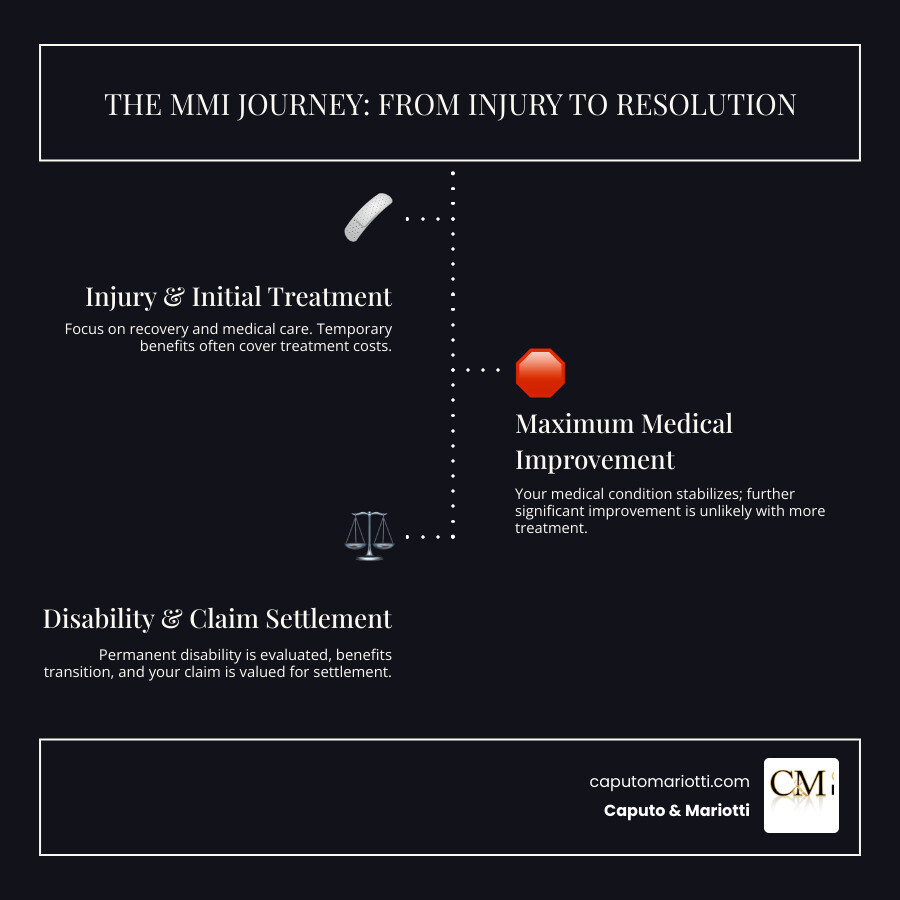
The Critical Role of MMI in Your Injury Lawsuit
When you’ve suffered an injury due to someone else’s negligence, your focus is naturally on getting better. You follow your doctor’s orders, attend therapy, and hope for a full recovery. However, there comes a point in every recovery journey where medical science has done all it can do, and further significant improvement is simply not expected. This pivotal moment is what we call maximum medical improvement, or MMI.
What is Maximum Medical Improvement (MMI)?
At its core, maximum medical improvement signifies a medical plateau. It’s the stage where your doctor believes your injury has healed as much as it’s going to, and no amount of additional treatment, therapy, or medication is likely to make a material difference in your condition. As the medical community often states, your condition is “well stabilized and is unlikely to change substantially in the next year, with or without medical treatment.”
It’s vital to understand that reaching MMI does not mean you are 100% healed, or that you’re completely free of pain or limitations. Far from it. Many individuals reach MMI still experiencing chronic pain, reduced mobility, or other lasting effects from their injury. What it does mean is that your medical journey has reached a point where the focus shifts from active recovery to managing your long-term condition.
For us, representing clients in personal injury law, MMI provides a clear picture of your future prognosis. It allows us to accurately assess the full extent of your injuries and their permanent impact on your life.
Who Determines When MMI is Reached?
Typically, your own treating physician is the primary individual responsible for determining when you have reached maximum medical improvement. They are the ones who have been with you throughout your recovery, understand your specific injury, and have observed your progress (or lack thereof) over time. They will often provide a specific date when this point was reached.
However, it’s not always a straightforward process. In personal injury lawsuits, insurance companies often have a vested interest in your MMI determination. They may request what’s known as an Independent Medical Examination (IME). An IME is conducted by a physician chosen by the insurance company, not necessarily one aligned with your best interests. The IME doctor’s opinion can sometimes confirm, but often disputes, your treating physician’s MMI determination.
We’ve seen many instances where these conflicting medical opinions become a battleground in a lawsuit. This is where our experience becomes invaluable. We work to ensure that your treating doctor’s assessment, which is based on a comprehensive understanding of your medical history and ongoing care, is given the weight it deserves.
Why MMI Dictates Your Settlement Strategy
The date you reach maximum medical improvement is a critical juncture for your entire injury lawsuit. Why? Because it’s the point at which we can finally get a clear, stable picture of your long-term medical needs, permanent limitations, and potential lost earning capacity. Without this clarity, it’s nearly impossible to accurately calculate the full value of your damages.
For example, if you settle your claim before reaching MMI, you risk accepting a settlement that doesn’t account for future surgeries, ongoing medications, or therapies that become necessary months or years down the line. Once a settlement is signed, it’s usually final, and you cannot seek further compensation. This is why we consistently advise our clients not to accept a premature settlement, even if faced with financial pressure. Accepting a low-ball offer too early could result in you being seriously under-compensated and facing significant financial hardship later.
MMI allows us to establish a baseline. We can compare your pre-injury functional ability with your post-injury functional ability, enabling us to seek compensation for the difference. This comprehensive assessment is crucial for maximizing your personal injury compensation in Scranton and ensuring you receive what you truly deserve for both economic and non-economic losses.
What Happens After Reaching Maximum Medical Improvement?

Reaching maximum medical improvement marks a significant shift in your injury lawsuit. The focus transitions from active treatment aimed at improving your condition to evaluating the long-term impact of your injuries. This includes assessing any permanent impairment and planning for ongoing care. It’s a complex stage that often requires careful legal guidance to ensure your rights and future needs are protected.
Calculating Your Full and Fair Compensation
Once MMI is declared, your personal injury lawyer can begin the crucial process of calculating the full value of your damages. This is the point where a comprehensive picture of your losses becomes clear. Your compensation demand will be built to include:
- Future Medical Expenses: This includes all anticipated costs for managing your condition, such as future surgeries, physical therapy, prescription medications, and palliative care.
- Lost Earning Capacity: If your injury permanently affects your ability to work or earn the same income as before, we calculate the lifetime value of that lost income.
- Non-Economic Damages: MMI solidifies the extent of your permanent pain and suffering, loss of enjoyment of life, and emotional distress, which are significant components of your claim’s value.
This detailed calculation is the foundation of settlement negotiations and is essential for proving your damages if your case goes to trial.
Understanding Your Impairment Rating
Once you’ve reached maximum medical improvement, your doctor will typically assign you an “impairment rating.” This rating is a crucial component in determining the value of your claim for any permanent loss of function.
It’s important to distinguish between “impairment” and “disability”:
- Impairment refers to what is medically wrong with a body part or organ system, often expressed as a percentage of loss of normal function.
- Disability refers to the alteration of an individual’s ability to meet personal, social, or occupational demands. Impairment is a medical concept, while disability is a vocational or functional one.
Impairment ratings are usually determined using standardized guidelines, most commonly the American Medical Association (AMA) Guides to the Evaluation of Permanent Impairment. These guides provide a systematic way for physicians to assess the extent of your permanent functional loss based on objective clinical findings. For example, a permanent injury to an extremity might be assigned a percentage of impairment, which directly influences the amount of compensation you receive.
As the AMA Guides themselves state, “one cannot determine permanent impairment until a condition has resolved or reached a stable plateau with respect to improvement.” This rating, supported by objective medical evidence, becomes a cornerstone of your compensation claim. You can learn more about this in articles like “Maximum Medical Improvement” according to the AMA.
Can Your MMI Status Change After It’s Been Determined?
While maximum medical improvement indicates a stable condition, it’s not always set in stone. Life, and medicine, can be unpredictable. There are circumstances under which an MMI status can change after it has been initially determined.
For instance, if your medical condition significantly worsens due to unforeseen complications, new medical developments offer a treatment that was previously unavailable, or diagnostic tests reveal a previously undiagnosed issue directly related to your initial injury, your MMI status might be revisited. In such cases, it may be possible to challenge the initial MMI finding and argue for additional compensation to cover these changes, provided a final settlement has not been reached.
This is a complex area, and insurance companies are often reluctant to acknowledge a change in MMI status once it’s been established. However, with strong medical evidence and skilled legal representation, it is possible to advocate for a re-evaluation of your long-term prognosis.
Navigating MMI Disputes and Insurance Company Tactics
The period surrounding the declaration of maximum medical improvement is often when the tension between injured individuals and insurance companies escalates. This is because MMI triggers significant financial implications for the insurer, leading them to employ various strategies to minimize their payouts. Understanding these tactics and knowing how to challenge MMI determinations is crucial for protecting your rights.
How to Challenge an MMI Designation
It’s not uncommon for an injured individual to disagree with their doctor’s or an IME doctor’s MMI designation. You might still feel you have room for improvement, or you might believe your impairment rating doesn’t accurately reflect your limitations. If you find yourself in this situation, you do have options:
- Seek a Second Opinion: If you disagree with the MMI determination from an IME doctor, your treating physician can provide a counter-opinion. You might also consider consulting with another medical expert who can review your case independently.
- Gather Additional Medical Evidence: Solid medical documentation is your strongest ally. This includes detailed reports from your treating physicians, diagnostic test results, and records of your ongoing symptoms and limitations.
- Formal Legal Disputes: In a personal injury lawsuit, a dispute over MMI becomes a key point of contention. Your attorney will use depositions from your treating physicians, hire medical experts, and present compelling evidence to counter the insurance company’s position, either in settlement negotiations or at trial.
Successfully challenging an MMI designation requires meticulous preparation and a thorough understanding of the legal and medical arguments involved. This is precisely why legal representation is so important during this phase. We can help you gather the necessary medical evidence, consult with appropriate experts, and represent your interests forcefully in any dispute.
How Insurance Companies Approach Maximum Medical Improvement
Insurance companies are businesses, and their primary goal is to minimize their expenses. When it comes to maximum medical improvement, this often translates into several common tactics:
- Pressuring for Early MMI: Insurers may try to push for an MMI declaration sooner rather than later to push for a quick, low settlement and limit their liability for ongoing medical care.
- Requesting Biased IMEs: The “independent” in Independent Medical Examination can sometimes be a misnomer. IME doctors are paid by the insurance company, and their opinions may lean towards minimizing the severity of your injuries or suggesting you’ve reached MMI prematurely.
- Denying Further Treatment: Once MMI is declared, insurers may become very resistant to acknowledging the need for future medical treatment when calculating damages.
- Offering Low-Ball Settlements: After MMI, insurers often present settlement offers that do not fully account for your future medical needs, lost earning capacity, or overall pain and suffering. They hope you’ll accept out of financial desperation.
We understand these tactics inside and out. Our decades of experience mastering negotiations with insurance companies mean we can anticipate their moves and protect you from being unfairly compensated. It’s crucial to remember that the insurance company is not on your side, and you should never sign any paperwork or agree to a settlement without consulting with an attorney.
Frequently Asked Questions about MMI

Understanding maximum medical improvement can be challenging, especially since it is a critical turning point in a personal injury or medical malpractice lawsuit. Here, we address some common questions we receive from our clients.
How does MMI affect my personal injury lawsuit?
Reaching maximum medical improvement is the signal for your personal injury lawyer to begin building the full financial scope of your case. Before MMI, the full extent of your injuries and future needs is unknown. After MMI, your lawyer can accurately calculate all your damages, including:
- The total cost of all past medical treatment.
- The projected cost of all future medical care, including therapy, medication, and potential surgeries.
- Past and future lost wages, including diminished earning capacity.
- Compensation for permanent impairment, pain and suffering, and loss of quality of life.
MMI provides the stable medical foundation needed to make a comprehensive settlement demand to the insurance company or present a clear case for damages to a jury.
Can I settle my case before reaching MMI?
While you can technically settle a claim at any time, settling before reaching MMI is extremely risky and generally not recommended by experienced personal injury attorneys. If you settle too early, you may discover later that you need an expensive surgery or will be out of work for longer than anticipated. Once you sign a final settlement agreement, you cannot go back and ask for more money. Waiting until you reach MMI ensures that your settlement demand accounts for the true, long-term consequences of your injury, protecting you from future financial hardship.
What types of future medical costs are included in a settlement after MMI?
After you reach maximum medical improvement, your settlement demand should include compensation for all reasonable and necessary future medical care related to your injury. The goal is to secure a lump sum that will cover these expenses for the rest of your life. This care is not for “improving” your condition, but for managing it. Common examples include:
- Maintenance Care: Treatments that help you maintain your current level of function and prevent deterioration.
- Palliative Care: Medical care focused on relieving chronic pain and other symptoms.
- Prescription Drugs: The lifetime cost of medications needed to manage your condition.
- Medical Equipment: Costs for items like braces, wheelchairs, or home modifications.
An insurance company will almost certainly challenge the necessity and cost of this future care. Your attorney’s job is to use medical expert testimony and evidence to prove these costs are justified.
Secure Your Future After Reaching MMI
Reaching maximum medical improvement is a complex and often emotional milestone in your recovery journey. While it signals the end of active treatment for improvement, it simultaneously opens the door to critical legal and financial decisions that will shape your future. From calculating the cost of lifelong care to battling insurance companies over impairment ratings and settlement values, the path after MMI is fraught with potential pitfalls.
At Caputo & Mariotti, we bring over 55 years of combined experience to the table, dedicated to navigating these complexities for our clients in Northeastern Pennsylvania. We believe in providing unwavering commitment to justice, ensuring that you are not left to face these challenges alone.
Don’t let the intricacies of MMI jeopardize your right to fair compensation. If you’ve reached maximum medical improvement and have questions about your next steps, we are here to help.
Contact us for a free consultation today to discuss your personal injury or medical malpractice claim. Let us put our expertise to work for you.
You can also learn more about our personal injury services and explore our medical malpractice services to see how we can assist you in securing the future you deserve.