

The dedicated legal team of Caputo & Mariotti
Odds and Ends: Factors Affecting Your Chances of Winning a Wrongful Death Suit
April 16, 2026
What Are Your Real Chances of Winning a Wrongful Death Suit?
The chances of winning a wrongful death suit depend on several key factors — and knowing them upfront can make a real difference for your family.
Here is a quick summary:
| Factor | Impact on Your Chances |
|---|---|
| Clear liability (e.g., drunk driving) | High — strongest cases |
| Medical malpractice | Harder — 20–30% trial win rate |
| Motor vehicle accidents | Strong — 60–64% trial win rate |
| Strong evidence (records, witnesses) | Significantly improves odds |
| Experienced attorney | One of the biggest factors |
| Filing within the statute of limitations | Required — miss it and you lose the right to sue |
The bottom line:
- Plaintiffs win roughly 40–60% of wrongful death cases that go to trial nationally
- Over 90% of cases settle before trial — often with favorable financial outcomes
- In Pennsylvania, the estimated trial success rate is around 48%
- Cases with clear negligence and strong evidence have the best odds
Losing someone you love is devastating. When that loss is caused by another person’s negligence — whether in a car crash, a medical setting, or a workplace — families in Northeastern Pennsylvania often want to know whether pursuing a wrongful death lawsuit is worth it. The answer is rarely simple. Liability, evidence, timing, and legal strategy all shape the outcome in ways that are hard to predict without a careful case evaluation.
I’m Chris Caputo, a Pennsylvania personal injury attorney with decades of litigation experience — including trying complex wrongful death and negligence cases since 2007 — and I’ve seen how the right preparation can dramatically shift the chances of winning a wrongful death suit in your family’s favor. In this guide, I’ll walk you through exactly what affects your odds and what you can do about it.
What is a Wrongful Death Lawsuit and Who Can File?
A Wrongful Death lawsuit is a civil action brought when a person dies due to the “wrongful act, neglect, or unlawful violence” of another party. It is essentially a personal injury claim that the deceased person would have been able to file themselves had they survived. Because they cannot, the law allows their survivors to seek compensation for the losses they have suffered as a result of the death.
In Pennsylvania, the law is very specific about how these cases are initiated. Generally, the suit must be brought by the personal representative (also known as the executor or administrator) of the deceased person’s estate. This individual files the claim on behalf of the beneficiaries. If a personal representative is not appointed within six months of the death, any person entitled to share in the damages may bring the action.

Legal Standing and Eligibility
While the personal representative files the paperwork, the “real parties in interest” are the beneficiaries. Under Pennsylvania’s intestate and wrongful death laws, the recovery is intended for the benefit of:
- The surviving spouse
- Children of the deceased
- Parents of the deceased
If none of these relatives exist, the personal representative can still seek “special damages” to cover medical, funeral, and administration expenses. Understanding who has the legal standing to sue is the first hurdle in evaluating the chances of winning a wrongful death suit. Without the proper “standing,” a case can be dismissed before it even begins. You can learn more about these distinctions in our Wrongful Death section.
Proving Negligence: The Four Elements of a Strong Claim
To win a wrongful death case, we must prove that the defendant was negligent. This isn’t just about showing that a tragedy happened; it’s about meeting a specific legal burden called the “preponderance of the evidence.” This means we must show it is “more likely than not” that the defendant’s actions caused the death.
To do this, we must establish four critical elements:
- Duty of Care: The defendant owed the deceased a legal duty to act with reasonable care (e.g., a driver must follow traffic laws; a doctor must follow medical standards).
- Breach of Duty: The defendant failed to meet that duty (e.g., speeding, misdiagnosis, or failing to fix a broken stair).
- Causation: This breach of duty directly caused the death. This is often the hardest part to prove, especially in medical cases where the person was already ill.
- Damages: The death resulted in quantifiable losses, such as funeral costs, lost wages, and emotional suffering.
Essential Evidence for Success
The chances of winning a wrongful death suit skyrocket when the evidence is concrete. We look for a “paper trail” that leaves no room for doubt. This includes:
- Forensic and Autopsy Reports: To establish the exact cause of death.
- Surveillance Footage: Essential in car accidents or slip-and-fall cases.
- Black Box Data: From commercial trucks or modern passenger vehicles to prove speed and braking patterns.
- Expert Testimony: We often hire medical experts or accident reconstructionists to explain complex technical details to a jury.
For a deeper dive into how we build these cases, see our guide on Navigating The Legal Maze Catastrophic Injuries And Wrongful Death In Personal Injury Law.
Understanding the Chances of Winning a Wrongful Death Suit
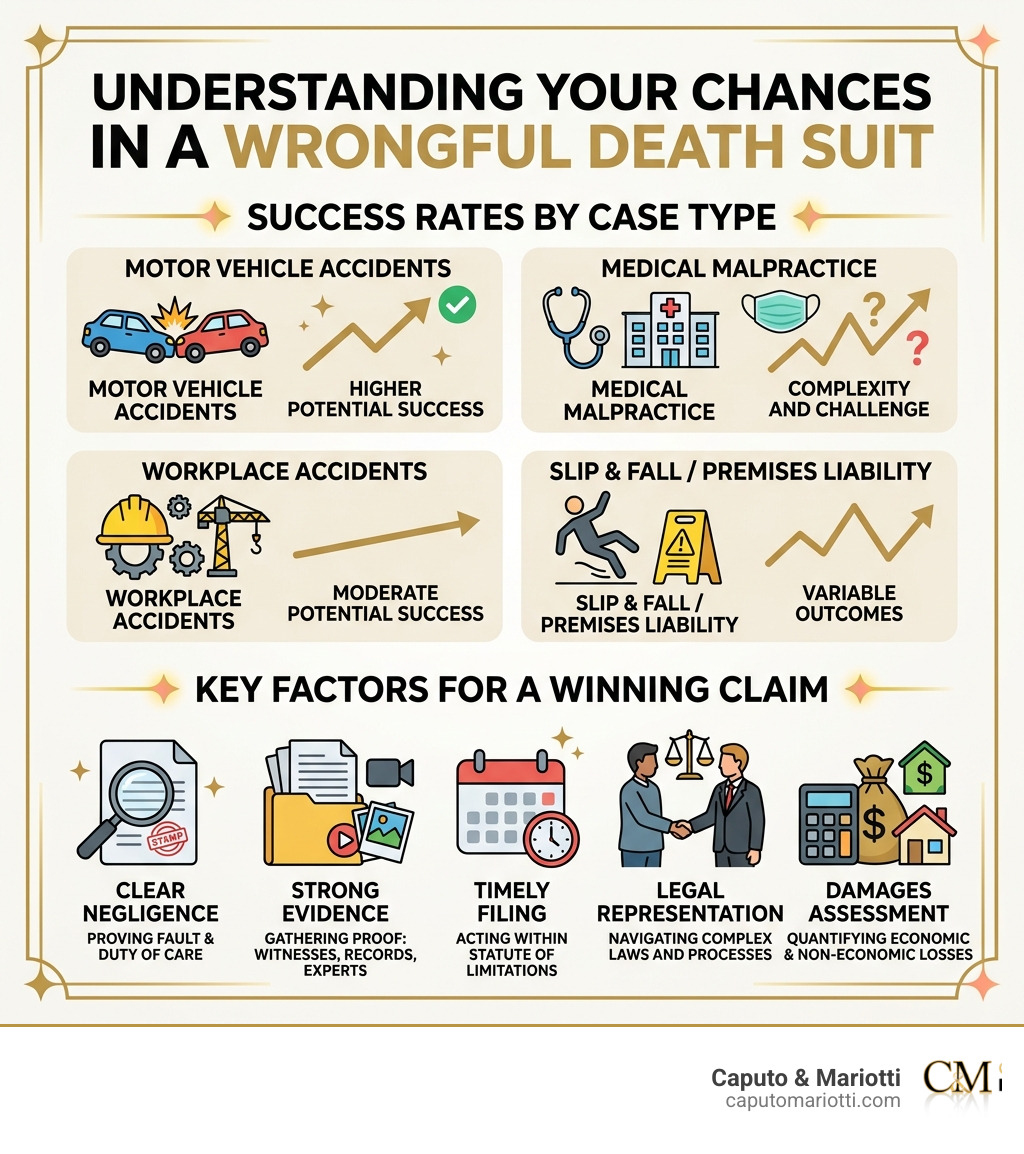
When families ask about their odds, they are often surprised by the statistics. Nationally, when these cases go to trial, plaintiffs win between 40% and 60% of the time. However, it is important to remember that fewer than 10% of these cases ever see a courtroom. The vast majority — over 90% — are settled out of court.
The type of accident significantly influences these percentages. Here is a breakdown of trial success rates based on the cause of action:
| Case Type | Estimated Plaintiff Win Rate at Trial |
|---|---|
| Motor Vehicle Accidents | 60% – 64% |
| General Personal Injury | 51% |
| Premises Liability | 38% – 39% |
| Medical Malpractice | 20% – 30% |
As the data shows, medical malpractice cases are notoriously difficult to win at trial. This is often because 80-90% of “defensible” medical claims (where the provider can argue they met the standard of care) are dropped or dismissed without any payment.
Statistical Chances of Winning a Wrongful Death Suit at Trial
Venue and geography play a role as well. Some states and counties are known for being more “plaintiff-friendly” than others. For example, while states like Ohio or Washington report trial success rates as high as 65%, Pennsylvania sits closer to 48%. In areas like Lackawanna and Luzerne County, juries are known for being fair but thorough, meaning your evidence must be airtight to succeed.
How Evidence Impacts the Chances of Winning a Wrongful Death Suit
The clarity of “causation” is the biggest swing factor. If a drunk driver hits a pedestrian, causation is clear. If a nursing home resident passes away, the defense may argue the death was a natural result of old age or pre-existing conditions rather than neglect. This is why having a nursing home wrongful death attorney is so critical; we know how to differentiate between natural decline and actionable negligence.
The defendant’s resources also matter. A suit against a major trucking corporation with a $10 million insurance policy is handled differently than a suit against an uninsured individual. We must evaluate not just the “win-ability” of the case, but the “collectability” of the damages.
Factors That Influence Settlement Amounts and Success
If you win or settle, the compensation is divided into three main categories:
- Economic Damages: These are the “receipt-based” losses. They include medical bills incurred before death, funeral and burial expenses, and the loss of the deceased’s expected future earnings.
- Non-Economic Damages: These cover the loss of companionship, comfort, guidance, and the “consortium” the deceased provided to their family.
- Punitive Damages: These are rare and only awarded if the defendant’s conduct was particularly “wanton” or “reckless,” intended more to punish the wrongdoer than to compensate the family.
Calculating these amounts requires looking at the victim’s age, health, earning capacity, and the number of dependents they left behind.
Comparative Negligence and Workplace Fatalities
One of the most common ways the chances of winning a wrongful death suit are threatened is through the defense of “comparative negligence.” Pennsylvania follows a 51% bar rule. This means if the deceased person is found to be 51% or more at fault for the accident, the family recovers nothing. If they are 20% at fault, the total award is reduced by 20%.
In workplace fatalities, the situation is different. If a loved one dies on the job, the family may be entitled to death benefits through the workers’ compensation system. This is a “no-fault” system, meaning you don’t have to prove the employer did anything wrong to get benefits. However, the trade-off is that you generally cannot sue your employer for additional damages. In these cases, we often look for a “third-party” claim — such as a manufacturer of a defective machine — to maximize recovery.
If you are facing this situation, consulting a workers’ compensation lawyer is the best way to manage the necessary steps:
- Reporting: You must notify the employer of the incident within specific timeframes to maintain eligibility.
- Medical Treatment: Proper medical documentation is required to link the fatality to workplace conditions.
- Evidence Gathering: We assist in securing safety records, witness statements, and forensic evidence from the site.
- Filing Process: We guide you through the formal claim petition process with the Bureau of Workers’ Compensation to ensure all deadlines are met.
Navigating the Legal Process: Timelines and Statutes
In Pennsylvania, you generally have two years from the date of the death to file a wrongful death lawsuit. This is known as the statute of limitations. While two years might seem like a long time, the “discovery process” — where we gather evidence, take depositions, and hire experts — takes months of preparation. If you miss this deadline by even one day, you likely lose your right to sue forever.
The timeline for a case varies:
- Settlements: Often reached within 6 to 12 months if liability is clear.
- Trials: Can take 1 to 3 years (or more) depending on the court’s schedule and the complexity of the case.
Trial vs. Out-of-Court Settlements
Most families prefer to settle. Settlements offer privacy, a guaranteed outcome, and faster closure. Trials are public, expensive, and risky — even with a strong case, a jury can be unpredictable. However, we always prepare every case as if it is going to trial. This “trial-ready” approach gives us the leverage needed to force insurance companies to offer a fair settlement.
How to Maximize Your Odds of a Successful Outcome
To improve your chances of winning a wrongful death suit, we recommend taking these steps immediately:
- Act Fast: Evidence like skid marks, surveillance video, and witness memories fades quickly.
- Keep a Diary: Document the emotional and financial impact on your family. This helps us prove non-economic damages.
- Avoid Insurance Adjusters: Do not give recorded statements to the other party’s insurance company. Their goal is to find ways to shift the blame to your loved one.
- Gather Paperwork: Collect medical bills, tax returns (to prove lost wages), and the death certificate.
Why Experienced Representation Matters
Wrongful death law is complex. Between navigating the 51% bar for comparative negligence and identifying every possible source of insurance coverage, there is no room for error. An experienced firm brings the resources needed to hire top-tier experts and the reputation that makes insurers take your claim seriously. At Caputo & Mariotti, we use our 55+ years of combined experience to provide the aggressive advocacy families in Northeastern Pennsylvania need.
Frequently Asked Questions about Wrongful Death Suits
How long does a wrongful death case typically take to resolve?
Most cases settle within a year, but if a trial is necessary, it can take two to three years. The timeline depends on how clearly fault can be proven and how much the defendant’s insurance company fights the claim.
What is the average settlement amount for a wrongful death claim?
There is no “true” average because every life is unique. Settlements can range from $100,000 in minor car accidents to several million dollars in cases involving high-earning individuals or extreme corporate negligence. Factors include the victim’s age, income, and the number of surviving dependents.
Can I sue for wrongful death if my loved one was partially at fault?
Yes, as long as they were not 51% or more at fault. If they were 25% at fault, your final compensation will be reduced by 25%. We work hard to minimize the fault attributed to the deceased to protect your recovery.
Conclusion
The chances of winning a wrongful death suit are never 100%, but with the right legal team, you can significantly tip the scales in your favor. At Caputo & Mariotti, we understand that no amount of money can replace your loved one. However, holding the responsible party accountable can provide the financial security your family needs to move forward and the sense of justice you deserve.
We have served the Scranton, Wilkes-Barre, and greater Northeastern Pennsylvania community for decades. If you believe your loved one’s death was preventable, don’t wait until the statute of limitations draws near. Contact us today for a free, compassionate consultation at https://caputomariotti.com/consultation/. We are here to help you navigate this difficult time with the dedication and experience your case requires.