

The dedicated legal team of Caputo & Mariotti
When Care Goes Wrong: A Guide to Suing Hospitals for Negligence
May 14, 2026
When Medical Care Causes Harm: Understanding Your Legal Rights
Suing hospital for negligence becomes necessary when medical treatment causes serious harm rather than healing. Here is what you need to know:
Key Requirements for Suing a Hospital:
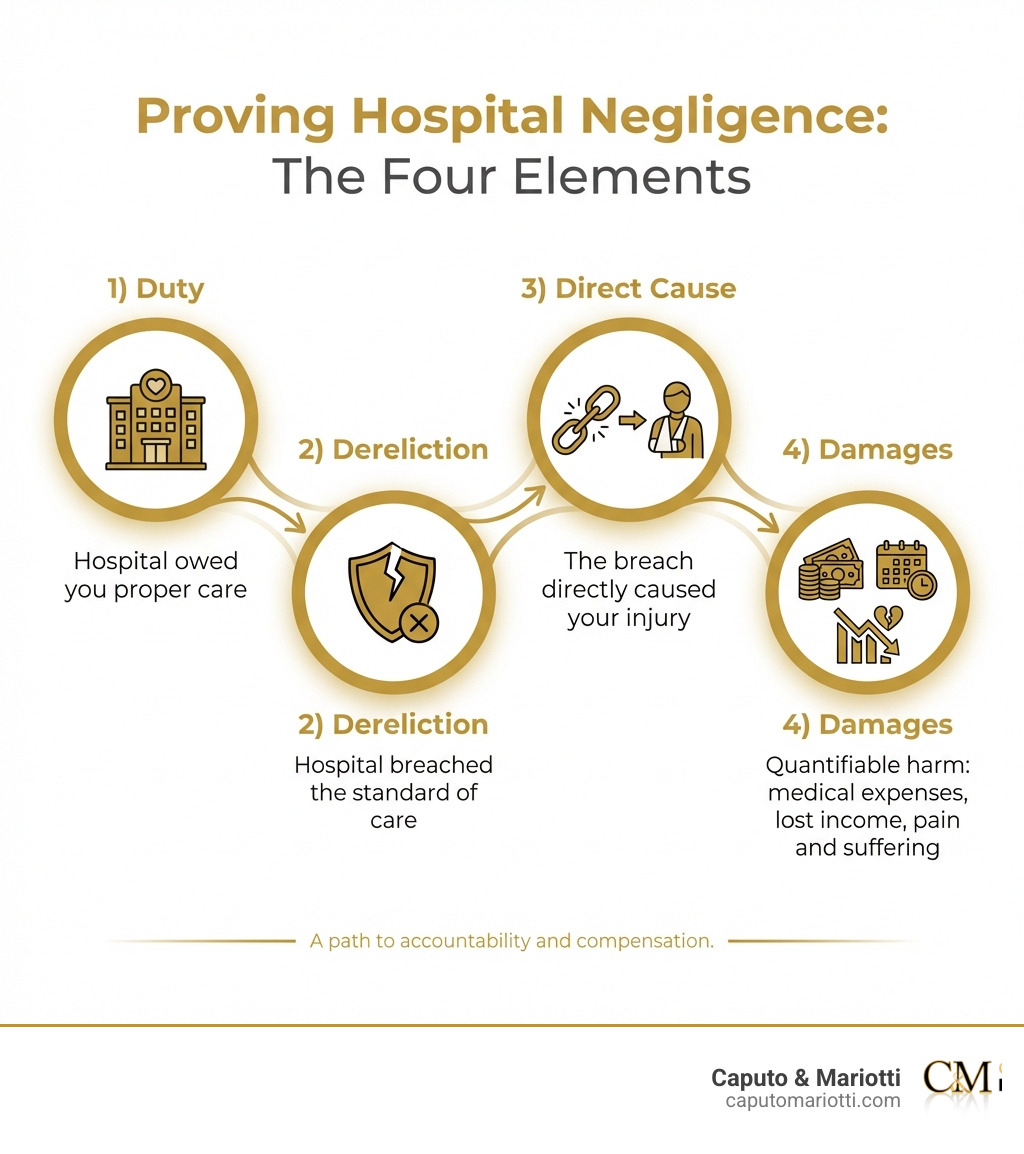
- Duty of Care – The hospital owed you a legal obligation to provide proper medical care.
- Breach of Duty – The hospital or its staff failed to meet the accepted standard of care.
- Causation – This failure directly caused your injury or worsened your condition.
- Damages – You suffered quantifiable harm (medical bills, lost wages, pain and suffering).
Important Facts:
- You typically have 2 years from the date of injury to file a lawsuit in Pennsylvania.
- Hospital negligence cases have a 25-35% success rate but can result in settlements from $50,000 to several million dollars.
- Most cases settle within 2-3 years, though trials can take longer.
- Expert medical witnesses are almost always required and cost $15,000-$50,000.
When you enter a hospital, you place your trust in trained professionals. But sometimes that trust is broken by medical errors. A surgical error might leave you with a permanent disability, a medication mistake could cause organ damage, or a delayed diagnosis might allow a treatable condition to become life-threatening. These are not just statistics; they are real people whose lives are changed in an instant.
The path to holding a hospital accountable is complex. It requires understanding medical standards, navigating legal procedures, and proving your case with expert testimony. Hospitals have sophisticated legal teams, and you will face time limits and significant costs. However, you have rights. When hospitals fail to maintain reasonable standards of care and patients suffer, the legal system provides a path to compensation through personal injury and medical malpractice lawsuits.
This guide explains what you need to know about suing hospital for negligence. We will cover what constitutes negligence, how to prove your case, and what damages you can recover. The attorneys at Caputo & Mariotti have spent over two decades representing individuals harmed by negligence in Northeastern Pennsylvania and surrounding areas. We understand the medical evidence, legal complexities, and defense strategies that shape these cases, and we are here to help you understand your rights and options.
Understanding Hospital Negligence and Your Rights

When we talk about medical negligence, especially in the context of a hospital, it’s crucial to understand what it means. Medical malpractice occurs when a healthcare provider’s actions fall below the accepted standard of care, causing injury to a patient. This can apply to doctors, nurses, technicians, or the hospital itself.
Hospitals have a responsibility to ensure competent staff and safe procedures. Under a legal theory called “vicarious liability,” a hospital can be held responsible for the negligent actions of its employees (like most nurses and technicians) if those actions occurred within the scope of their employment. This is sometimes referred to as “respondeat superior,” meaning “let the master answer.”
Understanding these principles is the first step in determining if you have a case. If you’re wondering if you’ve been a victim of medical negligence, explore our resources on Did I Suffer Medical Malpractice? Here Is How to Identify It and Medical Malpractice.
What Constitutes Hospital Negligence?
Hospital negligence is a failure to act with reasonable care, leading to foreseeable harm. To prove it, you must establish the four key elements: a duty of care was owed, that duty was breached, the breach directly caused an injury, and you suffered quantifiable damages. This means showing the hospital or its staff did not act as a reasonably prudent medical professional would have in similar circumstances, and this failure led to your physical, emotional, and financial losses. For a deeper dive, read The Critical Elements of Medical Negligence Lawsuits and What to Know About Medical Malpractice.
Common Types of Hospital Negligence Claims
Hospital negligence can manifest in various ways. Some of the most common claims include:
- Surgical Errors: Operating on the wrong body part, leaving instruments inside a patient, or anesthesia errors.
- Misdiagnosis or Delayed Diagnosis: A flawed diagnostic process that prevents timely and effective treatment.
- Medication Mistakes: Administering the wrong medication, incorrect dosage, or failing to check for harmful drug interactions.
- Birth Injuries: Negligence during labor and delivery that harms the birthing parent or newborn.
- Anesthesia Errors: Mistakes by anesthesiologists that can lead to brain damage or death.
- Inadequate Monitoring: Failure to properly monitor a patient’s condition, leading to undetected complications.
- Hospital-Acquired Infections: Infections due to inadequate sanitation or sterilization.
- Emergency Room Negligence: Errors in the high-pressure ER environment, like misdiagnosing obvious conditions.
If you or a loved one has suffered harm due to any of these issues, investigate your rights. Learn more in our articles, 5 Common Types of Medical Malpractice in Scranton, PA, and How a Lawyer Can Help, and Misdiagnosis in Healthcare: What You Need to Know and How to Protect Your Rights.
The Legal Framework for Suing a Hospital for Negligence

The legal process for suing hospital for negligence is more complex than other personal injury claims, involving intricate medical facts and procedural rules that vary by state. In Pennsylvania, New York, and New Jersey, these laws can create significant problems for injured patients and their families.
Understanding this framework is vital. Medical malpractice and hospital negligence lawsuits are often an uphill battle due to their complexity, which is why experienced legal counsel is essential. The personal injury lawyers at Caputo & Mariotti have dedicated decades to navigating medical malpractice law in Northeastern Pennsylvania, including Scranton, Wilkes-Barre, Hazleton, Dickson City, Pittston, and surrounding communities. For specific insights into Pennsylvania medical negligence law, refer to Medical Malpractice in Pennsylvania: Your Attorney Lifeline.
The Four Elements You Must Prove
As mentioned, establishing negligence requires proving four critical elements:
- Establishing a Doctor-Patient Relationship (Duty of Care): This is usually straightforward and means you were under the care of the hospital or its professionals.
- Proving the Standard of Care Was Breached: You must show the provider’s actions fell below the accepted standard of care, which often requires expert testimony from other medical professionals.
- Linking the Breach Directly to Your Injury (Causation): You must demonstrate that the negligent act, and not some other factor, was the direct cause of your injury.
- Demonstrating Quantifiable Harm (Damages): You must show you suffered actual damages, including physical pain, emotional distress, and financial losses that can be pursued through a medical malpractice or personal injury lawsuit.
These elements are the backbone of any medical malpractice claim. For more information, the American Bar Association provides a good overview on More about medical malpractice claims, and you can also review our own resources on Medical Malpractice.
Time Limits: The Statute of Limitations
One of the most critical aspects of any legal claim is the statute of limitations. Failing to file your lawsuit within this period almost always means you lose your right to seek compensation.
In Pennsylvania, the statute of limitations for medical malpractice is generally two years from the date the malpractice occurred or was finded. This findy rule is vital: the clock might start when you reasonably should have known about the injury. However, there are exceptions, such as for minors.
In New York, the statute is generally 2.5 years, while in New Jersey, it is typically two years. These deadlines highlight why it is so important to act quickly if you believe you have a personal injury or medical malpractice claim against a hospital or healthcare provider. Evidence can disappear, memories can fade, and the legal window can close. Our guide on Making Your Case: The Medical Negligence Claim Process Explained offers further details on the process and how our injury lawyers can help protect your rights.
Building a Strong Case: Steps and Strategies
Building a strong case for suing hospital for negligence requires meticulous preparation and strategic execution. It is not a task to undertake lightly, as hospitals and their insurers will mount a vigorous defense to protect themselves from personal injury and medical malpractice liability. While the success rate for plaintiffs can be challenging (around 25-35%), a well-prepared case significantly improves your odds.
Our firm has experience in the Scranton, Wilkes-Barre, and broader Northeastern Pennsylvania areas, helping clients steer these complex medical negligence and serious injury claims. For more about our approach as personal injury and medical malpractice lawyers, see Medical Malpractice Lawyers in Scranton, PA: What You Need to Know.
Key Steps in Suing a Hospital for Negligence
Here is a general overview of the steps involved:
- Gathering Medical Records: We obtain all relevant records, including charts, notes, and test results, which form the factual basis of your claim.
- Documenting Injuries and Expenses: Keep detailed records of your injuries, treatment, lost wages, and the emotional and physical impact on your life.
- Consulting an Attorney: An experienced personal injury and medical malpractice attorney can evaluate your case, determine if negligence can be proven, and guide you through the legal process.
- Expert Medical Review: Independent medical experts review records to determine if the standard of care was breached. In Pennsylvania, this is required before filing a lawsuit.
- Filing a Complaint: If the expert review is supportive, a formal complaint is filed with the court, outlining the facts and damages sought.
- Findy Process: This phase involves exchanging information with the defendant through written questions, document requests, and depositions.
Navigating these steps requires legal and medical expertise. For those in the Wilkes-Barre area or anywhere in Northeastern Pennsylvania, our team of injury lawyers is ready to assist. Learn more at Wilkes-Barre Medical Malpractice Lawyer.
The Crucial Role of Expert Medical Witnesses
In medical malpractice cases, expert medical witnesses are indispensable. They are the cornerstone of proving both the breach of the standard of care and causation.
- Establishing Standard of Care: An expert testifies about what a reasonably prudent physician would have done and how the defendant’s actions deviated from this standard.
- Proving Causation: Experts also link the negligent act directly to your injury, explaining the medical science behind the harm.
- Cost of Expertise: Retaining qualified experts is a significant expense, often costing between $15,000 and $50,000 per expert.
- Selecting a Qualified Expert: We work with a network of highly credentialed medical professionals who can provide credible, impartial testimony.
For residents of Hazleton and surrounding Luzerne County communities, our legal team can connect you with the necessary expert resources to pursue your hospital negligence or personal injury claim. Visit Hazleton Medical Malpractice Lawyer.
Calculating Potential Damages
When suing hospital for negligence, the goal is to recover damages for the harm you have suffered. These are typically categorized as follows:
| Type of Damage | Description |
|---|---|
| General Damages | Compensates for non-economic losses like pain and suffering, emotional distress, and loss of enjoyment of life. These are subjective but significant. |
| Special Damages | Covers quantifiable financial losses, including past and future medical expenses, lost wages, and costs for in-home care. Must be supported by records and bills. |
| Punitive Damages | Awarded in rare cases of reckless or malicious conduct to punish the defendant and deter future behavior. |
| Future Care Costs | Compensation for ongoing medical care, therapies, and other long-term needs resulting from catastrophic or permanent injuries. |
In Pennsylvania, general and special damages in most personal injury and medical malpractice cases are not capped, allowing for full compensation based on the severity of the injury. Our firm works to ensure all potential damages are thoroughly calculated, particularly for seriously injured clients in Dickson City, Scranton, and throughout Northeastern Pennsylvania. For those in Dickson City, we are here to help. Learn more at Dickson City Medical Malpractice Lawyer.
Navigating the Process and Common Challenges
The journey of suing hospital for negligence is rarely swift or simple. Medical malpractice and serious personal injury cases are known for their lengthy timelines and the significant resources they demand. On average, these cases can take 3-5 years to resolve through trial, though many settle within 2-3 years. This extended timeline is due to the complexity of medical evidence, the need for multiple expert opinions, and the robust defense strategies employed by hospitals and their insurers.
The average cost of litigating a medical malpractice claim can easily exceed $100,000, covering expert witness fees, medical record analysis, court filing fees, and findy costs. These financial demands can be daunting for individuals already facing medical bills and lost income after a serious injury.
Common Challenges When Suing a Hospital for Negligence
Even with a strong case, you should be prepared for several challenges:
- Sophisticated Legal Defense Teams: Hospitals and their insurance providers employ highly experienced legal teams dedicated to defending against negligence claims. They have vast resources and will challenge every aspect of your case.
- High Financial Cost of Litigation: As noted, the expenses involved in bringing a medical malpractice lawsuit are substantial. This can be a barrier for many injured patients.
- Proving Causation: This remains one of the most difficult problems. Defense teams often argue that the injury was a pre-existing condition, an unavoidable complication, or caused by factors unrelated to their client’s actions.
- Emotional and Time-Consuming Process: Litigation is inherently stressful. The process can be emotionally draining, forcing you to relive painful events, and the long duration can test your patience.
- Defense Strategies: Hospitals often use strategies like causation disputes, arguing that the injury would have occurred regardless of their actions, or even alleging contributory negligence on the part of the patient. In Pennsylvania, a modified comparative negligence rule applies: if you are found to be 51% or more at fault for your injury, you cannot recover any damages. If you are less than 51% at fault, your damages will be reduced by your percentage of fault.
Understanding these challenges upfront is key to setting realistic expectations in any hospital negligence or personal injury lawsuit. For those in Pittston seeking legal guidance after a serious medical error, our team is here to help you prepare for what is ahead. Visit Pittston Medical Malpractice Lawyer.
How a Lawyer Can Help Your Claim
Given the complexities and challenges, attempting to pursue a hospital negligence claim without experienced legal representation is extremely difficult. A dedicated medical malpractice and personal injury lawyer can be your strongest advocate by:
- Providing Access to Expert Networks: We have established relationships with leading medical experts across various specialties who are crucial for building and proving your case.
- Navigating Complex Procedures: From understanding state-specific pre-filing requirements to managing the extensive findy process, we handle all the legal intricacies.
- Negotiating Settlements: Most medical malpractice and injury cases settle out of court. We are skilled negotiators who will advocate for a fair settlement that fully compensates you for your losses.
- Representing You at Trial: If a fair settlement cannot be reached, we are prepared to take your case to trial, presenting a compelling argument to a judge and jury.
- Working on Contingency Fee Arrangements: Many medical malpractice lawyers, including our firm, work on a contingency fee basis. This means you do not pay any attorney fees unless and until we recover compensation for you, typically taking 30-40% of the recovery. This arrangement allows injured patients to pursue justice without upfront financial burdens.
Choosing the right legal partner is paramount when you or a loved one has suffered a serious injury due to hospital negligence. Our firm, Caputo & Mariotti, has been representing victims of medical malpractice and personal injury in Scranton, Wilkes-Barre, Moosic, Hazleton, Pittston, Dickson City, and throughout Northeastern Pennsylvania for decades. We have the experience and resources to stand up to powerful hospital defense teams. Learn more about how to choose the right legal representation at Choosing the Right Medical Malpractice Lawyers Near Me: What You Need to Know and Medical Malpractice: Finding Lawyers Near Me.
Frequently Asked Questions about Suing a Hospital for Negligence
We understand you likely have many questions about suing hospital for negligence and how these medical malpractice and personal injury claims work in Pennsylvania, New York, and New Jersey. Here are answers to some of the most common inquiries we receive at Caputo & Mariotti.
Can family members sue if hospital negligence caused a patient’s death?
Yes, absolutely. If hospital negligence leads to a patient’s death, surviving family members can pursue a wrongful death claim. Under Pennsylvania law, these claims typically seek compensation for:
- Loss of Financial Support: The income and benefits the deceased would have provided.
- Loss of Services and Companionship: The value of household services, guidance, care, and emotional support.
- Funeral and Burial Expenses: Direct costs associated with the death.
- Medical Expenses: Costs incurred for the deceased’s final injury or illness.
Eligible family members usually include spouses, dependent children, and sometimes parents. The specifics can vary, but generally, the closest relatives who relied on the deceased have the strongest claims. Our wrongful death and personal injury lawyers can explain how these rules apply to your situation during a consultation.
What is the success rate for hospital negligence lawsuits?
The success rate for plaintiffs in hospital negligence cases is challenging, generally falling between 25-35% for favorable outcomes or settlements. This is lower than other personal injury cases due to the complex medical evidence required and the robust defense mounted by hospitals.
However, certain types of cases tend to have higher success rates:
- Surgical errors: These often have clear documentation and obvious causation links, leading to higher success rates (35-45%).
- Medication mistakes: With clear evidence of incorrect dosage or wrong medication, these can have success rates of 40-50%.
- Birth injuries: While complex, cases with clear negligence during labor and delivery can result in substantial settlements and success rates of 30-40%.
While the overall odds might seem low, experienced legal representation by a dedicated medical malpractice and personal injury lawyer significantly improves your chances. Strong cases, especially those involving clear errors and permanent injury, often result in substantial settlements, ranging from $50,000 for minor errors to several million dollars for catastrophic injuries. You can explore more about these claims in our Medical Malpractice resources.
Can I sue the hospital if my doctor was an independent contractor?
Yes, potentially. While hospitals are generally vicariously liable for the actions of their employees (like nurses, technicians, and residents), the situation becomes more complex with independent contractor physicians. Many doctors, even those who regularly practice at a hospital, are technically independent contractors.
However, you may still be able to sue the hospital under several theories:
- Apparent Agency: If the hospital held out the doctor as its employee, and you reasonably believed the doctor was acting on behalf of the hospital, the hospital can still be held liable. This is common in emergency rooms where patients do not choose their doctors.
- Direct Hospital Negligence: The hospital can be directly liable if its own actions contributed to the harm. This includes:
- Inadequate Credentialing: The hospital failed to properly vet the doctor’s qualifications or track their history of malpractice.
- Faulty Policies or Procedures: The hospital’s internal rules or lack thereof contributed to the negligence.
- Inadequate Staffing or Equipment: The hospital failed to provide sufficient staff or necessary equipment, leading to the injury.
Determining liability in these situations is intricate and requires careful legal analysis by experienced personal injury and medical malpractice attorneys. Our Best Malpractice Attorneys are adept at untangling these complexities to ensure all responsible parties are held accountable and that injured patients throughout Northeastern Pennsylvania receive the compensation they deserve.
Conclusion
When medical care goes wrong, and you or a loved one suffers harm due to negligence, the path to justice can seem overwhelming. Suing hospital for negligence is a serious undertaking that involves navigating complex medical facts, stringent legal requirements, and formidable defense teams. These are not simple claims; they are high-stakes personal injury and medical malpractice cases that can determine your long-term financial security and access to needed medical care.
However, you do not have to face this challenge alone. Our firm, Caputo & Mariotti, stands ready to be your attorney lifeline in Northeastern Pennsylvania and beyond. With over 55 years of combined experience, our dedicated team of personal injury and medical malpractice lawyers is committed to justice for those injured by medical negligence in Scranton, Wilkes-Barre, Hazleton, Pittston, Dickson City, Moosic, and throughout Lackawanna and Luzerne Counties, as well as clients in Pennsylvania, New York, and New Jersey. We understand the nuances of these states’ laws, and we have the resources, including an in-house medical doctor, to build a strong case on your behalf.
We believe that when hospitals fail to uphold their duty of care, they must be held accountable through the civil justice system. Our goal is to secure the compensation you deserve for medical expenses, lost wages, pain and suffering, and other damages, and to help prevent similar tragedies from happening to others.
If you suspect you have been a victim of hospital negligence or another form of medical malpractice, do not delay. The statute of limitations is a critical factor in any injury lawsuit, and early action can be vital to preserving your rights and evidence.
Schedule a free consultation with our experienced attorneys today. Let us review your case, explain your legal options, and help you take the first step toward healing and justice through a personal injury or medical malpractice claim.
Learn more about our personal injury practice and how we can be your trusted legal support after a serious injury caused by hospital or medical negligence.