
The dedicated legal team of Caputo & Mariotti
Detailed Guide to What Is a Birth Injury Claim in Pennsylvania
May 29, 2026
When Something Goes Wrong at Birth: Understanding Your Rights in Pennsylvania
A birth injury claim in Pennsylvania is a type of medical malpractice lawsuit filed when a healthcare provider’s negligence causes physical harm to a baby or mother during labor or delivery.
Quick Answer: What Is a Birth Injury Claim in Pennsylvania?
| Element | What It Means |
|---|---|
| What it is | A legal claim against a healthcare provider whose negligence caused harm during childbirth |
| Who can file | Parents on behalf of an injured child, or parents for their own injuries |
| Legal basis | Medical malpractice — failure to meet the accepted standard of care |
| Filing deadline | 2 years from the injury; for minors, typically until the child turns 20 |
| Compensation | Medical costs, long-term care, pain and suffering, lost earning capacity |
Birth injuries can range from temporary bruising to permanent conditions like cerebral palsy or Erb’s palsy. According to national data from the CDC, birth injuries account for roughly 20% of the approximately 20,000 infant deaths that occur in the United States each year — making them a serious and, often, preventable problem.
When a preventable medical error causes lasting harm to your child, Pennsylvania law gives your family the right to seek accountability and compensation.
I’m Chris Caputo, a Pennsylvania personal injury attorney with decades of litigation experience, including complex medical malpractice and negligence cases — exactly the type of high-stakes legal work that birth injury claims in Pennsylvania demand. If you suspect your child was harmed by a medical error at birth, the information in this guide will help you understand your options clearly and quickly.
Defining What Is a Birth Injury Claim in Pennsylvania
At its core, understanding what is a birth injury claim pennsylvania involves looking at the intersection of medicine and law. It is a specific branch of medical malpractice that addresses physical trauma or harm sustained by a newborn (or the mother) during the birthing process.
In Pennsylvania, every healthcare professional — whether they are an obstetrician, a nurse, or an anesthesiologist — is bound by a standard of care. This is the level of skill and care that a reasonably competent professional with similar training would provide under similar circumstances. When a provider fails to meet this standard, and that failure leads to an injury, it constitutes medical malpractice.
A Birth Injury claim is the legal vehicle families use to hold these providers accountable. It isn’t just about a “bad outcome”; it’s about proving that the outcome was avoidable if the medical team had done their jobs correctly. Whether the harm was caused by excessive force during delivery, a failure to monitor fetal distress, or a delayed C-section, the claim seeks to provide the resources necessary for the child’s future.
Birth Injury vs. Birth Defect
It is vital to distinguish between a birth injury and a birth defect, as they are viewed very differently under the law.
- Birth Defects: These are typically congenital, meaning they develop while the baby is in the womb. They are often the result of genetics, environmental factors, or issues during fetal development (such as a heart murmur or a cleft palate). Generally, birth defects are not the result of medical negligence during delivery.
- Birth Injuries: These are caused by external factors and trauma during the labor and delivery process itself. For example, if a baby is deprived of oxygen because the doctor failed to notice the umbilical cord was wrapped around their neck, that is a birth injury.
Identifying preventable medical errors is the first step in a successful claim. While birth defects are often unavoidable, birth injuries are frequently the result of a breach in the standard of care.
Common Types of Birth Injuries and Liable Parties
Birth injuries can manifest in many ways, ranging from mild physical marks to life-altering neurological disorders. In our work as a Wilkes-Barre Birth Injury Lawyer, we often see families struggling with the overwhelming costs associated with these injuries.
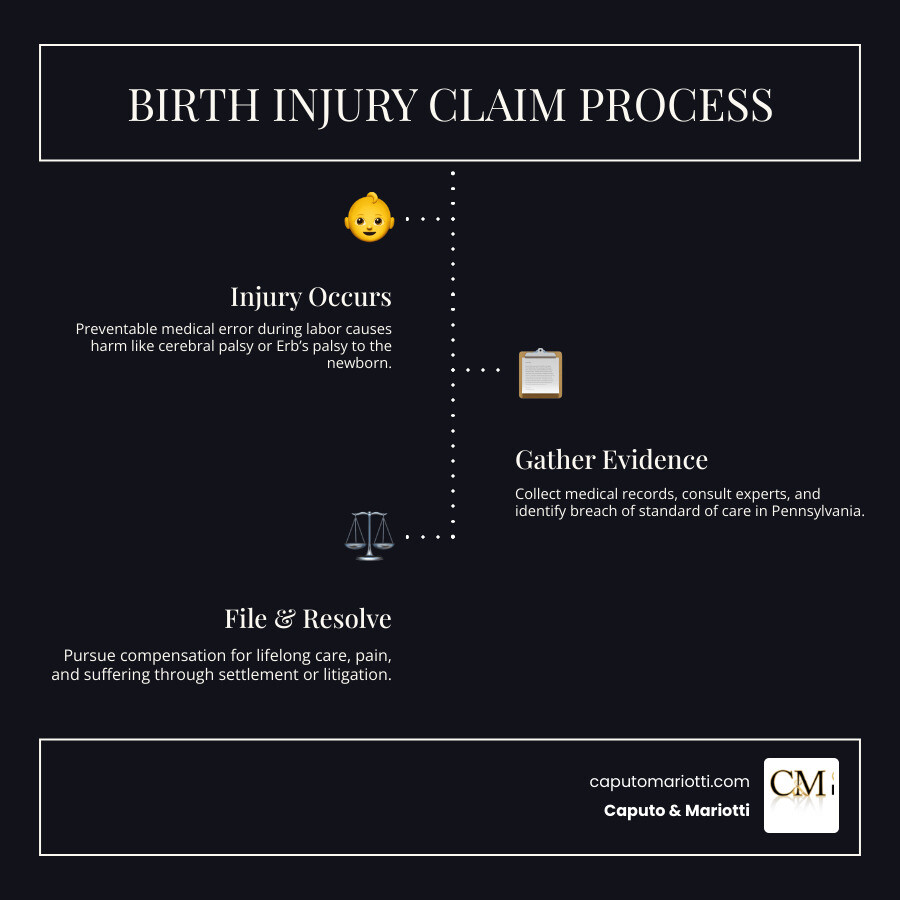
Common injuries that lead to legal action in Pennsylvania include:
- Cerebral Palsy: Often caused by Hypoxic-Ischemic Encephalopathy (HIE), which is a lack of oxygen to the brain during delivery. Statistics from the Centers for Disease Control and Prevention show that 1 in 345 children suffer from cerebral palsy.
- Erb’s Palsy (Brachial Plexus Injuries): This occurs when the nerves in the baby’s shoulder are stretched or torn, often during a difficult delivery involving shoulder dystocia. Erb’s palsy occurs in roughly 0.9 to 2.6 cases per 1,000 births.
- Bone Fractures: Clavicle fractures are the most common, occurring in up to 3.2% of births, often due to excessive force.
- Cephalohematoma: This is a buildup of blood under the scalp, occurring in 3% to 4% of assisted deliveries using forceps or vacuums.
Whether you need a Hazleton Birth Injury Lawyer or a Pittston Birth Injury Lawyer, the goal remains the same: identifying exactly what went wrong and who is to blame.
Who is Liable in a Birth Injury Claim in Pennsylvania?
Liability in these cases can be complex because multiple people are usually involved in a single delivery. Under Pennsylvania law, we can often hold several parties responsible:
- Obstetricians and Doctors: If they fail to recognize distress or misuse delivery tools.
- Nurses and Medical Staff: If they fail to monitor the mother or baby or fail to report vital changes to the doctor.
- Hospitals: Hospitals can be held “vicariously liable” for the actions of their employees. They can also be sued for institutional negligence, such as having inadequate staffing or failing to maintain equipment.
- Anesthesiologists: If errors in medication or epidural administration lead to maternal or fetal harm.
- Pharmaceutical and Device Manufacturers: If a defective drug or a malfunctioning vacuum extractor caused the injury.
Proving Medical Negligence and Recovering Damages
Proving a birth injury claim is a heavy lift. It requires more than just showing that a child is injured; you must prove the four elements of negligence:
- Duty of Care: A provider-patient relationship existed.
- Breach of Duty: The provider deviated from the accepted standard of care.
- Causation: This specific breach directly caused the child’s injury.
- Damages: The injury resulted in actual losses (financial, physical, or emotional).
In Pennsylvania, one of the most critical steps is obtaining a Certificate of Merit. This is a document signed by a qualified medical expert (usually another doctor in the same field) stating that there is a “reasonable probability” that the care provided fell below professional standards. Without this, the court will likely dismiss the case.
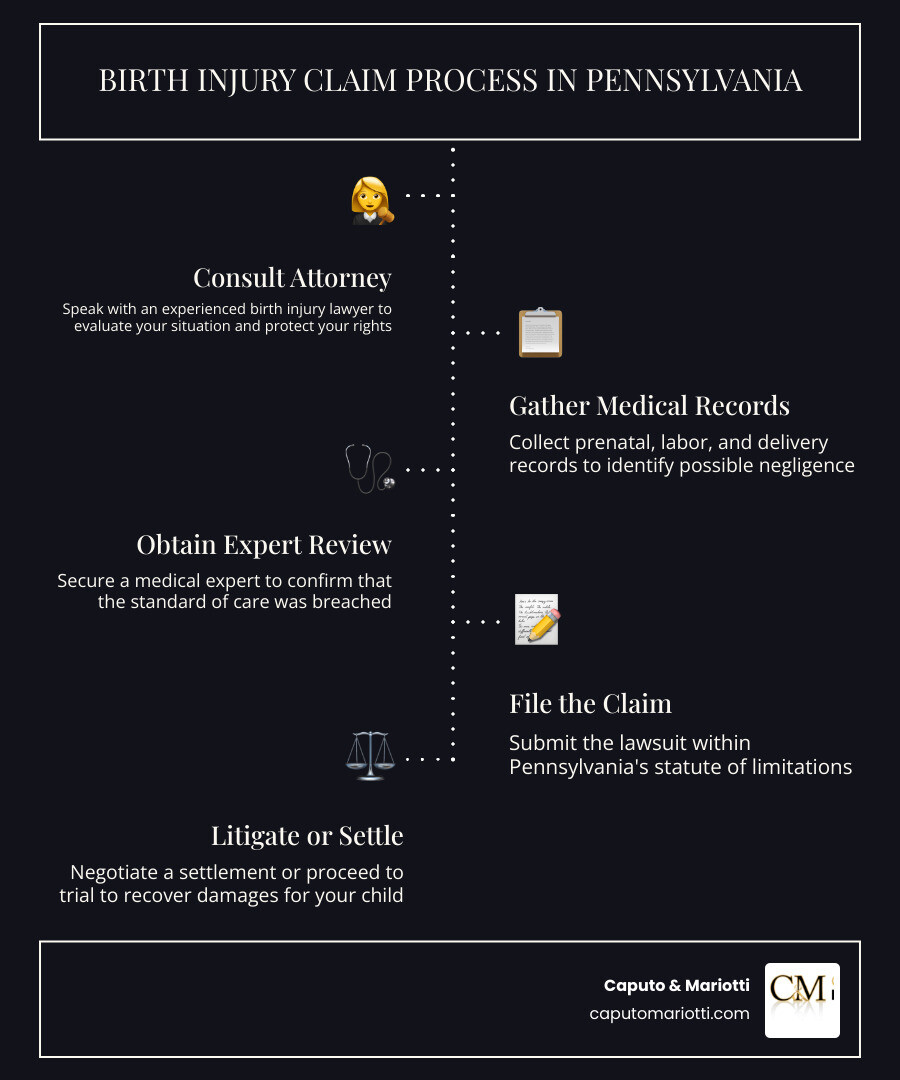
Understanding the Birth Injury Lawsuit Process Things You Need to Know is essential for parents who are already exhausted by the demands of caring for an injured newborn.

Recovering Compensation for Your Child
The financial impact of a birth injury can be staggering. When we file a claim in the Category Birth Injury, we look at two main types of damages:
Economic Damages (Measurable Financial Losses):
- Medical Expenses: Past, current, and future hospital stays, surgeries, and medications.
- Future Care: Costs for long-term rehabilitation, physical therapy, and 24/7 nursing care.
- Lost Earning Capacity: If the injury prevents the child from ever being able to work as an adult.
- Home Modifications: Installing ramps, widening doors, or adding specialized equipment for a child with mobility issues.
Non-Economic Damages (Intangible Losses):
- Pain and Suffering: The physical and mental anguish the child endures.
- Loss of Life’s Pleasures: The inability to enjoy activities and milestones that a healthy child would experience.
- Emotional Distress: The trauma experienced by both the child and the parents.
Pennsylvania is unique because it does not cap these damages in medical malpractice cases. This means if a jury determines your child needs $20 million for lifetime care, that is what they can be awarded.
Pennsylvania Statute of Limitations and the Discovery Rule
Timing is everything in a birth injury claim in Pennsylvania. If you wait too long, you lose your right to sue forever. Generally, the statute of limitations for medical malpractice in PA is two years. However, when it comes to children, the rules are much more generous.
Under the Minor Tolling Rule, the two-year “clock” for a child’s injury does not start until they turn 18. This effectively gives the child until their 20th birthday to file a lawsuit.
However, parents have their own separate claims (for the medical bills they paid while the child was a minor), and those usually must be filed within two years of the injury. This is why consulting a Scranton Birth Injury Lawyer immediately is so important.
Filing Deadlines for a Birth Injury Claim in Pennsylvania
The Discovery Rule also plays a major role. Sometimes, a birth injury isn’t obvious the day the baby is born. You might not realize something is wrong until the child misses developmental milestones like crawling or speaking at age two or three. In these cases, the two-year clock may not start until the parents “discovered” (or reasonably should have discovered) the injury.
It’s also worth noting that in 2019, the Pennsylvania Supreme Court overturned the “statute of repose,” which previously put an absolute seven-year limit on filing medical malpractice claims. This was a huge win for families, as it ensures that even injuries that take years to manifest can still be litigated.
Frequently Asked Questions
How long does a birth injury lawsuit take to resolve in Pennsylvania?
On average, these cases take between 2 to 4 years to resolve. Because the stakes are so high and the medical evidence is so dense, the “discovery phase”—where both sides exchange documents and depose experts—can take a long time. While many cases settle before trial, we prepare every case as if it is going before a jury to ensure we have the strongest possible leverage.
What is the average settlement for a birth injury in PA?
There is no “average” because every injury is unique. However, because Pennsylvania has no damage caps, settlements and verdicts can be very high. We have seen cases involving severe brain damage result in multi-million dollar awards to cover a lifetime of specialized care. The value of your case depends on the severity of the injury, the clarity of the negligence, and the projected lifetime costs for the child.
Why is it important to consult a birth injury lawyer early?
Evidence disappears. Medical records can be lost, and the memories of hospital staff fade over time. By hiring a lawyer early, we can:
- Immediately secure all medical records from the pregnancy and delivery.
- Identify and interview witnesses while the events are fresh.
- Consult with top-tier medical experts to verify the claim.
- Ensure all filing deadlines (statutes of limitations) are met.
Conclusion
At Caputo & Mariotti, we bring over 55 years of combined experience to every case we handle in Northeastern Pennsylvania. We understand that a birth injury isn’t just a legal case; it’s a family tragedy that requires compassion, dedication, and an unwavering commitment to justice. We serve families in Scranton, Wilkes-Barre, Hazleton, and throughout Lackawanna and Luzerne Counties.
If you are struggling with the aftermath of a difficult delivery, you don’t have to face it alone. We will handle the medical treatment reviews, evidence gathering, and complex filing procedures so you can focus on your child.
Contact us for a consultation to discuss your Personal injury support and Birth injury legal help.
For those facing workplace injuries, a workers’ compensation lawyer can explain the no-fault system, reporting requirements, and the importance of gathering evidence such as witness statements and medical records to support your claim through the filing and appeals process. We are here to ensure your family’s future is protected.