

The dedicated legal team of Caputo & Mariotti
Can Family Sue for Wrongful Death in Pennsylvania?
August 14, 2026
When a Family Loses Someone: Can Family Sue for Wrongful Death in Pennsylvania?
Can family sue for wrongful death in Pennsylvania? Yes — but only certain family members have the legal right to do so, and the process must follow strict rules under Pennsylvania law.
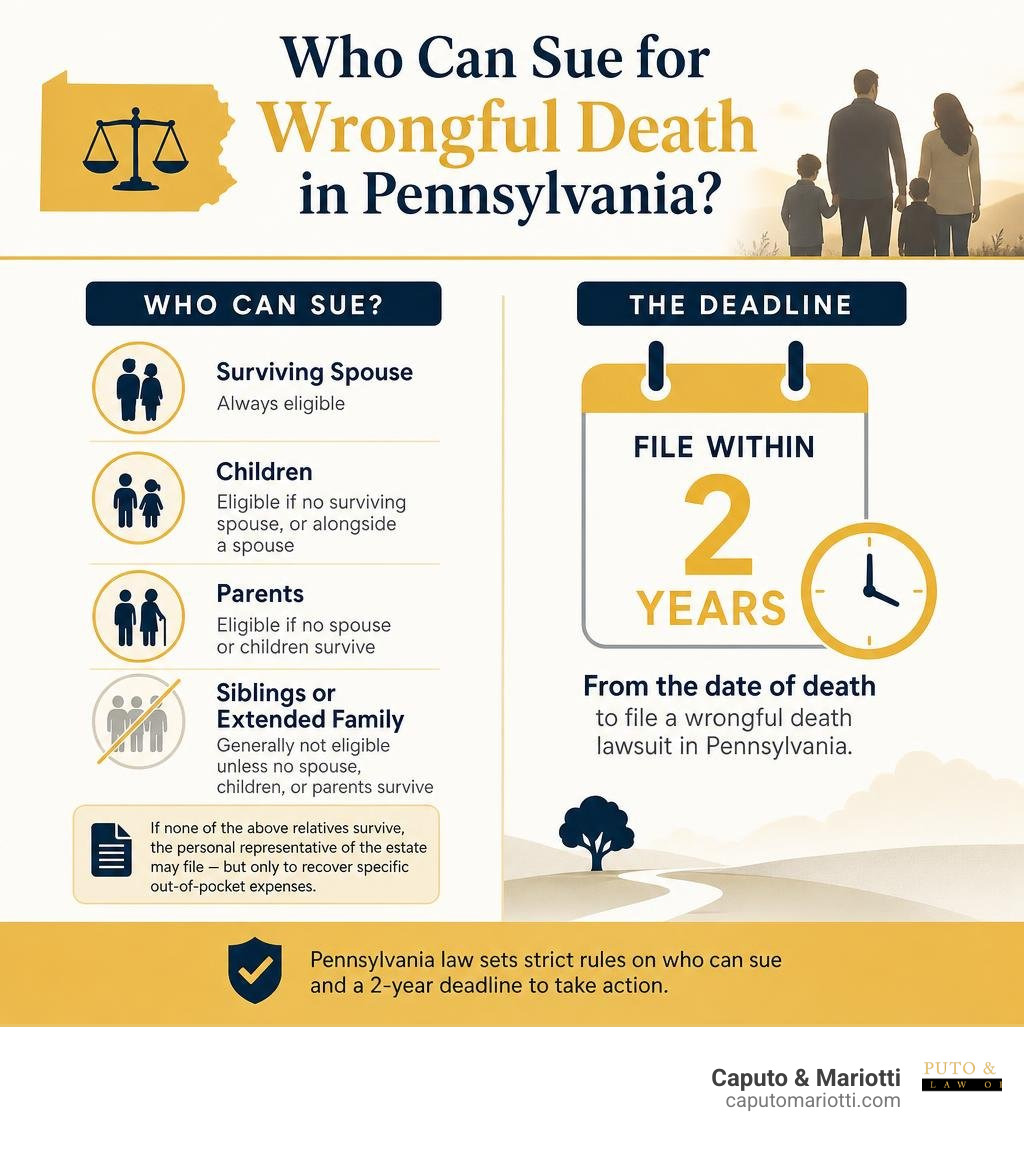
Here is a quick answer to who qualifies:
- Surviving spouse — always eligible
- Children (including adopted children) — eligible if the decedent has no surviving spouse, or alongside a spouse
- Parents — eligible if no spouse or children survive
- Siblings or extended family — generally not eligible unless no spouse, children, or parents survive
Pennsylvania’s Wrongful Death Act, 42 Pa. Cons. Stat. § 8301, limits who can recover damages. If none of the above relatives survive, the personal representative of the estate may file — but only to recover specific out-of-pocket expenses.
Losing a loved one to someone else’s negligence is devastating. On top of the grief, families suddenly face unfamiliar legal questions, tight deadlines, and insurance companies that are rarely on their side. Understanding your rights early can make a real difference in what your family is able to recover.
I’m Chris Caputo. As a Pennsylvania personal injury and wrongful death attorney with decades of litigation experience — including years as a prosecutor handling serious felony cases before dedicating my practice to representing injured individuals and grieving families — I have guided many Pennsylvania families through exactly these questions about can family sue for wrongful death in Pennsylvania. The sections below walk you through everything you need to know.
How Can Family Sue for Wrongful Death Pennsylvania?
To pursue a civil claim for wrongful death in Pennsylvania, the family must establish legal standing and prove that the death was caused by the “wrongful act, neglect, unlawful violence or negligence” of another party.
A wrongful death claim is entirely separate from any criminal proceedings. If someone causes a fatal accident, they may face criminal charges brought by the commonwealth. However, a criminal case focuses on punishment (such as jail time or fines paid to the state), whereas a wrongful death lawsuit is a civil action designed to provide financial compensation directly to the grieving family.
Because it is a civil case, the burden of proof is different. In a criminal trial, the prosecutor must prove guilt “beyond a reasonable doubt.” In a civil wrongful death lawsuit, we must prove liability by a “preponderance of the evidence.” This means we must show that it is more likely than not that the defendant’s negligent actions directly caused your loved one’s death.
Who in the Family Can Sue for Wrongful Death Pennsylvania?
While many relatives feel the deep pain of a loss, Pennsylvania law strictly limits who can actually receive compensation from a wrongful death claim. Under 42 Pa. Cons. Stat. § 8301, the statutory beneficiaries are limited to:
- The Surviving Spouse: A husband or wife has the primary right to recover damages. However, Pennsylvania does not recognize common-law marriages established after January 1, 2005. The marriage must be legally valid.
- Surviving Children: This includes biological and legally adopted children. Minor children are legally presumed to be dependent on their parents, but adult children can also recover if they can demonstrate a pecuniary (financial) loss or loss of services and guidance.
- Surviving Parents: If the deceased person had no spouse or children, the parents are the next in line to recover.
To recover damages in a Pennsylvania wrongful death claim, these beneficiaries must demonstrate a “pecuniary loss.” This means showing they had a reasonable expectation of financial support, services, companionship, or guidance from the deceased. Stepchildren do not automatically qualify under the law unless they were legally adopted by the decedent.
The Role of the Personal Representative in Pennsylvania Death Actions
One of the most common misconceptions is that any family member can walk into a courthouse and file a lawsuit. Under 231 Pa. Code Chapter 2200, the lawsuit must be brought by the personal representative of the deceased person’s estate.
The personal representative is the executor named in the deceased person’s will, or the administrator appointed by the Register of Wills (in Lackawanna County, Luzerne County, or other local counties) if there is no will.
Here is how the timeline works for filing:
- First Six Months: For the first six months after the date of death, only the personal representative of the estate has the legal standing to file the wrongful death lawsuit.
- After Six Months: If the personal representative has not filed a lawsuit within six months, any entitled beneficiary (spouse, child, or parent) may step forward and file the action as a “trustee ad litem” on behalf of all eligible beneficiaries.
Understanding these procedural hurdles highlights the difference between a wrongful death lawyer and a personal injury attorney. A wrongful death attorney must navigate probate rules, estate administration, and complex distribution laws to ensure the lawsuit is filed correctly.
Wrongful Death Actions vs. Survival Actions in Pennsylvania
When a fatal accident occurs in Northeastern Pennsylvania, we typically file two separate legal claims within the same lawsuit: a wrongful death action and a survival action. While they arise from the same tragedy, they serve entirely different purposes, compensate different losses, and distribute funds to different parties.
| Feature | Wrongful Death Action (42 Pa. C.S. § 8301) | Survival Action (42 Pa. C.S. § 8302) |
|---|---|---|
| Whose Perspective? | Compensates the surviving family members for their losses. | Continues the legal claim the deceased could have filed if they survived. |
| Primary Damages | Lost financial support, funeral costs, loss of companionship/guidance. | Pain and suffering before death, medical bills, lost wages before death. |
| Where the Money Goes | Directly to eligible beneficiaries (spouse, children, parents). | Directly into the deceased’s estate. |
| Subject to Estate Creditors? | No. Protected from the deceased’s personal debts. | Yes. Creditors can claim these funds during probate. |
| Subject to Inheritance Tax? | No. | Yes. Subject to PA inheritance and estate taxes. |
Key Differences in Damages and Beneficiaries
The damages in a wrongful death action focus on the hole left in the family’s life. This includes economic damages like lost financial contributions and the value of household services, as well as non-economic damages like the loss of companionship, comfort, and consortium.
By contrast, a survival action (authorized under 42 Pa. C.S. § 8302) is a continuation of the victim’s personal injury claim. If a person survived for even a few minutes or hours after a motorcycle accident or a workplace injury, the estate can recover damages for the physical pain, mental suffering, and medical expenses incurred during that window. For more on how these catastrophic claims interact, see our guide on navigating the legal maze catastrophic injuries and wrongful death in personal injury law.
Because survival action damages pass through the estate, they are subject to inheritance taxes and can be used to pay off the deceased’s debts. This is why experienced legal representation is vital; we must carefully allocate settlement funds between the wrongful death and survival portions of a claim to maximize the amount that safely reaches the family.

How Prior Personal Injury Claims Affect a Death Lawsuit
If your loved one filed a personal injury lawsuit before they passed away, it has a direct impact on a subsequent wrongful death claim. Under Pennsylvania law, a family cannot recover twice for the exact same negligent act.
If the deceased person settled their personal injury claim or received a court verdict during their lifetime, a wrongful death action is generally barred. However, if the personal injury lawsuit was still pending at the time of death, the action must be consolidated and converted into a survival action, which can then be joined with a new wrongful death claim. Managing these overlapping timelines is highly complex, and several odds and ends factors affecting your chances of winning a wrongful death suit will depend on how the initial injury claim was documented.
Distribution of Proceeds and the Statute of Limitations in Pennsylvania

Once a settlement or verdict is reached, the distribution of wrongful death proceeds must follow strict legal guidelines. Unlike standard personal injury settlements, wrongful death allocations require court approval to ensure all statutory beneficiaries are treated fairly, especially when minor children are involved.
Pennsylvania Intestacy Laws and Settlement Allocation
Under Pennsylvania law, wrongful death proceeds are distributed in the same proportions as an estate would be divided if the deceased died without a will (intestate succession).
The distribution rules can be complex:
- Spouse and No Children/Parents: The spouse receives 100% of the recovery.
- Spouse and Surviving Parents (No Children): The spouse receives the first $30,000, plus one-half of the remaining balance. The parents split the rest.
- Spouse and Children: The spouse receives the first $30,000, plus one-half of the remaining balance. The children split the remaining half evenly.
- Children and No Spouse: The children split the recovery evenly.
If a minor child is entitled to a portion of the settlement, the court will require the funds to be placed into a restricted, safe account or a structured settlement trust until the child reaches adulthood. If you lost a loved one in a serious accident, such as a motorcycle crash, you can read more about seeking justice your rights in a motorcycle wrongful death case.
What Happens If There Are No Eligible Beneficiaries?
If the deceased person leaves behind no surviving spouse, children, or parents, a wrongful death claim cannot be brought in Pennsylvania for general damages like loss of companionship.
However, the personal representative of the estate can still file a claim to recover specific out-of-pocket expenses. These include:
- Reasonable hospital, nursing, and medical bills related to the final injury.
- Funeral and burial expenses.
- The administrative expenses of opening and managing the estate.
In these situations, the recovered funds go directly to the estate to cover these debts. If your loved one passed away due to neglect in a care facility, you may want to consult our resources on protecting elders finding a nursing home wrongful death attorney.
When Can Family Sue for Wrongful Death Pennsylvania?
In Pennsylvania, the statute of limitations for filing a wrongful death claim is strictly two years from the date of death (42 Pa.C.S. § 5524).
As we write this in July 2026, if a fatal accident occurred on July 15, 2024, the absolute deadline to file a lawsuit in court is July 15, 2026. If you miss this deadline by even a single day, the court will almost certainly dismiss your case, and you will lose your right to seek compensation.
While two years may seem like a long time, building a strong personal injury or wrongful death case requires extensive preparation, including:
- Securing accident reports, medical records, and physical evidence.
- Interviewing witnesses while their memories are fresh.
- Hiring reconstruction experts or medical specialists to prove negligence.
- Opening the estate and having a personal representative formally appointed.
Waiting until the last minute severely limits your attorney’s ability to build a strong case and negotiate effectively with insurance companies.
Exceptions and Tolling of the Two-Year Deadline
While the two-year deadline is strictly enforced, there are rare exceptions where the statute of limitations may be extended or “tolled”:
- The Discovery Rule: If the cause of death was not immediately knowable due to hidden factors, the clock may start when the family reasonably should have discovered the negligence.
- Fraudulent Concealment: If the negligent party actively hid their wrongdoing or misrepresented the cause of death, the court may pause the timeline.
- Minor Plaintiffs: If the sole beneficiary is a minor child, the clock may be paused until they reach the age of 18.
Additionally, if a government entity (such as a local township, Luzerne County, or a state agency) is responsible for the death, you must file a formal notice of claim within six months of the incident. Failing to file this notice can bar your lawsuit entirely, even if you are well within the two-year wrongful death deadline.
Frequently Asked Questions about Pennsylvania Wrongful Death Law

Navigating the aftermath of a loss brings up many difficult questions. Below are answers to some of the most common questions families ask us.
Can siblings or grandparents sue for wrongful death in Pennsylvania?
Generally, no. Under Pennsylvania’s strict statutory list, siblings, grandparents, aunts, and uncles do not have standing to recover wrongful death damages.
The only exception is if a sibling or grandparent was legally appointed as the personal representative of the estate, and even then, they can only sue to recover the estate’s direct out-of-pocket expenses (like medical and funeral bills) unless they can prove they were legal guardians or stood in loco parentis to the deceased.
Are wrongful death settlements subject to estate taxes or creditors?
No. Because wrongful death damages are paid directly to the surviving beneficiaries to compensate them for their personal loss, these funds do not belong to the deceased person’s estate. Therefore, they are entirely protected from the deceased’s personal creditors and are not subject to Pennsylvania inheritance tax.
However, any damages recovered under a survival action (such as pain and suffering experienced by the deceased before death) are paid to the estate, meaning they are subject to both estate taxes and outstanding debts.
Can a wrongful death claim arise from a workplace accident?
Yes. If your loved one was killed on the job, the family may be entitled to benefits. While the workers’ compensation system is generally a no-fault system that prevents you from suing the employer directly, you can still secure vital benefits.
To protect your rights, the family must navigate strict reporting requirements, document medical treatment, and gather key evidence such as witness statements, safety records, and official documentation. If a defective piece of machinery, a negligent subcontractor, or an unsafe third party caused the accident, you can file a third-party wrongful death lawsuit alongside your workers’ compensation claim to secure full compensation. If you need help navigating filing procedures, documentation, or legal appeals, speaking with an experienced workers’ compensation lawyer is essential.
Conclusion
Losing a loved one is a heavy burden to carry, and trying to handle a complex legal battle while grieving is something no family should have to face alone.
At Caputo & Mariotti, we bring more than 55 years of combined legal experience to every case. Our dedicated team serves families throughout Northeastern Pennsylvania — including Scranton, Wilkes-Barre, Moosic, Dickson City, Pittston, Hazleton, and across Lackawanna and Luzerne counties. We are deeply committed to securing justice and financial peace of mind for our clients.
If you have questions about whether your family can sue for wrongful death, we are here to help. Contact us today for a compassionate, risk-free consultation. We handle wrongful death cases on a contingency fee basis, meaning you pay nothing upfront, and we only get paid if we win your case.