

The dedicated legal team of Caputo & Mariotti
Understand IME Process and Rights: Beginner’s Guide to Pennsylvania
October 9, 2026
What to Do When a Pennsylvania Workers’ Comp IME Is Scheduled
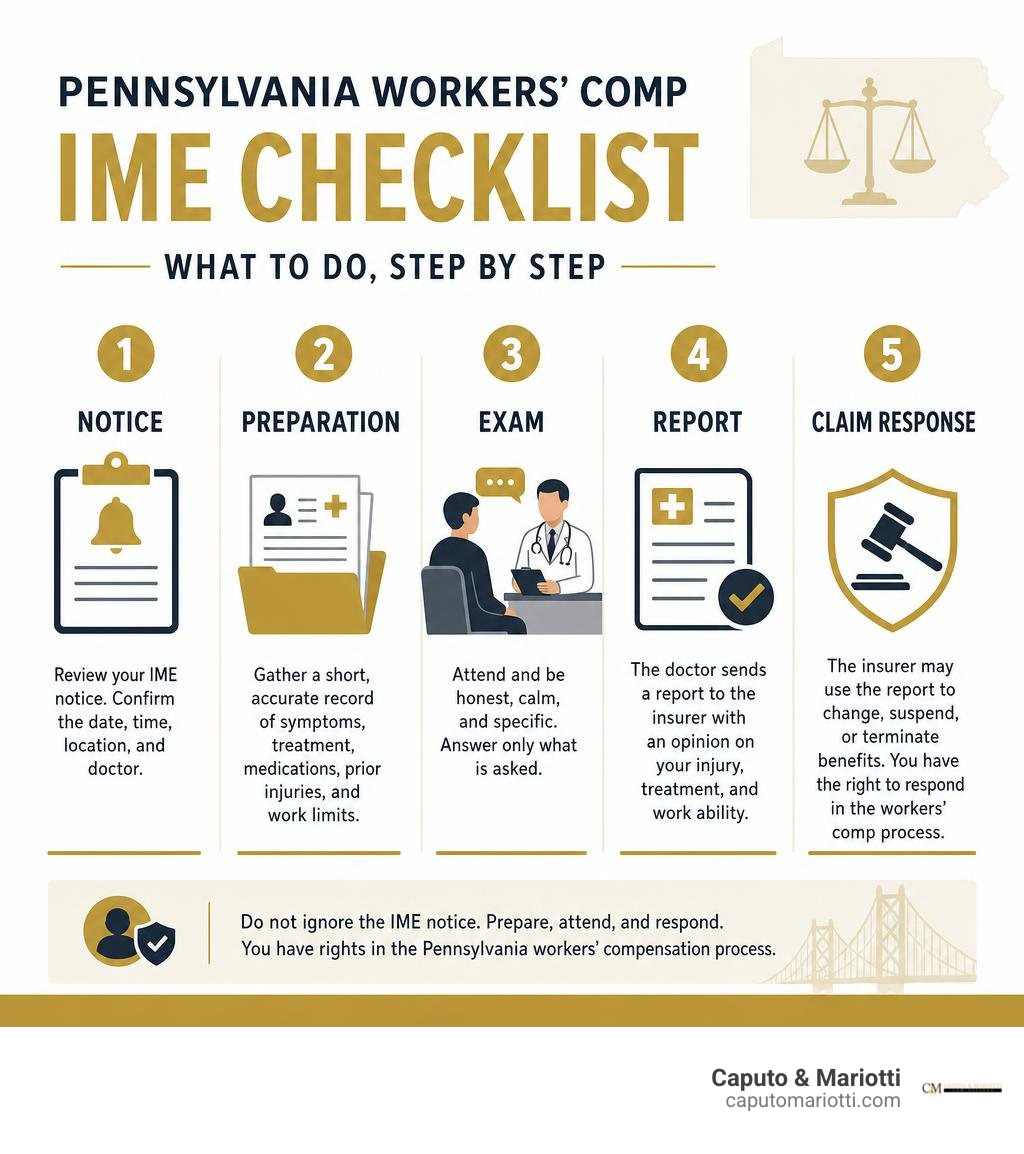
If you have an independent medical exam workers comp Pennsylvania appointment, do not ignore the notice. Confirm the date, time, location, and doctor; gather a short, accurate record of your symptoms, treatment, medications, prior injuries, and work limits; and attend unless you have legal advice to reschedule. Under Section 314 of the Pennsylvania Workers’ Compensation Act, an employer or insurer may request an exam at a reasonable time and place. Refusing without a valid reason can put your benefits at risk.
An IME doctor does not treat you. The insurer typically selects and pays the doctor to give an opinion about your work injury, medical care, restrictions, and ability to return to work. Be calm, honest, and specific. Do not exaggerate pain, minimize real limits, guess at answers, or hide a prior condition.
A negative IME report does not automatically end workers’ compensation benefits. The insurer may use it to seek a termination, suspension, or change in benefits, but it generally must prove its position in the workers’ compensation process.
I am Chris Caputo, a Pennsylvania attorney with decades of litigation experience representing people harmed by negligence and challenging insurance-company decisions. In an independent medical exam workers comp Pennsylvania case, I help injured people understand the notice, prepare factually, and respond when an insurer uses medical opinions to question a claim.
Independent Medical Exam Workers Comp Pennsylvania: Legal Framework, Reporting, and Medical Treatment
Understanding Pennsylvania’s workers’ compensation system requires recognizing how wage-loss and medical benefits operate. The system is designed as a mandatory no-fault structure. In exchange for prompt medical coverage and wage replacement without having to prove employer negligence, injured workers relinquish the right to sue employers in standard tort litigation.
Strict reporting rules apply. Under Pennsylvania law, you must report your workplace injury to your employer within 21 days to ensure full retroactivity of wage benefits, and no later than 120 days from the injury date to preserve your right to claim compensation. Following the injury, your employer may require you to treat with a panel physician from a designated list for the first 90 days. After this initial 90-day period, you have the statutory right to choose your own treating physicians and medical specialists.
As your recovery continues, medical evaluations serve as a core evidentiary foundation for ongoing benefits. To understand the broader impact of clinical evaluations on your claim, review the role of medical evaluations in workers’ compensation claims.
Under Section 314 of the Pennsylvania Workers’ Compensation Act, employers and their insurance carriers have the statutory right to request an evaluation by an outside physician. The stated purpose of an IME is to provide an objective, expert medical opinion regarding:
- The exact diagnosis and causal relationship between the injury and workplace duties
- The reasonableness and medical necessity of ongoing treatment
- The current degree of physical disability or functional impairment
- The worker’s capacity to return to modified, light-duty, or full-duty employment
While labeled “independent,” these evaluations carry structural bias. The physician is selected, scheduled, and compensated directly by the workers’ compensation insurance carrier. Many defense physicians derive significant income from performing insurance exams rather than maintaining an active clinical treatment practice. This financial relationship can incentivize findings that minimize injury severity or claim work capacity, a reality discussed in legal analyses such as The Unavoidable Bias of an Independent Medical Exam.
Differences Between an IME and an Impairment Rating Evaluation (IRE)
Injured workers often confuse an Independent Medical Examination (IME) with an Impairment Rating Evaluation (IRE). While both involve evaluations by non-treating physicians, their legal triggers, procedures, and statutory consequences differ significantly under the Pennsylvania Workers’ Compensation Act.
An IME can be requested at almost any reasonable point in a claim under Section 314 to assess treatment necessity, causation, or work capacity. In contrast, an IRE is governed strictly by Section 306(a)(2) of the Act. An insurer cannot demand an IRE until an injured worker has received 104 weeks of total disability benefits.
During an IRE, a state-designated physician evaluates the claimant using the American Medical Association (AMA) Guides to the Evaluation of Permanent Impairment to calculate a whole-body impairment percentage. Certified physicians performing these assessments are cataloged in the state’s official registry; you can review the Department of Labor and Industry IRE Physician Listing for designated evaluators across Lackawanna County, Luzerne County, and throughout Northeastern Pennsylvania.
If the calculated whole-body impairment rating falls below the statutory threshold (currently 35% under Act 111), the insurer can file to convert the claimant’s status from total disability to partial disability. This change places a strict 500-week cap on future wage-loss compensation, even if medical coverage remains ongoing.
| Feature / Standard | Independent Medical Examination (IME) | Impairment Rating Evaluation (IRE) |
|---|---|---|
| Statutory Authority | Section 314, PA Workers’ Comp Act | Section 306(a)(2), PA Workers’ Comp Act |
| Timing | Any reasonable point during claim | Only after 104 weeks of total disability |
| Examiner Selection | Insurer chooses and pays physician directly | Assigned via PA Department of Labor & Industry |
| Primary Objective | Assess causation, treatment, work ability | Calculate whole-body impairment percentage |
| Direct Legal Impact | May support Petitions to Terminate, Modify, or Suspend | Caps wage benefits at 500 weeks if below 35% |
Claimant Rights, Rules, and Attendance Obligations
Receipt of an IME notice establishes a legal duty to appear. Under Pennsylvania law, failing to attend a properly scheduled IME without reasonable cause allows the insurer to petition a Workers’ Compensation Judge (WCJ) to suspend wage-loss and medical payments until compliance occurs.
However, statutory attendance rules also impose obligations on insurers to protect claimant rights:
- Reasonable Scheduling: The appointment must be scheduled at a reasonable time, date, and geographic location. Claimants in Scranton, Wilkes-Barre, Hazleton, Pittston, Dickson City, and Moosic cannot be forced to travel unreasonable distances when qualified local physicians are available.
- Travel Reimbursement: The workers’ compensation carrier is required to reimburse the claimant for reasonable travel expenses, including mileage, tolls, and parking fees.
- Advance Notice: Notice must be delivered with sufficient time to allow scheduling and travel arrangements.
To understand the full scope of statutory protections during injury disputes, see our guide to navigating workers’ comp claim rights and employer duties.

Evidence Gathering, Documentation, and Preparing for the Exam
Preparation and structured evidence gathering are critical to ensure that your medical reality is accurately presented. Before the appointment:
- Gather Medical Records and Treatment History: Assemble and review your complete clinical records, including diagnostic imaging (MRIs, EMGs, X-rays), surgical reports, physical therapy progress notes, and medication logs.
- Document Current Symptoms and Daily Limitations: Prepare clear documentation detailing physical restrictions. Identify specific daily activities affected by your injury, such as sitting tolerance, standing limits, lifting capacity, and sleep disruption.
- Secure Witness Statements and Job Demands: Collect witness statements from co-workers who observed the incident or can testify to your physical limitations. Revisit your formal pre-injury job description and physical demands (heavy lifting, repetitive motion, overhead reaching) to demonstrate why your physical limitations prevent you from executing those duties.
- Account for Pre-Existing Conditions: If you experienced symptoms or injuries to the same body part prior to the work incident, prepare an honest explanation of how the work injury aggravated or worsened that baseline condition.
Maintaining clinical consistency between your statements, witness accounts, and treating provider records prevents defense attorneys from alleging credibility issues. For broader context on procedural timelines, review our step-by-step guide to navigating injury claims.
Protecting Your Privacy and Addressing Duplicative Examinations
Claimants are entitled to protect their privacy during the IME process:
- Support Person Attendance: You may bring a trusted friend or family member to the examination to serve as a witness and take notes regarding appointment start and end times, specific physical tests performed, and questions asked by the physician.
- Contemporaneous Note-Taking: Immediately following the exam, record every detail while fresh in your memory, including how long the physical examination lasted and which body parts the physician touched or measured.
Insurers may sometimes subject claimants to frequent, harassing, or duplicative medical exams. Pennsylvania courts limit repetitive examinations without demonstrated justification. In Driscoll v. Walker, the Lackawanna County Court of Common Pleas addressed redundant examinations, emphasizing that multiple exams require a heightened showing of good cause—such as a new or concealed injury—and reinforcing the consolidation of exams to protect claimant privacy and promote judicial economy. You can review the judicial analysis in Driscoll v. Walker judicial limits on multiple exams.

What Happens During the Exam and Key Pitfalls
An IME visit typically consists of three stages: intake paperwork, a clinical interview, and a physical assessment.
Upon arrival, you will complete intake questionnaires regarding your accident history, medical background, current symptoms, and work requirements. Complete these forms carefully and accurately; defense counsel routinely compare these intake sheets against your deposition testimony.
During the clinical interview, the doctor will review how the injury occurred, past medical interventions, and current limitations. Following the interview, the physician conducts physical mobility testing, which may include range-of-motion assessments, reflex checks, straight-leg raise tests, and localized palpation.
That evaluation begins the moment you enter the facility parking lot. IME physicians and clinic staff routinely observe claimants walking into the clinic, sitting in waiting areas, removing shoes or coats, and climbing onto examination tables to cross-reference these organic movements against formal range-of-motion testing.

Crucial Mistakes to Avoid at an Independent Medical Exam Workers Comp Pennsylvania
Small missteps during an IME can compromise legitimate workers’ compensation benefits. Avoid these common errors:
- Exaggerating Symptoms or Pain Levels: Dramatic displays, groaning without stimulus, or claiming constant “10 out of 10” pain while conversing calmly will be documented as symptom magnification or non-organic behavioral responses (such as positive Waddell signs).
- Minimizing Pain Out of Politeness: Trying to appear stoic by downplaying symptoms or stating you are “fine” can result in a report claiming full recovery.
- Guessing or Speculating: If you do not recall a specific date, medication dosage, or medical detail, state that you do not recall rather than guessing.
- Arguing with the Examiner: Maintain a polite, professional demeanor. Do not debate legal liability or express frustration about your employer or insurer.
- Concealing Prior Medical Issues: Failing to disclose prior injuries gives the insurer grounds to attack your credibility. Disclose prior conditions and explain how the workplace incident worsened your baseline functionality.
Clearing up common misunderstandings early helps safeguard your rights; see our breakdown of common misconceptions about workers’ comp claims.
Next Steps After Receiving the IME Medical Report: Filing Procedures and Legal Appeals
Following the evaluation, the examiner prepares a comprehensive narrative report and forwards it to the insurance carrier. The findings generally fall into three categories:
- Full Recovery: The examiner states that the work-related injury has fully resolved and that no ongoing medical care or work restrictions are necessary.
- Partial Recovery / Light Duty Capacity: The doctor concludes that while the worker is not fully healed, they possess functional capacity to perform sedentary, modified, or light-duty work.
- Ongoing Disability: The physician agrees with the treating doctor that the employee remains totally disabled and requires ongoing medical management.
Filing Procedures, Dispute Litigation, and the Appeals Process
If the report alleges full recovery, the insurer will likely file a Petition to Terminate benefits. If the report alleges partial capacity, the insurer may issue a Notice of Ability to Return to Work (Form LIBC-757) and file a Petition to Modify or Suspend compensation. Similarly, if an employer denies a claim initially, the claimant must initiate the filing process by submitting a formal Claim Petition (Form LIBC-362) with the Bureau of Workers’ Compensation within the statutory three-year filing window.
When petitions are filed, the dispute proceeds to formal litigation before an assigned Workers’ Compensation Judge (WCJ). The insurer’s IME report does not automatically dictate the outcome. To protect your claim, our legal team gathers rebuttal evidence, deposes your treating physicians, introduces witness testimony and medical documentation, and conducts cross-examinations of the defense medical expert.
If a WCJ issues an adverse ruling, the Act provides a multi-tiered legal appeals process. You have the right to appeal the decision to the Workers’ Compensation Appeal Board (WCAB) within 20 days of the decision date. If the WCAB upholds an unfavorable determination, further appellate review may be sought before the Commonwealth Court of Pennsylvania and ultimately the Supreme Court of Pennsylvania. If you are confronting an unfavorable report, review our strategies for handling disputed benefits and denied workers’ comp claims.
Frequently Asked Questions About Pennsylvania Workers’ Comp IMEs
Can the Insurance Carrier Stop My Benefits Immediately After a Negative IME?
No. An insurer cannot unilaterally stop or reduce ongoing wage-loss benefits simply because it received an unfavorable IME report. Under Pennsylvania law, the insurer must file a formal petition (such as a Termination, Suspension, or Modification Petition) with the Bureau of Workers’ Compensation.
Benefits must continue uninterrupted until a Workers’ Compensation Judge issues an interlocutory or final order authorizing modification or termination, or until the parties execute a formal written agreement. Claimants receive formal notice through the state’s Workers’ Compensation Automation and Integration System (WCAIS) and retain the right to contest the insurer’s claims through legal hearings.
How Often Can an Insurer Demand an IME in Pennsylvania?
Under Section 314 guidelines, an employer or insurer is generally permitted to require an injured worker to submit to an examination no more than once every six months.
If an insurer attempts to schedule exams more frequently without establishing good cause—such as major intervening surgery, new distinct injuries, or significant changes in physical condition—a claimant can challenge the scheduling notice. The insurer must then file a Petition to Compel Physical Examination before a Workers’ Compensation Judge, who will decide whether the requested exam is reasonable.
Can I Sue an Employer or Third Party Outside of Workers’ Comp?
The Pennsylvania Workers’ Compensation Act provides the exclusive remedy against direct employers and co-workers for injuries occurring within the course and scope of employment. However, if your workplace injury was caused by a negligent third party (such as a reckless driver during a delivery run, a negligent property owner, or the manufacturer of defective industrial machinery), you may pursue a third-party personal injury lawsuit alongside your workers’ compensation claim. For a detailed legal explanation, read our analysis on suing an employer or third party in Pennsylvania.
Conclusion
An independent medical examination is a critical juncture in any workers’ compensation claim. Approaching the appointment with organized medical records, clear documentation of your symptoms and work restrictions, and a factual, honest presentation protects your credibility and benefits.
At Caputo & Mariotti, our attorneys bring over 55 years of combined legal experience to personal injury, medical malpractice, and workers’ compensation litigation across Northeastern Pennsylvania, including Lackawanna County, Luzerne County, Scranton, Wilkes-Barre, and surrounding communities. If your employer or insurer has scheduled an evaluation or filed a petition against your benefits, consult a knowledgeable workers’ compensation lawyer promptly.
To safeguard your rights and secure the compensation you deserve, schedule a free consultation with an experienced workers’ compensation lawyer at Caputo & Mariotti today.
