

The dedicated legal team of Caputo & Mariotti
Workers Comp Denied Claim Pennsylvania: Survival Guide
October 19, 2026
What to Do After a Pennsylvania Workers’ Comp Claim Denial
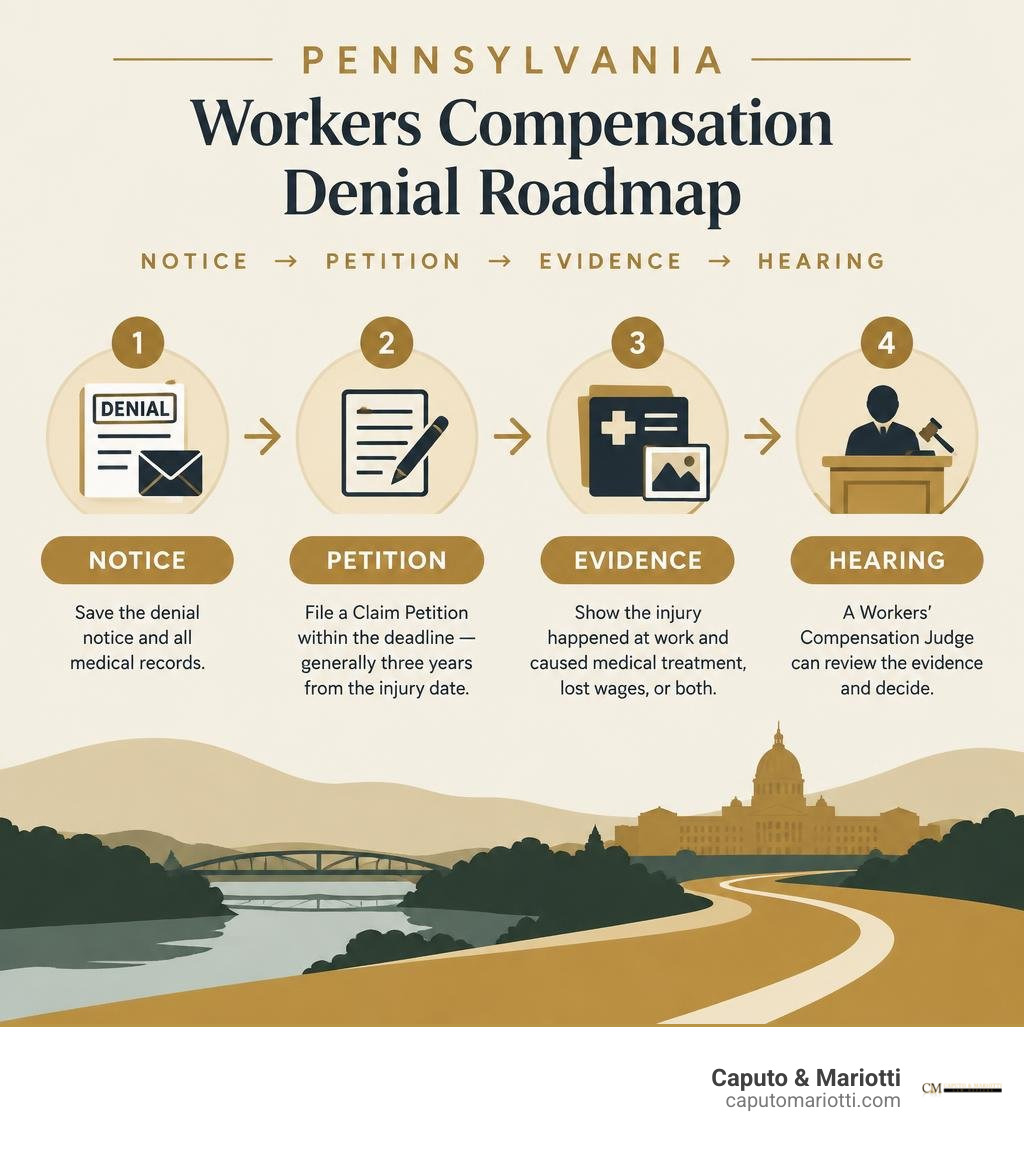
If your Pennsylvania workers’ compensation claim was denied, do not assume the decision is final. Protect your rights by:
- Saving the denial notice and all medical records.
- Reporting the injury in writing if you have not already done so.
- Filing a Claim Petition with the Pennsylvania Bureau of Workers’ Compensation within the applicable deadline – generally, three years from the injury date.
- Preparing evidence that the injury happened at work and caused medical treatment, lost wages, or both.
A denial may claim that the injury was not work-related, that you did not give timely notice, or that you did not miss work. But a denial is the insurer’s position, not a judge’s ruling. A Workers’ Compensation Judge can review the evidence and decide whether benefits are owed.
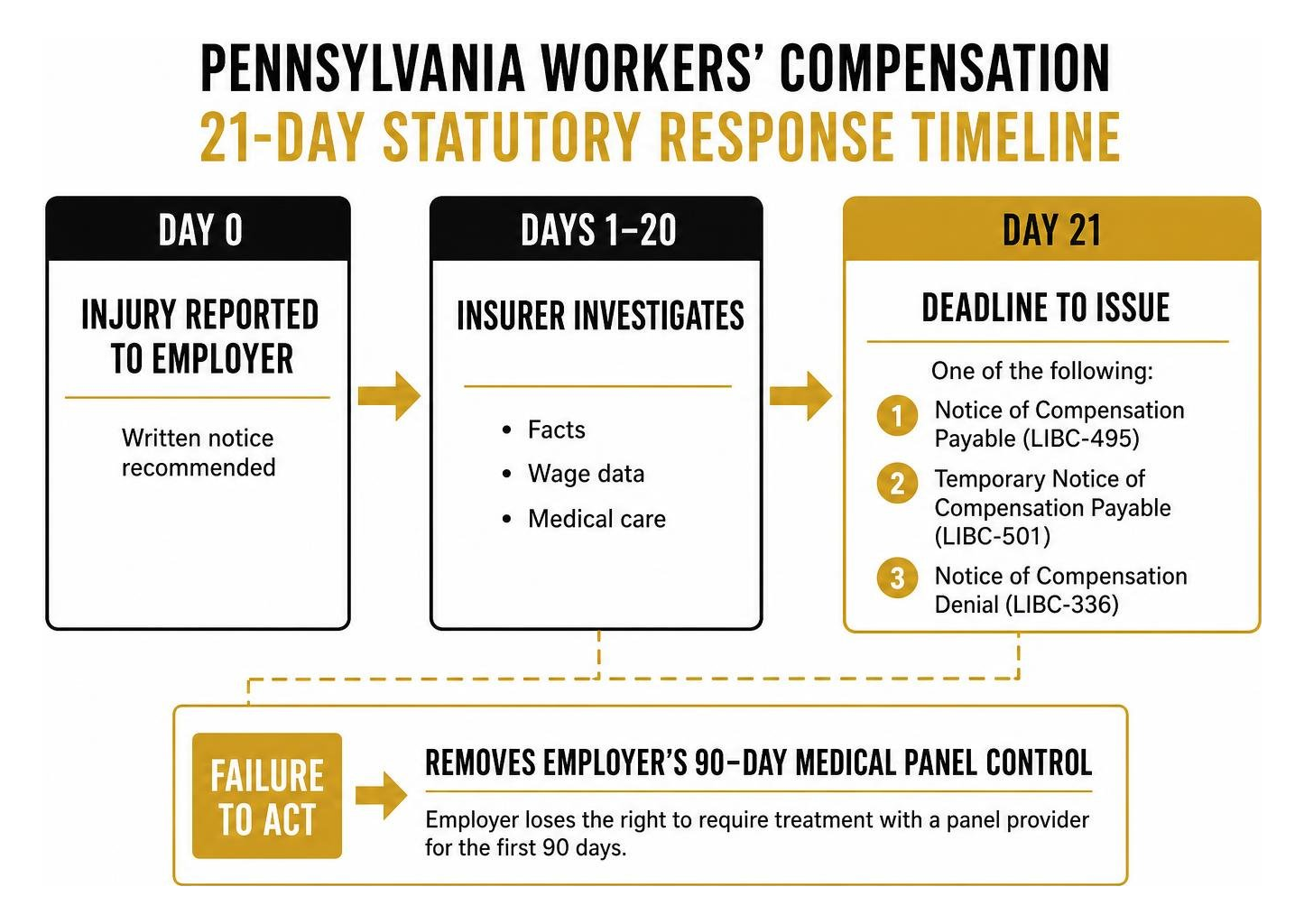
Employers and insurers generally have 21 days after learning of an injury to accept the claim, temporarily accept it, or issue a Notice of Compensation Denial. Missing that deadline can affect the employer’s control over medical treatment, even though it does not automatically resolve every benefit dispute.
I am Chris Caputo, a Pennsylvania attorney with decades of courtroom and insurance-dispute experience, including cases involving insurers that improperly deny claims. If you are facing a workers comp denied claim Pennsylvania dispute, this guide explains the key forms, deadlines, and next steps before your rights expire. Navigating a dispute also requires understanding whether an employer can fire you while on workers’ comp in Pennsylvania and reviewing the standard process for how to file a workers’ comp claim in Pennsylvania to protect your full legal recovery.
Understanding Your Denial Notice and Employer Deadlines
Pennsylvania operates under a no-fault workers’ compensation framework designed to provide prompt medical and wage-loss support to injured workers regardless of who caused the accident. In exchange for this protection, workers give up the right to sue employers directly in ordinary negligence lawsuits. However, the system requires strict adherence to statutory timelines and formal paperwork by both sides.
Under Section 406.1 of the Pennsylvania Workers’ Compensation Act, your employer and their insurance carrier have strict statutory obligations once you report an injury. The insurer has a 21-day decision window from the date of notice or knowledge of your injury to take one of three specific actions:
- Issue a Notice of Compensation Payable (LIBC-495) accepting liability for the injury.
- Issue a Temporary Notice of Compensation Payable (LIBC-501) agreeing to pay wage loss or medical benefits for up to 90 days while investigating.
- Issue a formal NOTICE OF WORKERS’ COMPENSATION DENIAL (Form LIBC-336) refusing to pay benefits.
When employers or insurers miss this 21-day deadline, significant legal consequences follow. Most notably, under Section 306(f.1) of the Act, an employer forfeits its statutory right to control initial medical treatment. Normally, an employer who provides a compliant designated panel list of physicians can require an injured worker to treat with a panel provider for the first 90 days. If the employer fails to issue an acceptance or a formal denial within 21 days, that 90-day provider restriction evaporates, allowing you to treat immediately with any licensed medical doctor of your choice.
Understanding Form LIBC-336 in a Workers Comp Denied Claim Pennsylvania
Form LIBC-336, officially titled the Notice of Compensation Denial, is the standard document insurers use to reject a claim. The form is filed electronically by the insurer through the Pennsylvania Department of Labor & Industry’s Workers’ Compensation Automation and Integration System (WCAIS) and served on you and your legal counsel.
Understanding how to fill out Pennsylvania Form LIBC-336 helps demystify the checkboxes the adjuster selected. On the form, the insurance carrier must indicate the legal rationale behind the rejection by checking one or more specific boxes:
- No Injury Occurred: Alleging no physical or psychological injury happened.
- Injury Not in Course and Scope of Employment: Claiming the injury occurred outside job duties or off company premises during non-work hours.
- No Disability (Wage Loss): Acknowledging an injury occurred but asserting it did not cause a loss of earnings beyond the statutory seven-day waiting period.
- Lack of Timely Notice: Alleging you failed to notify your employer within the required 120-day window under Section 311 of the Act.
- Not an Employee: Claiming you were an independent contractor, casual worker, or otherwise excluded from coverage.
- “Other” Grounds: Requiring a written explanation narrative detailing non-standard factual or legal reasons.
Vague or boilerplate narratives in the “Other” block can expose insurers to severe litigation setbacks. Knowing how these administrative filings function is essential when navigating workers compensation from filing claims to resolving delays.
Full Denial vs. Medical-Only Denial
Not all denials eliminate every benefit. Insurance carriers frequently issue partial denials or handle claims as “medical-only” depending on the severity of the injury and lost work time.
| Feature | Full Claim Denial (Form LIBC-336) | Medical-Only Acceptance (Form LIBC-495 or LIBC-501) | Medical Treatment Denial |
|---|---|---|---|
| Wage-Loss Benefits | Denied completely | Denied / Not paid (no disability established) | Unaffected if wage-loss was already accepted |
| Medical Expenses | Denied completely; insurer pays $0 | Insurer pays reasonable, related medical bills | Insurer refuses specific tests, procedures, or prescriptions |
| Employer Liability | Fully contested | Injury accepted; work-related causation admitted | Liability admitted, but medical necessity contested |
| Worker’s Remedy | File Form LIBC-362 Claim Petition | File Claim Petition for lost wages if work is missed | File Form LIBC-344 / Penalty / Review Petition |
When an insurer acknowledges that an injury occurred on the job but refuses to pay for specialized surgeries, imaging, or physical therapy, you can challenge their decision. If you find your medical treatment denied, filing appropriate petitions before a Workers’ Compensation Judge allows you to establish the necessity of your care and enforce payment.
Common Reasons Insurers Reject Pennsylvania Work Injury Claims

Roughly 175,000 work injuries are reported annually in Pennsylvania, and nearly one in three claims is denied outright by insurance carriers. While some denials stem from genuine factual disputes, many arise from cost-containment measures by insurers looking to minimize exposure.
Common grounds insurers use to reject Pennsylvania work injury claims include:
- Course and Scope of Employment Disputes: Insurers frequently argue that the employee was engaged in horseplay, commuting (the “coming and going” rule), running personal errands, or violating positive work orders when injured.
- Pre-Existing Degenerative Conditions: Carriers routinely obtain medical records to argue that back, neck, shoulder, or knee problems are purely degenerative rather than caused or aggravated by workplace duties. Under Pennsylvania law, work-related aggravation of a pre-existing condition is fully compensable.
- Intoxication or Drug Use Defense: Under Section 301(a) of the Act, an insurer may deny benefits if the injury was caused by intentional self-infliction, illegal drug use, or intoxication. The burden of proof rests heavily on the employer to prove intoxication was the direct cause of the incident.
- Late Reporting: If notice of injury is not given within 120 days of the occurrence (or from when the worker should have known of the injury’s work-related nature), benefits are barred completely under Section 311.
- Independent Contractor Misclassification: Construction and transportation companies frequently mislabel employees as independent 1099 contractors to avoid paying workers’ compensation premiums.
Dispelling these carrier arguments begins by clearing up common misconceptions about workers compensation in northeastern pa.
Occupational Illness and Cumulative Trauma Defenses
Workplace injuries are not always sudden, catastrophic accidents like falls or machinery malfunctions. Many of the most debilitating conditions develop over months or years of repetitive motion or toxic exposure.
Repetitive stress injuries (such as carpal tunnel syndrome, tendinitis, and repetitive lumbar strain) and occupational diseases (such as silica exposure, chemical toxicity, and coal workers’ pneumoconiosis) face heightened scrutiny from claims adjusters.
Under Section 301(c)(2) of the Act, for an occupational disease to be compensable, disability or death must occur within 300 weeks after the last date of employment in an occupation involving the hazard. Furthermore, a Claim Petition must be filed within three years of the date disability begins.
Overcoming these defenses requires detailed workplace exposure logs, air-quality or ergonomic analyses, and unequivocal medical causation testimony. You can read more about navigating workers compensation for occupational diseases to see how complex disease claims are handled under Pennsylvania law.
Steps to Appeal a Workers Comp Denied Claim Pennsylvania
Receiving a Form LIBC-336 in the mail can feel discouraging, but it marks the start of the formal legal dispute, not the end of your benefits. By taking structured procedural steps, you can challenge the insurer’s denial effectively.

When taking action, follow these practical steps:
- Retain Qualified Legal Counsel: Retain an experienced workers’ compensation lawyer licensed in Pennsylvania to prepare your claim. The procedural and evidentiary rules before the Office of Adjudication are demanding, and defending insurers are represented by experienced defense counsel.
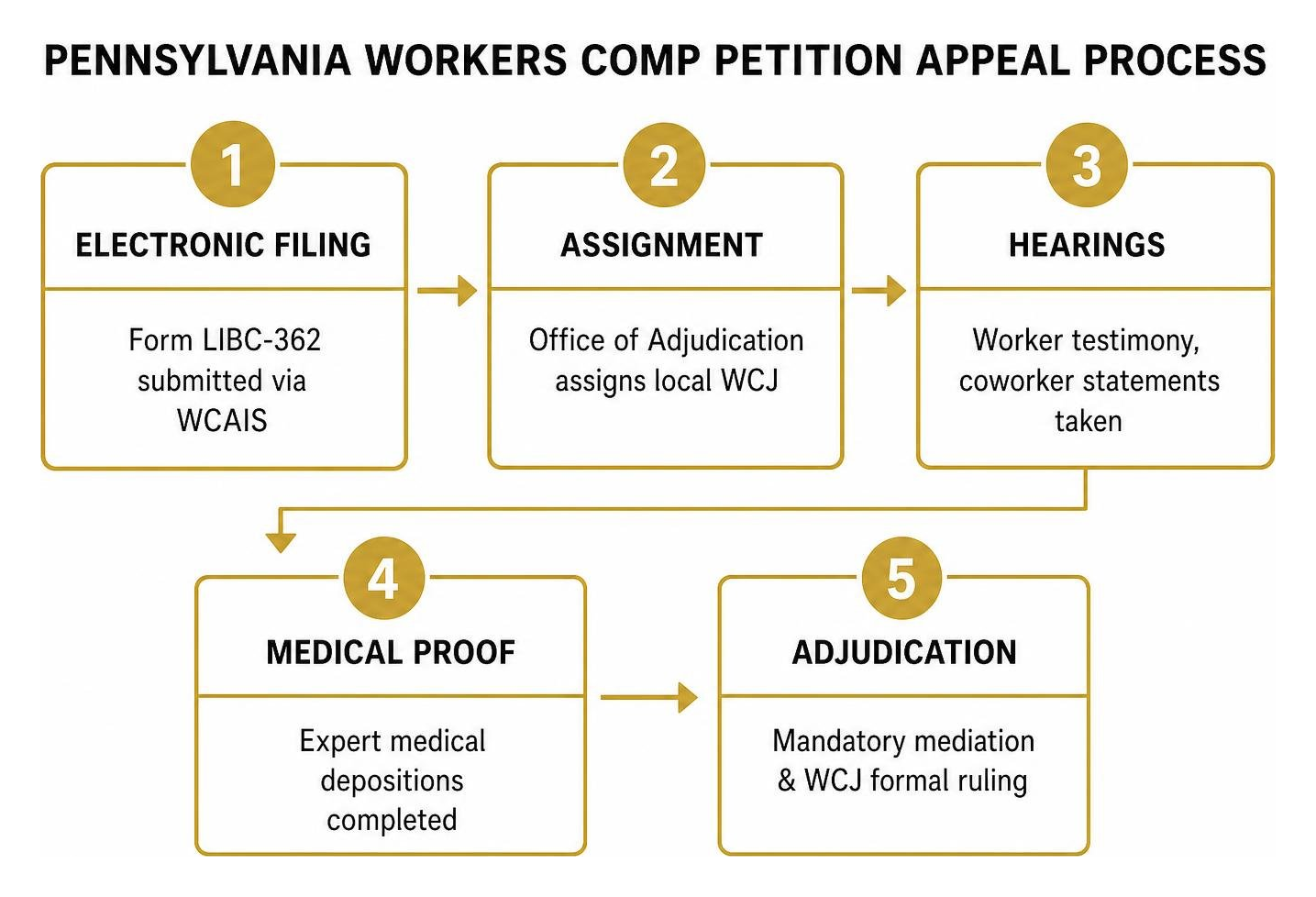
- File a Formal Claim Petition (Form LIBC-362): Submit Form LIBC-362 electronically through the Bureau’s WCAIS portal. This document states the injury details, body parts affected, the exact date of disability, and whether wage-loss or medical compensation is sought.
- Assemble Comprehensive Medical Records: Gather all emergency department records, operative notes, physical therapy logs, diagnostic MRI/CT reports, and detailed physician notes.
- Obtain Unequivocal Medical Causation: In Pennsylvania, if the causal relationship between the injury and work duties is not obvious to a layperson, you must present unequivocal medical testimony from a treating physician or medical specialist.
- Collect Witness and Workplace Documentation: Secure witness statements from coworkers, surveillance camera footage, equipment maintenance logs, supervisor incident reports, and wage documentation (W-2s, 1099s, and paystubs).
- Track Out-of-Pocket Costs: Keep itemized receipts for prescription medications, co-pays, mileage to and from medical appointments, and medical devices.
Working closely with experienced counsel makes navigating workers compensation challenges, denied claims, and benefit disputes far more manageable.
Time Limits to Contest a Workers Comp Denied Claim Pennsylvania
Missing statutory deadlines in Pennsylvania workers’ compensation can permanently extinguish your legal rights. Keep two distinct timelines in mind:
- The 120-Day Notice Requirement (Section 311): You must give notice of your injury to your employer within 21 days for benefits to be paid from the date of injury. If notice is given between 22 and 120 days, benefits are only payable from the date notice was received. If you fail to notify your employer within 120 days, all compensation is barred by law.
- The Three-Year Statute of Limitations (Section 315): Under Section 315 of the Pennsylvania Workers’ Compensation Act, an injured worker must file a formal Claim Petition with the Bureau within three years from the date of the injury. If the claim involves payments made in lieu of compensation, this timeline may be extended, but relying on exceptions is risky.
To protect your rights, explore the easiest way to file a workers comp claim in pennsylvania well before statutory deadlines approach.
The Role of the Workers’ Compensation Judge and Hearings
Once your Claim Petition is electronically submitted, the Bureau of Workers’ Compensation Office of Adjudication assigns your case to a Workers’ Compensation Judge (WCJ) based on your geographic county (such as Lackawanna County or Luzerne County in Northeastern Pennsylvania).
The WCJ acts as the finder of fact and the sole judge of witness credibility. The litigation process typically involves:
- First Hearing: The WCJ establishes preliminary deadlines, reviews insurance documents, and takes live testimony from you regarding how the injury happened, your current physical limitations, and your job history.
- Mandatory Mediation: Under Section 401 of the Act, parties are generally ordered to participate in formal mediation before a different WCJ to explore settlement opportunities before complete trial litigation.
- Medical Depositions: Because live physician appearances in court are costly and impractical, medical evidence is submitted through transcribed, sworn medical depositions taken outside court. Both your doctor and the insurer’s Independent Medical Examination (IME) physician are questioned under oath.
- Final Decision & Order: After both sides file proposed findings of fact and legal briefs, the WCJ issues a binding written decision granting or denying benefits.
A critical phase of this process involves understanding the role of medical evaluations in pa workers compensation claims and how treating medical records weigh against insurer-hired IME physicians.
Frequently Asked Questions About Denied PA Work Injury Claims
Can I still receive medical benefits if my wage-loss claim is denied?
Yes. An insurer can accept liability for the medical component of a work injury while denying wage-loss compensation if they believe you suffered no loss of earnings. If this happens, your health care providers can submit itemized bills and treatment notes directly to the workers’ compensation insurance carrier using standard CMS-1500 and UB-04 billing formats. The insurer is required to pay those bills in accordance with the Pennsylvania workers’ compensation medical fee schedule.
If the insurer refuses to pay medical bills for an established work injury, your attorney can file a Petition for Penalties or a Review Petition to compel payment and enforce statutory compliance.
What penalties can an employer face for an improper denial?
Under Section 435 of the Pennsylvania Workers’ Compensation Act, Workers’ Compensation Judges have the authority to assess monetary penalties against an employer or insurance carrier for violations of the Act, rules, or appellate court decisions.
- Penalties up to 50%: If the employer or insurer unreasonably violates the Act, causes excessive delays, or acts in bad faith, the WCJ may award penalties of up to 50% of the compensation awarded, payable directly to the injured worker.
- Unreasonable Contest Attorney’s Fees: Under Section 440 of the Act, if the insurer contests a claim without a reasonable basis, the WCJ must order the insurer to pay the worker’s reasonable attorney’s fees on top of standard compensation.
- Statutory Interest: Delayed wage-loss payments accrue statutory interest at an annual rate of 10%, which is added to the retroactive compensation owed to the worker.
Do I need a lawyer to appeal a denied claim in Pennsylvania?
While Pennsylvania law permits workers to represent themselves (pro se), appealing without legal counsel puts you at a severe disadvantage. Workers’ compensation litigation involves strict rules of civil procedure, formal rules of evidence, specialized medical terminology, and cross-examination of expert medical witnesses.
Insurance carriers retain experienced defense law firms whose primary goal is to minimize or eliminate your benefits. An experienced workers’ compensation attorney works on a contingent fee basis (typically 20% of awarded or settled wage-loss benefits, subject to WCJ approval), meaning you pay no upfront legal fees or hourly retainers out of pocket.
Conclusion
A denied workers’ compensation claim creates immediate financial and emotional strain, but receiving a Form LIBC-336 is simply the insurer’s initial position, not the final word under the law. By understanding the 21-day insurer response rules, preserving medical records, and filing a timely Claim Petition before the three-year statute of limitations expires, you can effectively challenge an unfair rejection.
At Caputo & Mariotti, we bring combined 55+ years of legal experience fighting for injured workers and accident victims across Northeastern Pennsylvania, including Scranton, Wilkes-Barre, Moosic, Pittston, Hazleton, Dickson City, Lackawanna County, and Luzerne County. We handle every phase of workers’ compensation litigation, from initial petition filings and doctor depositions to mandatory mediations and appeals before Workers’ Compensation Judges.
If your work injury claim has been rejected by an employer or insurer, do not navigate the appeals process alone. Contact our dedicated legal team today to protect your rights, recover your lost wages, and secure coverage for the medical treatment you need.
Schedule a free consultation with Caputo & Mariotti today, or call our Northeastern Pennsylvania office to speak directly with an experienced legal advocate about your denied claim.
