
The dedicated legal team of Caputo & Mariotti
The Ultimate Guide to Recoverable Damages in a PA Personal Injury Case
October 21, 2026
What Damages Can You Recover in a Pennsylvania Personal Injury Case?
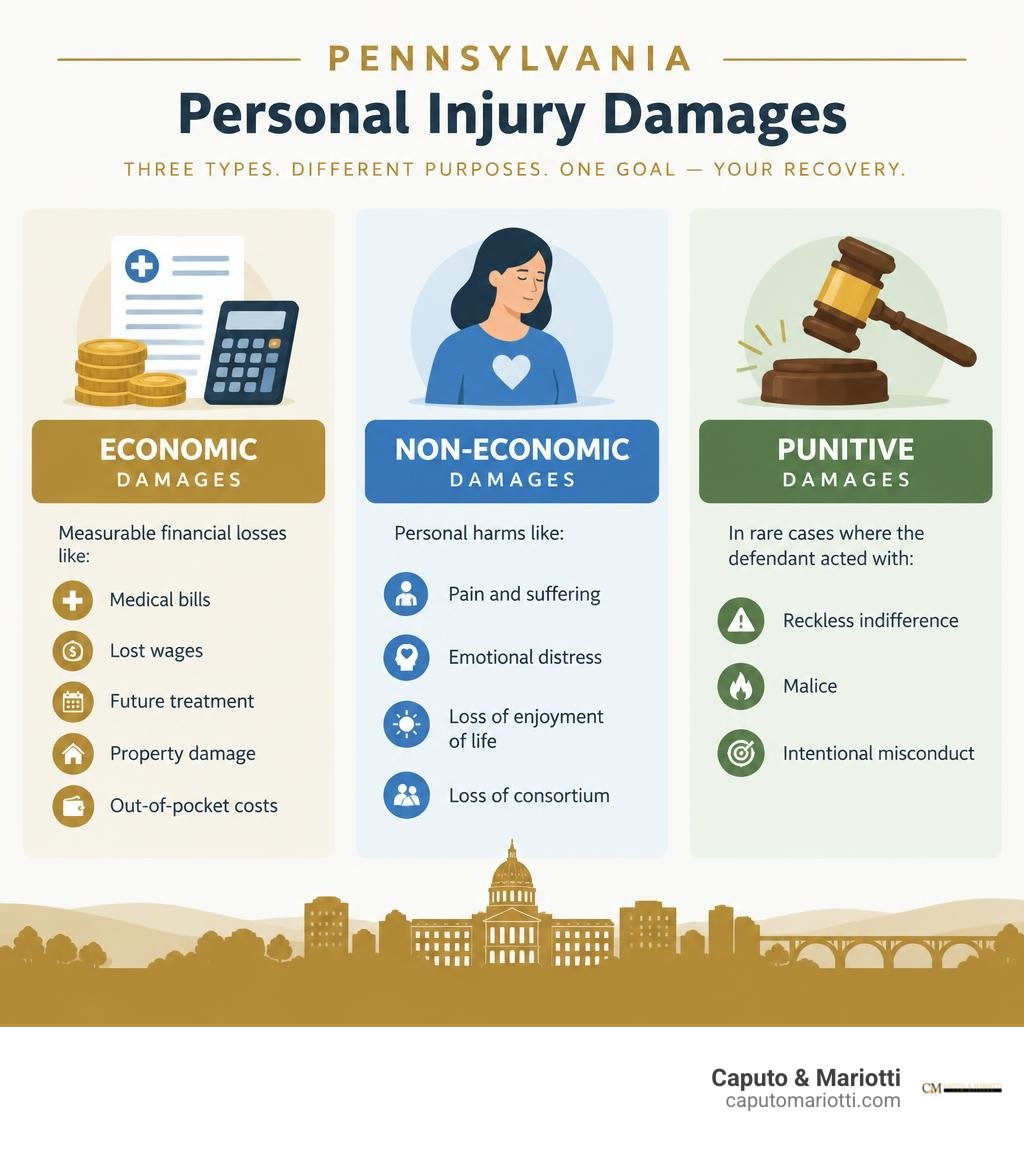
In Pennsylvania, an injury claim may include three main types of damages:
- Economic damages for measurable financial losses, such as medical bills, lost wages, future treatment, property damage, and out-of-pocket costs.
- Non-economic damages for personal harms, including pain and suffering, emotional distress, loss of enjoyment of life, and loss of consortium.
- Punitive damages in rare cases where the defendant acted with reckless indifference, malice, or intentional misconduct.
Your final recovery can also be affected by your share of fault, available insurance coverage, and, in car-crash cases, whether you chose full tort or limited tort insurance. Pennsylvania generally has no broad cap on compensatory damages in ordinary injury claims, but special limits apply to claims involving government entities and certain medical malpractice rules.
I am Chris Caputo, a Pennsylvania personal injury attorney who has represented injured people and families since 2007 after years of litigation and prosecution experience. If you are asking, what damages can I recover in a personal injury case PA, this guide explains the losses to document and the Pennsylvania rules that can shape your claim.
Know your what damages can i recover in a personal injury case pa terms:
- How Insurance Companies Calculate Injury Settlements
- How to Document Injuries After an Accident Pennsylvania
- How to Choose a Personal Injury Lawyer Pennsylvania
What Damages Can I Recover in a Personal Injury Case PA?
When pursuing an injury claim across Lackawanna County, Luzerne County, or anywhere in Northeastern Pennsylvania, the law organizes compensation into specific legal classifications. Understanding these categories is essential for establishing the actual value of your losses.
Compensatory damages are designed to make you whole again after an injury caused by another party’s negligence. These consist of both quantifiable economic losses and subjective non-economic hardships. In limited scenarios involving egregious behavior, courts may also award punitive damages to punish the wrongdoer.
| Damage Category | Primary Purpose | Common Examples | How It Is Proven |
|---|---|---|---|
| Economic Damages | Reimburse direct, measurable financial losses | Medical bills, lost income, physical therapy, prescription costs, vehicle repairs | Invoices, receipts, pay stubs, tax returns, life care plans |
| Non-Economic Damages | Compensate for intangible, subjective life impacts | Physical pain, emotional trauma, loss of life enjoyment, loss of consortium | Medical narratives, personal pain journals, expert testimony, witness statements |
| Punitive Damages | Punish malicious or reckless conduct and deter others | Extreme DUI crashes, intentional harm, gross safety violations | Evidence of conscious disregard, malice, or deliberate wrongdoing |
Understanding types of damages in Pennsylvania personal injury cases allows victims to build comprehensive claims that cover all current and future needs.
Tangible Losses: What Damages Can I Recover in a Personal Injury Case PA for Financial Costs?
Economic damages cover the direct monetary costs resulting from your injury. Because these losses have direct documentation, they are calculated through invoices, receipts, and financial projections.
Tangible losses generally encompass:
- Past Medical Expenses: Emergency room visits, surgeries, hospital stays, diagnostic imaging (MRIs, CT scans), prescription medications, and assistive medical devices.
- Future Medical Care: Ongoing physical therapy, future surgeries, home health aides, long-term rehabilitation, and necessary home or vehicle modifications.
- Lost Wages: Income lost from missing work during your initial recovery, including missed bonuses, sick leave, and used vacation time.
- Loss of Earning Capacity: Diminished future earning ability if a permanent impairment prevents you from returning to your prior job or career path.
- Property Damage: Repair or replacement costs for your vehicle, personal electronics, or other personal items damaged in the accident.
- Out-of-Pocket Expenditures: Travel costs to medical appointments, specialized childcare, or household maintenance services you can no longer perform.
When serious injuries occur, partnering with a skilled Pennsylvania personal injury lawyer helps ensure that long-term medical care plans and complex economic projections are calculated correctly.
Pain and Suffering: What Damages Can I Recover in a Personal Injury Case PA for Non-Economic Hardship?
Non-economic damages address the intangible, human cost of an accident. Although these losses lack a specific price tag, they frequently represent the most significant impact on an injured individual’s quality of life.
Key forms of non-economic recovery include:
- Physical Pain and Suffering: Chronic pain, physical discomfort, and the daily physical struggles associated with acute injuries.
- Emotional Distress and Mental Anguish: Psychological trauma, anxiety, post-traumatic stress disorder (PTSD), depression, sleep disorders, and fear resulting from the incident.
- Loss of Enjoyment of Life: The inability to participate in hobbies, recreational activities, family traditions, or daily routines that previously brought fulfillment.
- Loss of Consortium: Damage to the marital relationship, including the loss of companionship, affection, assistance, and emotional intimacy.
Insurance carriers and courts often use standard methodologies to evaluate these subjective harms. To learn more about standard assessment approaches, see this resource on how are personal injury damages calculated in Pennsylvania. Methods typically involve:
- The Multiplier Method: Total economic damages are multiplied by a number typically ranging from 1.5 to 5, depending on injury severity, duration, and permanency.
- The Per Diem Method: A daily monetary rate (often tied to the victim’s daily wage) is assigned and multiplied by the number of days the individual experiences pain before reaching maximum medical improvement.
Punitive Damages for Reckless or Egregious Conduct
Unlike compensatory awards, punitive damages are not intended to restore financial losses. Instead, they serve to punish a defendant for outrageous, willful, or malicious conduct and to deter similar actions in the future.
Under Pennsylvania common law, establishing punitive damages requires proving that the defendant acted with gross negligence, malice, or conscious disregard for the safety of others. Simple negligence—such as a brief driving distraction—is insufficient. Common examples include high-speed drag racing, driving with extreme blood-alcohol levels, or intentional physical assaults. In medical malpractice litigation governed by the Medical Care Availability and Reduction of Error (MCARE) Act, punitive damages are subject to statutory guidelines, generally not exceeding 200% of compensatory damages (excluding intentional misconduct), with 25% of any punitive recovery paid into the state MCARE fund.
Key Pennsylvania Laws That Impact Your Total Recovery
Legal statutory frameworks directly govern how much financial compensation you can ultimately recover in Pennsylvania courts.

Modified Comparative Negligence and the 51 Percent Bar
Pennsylvania applies a modified comparative negligence rule under Title 42 Pa.C.S. § 7102. Under this statute, your compensation is reduced in direct proportion to your share of fault, provided your responsibility does not exceed 50%.
For instance, if a court determines your total damages equal $100,000, but finds you were 20% responsible for the accident, your final payout is reduced to $80,000. However, if you are assigned 51% or more of the blame, Pennsylvania law bars you from recovering any compensation from other parties. Working with experienced Scranton personal injury attorneys is crucial to defending against unfair fault allocation by aggressive insurance adjusters.
Full Tort vs. Limited Tort Auto Insurance Choices
Under the Pennsylvania Motor Vehicle Financial Responsibility Law (Title 75 Pa.C.S. § 1705), auto insurance policyholders must elect between full tort and limited tort coverage. Detailed rules are outlined in this breakdown of Pennsylvania car accident laws: tort choice, PIP, and your claim.
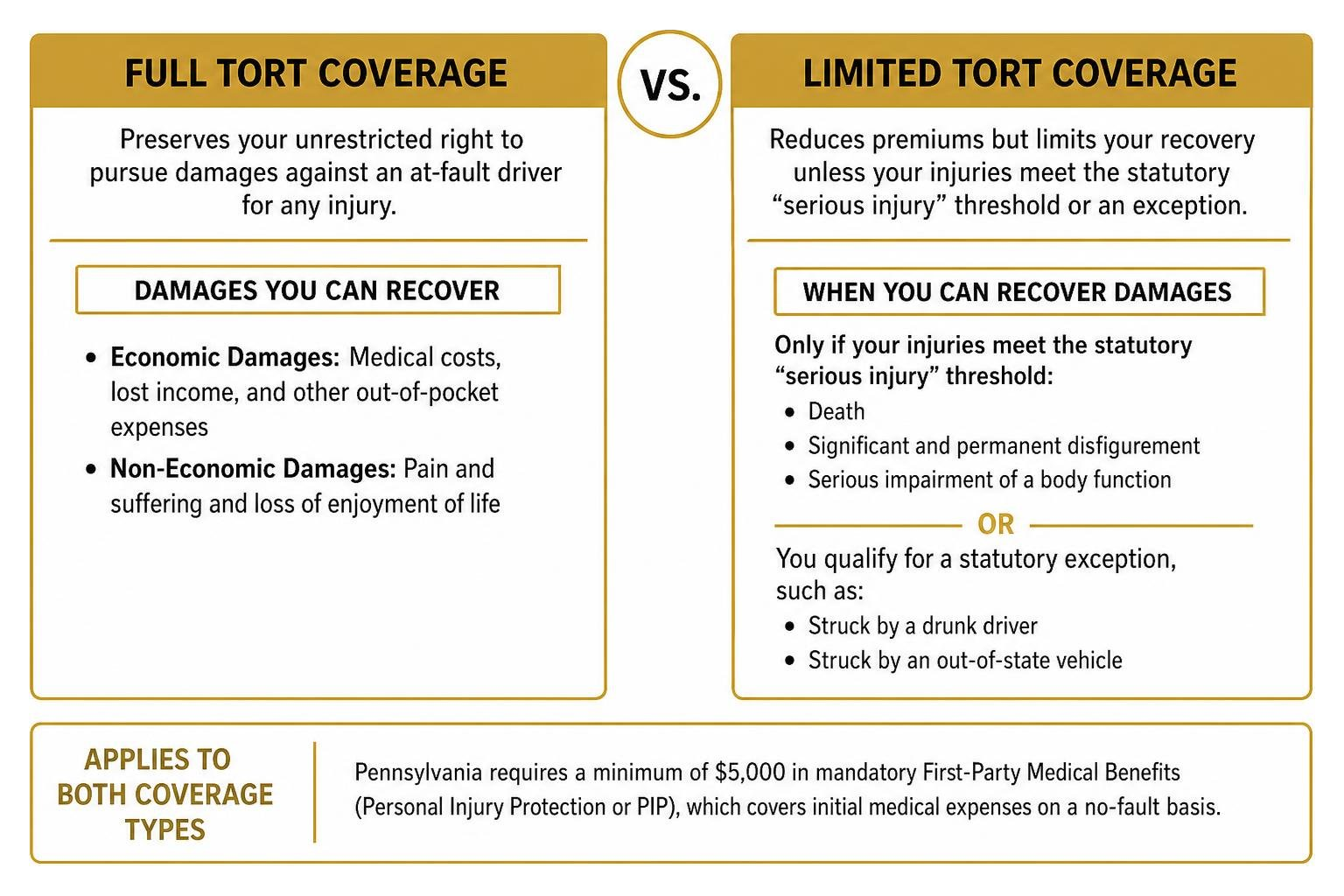
- Full Tort Coverage: Preserves your unrestricted right to pursue both economic damages (medical costs, lost income) and non-economic damages (pain and suffering) against an at-fault driver for any injury.
- Limited Tort Coverage: Reduces premium costs but limits your recovery solely to out-of-pocket economic damages unless your injuries satisfy the statutory “serious injury” verbal threshold—defined as death, significant and permanent disfigurement, or serious impairment of a body function—or meet specific statutory exceptions (such as being struck by a drunk driver or an out-of-state vehicle).
Regardless of your tort choice, Pennsylvania requires a minimum of $5,000 in mandatory First-Party Medical Benefits (Personal Injury Protection or PIP), which covers initial medical expenses on a no-fault basis.
Statutory Damage Caps and Sovereign Immunity Limits
In standard personal injury claims involving private individuals or corporations, the Pennsylvania Constitution prohibits general statutory caps on compensatory damages. Victims can pursue the full extent of their demonstrated economic and non-economic losses.
However, strict statutory caps apply when suing government agencies:
- Commonwealth Agencies (State Government): Under the Sovereign Immunity Act, damages are capped at $250,000 per plaintiff and $1,000,000 per occurrence.
- Local Municipalities and School Districts: Under the Political Subdivision Tort Claims Act, damages are capped at an aggregate of $500,000 per incident.
Additionally, claims against government entities require formal written notice within six months of the injury date, and punitive damages cannot be recovered against municipal or state bodies.
Average Settlement Values and Factors Influencing Claim Worth
Settlement amounts across Pennsylvania vary substantially based on liability clarity, available insurance policies, and injury severity.

If an injury occurs on the job, the legal recovery process differs from third-party liability claims. Workers must navigate a specialized system requiring immediate injury reporting, authorized medical treatment, detailed recordkeeping, and formal claims processes. When handling these distinct administrative requirements and legal appeals, consulting a workers’ compensation lawyer ensures your rights to wage-loss benefits and medical coverage remain protected under the state’s no-fault framework.
Pennsylvania Settlement Benchmarks by Injury and Accident Type
While every claim depends on unique factual circumstances, reviewing state and national settlement data offers helpful context regarding potential claim valuations:
- Car Accidents: Pennsylvania motor vehicle settlements average approximately $20,235 for moderate claims, with catastrophic collisions yielding significantly higher recoveries.
- Commercial Truck Accidents: Due to substantial vehicle weight disparities and higher commercial insurance policies, truck accident settlements average around $103,654.
- Pedestrian Collisions: Pedestrian injury settlements in the state average roughly $67,511.
- Motorcycle Crashes: Settlements for motorcycle accidents average approximately $66,107, reflecting severe physical impacts.
- Slip and Fall Incidents: Typical premises liability settlements in Pennsylvania range from $15,000 to $45,000.
- National Overview: Across all injury categories nationally, average settlements range between $52,900 and $55,056, with a median payout near $31,000.
Insurance Policy Limits and Evidence Preservation
A primary practical constraint on financial recovery is the available insurance coverage. Pennsylvania maintains low mandatory auto liability minimums (15/30/5):
- $15,000 for bodily injury to one person per accident.
- $30,000 total bodily injury liability per accident.
- $5,000 for property damage.
When damages exceed minimum policy limits, recovering total losses requires identifying additional coverage sources, such as Underinsured Motorist (UIM) coverage, umbrella policies, or corporate liability policies. Maximizing your case requires prompt evidence preservation, including:
- Comprehensive medical documentation and treatment continuity.
- Visual evidence from accident scenes, vehicle damage, and physical injuries.
- Police collision reports and witness depositions.
- Expert economic analyses and medical life care plans.
Carefully choosing the right Scranton personal injury attorney ensures all available insurance sources and critical pieces of evidence are thoroughly investigated.
Frequently Asked Questions About Pennsylvania Personal Injury Damages
What is the deadline to file an injury lawsuit in Pennsylvania?
Under Title 42 Pa.C.S. § 5524, Pennsylvania enforces a strict two-year statute of limitations for personal injury and wrongful death lawsuits. The clock typically begins running on the date the injury occurred.
Under the “discovery rule,” this deadline may be extended if an injury was not immediately discoverable through reasonable diligence. Additionally, the statute of limitations is tolled for minors, granting them two years from their 18th birthday (until age 20) to initiate legal action.
How do insurance adjusters calculate pain and suffering awards?
Insurance adjusters evaluate pain and suffering by reviewing the severity of your injuries, treatment duration, medical records, objective diagnostic findings, and the extent of daily lifestyle disruption. Adjusters typically input these variables into claims evaluation software, utilizing either the multiplier method (multiplying total medical costs by a factor between 1.5 and 5) or the per diem method (assigning a daily monetary rate across your recovery period).
Can I recover compensation if I am partially at fault for the accident?
Yes. Under Pennsylvania’s modified comparative fault law, you can recover damages as long as you are 50% or less responsible for the incident. Your overall financial award will be reduced in proportion to your assigned share of fault. If you are determined to be 51% or more at fault, you are barred from recovering damages.
Conclusion
Understanding what damages you can recover is the foundation of protecting your financial security after an unexpected accident. From economic losses like medical bills and wage loss to intangible non-economic hardships, securing complete compensation requires an in-depth understanding of Pennsylvania tort law, comparative fault rules, and insurance coverage structures.
At Caputo & Mariotti, our legal team brings more than 55 years of combined experience fighting for injured individuals and their families throughout Scranton, Wilkes-Barre, Moosic, Pittston, Dickson City, Hazleton, and all of Northeastern Pennsylvania. We handle injury lawsuits, complex personal injury claims, and medical malpractice litigation with dedicated advocacy and an unwavering commitment to justice.
If you or a loved one has suffered an injury, do not navigate the insurance claims process alone. Contact the Caputo & Mariotti legal team today to schedule a free case consultation and let us evaluate your claim to pursue the maximum compensation you deserve.