

The dedicated legal team of Caputo & Mariotti
A Comprehensive Guide to Personal Injury Law
July 1, 2026
What Is Personal Injury Law — and Why It Matters After an Injury
What is personal injury law? Here’s the short answer:
Personal injury law (also called tort law) gives you the legal right to seek financial compensation when someone else’s negligent, reckless, or intentional actions cause harm to your body, emotions, or reputation.
The key points at a glance:
- It covers a wide range of injuries — from car accidents and slip and falls to medical malpractice and defamation
- You don’t need a criminal conviction against the other party — this is a civil process
- A successful claim can recover medical expenses, lost wages, pain and suffering, and more
- Claims are based on three legal grounds: negligence, strict liability, or intentional wrongs
- You must file within a set time limit (the statute of limitations) — in Pennsylvania, that’s generally two years
Personal injury law exists for one core reason: to make injured people whole again after someone else’s actions turned their lives upside down. Whether you were hurt in a car crash on I-81 or suffered harm due to a defective product, the law provides a path to accountability and compensation.
Not every injury qualifies, though. Even a real accident caused by real negligence may not support a legal claim if the harm is too minor or the damages too difficult to prove. Understanding where your situation fits is the critical first step.
I’m Chris Caputo, a Pennsylvania personal injury attorney with over 30 years of experience representing accident victims and families across Northeastern Pennsylvania — and what is personal injury law is the foundation of every case I handle. Since 2007, I’ve dedicated my practice to fighting for people seriously harmed by the negligence of others, securing millions of dollars in compensation on their behalf.
What is Personal Injury Law?

At its heart, Personal injury law is a subset of tort law. While “tort” might sound like a fancy dessert, in the legal world, it refers to a civil wrong that causes a claimant to suffer loss or harm. Unlike criminal law, where the government seeks to punish a defendant with jail time or fines, personal injury law is about the victim. It is a civil litigation framework designed to shift the financial burden of an injury from the victim to the party responsible for causing it.
According to the Legal Information Institute, personal injury encompasses every variety of injury to a person’s body, emotions, or reputation. This is distinct from property law, which deals with damage to your car or home. In a personal injury case, we are looking at how the incident affected you as a human being.
Negligence: The Foundation of What is Personal Injury Law
Most cases we handle in Scranton and Wilkes-Barre are rooted in the concept of negligence. To win a case based on negligence, we must prove four specific elements:
- Duty of Care: The defendant had a legal obligation to act reasonably (for example, a driver has a duty to obey traffic lights).
- Breach: The defendant failed to meet that duty (they ran a red light).
- Causation: That failure directly caused your injury (the collision led to your broken arm).
- Measurable Damages: You suffered actual losses, such as medical bills or lost wages.
Understanding Personal Injury Law in Scranton: A Comprehensive Guide often begins with identifying who owed you a duty and how they failed to protect your safety.
Strict Liability and Intentional Wrongs
While negligence is common, it isn’t the only way to bring a claim. Strict liability applies in situations where a defendant is responsible regardless of intent or “carefulness.” This is most common in product liability cases involving defective goods or dog bite cases. If a manufacturer sells a toaster that explodes during normal use, they may be strictly liable for the resulting burns.
Intentional wrongs occur when someone purposely harms you. This includes:
- Assault and Battery: Physical strikes or the threat of them.
- False Imprisonment: Being held against your will (often seen in retail “shopkeeper’s privilege” gone wrong).
- Defamation: Harm to your reputation through false statements.
Common Causes and Types of Personal Injury Cases

In May 2026, as we look at the current legal landscape in Lackawanna and Luzerne Counties, certain types of accidents remain the most frequent drivers of personal injury claims.
- Auto Accidents: From fender-benders in Moosic to major trucking accidents on the Pennsylvania Turnpike, vehicle collisions are the leading cause of injury claims.
- Medical Malpractice: This occurs when a healthcare professional deviates from the “standard of care,” resulting in patient harm.
- Premises Liability: Often called “slip and fall” cases, these arise when a property owner fails to fix a hazard, like an icy sidewalk in Pittston or a spill in a Hazleton grocery store.
- Wrongful Death: When a personal injury is so severe that it results in the victim’s passing, the family may file a claim for the losses they have suffered.
Bodily Harm vs. Non-Bodily Injuries
When people ask, “what is personal injury law?” they usually think of broken bones or surgeries. However, the law is much broader.
- Bodily Harm: These are physical injuries like spinal cord damage, traumatic brain injuries (TBI), or lacerations.
- Non-Bodily Injuries: You can also recover for harm to your “mind or emotions.” This includes intentional infliction of emotional distress or damage to your reputation through libel or slander.
Navigating Workers’ Compensation in Pennsylvania
If you are injured while on the clock in Northeastern Pennsylvania, your path to recovery usually goes through a different system. Pennsylvania uses a no-fault workers’ compensation system. This means you generally don’t have to prove your employer was “negligent” to receive benefits—you only need to show the injury happened in the scope of your employment.
The process involves several critical steps:
- Reporting: You must notify your employer within 21 to 120 days of the injury. Failing to report promptly can jeopardize your claim.
- Medical Treatment: In many cases, you must seek treatment from a list of employer-approved providers for the first 90 days.
- Evidence Gathering: It is vital to document the incident, collect witness statements, and keep detailed records of all medical visits and symptoms.
- The Filing Process: If your claim is denied or benefits are stopped, you must file a claim petition with the Bureau of Workers’ Compensation to have your case heard by a judge.
Because these claims involve insurance companies looking to minimize payouts, many workers find they need a workers’ compensation lawyer to handle appeals and ensure they receive their full income loss benefits (which can cover up to 80% of gross income).
Recoverable Damages in a Successful Lawsuit
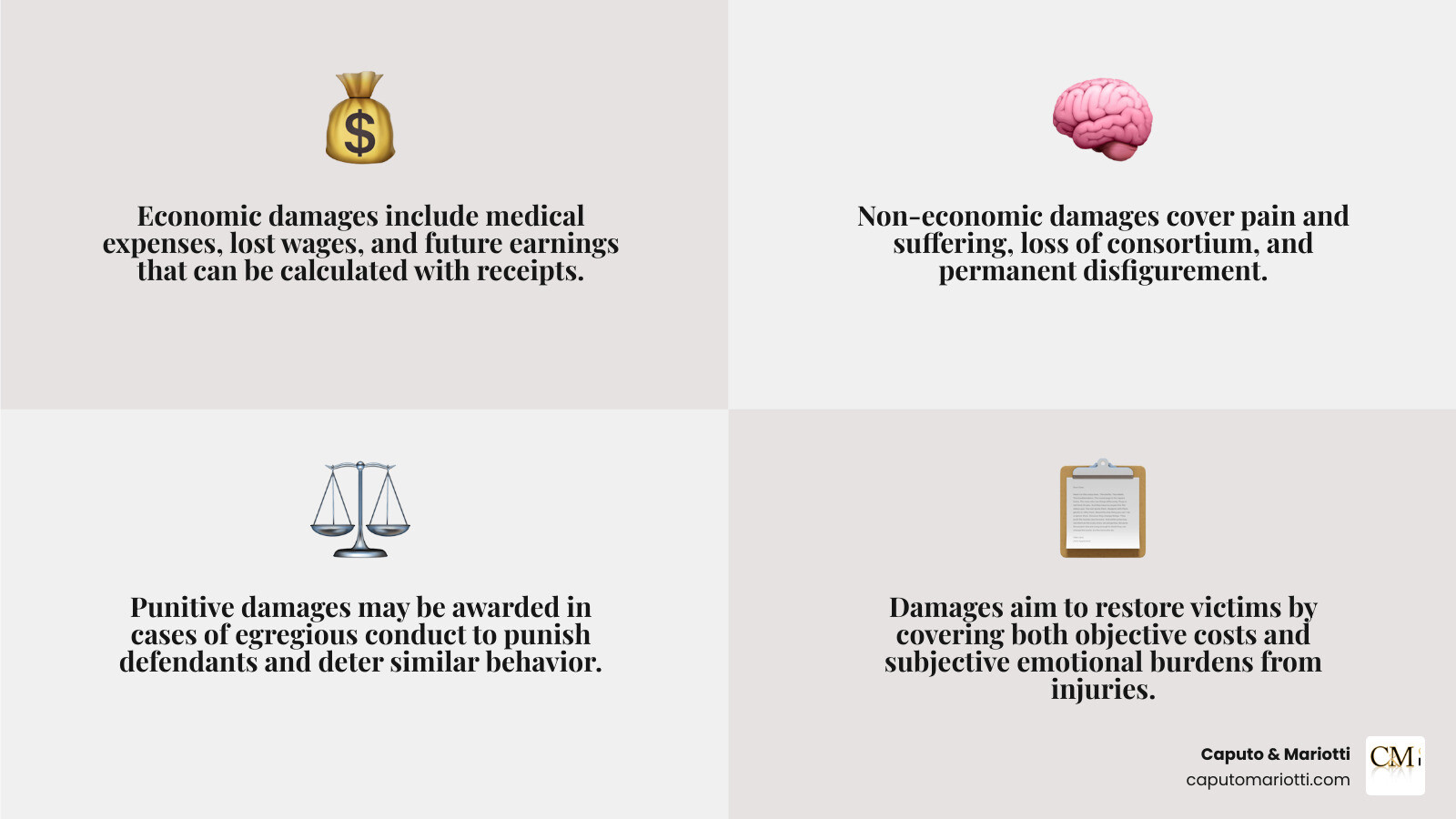
The goal of a personal injury claim is to secure “damages”—a legal term for monetary compensation. There are two primary categories of compensatory damages.
Economic and Non-Economic Losses
Economic Damages: These are your “out-of-pocket” costs that can be easily calculated with a receipt or a calculator.
- Medical Expenses: Past surgeries, current hospital stays, and future physical therapy.
- Lost Wages: Income you missed while recovering.
- Future Earnings: If your injury prevents you from returning to your previous career, you can claim the loss of future earning capacity.
Non-Economic Damages: These are more subjective but often represent the heaviest burden of an injury.
- Pain and Suffering: The physical discomfort and mental anguish caused by the accident.
- Loss of Consortium: The impact the injury has on your relationship with your spouse.
- Disfigurement: Compensation for permanent scarring or loss of a limb.
In rare cases involving “egregious” or “outrageous” conduct, a court may award punitive damages. These aren’t meant to compensate you, but rather to punish the defendant and deter others from acting similarly. You can Explore Personal Injury Recovery Options to see which might apply to your specific situation.
The Personal Injury Legal Process in Pennsylvania
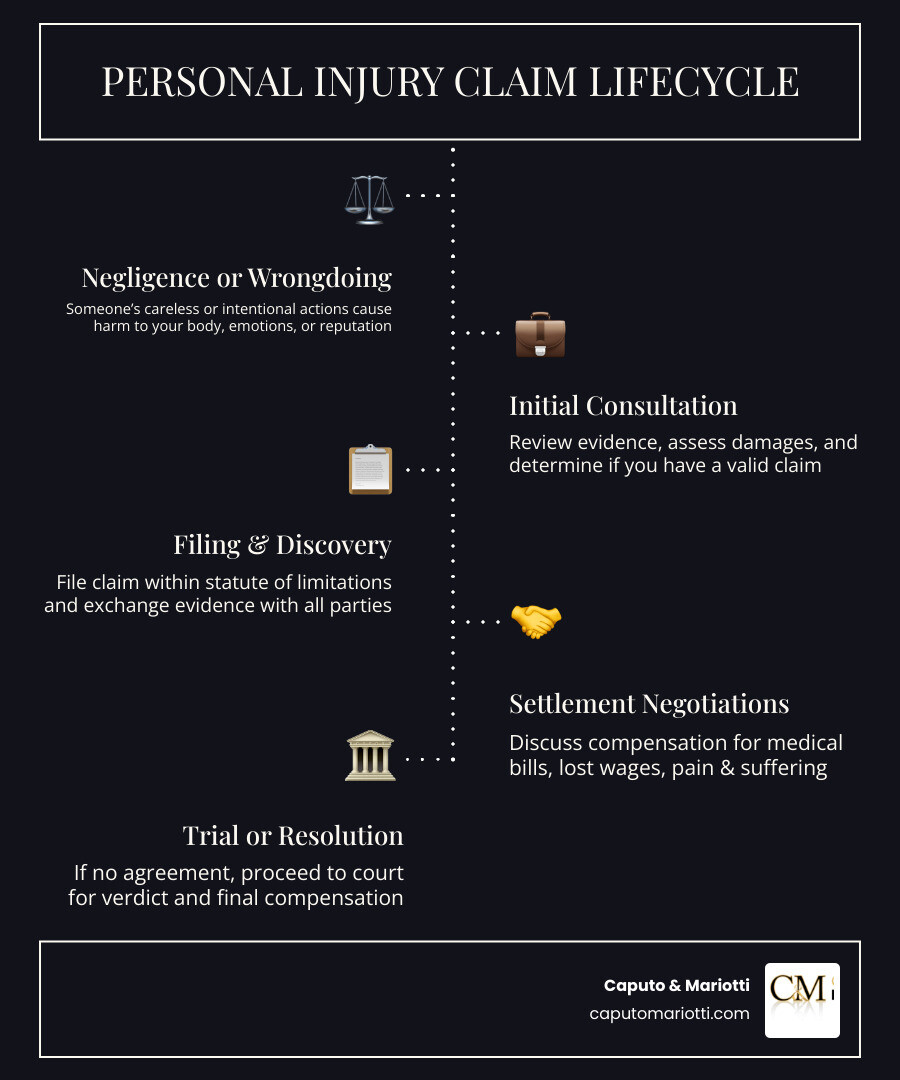
Filing a lawsuit isn’t like what you see on TV—it doesn’t happen in an hour. It is a structured process designed to uncover the truth.
- Statute of Limitations: In Pennsylvania, you generally have two years from the date of the accident to file a lawsuit. If you miss this deadline, you lose your right to sue forever.
- Discovery Phase: This is the longest part of the case. Both sides exchange documents, answer written questions (interrogatories), and give sworn testimony (depositions).
- Settlement Negotiations: Most personal injury cases—upwards of 95%—settle before they ever reach a jury. We negotiate with insurance adjusters to get a fair value without the stress of a trial.
- Trial Litigation: If the insurance company refuses to be fair, we take the case to court in Lackawanna or Luzerne County, where a judge or jury will decide the outcome.
Working with a Personal Injury Lawyer in Scranton ensures that you don’t miss these critical deadlines or procedural steps.
Key Factors in What is Personal Injury Law Success
Winning a case requires more than just being “right.” It requires evidence.
- Evidence Preservation: Taking photos of the crash scene, keeping your torn clothing, and saving every medical bill.
- Expert Testimony: We often hire medical experts or accident reconstructionists to explain to a jury exactly how an injury occurred.
- Comparative Negligence: Pennsylvania follows a “modified comparative negligence” rule. If you are found to be 30% at fault for an accident, your total award will be reduced by 30%. However, if you are more than 50% at fault, you cannot recover anything.
If you are unsure how these factors affect your case, it is best to Schedule a Free Consultation immediately.
Frequently Asked Questions about Personal Injury
How long do I have to file a claim in Pennsylvania?
For most personal injury cases in Pennsylvania, the statute of limitations is two years from the date the injury occurred or was discovered. There are very narrow exceptions for minors or cases involving “fraudulent concealment,” but you should always assume the two-year clock is ticking.
What if I am partially at fault for my accident?
As mentioned, you can still recover compensation as long as you are 50% or less at fault. For example, if a jury decides your damages are $100,000 but you were 20% responsible because you were speeding slightly, you would receive $80,000.
How much is my personal injury case worth?
There is no “magic formula.” The value depends on the severity of your injuries, the amount of your medical bills, the clarity of the defendant’s fault, and the available insurance policy limits. A case involving a permanent disability will naturally be valued higher than one involving a sprained ankle that heals in a month.
Conclusion
Understanding what is personal injury law is the first step toward reclaiming your life after an accident. It is a complex field where the rules are often written in decades of court decisions rather than simple statutes.
At Caputo & Mariotti, we bring over 55 years of combined experience to the table for our neighbors in Scranton, Wilkes-Barre, and throughout Northeastern Pennsylvania. We understand that behind every “case file” is a person trying to get back on their feet, pay their bills, and move past a traumatic event. Our dedicated team provides the unwavering commitment to justice that you deserve.
If you have been injured, don’t navigate the legal maze alone. Contact Our Scranton and Wilkes-Barre Team today for a free evaluation of your claim. We are here to be your advocates, your guides, and your voice in the pursuit of justice.