

The dedicated legal team of Caputo & Mariotti
An Essential Guide to Wrongful Death Lawsuits in Pennsylvania
August 12, 2026
What You Need to Know About a Wrongful Death Lawsuit in Pennsylvania
An Essential Guide to Wrongful Death Lawsuits in Pennsylvania

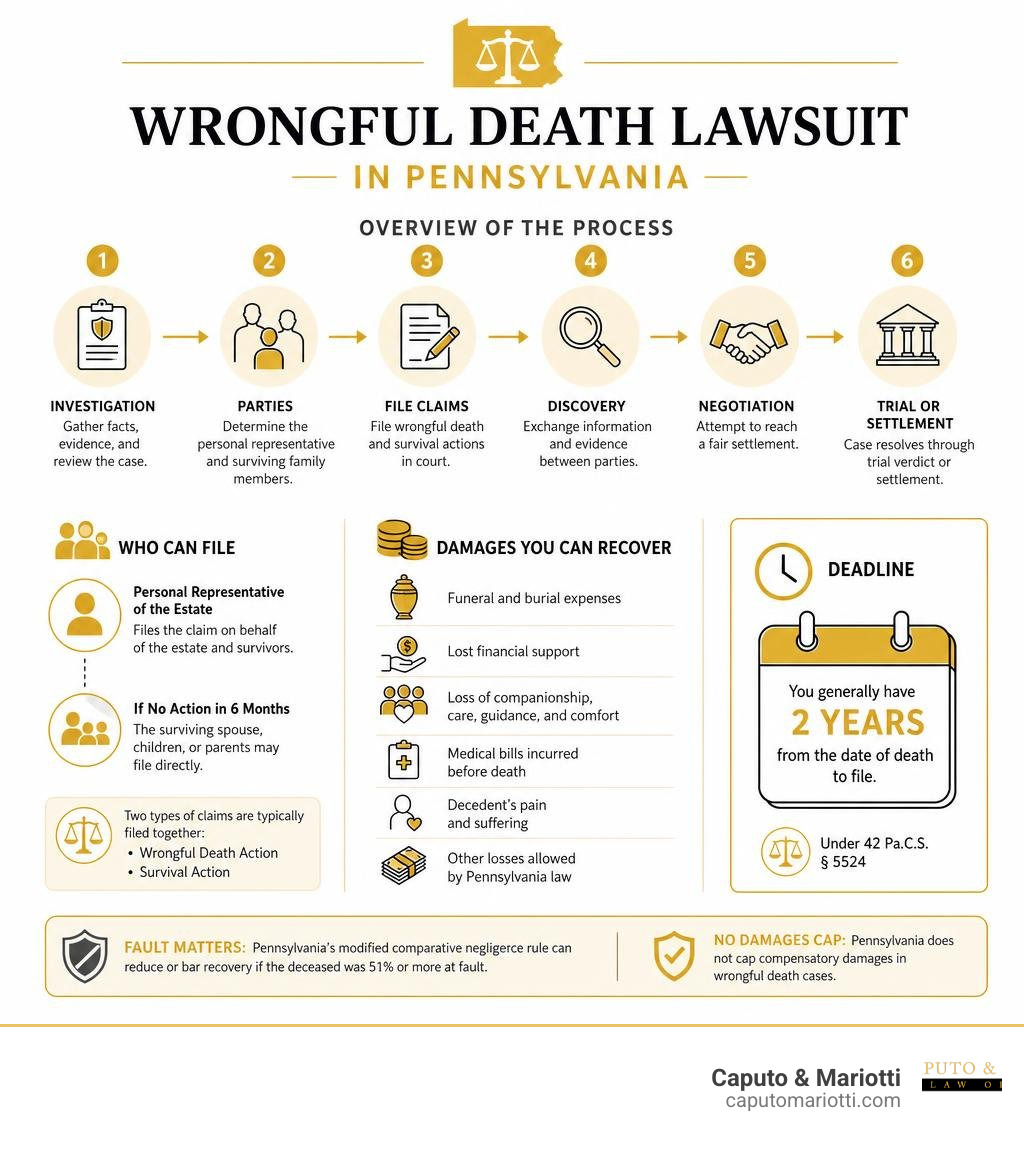
A wrongful death lawsuit in Pennsylvania gives families the legal right to seek compensation when a loved one dies because of someone else’s negligence, reckless conduct, or wrongful act. If you’ve just lost someone and are trying to understand your options, here is a quick overview:
Key facts at a glance:
- Who can file: The personal representative of the deceased’s estate files first. If no action is taken within six months, the surviving spouse, children, or parents may file directly.
- Deadline: You generally have two years from the date of death to file under 42 Pa.C.S. § 5524.
- Two types of claims: Pennsylvania law allows both a wrongful death action (for surviving family members) and a survival action (for the estate) — and both are typically filed together.
- What you can recover: Funeral costs, lost financial support, loss of companionship, medical bills before death, and the decedent’s pain and suffering, among other damages.
- Fault matters: Pennsylvania’s modified comparative negligence rule can reduce or bar recovery if the deceased was 51% or more at fault.
- No damages cap: Pennsylvania does not cap compensatory damages in wrongful death cases.
Losing a family member is devastating under any circumstances. When that loss is caused by someone else’s negligence — whether in a car accident, a medical setting, or a workplace — the grief is compounded by confusion about what legal steps to take and how quickly you need to act.
This guide walks you through every major aspect of Pennsylvania wrongful death law in plain language, so you can make informed decisions during one of the hardest times of your life.
I’m Chris Caputo, a Pennsylvania personal injury attorney who has been representing families in wrongful death lawsuits in Pennsylvania since 1994, with experience that spans criminal prosecution, defense litigation, and dedicated plaintiff-side injury law. Together with my team at Caputo & Mariotti, I’ve spent decades fighting for families across Northeastern Pennsylvania who deserve clear answers and committed legal representation.
Legal Framework of a Wrongful Death Lawsuit Pennsylvania
Under Pennsylvania law, a wrongful death claim is a civil action designed to compensate the survivors of a deceased person for the losses they have suffered due to the death. Codified under 42 Pa.C.S. § 8301, the statute provides that an action may be brought to recover damages for the death of an individual caused by the “wrongful act or neglect or unlawful violence of another.”
If the deceased person would have had the right to file a personal injury lawsuit had they survived the incident, then their close family members and estate have the right to pursue a wrongful death claim. This legal right covers a broad range of incidents, including fatal car wrecks, commercial truck collisions, slip-and-falls, defective products, and medical negligence.

When we handle these cases, we look closely at how the negligence occurred and who should be held accountable. For families seeking to understand their legal rights, we have compiled More info about wrongful death claims to help clarify the initial steps.
Who Has Standing to File a Wrongful Death Lawsuit Pennsylvania?
Not just anyone can walk into a courthouse in Lackawanna County or Luzerne County and file a lawsuit after a tragic accident. Pennsylvania has strict rules regarding who has “standing”—the legal right—to initiate the claim.
For the first six months following the death, only the personal representative (the executor named in a will, or the administrator appointed by the Register of Wills if there was no will) has the exclusive right to bring a wrongful death action.
If the personal representative fails to file a lawsuit within six months of the death, the rules change. Under Pennsylvania Rule of Civil Procedure 2202, any person entitled by law to recover damages (a beneficiary) may file the action as a “trustee ad litem” on behalf of all eligible beneficiaries.
The Pennsylvania Wrongful Death Act strictly limits the beneficiaries who can recover financial compensation to the following immediate family members:
- The surviving spouse
- The surviving children
- The surviving parents
If the deceased individual is not survived by a spouse, child, or parent, a wrongful death action cannot be brought to recover general damages for family loss. In those rare circumstances, the personal representative may only bring an action to recover “special damages,” which are limited to medical expenses, funeral costs, and the administration expenses necessitated by the death.
Beneficiaries and the Distribution of Damages
Even though the personal representative files the lawsuit, they do not keep the damages recovered in a wrongful death action. Instead, they hold the funds in trust for the statutory beneficiaries.
The compensation recovered in a wrongful death claim is distributed among the beneficiaries according to Pennsylvania’s intestacy laws—the same rules that govern how property is divided when someone dies without a will. For example, if a decedent leaves behind a spouse and children, the law dictates a specific percentage of the recovery that goes to the spouse and each child, regardless of what a will might say.
To receive a share of the damages, a beneficiary must generally show a “pecuniary loss,” meaning they had a reasonable expectation of receiving financial support, services, or society from the deceased. Minor children are legally presumed to be dependent on their parents, while adult children or parents may need to provide evidence of their relationship and financial or emotional reliance.
Because the distribution of these funds can be legally complex and sometimes leads to disputes, it is crucial to understand the Factors affecting your chances of winning and how Pennsylvania courts handle these allocations.
Wrongful Death Actions vs. Survival Actions
When a fatal accident occurs in Pennsylvania, families often hear the terms “wrongful death action” and “survival action” used interchangeably. However, they are two entirely separate and distinct legal claims under state law.
While a wrongful death action (42 Pa.C.S. § 8301) compensates the surviving family members for their personal losses, a survival action (42 Pa.C.S. § 8302) is a continuation of the deceased person’s own personal injury claim. It allows the estate to recover damages for the harm the deceased suffered from the moment of the injury until their death.
Understanding The difference between wrongful death and personal injury attorneys can help clarify how these claims are built and presented to a jury.
| Feature | Wrongful Death Action (42 Pa.C.S. § 8301) | Survival Action (42 Pa.C.S. § 8302) |
|---|---|---|
| Who Benefits? | Only the surviving spouse, children, or parents. | The deceased’s estate (distributed via will or intestacy to heirs). |
| Are Proceeds Taxed? | No, generally free from estate and inheritance taxes. | Yes, subject to Pennsylvania inheritance tax and federal estate tax. |
| Subject to Creditors? | No, protected from the deceased’s personal creditors. | Yes, funds become estate assets and can be claimed by creditors. |
| Primary Focus | The financial and emotional loss suffered by the family. | The pain, suffering, and financial loss experienced by the deceased. |
Recoverable Damages in a Survival Action
Because a survival action belongs to the estate, the damages are focused entirely on what the deceased person experienced. If the victim survived for even a few minutes or hours after the accident, a survival claim can seek significant compensation.
Recoverable damages in a survival action include:
- Pain and suffering: Compensation for the physical pain and mental anguish the deceased experienced between the time of the injury and the moment of death.
- Pre-death medical bills: The cost of emergency medical transport, hospital stays, surgeries, and palliative care prior to passing.
- Lost earning capacity: The net earnings the deceased would have reasonably earned during their remaining life expectancy, minus the cost of their own personal maintenance (what they would have spent on food, housing, and personal needs).
Because these funds pass through the estate, they are subject to any outstanding estate debts, medical liens, and state inheritance taxes before they can be distributed to the heirs.
Recoverable Damages in a Wrongful Death Action
In contrast, a wrongful death action focuses on the family’s loss. The goal is to compensate the survivors for the economic and emotional impact of losing their loved one.
Recoverable damages in a wrongful death action include:
- Funeral and burial expenses: The reasonable costs associated with a funeral, cremation, burial plot, and headstone.
- Loss of financial support: The loss of the financial contributions the deceased would have made to their family members over their working life.
- Loss of household services: The economic value of services the deceased provided, such as childcare, cooking, home maintenance, and managing household finances.
- Loss of society and comfort: The loss of companionship, guidance, tutelage, and moral upbringing. In Pennsylvania, following landmark rulings like Rettger v. UPMC Shadyside, these damages explicitly include the profound emotional and psychological loss experienced by close family members.
Importantly, wrongful death recoveries pass directly to the statutory beneficiaries. They are not considered part of the deceased’s estate, meaning they are completely shielded from the deceased’s creditors and are not subject to inheritance tax.
Statute of Limitations and Key Legal Deadlines
In Pennsylvania, you do not have an unlimited amount of time to seek justice. The statute of limitations for both wrongful death and survival actions is strictly set at two years under 42 Pa.C.S. § 5524.
For a wrongful death claim, the two-year clock begins ticking on the date of death. For a survival action, the clock technically begins on the date the injury occurred. In many cases, these dates are the same, but if a loved one was injured in a car accident in January and passed away from those injuries in August, the deadlines for the two claims may differ. Failing to file a lawsuit before the two-year deadline passes will almost always result in the court dismissing your case permanently.

Whether you are dealing with a tragic car wreck or Seeking justice in motorcycle accidents, acting quickly allows your legal team to preserve crucial evidence, secure witness testimony, and build a strong case before time runs out.
MCARE Section 513(d) and Medical Malpractice Claims
When a wrongful death is caused by medical malpractice, the legal deadlines are governed by Pennsylvania’s Medical Care Availability and Reduction of Error (MCARE) Act. Section 513(d) of the MCARE Act sets a two-year statute of limitations for death claims resulting from medical negligence.
Historically, families struggled to meet this deadline if a hospital or physician concealed the medical errors that led to a patient’s death. However, the law provides narrow “tolling” provisions (pausing the clock) in cases of affirmative misrepresentation or fraudulent concealment.
The Pennsylvania Supreme Court clarified the limits of this rule in the landmark case Reibenstein v. Barax (majority). The Court ruled that “cause of death” under Section 513(d) refers strictly to the medical cause of death listed on the death certificate, rather than the legal or negligent cause.
Therefore, the two-year statute of limitations is only paused if a healthcare provider actively misrepresents or conceals the medical, physiological cause of death. If a physician fails to disclose a negligent act but does not falsify the medical cause of death itself, the clock does not stop. This narrow interpretation makes it absolutely critical to consult an attorney immediately if you suspect medical malpractice played a role in a loved one’s passing.
Claims Involving Government Entities
If your loved one’s death involved a government entity—such as a crash involving a PennDOT vehicle, a poorly maintained municipal road in Scranton, or negligence at a county-run facility—the rules are even more restrictive.
Under Pennsylvania’s sovereign immunity and political subdivision tort claims laws, you must file a formal, written Notice of Claim within six months of the incident. This notice must be sent to the specific government agency involved, detailing the time, place, and circumstances of the accident. Failing to file this notice within six months can bar you from filing a lawsuit later, even if you are well within the two-year statute of limitations.
Common Defenses and Allocation of Damages
Defendants and insurance companies in Pennsylvania use various legal strategies to avoid paying wrongful death claims. The most common defense is comparative negligence.
Pennsylvania follows a modified comparative negligence rule (51% bar). Under this law, a plaintiff can recover damages as long as the deceased person’s negligence was not greater than the negligence of the defendant(s).
- If the deceased is found to be 20% at fault for a car accident (for example, by speeding slightly), the total financial recovery will be reduced by 20%.
- If the deceased is found to be 51% or more at fault, the family is completely barred from recovering any compensation.
Another common issue arises from disputes among surviving family members. When a spouse, estranged children, or parents disagree on how the proceeds should be split, it can lead to emotional and legal battles inside the courtroom.
Our role is to protect the family’s interests, gather clear evidence of liability, and manage these sensitive dynamics. For example, when representing vulnerable populations, such as in nursing home negligence cases, we focus on Protecting elders in nursing homes to ensure their dignity and the family’s rights are fully defended.
Court Approval and Settlement Allocation
If a wrongful death or survival action is settled before trial, the parties cannot simply split the money however they please. Under Pennsylvania Rule of Civil Procedure 2206, any settlement must be approved by the court if it involves minor children or incapacitated beneficiaries.
The court will review the proposed settlement to ensure:
- The total settlement amount is fair and reasonable.
- The allocation of funds between the wrongful death claim (tax-free, no creditors) and the survival claim (subject to taxes and debts) is appropriate.
- The attorney’s fees and litigation expenses are proper.
- The minor’s share is secured in a restricted bank account, structured settlement annuity, or a special needs trust until they reach the age of majority.
Workers’ Compensation and Fatal Claims
If a loved one’s death occurred while they were on the job, the family may be entitled to benefits under the Pennsylvania Workers’ Compensation Act. Unlike civil lawsuits, workers’ compensation is a no-fault system, meaning you do not have to prove the employer was negligent to receive benefits.
To protect your rights, you must follow strict reporting requirements: the injury or death must be reported to the employer within 21 to 120 days of the occurrence. The system also covers reasonable medical treatment leading up to the death, provided the care was related to the work injury.
To secure these benefits, our team gathers extensive evidence, including witness statements, workplace safety records, and medical documentation. We handle the complex filing procedures and represent families through any necessary legal appeals if the insurance carrier denies the claim. If you need help navigating this process, speaking with an experienced workers’ compensation lawyer is the best way to secure your family’s financial future.
The intersection of workers’ compensation and civil estate claims was recently addressed by the Pennsylvania Supreme Court in the decision [J-88-2024] [MO: Donohue, J.] IN THE SUPREME COURT OF PENNSYLVANIA MIDDLE DISTRICT . This ruling clarifies how specific loss benefits survive a worker’s death under Section 306(g) and Section 410 of the Act.
The Court distinguished between fatal claim benefits under Section 307 (when a worker dies directly from a work-related injury) and the survivability of specific loss benefits (when a worker dies from causes unrelated to the work injury). If a worker dies from their work injury, their dependents must file a fatal claim under Section 307, which pays specific wage-loss percentages to surviving spouses and children:
- A surviving spouse with no children receives 51% of the deceased worker’s average weekly wage.
- A surviving spouse with one child receives 60%.
- A surviving spouse with two or more children receives up to 66.67%.
Understanding these complex statutory rules is vital to ensure that your family does not leave valuable compensation on the table.
Navigating the Legal Process in Pennsylvania
Filing a wrongful death lawsuit in Pennsylvania requires meticulous legal drafting. The initial complaint must satisfy specific pleading requirements, including listing the plaintiff’s relationship to the deceased, their authority to bring the action, and the names, addresses, and relationships of every beneficiary entitled to recover damages.
To win, you must prove the four core elements of negligence:
- Duty of care: The defendant owed the deceased a legal duty to act reasonably (e.g., a driver must follow traffic laws).
- Breach of duty: The defendant failed to uphold that duty (e.g., texting while driving or failing to perform a necessary medical test).
- Causation: The defendant’s breach directly caused the accident and subsequent death.
- Damages: The surviving family and estate suffered measurable financial and emotional losses.
Choosing the right legal team to guide you through this process is one of the most important decisions you will make. We encourage you to read our guide on How to choose a personal injury lawyer in Scranton to understand what to look for in local representation.
Key Steps in a Wrongful Death Lawsuit Pennsylvania
When we take on a wrongful death case, we handle the heavy legal lifting so your family can focus on healing. The process typically involves several key steps:
- Opening the Estate: We assist in petitioning the Register of Wills in Lackawanna or Luzerne County to open an estate and officially appoint an executor or administrator.
- Investigation: We gather accident reports, surveillance footage, cell phone records, and physical evidence from the scene.
- Medical Records Review: We collect and analyze all medical documentation to establish the exact cause of death and the victim’s pre-death pain and suffering.
- Expert Retention: We work with forensic accident reconstructionists, medical experts, and economic appraisers to calculate the lifetime financial loss to your family.
- Negotiation and Trial: We present a comprehensive demand package to the insurance company. If they refuse to offer a fair settlement, we are fully prepared to present your case to a jury.
Frequently Asked Questions about Wrongful Death Law
Can grandchildren file a wrongful death claim in Pennsylvania?
No. Under the Pennsylvania Wrongful Death Act, only the surviving spouse, children, and parents of the deceased have standing to recover damages. Grandchildren do not qualify as direct beneficiaries, even if they were financially dependent on their grandparent, unless they were legally adopted by the grandparent prior to their death.
What happens to survival action damages if the deceased had significant debts?
Because survival action damages are paid directly to the deceased’s estate, they are treated as estate assets. This means they must first be used to satisfy any valid outstanding debts, medical liens, and funeral costs. Only the remaining funds, if any, are distributed to the heirs named in the deceased’s will or dictated by intestacy laws. Wrongful death damages, however, bypass the estate entirely and are completely protected from these creditors.
Does an ongoing criminal case pause the civil lawsuit deadline?
No. Civil wrongful death lawsuits and criminal prosecution are entirely separate legal proceedings. An ongoing criminal case (such as vehicular homicide charges against a drunk driver) does not pause or “toll” the two-year statute of limitations for filing your civil claim. You must still file your civil lawsuit within two years of the date of death, regardless of the status of the criminal trial.
Conclusion
Losing a loved one is an emotional storm that no family should have to navigate alone. While no amount of financial compensation can ever replace the person you lost, a wrongful death lawsuit in Pennsylvania can provide the financial security your family needs to face the future without added stress.
At Caputo & Mariotti, we bring more than 55 years of combined legal experience to every case we handle. Our dedicated team serves families throughout Northeastern Pennsylvania, including Scranton, Wilkes-Barre, Moosic, Dickson City, Hazleton, Pittston, and all of Lackawanna and Luzerne counties. We are deeply committed to seeking justice for our community, and we work on a contingency fee basis—meaning you pay nothing unless we recover compensation for you.
If you are ready to take the next step or simply want to understand your options, we invite you to Schedule a free consultation with us today. Let our family help yours find the answers and closure you deserve.