
The dedicated legal team of Caputo & Mariotti
Detailed Guide to 3M Earplug Lawsuit
July 22, 2026
Understanding the Landmark 3M Earplug Lawsuit
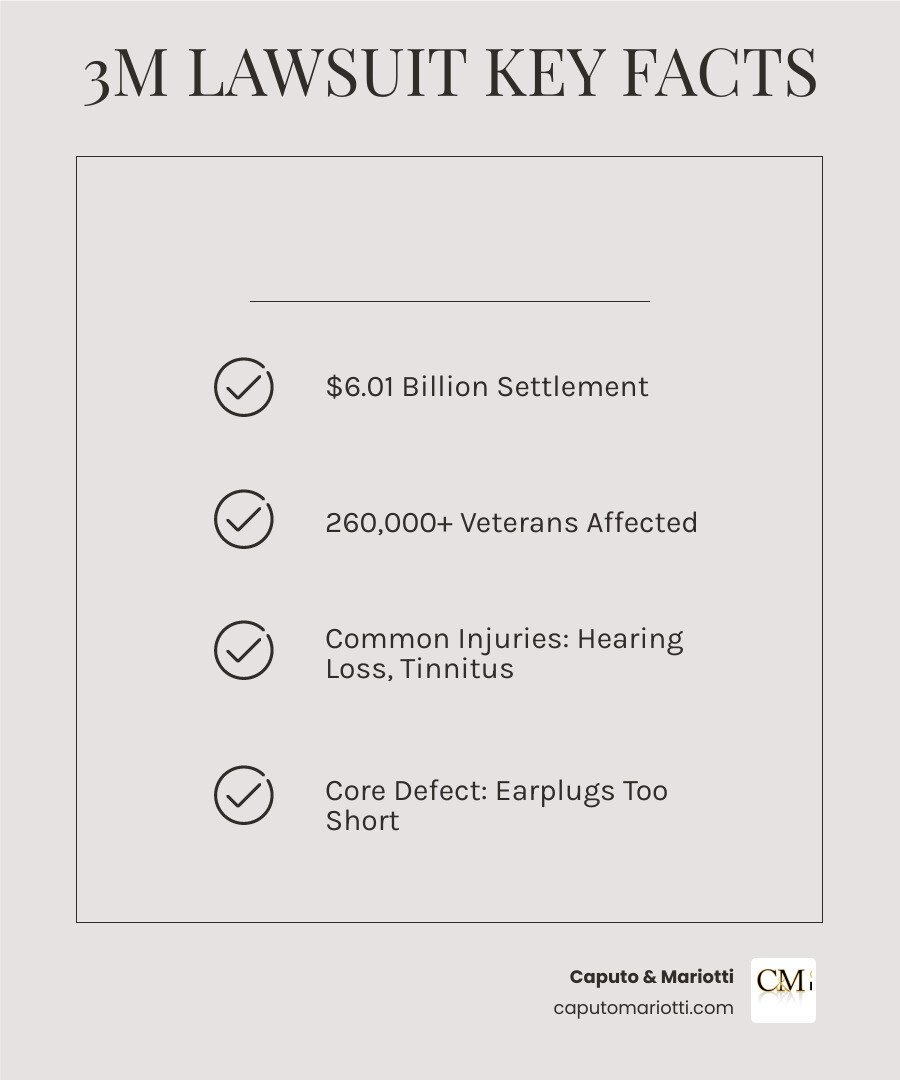
The 3m earplug lawsuit is one of the largest mass tort cases in U.S. history, involving nearly 260,000 military service members and veterans who suffered hearing loss and tinnitus from defective Combat Arms Earplugs Version 2 (CAEv2). Here’s what you need to know:
Key Facts:
- Settlement Amount: $6.01 billion agreed by 3M in August 2023
- Who Was Affected: U.S. military personnel who used CAEv2 earplugs between 2003-2015
- Common Injuries: Hearing loss, tinnitus, balance issues, hyperacusis
- Participation Rate: Over 99% of eligible claimants joined the settlement
- Payment Timeline: Distributions began in 2023 and continue through 2029
- The Problem: Earplugs were too short to maintain a proper seal, allowing harmful noise exposure
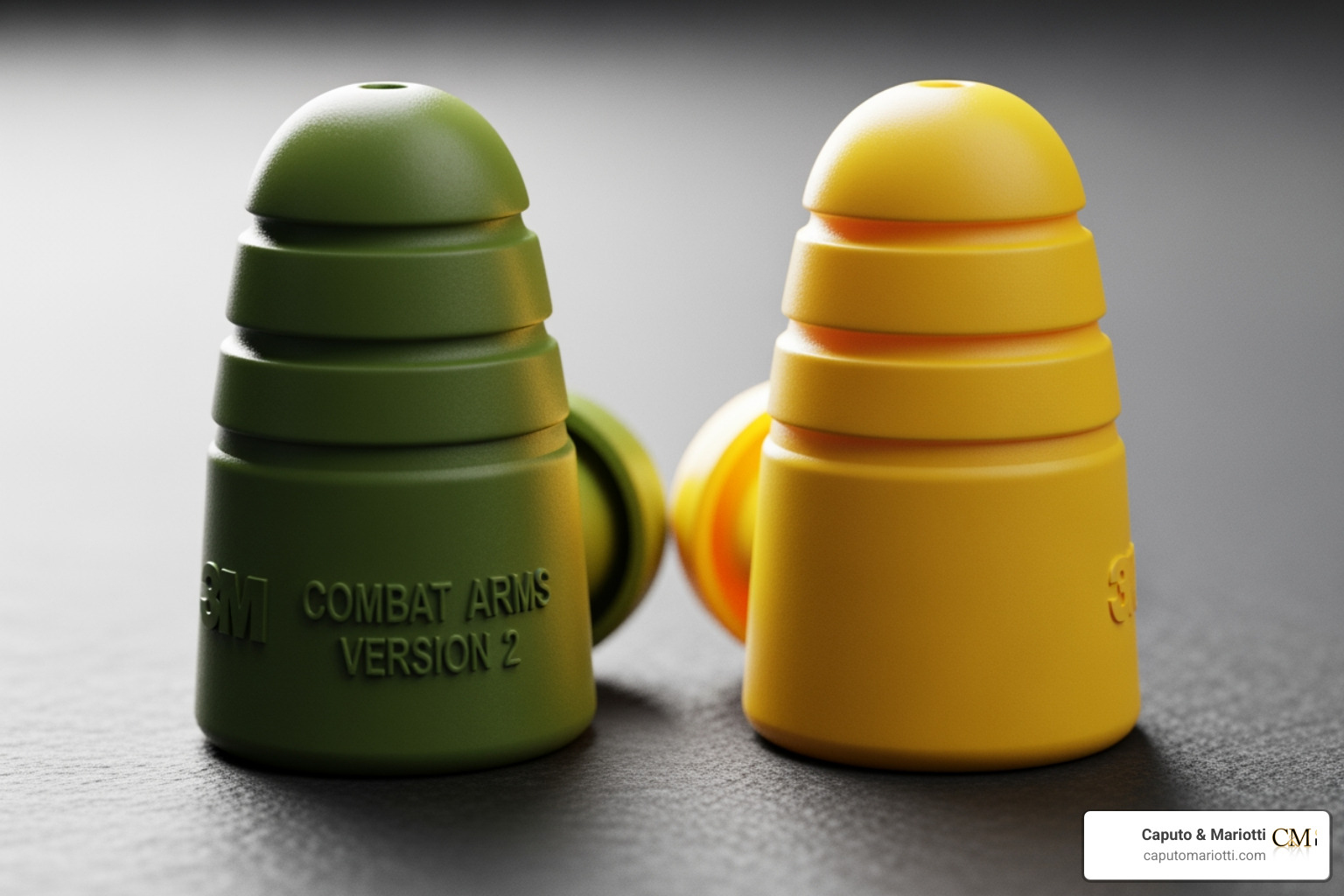
Between 2003 and 2015, 3M manufactured and sold Combat Arms Earplugs to the U.S. military as standard-issue hearing protection. Service members wore these dual-ended earplugs during training exercises and combat operations in Iraq and Afghanistan. However, the earplugs had a critical design flaw—they were too short to properly seal the ear canal. This defect allowed dangerous noise levels to reach service members’ ears, even when they believed they were protected.
What made this case particularly significant was that 3M knew about the defect as early as 2000. Internal safety tests showed the earplugs had a noise reduction rating of zero, yet the company continued selling them to the military for over a decade. In 2016, a whistleblower filed a lawsuit under the False Claims Act, revealing that 3M had knowingly supplied defective equipment. This led to a $9.1 million settlement with the U.S. government in 2018.
The individual lawsuits that followed were consolidated into Multidistrict Litigation (MDL 2885) in Florida federal court—the largest MDL in U.S. history. After several bellwether trials where plaintiffs won 10 out of 16 cases, 3M agreed to the historic $6 billion settlement in August 2023.
I’m Chris Caputo, a personal injury attorney with decades of experience handling complex litigation cases, and I’ve helped clients steer challenging legal battles against major corporations. While the 3m earplug lawsuit registration period has closed, understanding this landmark case demonstrates how dedicated legal representation can hold corporations accountable for harm caused to service members and civilians alike.
The Defective Product and Resulting Injuries
The heart of the 3m earplug lawsuit lies in a product designed to protect our service members but which, in reality, put them at greater risk. The Combat Arms Earplugs Version 2 (CAEv2) were standard issue for military personnel from 2003 to 2015, used extensively during training and deployments, including in Iraq and Afghanistan. These earplugs featured a dual-function design, intended to offer versatile hearing protection. One side, often yellow, was designed to dampen loud impulse noises while still allowing for situational awareness, meaning lower-level sounds like commands could still be heard. The other side, typically green, was meant to act as a traditional noise-canceling earplug, blocking out all sounds. It was a clever concept, but tragically flawed in execution.
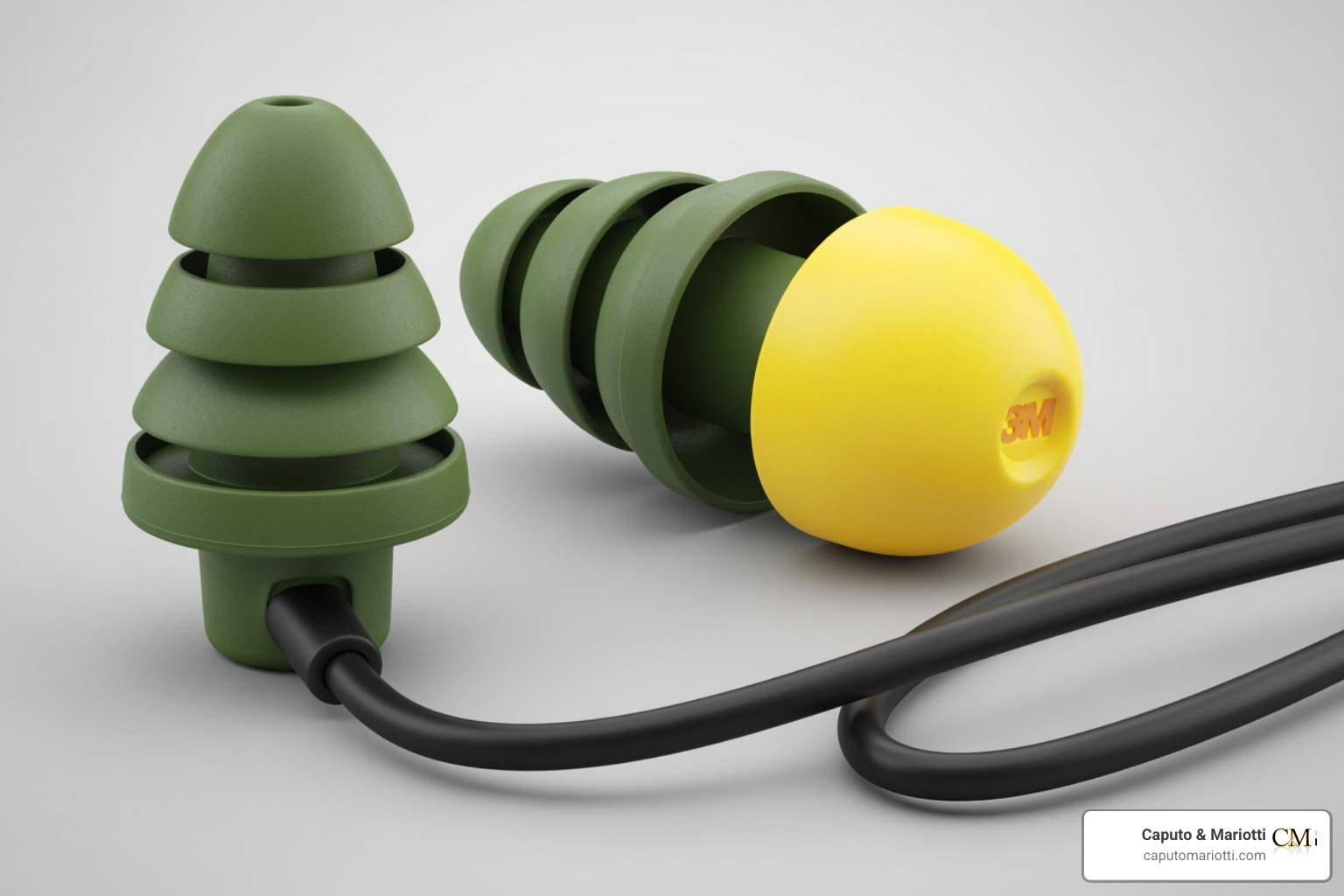
The critical design defect was simple yet devastating: the earplugs were too short to create a proper, consistent seal in the ear canal. This meant they could imperceptibly loosen, allowing dangerous levels of noise to penetrate and damage the delicate structures of the inner ear. Service members, trusting their equipment, often had no idea their hearing was compromised. This wasn’t a manufacturing fluke; 3M, the company behind these earplugs, allegedly knew about this defect as far back as 2000. In-house safety tests conducted that year reportedly revealed the earplugs had a noise reduction rating of zero, effectively rendering them useless for their intended purpose. Despite this knowledge, 3M continued to market and sell these defective earplugs to the U.S. military for years. For more information about the legal issues surrounding defective products, you can explore More info about the earplug lawsuit.
Injuries Suffered by Service Members
The consequences of using these defective earplugs were profound and long-lasting for hundreds of thousands of service members. Exposure to constant loud noises from firearms, explosions, aircraft, and heavy machinery without adequate protection led to a range of debilitating and permanent injuries.
The most common complaints from veterans and service members involved in the 3m earplug lawsuit include:
- Partial or Total Hearing Loss: For many, the damage was severe enough to cause significant or even complete loss of hearing, impacting their ability to communicate and engage with the world around them.
- Tinnitus (Ringing in the Ears): This persistent, often maddening ringing, buzzing, or hissing sound in the ears affects a vast number of veterans. Tinnitus can disrupt sleep, concentration, and overall quality of life, leading to frustration and anxiety.
- Hyperacusis (Sound Sensitivity): Some individuals developed an extreme sensitivity to everyday sounds, where normal noises become painfully loud or irritating.
- Balance Issues: Damage to the inner ear can also affect the vestibular system, leading to problems with balance and coordination.
- Meniere’s disease: While less common, some service members have reported developing Meniere’s disease, a disorder of the inner ear that can cause vertigo, tinnitus, hearing loss, and a feeling of fullness in the ear. You can find more Information on Meniere’s disease for a deeper understanding of this condition.
These injuries not only impact physical health but also lead to significant emotional distress, social isolation, and a diminished quality of life. Many veterans faced substantial medical bills, lost wages, and pain and suffering that went unacknowledged until the litigation brought their plight to light. Understanding the full scope of potential compensation is crucial, which is why we’ve detailed What damages are covered in the 3m earplug lawsuit payout? in a separate resource.
A Historic Legal Battle: The 3M Earplug Lawsuit Explained
The journey to justice for service members and veterans in the 3m earplug lawsuit was a long and arduous one, marked by several key legal battles and rulings. The litigation didn’t begin with individual personal injury claims, but rather with a brave whistleblower. In 2016, a whistleblower filed a lawsuit under the False Claims Act on behalf of the U.S. government, alleging that 3M had knowingly supplied defective earplugs to the military. This lawsuit revealed that 3M was aware of the earplugs’ ineffectiveness as far back as 2000. In July 2018, the Department of Justice announced that 3M had agreed to a $9.1 million settlement with the U.S. government to resolve these allegations. This initial settlement, while not directly compensating injured service members, was a crucial first step, establishing important facts about the defective nature of the earplugs. You can read more about this initial resolution here: 3M’s $9.1 million settlement with the U.S. government.

Following this government settlement, individual service members and veterans began filing their own personal injury lawsuits, seeking compensation for their hearing damage. 3M, naturally, employed various legal defense strategies to shield itself from liability. One significant attempt involved invoking the “government contractor defense,” arguing that they couldn’t be held responsible because the earplugs were supplied according to government specifications. This defense, rooted in cases like Feres v. the United States and Boyle v. United Technologies Corp, typically protects contractors from liability when the government approves their designs. However, the courts largely rejected this argument in the context of the 3m earplug lawsuit, finding that 3M had allegedly misrepresented the product’s capabilities and failed to disclose known defects.
Another controversial strategy by 3M was the attempt to move the lawsuits into bankruptcy court through its subsidiary, Aearo Technologies. In July 2022, Aearo Technologies, which 3M acquired in 2008 and was the original manufacturer of the earplugs, filed for bankruptcy. 3M pledged $1 billion to fund Aearo’s liabilities, a move widely seen as an attempt to cap its financial exposure and channel the hundreds of thousands of lawsuits into a more favorable bankruptcy process. This tactic, sometimes referred to as the “Texas Two-Step” bankruptcy, had been used by other companies facing mass tort litigation. However, a bankruptcy judge dismissed Aearo’s filing in June, citing insufficient financial distress, delivering a significant blow to 3M’s defense strategy and paving the way for the eventual global settlement.
The Largest Mass Tort: Understanding the 3M Earplug Lawsuit MDL
The sheer volume of individual lawsuits filed against 3M quickly necessitated a streamlined legal process. This led to the formation of a Multidistrict Litigation (MDL), a mechanism in the federal court system designed to manage complex cases that share common questions of fact. In January 2019, motions were filed to consolidate these cases, and by March 2020, at least 1,000 3m earplug lawsuit cases were indeed consolidated and transferred to the Northern District of Florida. This MDL, known as MDL 2885, was overseen by U.S. District Judge M. Casey Rodgers.
The 3m earplug lawsuit MDL quickly grew to become the largest MDL in U.S. history. At its peak, it involved hundreds of thousands of claimants, representing approximately 30% of all federal court cases nationwide. This consolidation allowed for efficient pre-trial findy, preventing redundant efforts and ensuring consistent rulings on common legal issues, such as the earplugs’ design, testing, marketing, and 3M’s knowledge of the defects. While often confused with class action lawsuits, an MDL is distinct: individual cases retain their separate identities but benefit from shared evidence gathering and legal arguments before potentially returning to their original districts for trial or settlement. The scale of this litigation underscores the widespread impact of the defective earplugs on our military community. For a more comprehensive look at the legal proceedings, refer to our page on Details on the 3m earplug lawsuit.
Key Rulings and Bellwether Trials in the 3M Earplug Lawsuit
Before a global settlement could be reached in such a massive and complex MDL, it was crucial to test the waters through bellwether trials. These are a small number of representative cases selected from the larger pool of lawsuits and tried before a jury. The outcomes of these trials serve to gauge how juries might react to evidence and arguments, providing both plaintiffs and defendants with valuable insights into the potential value of all claims and influencing settlement negotiations.
The bellwether trials in the 3m earplug lawsuit proved to be highly significant. The first bellwether case in April 2021 found 3M liable for hearing damage suffered by three U.S. military veterans, awarding them a combined $2.1 million in punitive damages and $830,500 in compensatory damages. This initial victory was a powerful indicator for the plaintiffs. Overall, out of 16 bellwether cases that went to trial, 3M lost 10, with approximately $265 million awarded to 13 plaintiffs. These substantial verdicts for the injured service members put immense pressure on 3M, demonstrating the strength of the plaintiffs’ claims and the likelihood of costly judgments if the cases proceeded to individual trials.
Coupled with the court’s dismissal of 3M’s bankruptcy strategy for Aearo Technologies, these bellwether trial results undeniably pushed 3M towards the negotiating table. The company faced mounting legal costs—reportedly spending $450 million in attorneys’ fees by January 2023—and the prospect of continued, unfavorable verdicts. These key rulings and trials were instrumental in setting the stage for the eventual, historic global settlement.
The $6 Billion Settlement: Payouts, Timelines, and Latest Updates
After years of intense litigation, including numerous bellwether trials and 3M’s unsuccessful attempt to use bankruptcy proceedings, a monumental resolution was finally reached. On August 29, 2023, 3M announced a global settlement agreement totaling up to $6.01 billion to resolve the vast majority of the 3m earplug lawsuit claims. This settlement aims to resolve more than 260,000 claims filed by U.S. service members and veterans who suffered hearing injuries.
A truly remarkable aspect of this settlement is the incredibly high claimant participation rate. As of the final registration date, over 99% of eligible claimants chose to participate, with more than 249,000 registering out of a total of over 293,000 claims. This overwhelming participation underscores the trust claimants placed in the legal process and the settlement program. The settlement fund, administered by a dedicated Settlement Administrator, is designed to disburse payments to these claimants over several years. The payment timeline for the $6 billion settlement is structured to occur between 2023 and 2029, ensuring a managed and orderly distribution of funds.
This resolution represents a significant victory for our service members and veterans, providing much-needed compensation for their suffering. It also highlights the critical role of mass tort litigation in holding large corporations accountable for defective products. For detailed information regarding the specifics of the settlement, including payment schedules and eligibility, we encourage you to review our dedicated resource on the Details on the 3m earplug lawsuit settlement.
How Settlement Payouts Are Distributed
The distribution of settlement payouts for the 3m earplug lawsuit is a complex but carefully structured process, designed to ensure fairness and efficiency for the hundreds of thousands of claimants. The settlement program operates under Master Settlement Agreements (MSA I and MSA III), which outline the procedures and criteria for payment.
A core principle guiding the distribution is the First-In, First-Out (FIFO) process. This means that claimants whose registrations and documentation were processed earlier generally receive their payments sooner, as long as all requirements are met. The Settlement Administrator, BrownGreer PLC, manages this intricate process, ensuring that claimants are paid in an organized sequence.
Individual claim values are determined through a comprehensive, points-based system. This system evaluates various factors related to each claimant’s injury and circumstances, including:
- Severity of Injury: The extent of hearing loss (partial or total) and the severity of tinnitus are primary factors. Medical records, audiograms, and other diagnostic tests provide crucial evidence.
- Impact on Quality of Life: How the hearing injuries have affected a veteran’s daily life, employment, and overall well-being.
- Medical Documentation: The completeness and strength of medical records supporting the diagnosis and causality of the injuries.
The settlement includes different payment tiers and programs to address varying degrees of injury. For instance, the Expedited Payment Program (EPP) may be available for claimants meeting certain criteria, while the Extraordinary Injury Fund (EIF) is designated for those with more severe or unusual injuries. As of recent updates, EIF payments have begun in the MSA III “Wave Cases,” with over $13.6 million distributed to hundreds of claimants. This tiered approach ensures that those with the most significant harm receive appropriate consideration.
While individual payouts can vary widely, successful claims have seen payouts ranging from approximately $5,000 to $250,000, depending on the specifics of the injury and the evidence presented. As of May 2025, over $2.8 billion has been funded for claimant payouts, with $2.39 billion already distributed, and over $2.78 billion in payments by September 2025. This ongoing distribution reflects the commitment to compensating our injured veterans. For a detailed breakdown of how individual payouts are calculated and what factors influence your potential compensation, we recommend reading our insights on 3m-earplug-lawsuit-average-payout-what-injured-veterans-need-to-know.
Frequently Asked Questions about the Lawsuit
Navigating a mass tort lawsuit of this magnitude can be confusing, especially with so many moving parts and legal jargon. We understand you likely have many questions, and we’re here to clarify some of the most common inquiries regarding the 3m earplug lawsuit.
Who was eligible to file a claim in the 3M earplug lawsuit?
Eligibility for the 3m earplug lawsuit was primarily focused on U.S. military service members and veterans who used the defective Combat Arms Earplugs Version 2 (CAEv2) and subsequently suffered hearing damage. Specifically, claimants generally needed to meet the following criteria:
- U.S. Military Service: The individual must have been a service member or veteran of the United States military.
- Active Duty Period: They must have served on active duty between 2003 and 2015, the period during which the CAEv2 earplugs were standard issue.
- Use of CAEv2 Earplugs: Crucially, they must have used the 3M Combat Arms Earplugs, Version 2, during their service.
- Diagnosed Injuries: Claimants needed to have a diagnosis of hearing loss or tinnitus (ringing in the ears). Medical records and audiograms were essential to substantiate these injuries.
Eligibility for VA disability benefits for hearing loss or tinnitus did not disqualify service members or veterans from participating in the 3m earplug lawsuit. In fact, many claimants were already receiving VA benefits, and the lawsuit offered an additional avenue for compensation from the manufacturer responsible for their injuries. Our firm has always been committed to helping veterans understand all their avenues for legal recourse, whether through personal injury claims or navigating complex benefit systems.
Is it too late to join the 3M earplug lawsuit?
Unfortunately, if you have not already registered, it is now too late to join the 3m earplug lawsuit. The final registration dates for both the Master Settlement Agreement (MSA I) and the Wave Cases Settlement (MSA III) have passed. As of the final registration date, participation levels exceeded 99%, with over 249,000 claimants already registered to participate in the settlement.
The settlement is currently in its final resolution process, with payments being distributed according to the established timeline (2023-2029). While we recognize the immense impact these defective earplugs have had on our service members, the legal process for this particular mass tort has largely concluded for new claims. This situation underscores the critical importance of being aware of deadlines in mass tort cases. Missing a registration deadline, even by a short period, can mean forfeiting the opportunity to receive compensation. Our team at Caputo & Mariotti consistently emphasizes the need for timely action in all personal injury lawsuits.
How are individual settlement amounts determined?
Determining individual settlement amounts in a mass tort like the 3m earplug lawsuit is a meticulous process designed to account for the unique circumstances and severity of each claimant’s injuries. It’s not a one-size-fits-all payout. Instead, a complex, points-based system is typically employed, which considers several critical factors:
- Severity of Injury: This is paramount. Claimants with more severe hearing loss (e.g., profound hearing loss vs. mild hearing loss) or more debilitating tinnitus (e.g., constant, severe ringing that impacts daily life) generally receive higher points.
- Medical Records and Evidence: Comprehensive and well-documented medical records, including audiograms, ENT specialist reports, and military service records, are crucial. The stronger the medical evidence linking the earplug use to the diagnosed injury, the higher the valuation.
- Impact on Quality of Life: The settlement considers how the hearing damage has affected a claimant’s ability to work, engage in social activities, sleep, and overall enjoyment of life.
- Type of Payment Program: As mentioned earlier, there are different tiers, such as the Expedited Payment Program (EPP) for less severe, more straightforward claims, and the Extraordinary Injury Fund (EIF) for those with more severe or unusual injuries requiring additional review. EIF claims, for example, have seen payouts for specific cases.
While individual results vary greatly, successful lawsuits have generally seen payouts ranging from $5,000 to $250,000. These figures are not guarantees but illustrate the broad spectrum of compensation based on individual circumstances. The goal of this structured approach is to provide equitable compensation, acknowledging that while all injuries are serious, their impact can differ significantly from person to person. Our firm, with its combined 55+ years of experience, understands the nuances of valuing personal injury claims, ensuring that every detail is considered to achieve the best possible outcome for our clients.
Conclusion: A Landmark Injury Lawsuit and Your Legal Rights
The 3m earplug lawsuit stands as a landmark case in American legal history, a powerful testament to the principle of corporate accountability and a significant victory for hundreds of thousands of our nation’s service members and veterans. This litigation, culminating in a $6.01 billion global settlement, highlighted how a company’s alleged negligence and concealment of a defective product could lead to widespread harm among those who served our country. It underscores the critical role that a dedicated personal injury attorney plays in holding powerful corporations responsible for the damage they cause.
For years, service members relied on 3M’s Combat Arms Earplugs, trusting them to protect against the deafening sounds of combat and training. Instead, these defective earplugs allegedly left them vulnerable to debilitating hearing loss and tinnitus. The journey from initial whistleblower allegations and government settlements to the largest Multidistrict Litigation in U.S. history and, finally, a global resolution, was long and complex. It involved meticulous legal strategy, compelling bellwether trials, and unwavering advocacy on behalf of injured veterans. This outcome demonstrates that the legal system, through complex injury lawsuits, can provide a path to justice and hold corporations financially responsible when their products cause harm.
While the registration period for the 3m earplug lawsuit has closed, its legacy continues to shape the landscape of mass torts and product liability. It serves as a stark reminder of the importance of vigilance and the power of collective action when individuals are harmed by negligent manufacturers.
At Caputo & Mariotti, we bring our combined 55+ years of experience, dedicated team, and unwavering commitment to justice to every case we handle. We understand the profound impact that personal injuries can have on individuals and their families. While we are not handling new 3M earplug cases, our expertise in complex litigation, including medical malpractice lawyers and other personal injury claims, means we are always ready to fight for your rights. If you or a loved one in Northeastern Pennsylvania, including Scranton, Wilkes-Barre, Hazleton, or any of our service areas in New York, New Jersey, or Ohio, needs legal support for a personal injury, we invite you to contact us for a consultation. We are here to help you steer your legal options and pursue the justice you deserve.