

The dedicated legal team of Caputo & Mariotti
Got Hurt on the Job in Scranton PA? A Worker’s Guide to Compensation
March 18, 2026
Filing a Lawsuit for a Pennsylvania Work Injury
A work injury can be devastating. While many cases are handled through the workers’ compensation system, this system limits your recovery to medical bills and partial wage loss. It does not compensate you for pain and suffering. However, in certain situations, you may have the right to file a personal injury lawsuit to recover full and fair compensation for all your losses.
Quick Facts About Pennsylvania Work Injury Lawsuits:
- Third-Party Liability: If someone other than your employer or a co-worker caused your injury, you can file a lawsuit against that “third party.”
- Full Damages: A lawsuit allows you to seek damages not available in workers’ comp, including pain and suffering, emotional distress, and full wage loss.
- Statute of Limitations: In Pennsylvania, you generally have two years from the date of injury to file a personal injury lawsuit.
- Employer Negligence: You can sue your employer directly if they intentionally caused your injury or failed to carry the required workers’ compensation insurance.
- No Upfront Fees: Personal injury lawyers typically work on a contingency fee basis, meaning you don’t pay unless they win your case.
The Pennsylvania Workers’ Compensation Act generally provides employers with immunity from lawsuits. However, this protection is not absolute. When the negligence of another company, a defective product, or an employer’s illegal actions cause your injury, a lawsuit may be your best path to justice.
I’m Chris Caputo. For over two decades, I’ve represented injured Pennsylvanians, securing millions for clients in complex personal injury lawsuits arising from work accidents. My background as a former prosecutor and defense attorney provides unique insight into how to build a powerful case against negligent parties and their insurers.
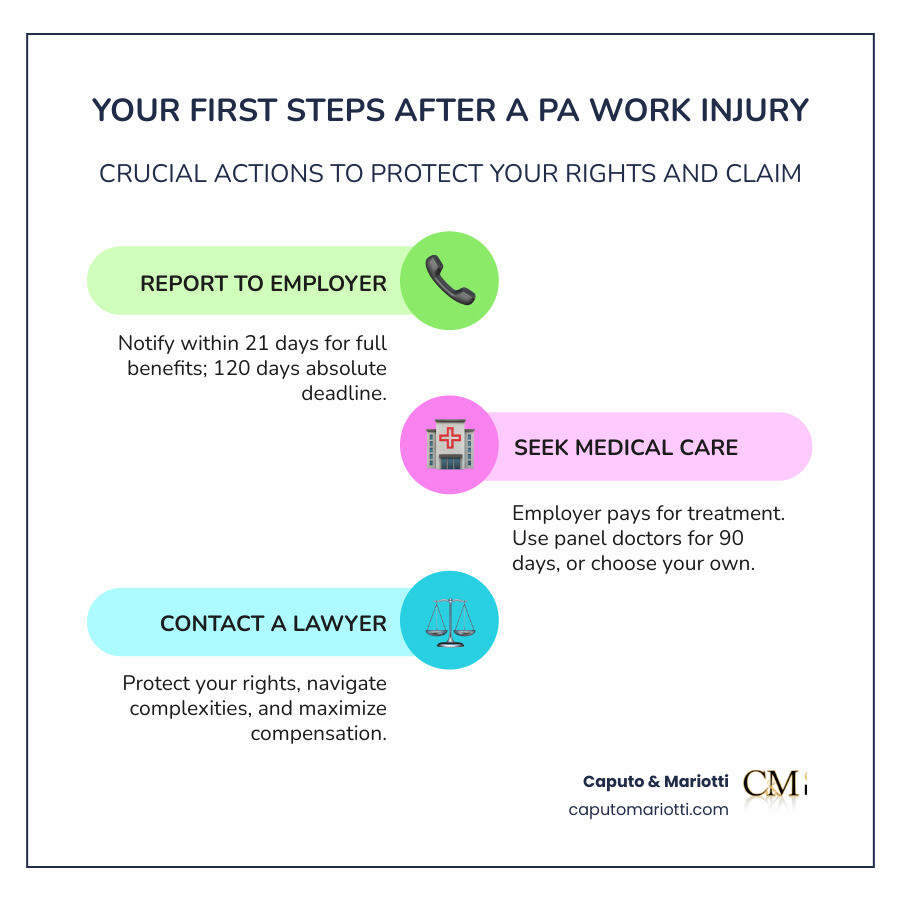
Critical First Steps After a Work Injury
When a work injury occurs, the moments immediately following are critical, not just for your health, but for preserving your legal right to file a lawsuit. We understand that dealing with an injury is a heavy burden, and we’re here to guide you through the process, starting with these fundamental actions.

1. Seek Immediate Medical Attention
Your health is the top priority. Seeking prompt medical care ensures your injuries are properly diagnosed and treated. It also creates an official medical record that serves as crucial evidence, linking your injuries directly to the workplace incident and documenting their severity.
2. Report the Injury to Your Employer
Notify your supervisor about the accident as soon as possible. While reporting is a key part of the workers’ compensation process, it is also a vital step in any potential legal action. Be sure to request a copy of any official incident report that is created.
3. Document Everything and Preserve Evidence
If possible, take photos and videos of the accident scene, the conditions that caused your injury, any equipment involved, and your visible injuries. Gather the names and contact information of any witnesses. It is also critical to preserve any defective product or piece of equipment that caused your harm—do not let it be repaired or discarded, as it is the most important evidence in a potential product liability lawsuit.
4. Contact a Personal Injury Lawyer
Before you give a recorded statement to any insurance adjuster, it is essential to speak with an experienced personal injury lawyer. An attorney can evaluate the circumstances of your work injury to determine if you have grounds for a lawsuit beyond a standard workers’ compensation claim. Every medical visit creates a record vital to your lawsuit, helping prove the extent of your injuries and the need for future care. For more insights, refer to The Role of Medical Evaluations in PA Workers’ Compensation Claims.
When Can You File a Lawsuit for a Pennsylvania Work Injury?
While the Pennsylvania Workers’ Compensation Act is typically the “exclusive remedy” for a work injury, this rule has significant exceptions. A personal injury lawsuit becomes an option when another party’s negligence is involved or when an employer acts outside the protections of the Act.

Third-Party Liability Claims
This is the most common basis for a work injury lawsuit. If your injury was caused by the negligence of a person or company other than your employer or a co-worker (a “third party”), you can sue them for damages. Examples include:
- An injury caused by a negligent subcontractor on a construction site.
- A car accident caused by another driver while you were working.
- An injury from a fall on an icy sidewalk at a property not owned by your employer.
- An attack by a dog while you are making a delivery.
Defective Product Claims
If your work injury was caused by faulty machinery, tools, or safety equipment, you may have a product liability claim against the manufacturer, distributor, or seller. This applies whether the product had a design flaw, a manufacturing defect, or inadequate warnings. Learn more at Product Liability on the Job.
Lawsuits Against an Employer
Though rare, there are situations where you can sue your employer directly:
- Failure to Carry Insurance: If your employer illegally operates without workers’ compensation insurance, they lose their immunity and can be sued for negligence.
- Intentional Injury: If your employer intentionally acted to harm you, their actions fall outside the scope of a workplace accident, and you may file a personal injury lawsuit.
Damages Available in a Work Injury Lawsuit
Unlike the limited benefits of workers’ compensation, a personal injury lawsuit allows you to seek full compensation for all your losses, including:
- Economic Damages: Coverage for all medical bills (past and future), full lost wages and lost earning capacity, and other out-of-pocket costs.
- Non-Economic Damages: Compensation for pain and suffering, emotional distress, scarring and disfigurement, and loss of enjoyment of life.
The Pennsylvania Personal Injury Lawsuit Process
Filing a lawsuit for your work injury involves a structured legal process. An experienced personal injury lawyer guides you through each stage, from the initial investigation to a final resolution, ensuring your rights are protected.
1. Free Consultation and Case Evaluation
The process begins with a free, no-obligation consultation. A lawyer will listen to the details of your accident, review any evidence you have, and determine if you have a valid personal injury claim against a third party or your employer.
2. Investigation and Evidence Gathering
Once you hire an attorney, their legal team will conduct a thorough investigation. This involves collecting police reports, medical records, and witness statements; consulting with experts (such as accident reconstructionists or engineers); and preserving key evidence like defective machinery.
3. Filing a Complaint
Your lawyer will draft and file a formal legal document called a “Complaint.” This document is filed with the court and served on the person or company you are suing (the defendant). It officially starts the lawsuit and outlines your legal claims and the damages you are seeking.
4. The Discovery Phase
During discovery, both sides exchange information and evidence. This is done through formal legal tools, including:
- Interrogatories: Written questions that the other party must answer under oath.
- Requests for Production: Requests for documents, such as maintenance logs or internal reports.
- Depositions: In-person, sworn testimony taken from parties and witnesses outside of court.
5. Negotiation, Mediation, and Settlement
Throughout the process, your attorney will negotiate with the defendant’s insurance company to reach a fair settlement. Many cases are resolved at this stage, sometimes with the help of a neutral third-party mediator. A settlement avoids the risk and expense of a trial.
6. Trial
If the insurance company refuses to offer a fair settlement, your case will proceed to trial. Your attorney will present your evidence and arguments to a judge and jury, who will then decide if the defendant is liable and how much compensation you should receive. An experienced personal injury lawyer is crucial for success at every stage.
Identifying Negligent Parties in a Work Injury Case
While workers’ compensation is the exclusive remedy against your employer for most work injury cases, a successful lawsuit depends on identifying all other responsible parties. An experienced lawyer will investigate to determine if the negligence of a “third party”—someone other than your employer or a co-worker—contributed to your harm.
Filing a Third-Party Claim for a Work Injury
If a third party caused your work injury, you may have a separate personal injury claim. This lets you seek damages not covered by workers’ comp, like pain and suffering.
- Identifying a Negligent Third Party: A third party could be:
- Property Owners: A property owner who fails to maintain a safe environment, leading to a slip and fall or other premises liability accident.
- Other Drivers: A negligent driver who causes a car accident while you are on the job. See also: Heavy Equipment Injury on the Job: Your Legal Rights and How to Seek Compensation.
- Contractors and Subcontractors: On a multi-employer worksite, another company’s employee may create a hazard that injures you.
- Equipment Manufacturers: A defect in machinery, tools, or safety gear that causes your injury can lead to a claim. (see Product Liability on the Job).
- Statute of Limitations: The statute of limitations for most Pennsylvania personal injury claims is two years from the accident date. You must act quickly to protect your right to file a lawsuit.
- Damages Available: A third-party claim allows you to seek broader damages, including pain and suffering, emotional distress, full lost wages, and loss of enjoyment of life.
- Subrogation Lien: If you win a third-party claim, the workers’ comp insurer has a right to be reimbursed from your recovery for the benefits it paid (this is called a subrogation lien). A skilled personal injury attorney can often negotiate this lien down to maximize the amount of money you keep.
Determining all liable parties is complex but can significantly increase your total compensation. For more information, see Understanding Work Site Injuries: What You Need to Know After an Accident. A workers’ compensation lawyer can evaluate your case and advise on all legal options, including a potential third-party lawsuit.
Frequently Asked Questions about Pennsylvania Work Injury Lawsuits
Can my employer fire me for filing a lawsuit for my Pennsylvania work injury?
No. In Pennsylvania, it is illegal for your employer to retaliate against you for exercising your legal rights. This includes firing you for filing a personal injury lawsuit against a negligent third party or for filing a claim directly against the employer when permitted by law (such as when they lack insurance). If you believe you were fired in retaliation for pursuing a claim, you should contact a lawyer immediately.
What if my employer doesn’t have workers’ compensation insurance?
If your employer fails to carry mandatory workers’ compensation insurance, they lose their legal immunity from lawsuits. This is a critical exception that gives you a significant advantage. You can sue your employer directly in civil court for their negligence. In this lawsuit, you can demand full compensation for all your damages, including pain and suffering. The employer also faces criminal prosecution and severe fines for breaking the law.
What damages can I get in a lawsuit that aren’t in workers’ comp?
Workers’ compensation primarily covers medical bills and a percentage (typically two-thirds) of your lost wages, up to a state maximum. A personal injury lawsuit allows you to seek much broader and more complete compensation for the harm you have suffered. This includes:
- Pain and suffering
- Emotional distress and mental anguish
- Full past and future lost wages and benefits
- Loss of enjoyment of life
- Compensation for permanent scarring and disfigurement
- Punitive damages (in cases of extreme or reckless misconduct)
These non-economic damages often represent the most significant part of a recovery and are intended to compensate you for how the work injury has impacted your quality of life.
Conclusion
A work injury can be a life-altering event. While the workers’ compensation system provides a safety net, it often fails to provide full justice for the total harm you’ve suffered. In cases involving negligence by a third party or specific employer misconduct, a personal injury lawsuit may be your path to securing the compensation you truly deserve.
At Caputo & Mariotti, we empower injured workers throughout Northeastern Pennsylvania, including Scranton, Wilkes-Barre, Hazleton, and Dickson City. Our 55+ years of combined experience has shown us that dedicated legal counsel is essential to explore every avenue for recovery, including complex personal injury litigation. We are committed to justice and ensuring you receive fair treatment.
Don’t face the complexities of a Pennsylvania work injury lawsuit alone. Let our team of experienced attorneys guide you.
Contact our Scranton Personal Injury Lawyers for a free consultation today to discuss your case.
Learn more about our Personal Injury services and how we can help you.