

The dedicated legal team of Caputo & Mariotti
How to File a Personal Injury Claim in Pennsylvania in 7 Easy-to-Follow Steps
September 14, 2026
How to File a Personal Injury Claim in Pennsylvania: A Quick Starting Point
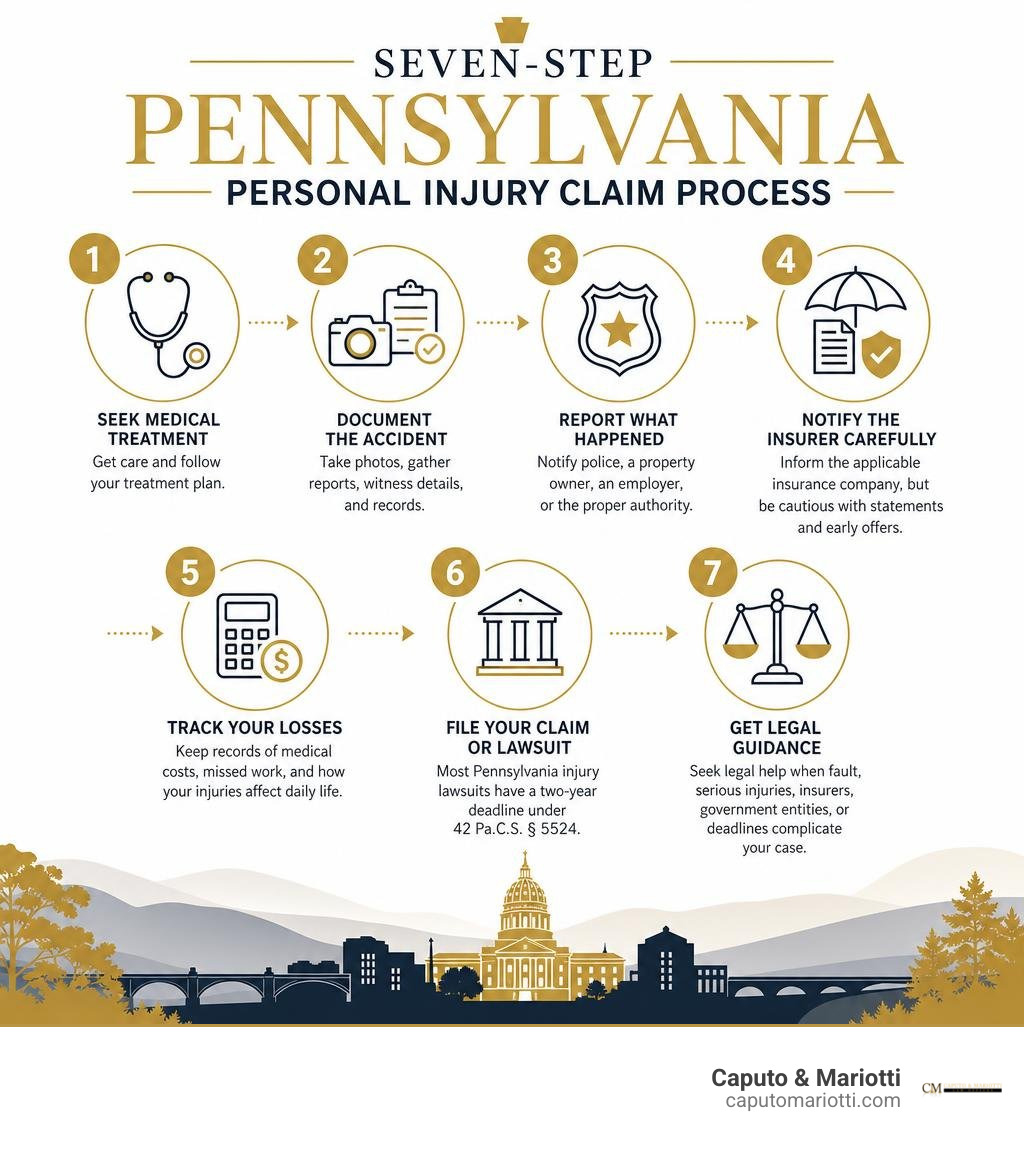
How to file a personal injury claim Pennsylvania usually involves seven core actions: get medical care, preserve evidence, report the incident, notify the insurer carefully, evaluate settlement, file a lawsuit if needed, and prepare for resolution.
- Seek medical treatment and follow your care plan.
- Document the accident with photos, reports, witness details, and records.
- Report what happened to police, a property owner, an employer, or another proper authority.
- Notify the applicable insurance company, but be cautious about recorded statements and early offers.
- Track your losses, including medical costs, missed work, and how injuries affect daily life.
- File your claim or lawsuit on time. Most Pennsylvania injury lawsuits have a two-year deadline under 42 Pa.C.S. § 5524.
- Get legal guidance when fault, serious injuries, insurers, government entities, or deadlines complicate the case.
A strong claim is not just about proving that an accident happened. It is about preserving proof, understanding the rules that affect compensation, and taking action before a deadline closes the door. For example, Pennsylvania generally reduces compensation by your share of fault and bars recovery if you are found 51% or more responsible.
I am Chris Caputo, a Pennsylvania attorney who has represented seriously injured people and families in personal injury, wrongful death, and insurance bad-faith matters for decades. I have handled hundreds of cases, and this guide explains how to file a personal injury claim Pennsylvania residents can pursue with clearer steps and fewer avoidable mistakes.
Step-by-Step Guide: How to File a Personal Injury Claim in Pennsylvania

Navigating the legal landscape after an unexpected injury can feel overwhelming. However, breaking down how to file a personal injury claim pennsylvania into distinct, actionable steps helps ensure that your rights remain protected throughout the entire process. Whether your injury stems from a motor vehicle collision in Scranton or a slip-and-fall in Wilkes-Barre, following a structured path protects both your physical well-being and your right to fair financial recovery.
Step 1: Seek Immediate Medical Treatment and Document Your Care
Your health and safety must always take top priority following an accident. Seeking immediate medical care is critical not only for your physical recovery, but also for building a solid foundation for your legal claim.
When you undergo a prompt medical evaluation at an emergency room, urgent care center, or physician’s office, medical staff record the exact nature and immediate extent of your injuries. Insurance companies routinely scrutinize gaps in treatment; if you delay seeking medical attention for days or weeks, insurance adjusters will almost certainly argue that your injuries were either exaggerated or unrelated to the incident.
To establish clear evidence for your recovery:
- Follow every doctor’s recommendation: Attend all physical therapy sessions, specialist consultations, and diagnostic tests.
- Keep a central file of health records: Retain hospital discharge instructions, prescriptions, diagnostic images, and billing receipts.
- Maintain an injury and recovery log: Keep a detailed journal describing your day-to-day pain levels, mobility restrictions, missed family events, and emotional distress.
- Document ongoing treatment plans: Secure written statements from your treating physicians outlining any anticipated long-term care or future surgical needs.
Step 2: Gather Essential Evidence to Support Your Claim
Solid physical and documentary evidence is the backbone of any successful lawsuit. While memories fade over time, contemporaneous records offer permanent proof of how an incident occurred and who was at fault.
As outlined in our guide on Understanding Personal Injury Claims in Scranton: A Comprehensive Guide, compiling evidence as early as possible prevents critical details from slipping away.
Key evidentiary materials to gather include:
- Accident site photographs: Clear pictures of the exact location, road or physical conditions, property damage, skid marks, lighting, and any visible bodily injuries.
- Witness contact information: Names, phone numbers, physical addresses, and email contact details for anyone who observed the incident.
- Police crash reports or incident logs: Official law enforcement summaries or commercial property incident files.
- Proof of financial losses: Pay stubs, tax documents, and employer verification letters demonstrating time missed from work and lost earnings.
Step 3: Report the Incident to Proper Authorities
To legally substantiate your claim, you must officially report the event to the appropriate governing body or entity immediately:
- Motor Vehicle Collisions: Under Pennsylvania law, traffic accidents resulting in injury, death, or severe vehicle damage must be reported to local police or the Pennsylvania State Police without delay.
- Commercial Property Slip-and-Falls: Report the fall immediately to the store manager or property owner, ensure they complete an official incident report, and request a written copy for your files before leaving.
- Workplace Accidents: If your injury occurs on the job, you must report it promptly to your supervisor. When navigating workplace injuries alongside third-party personal injury actions, consulting a skilled workers’ compensation lawyer ensures your benefits are properly protected. Under Pennsylvania’s no-fault system, injured employees can receive benefits regardless of fault. You must meet strict reporting requirements by notifying your employer within 21 days (and no later than 120 days) of the injury. Initial medical treatment must be obtained from an employer-designated panel of healthcare providers during the first 90 days. Proper claim preparation involves rigorous evidence gathering including statements from eye-witnesses and co-workers, job site incident logs, and medical records. Detailed documentation of all income loss, medical bills, and daily physical limitations is vital. If your employer or insurer denies your claim, formal filing procedures require submitting an Employee’s Claim Petition for Compensation to the Pennsylvania Bureau of Workers’ Compensation and pursuing necessary legal appeals before Workers’ Compensation Judges and the Appeal Board.
Step 4: Handle Insurance Adjusters Cautiously
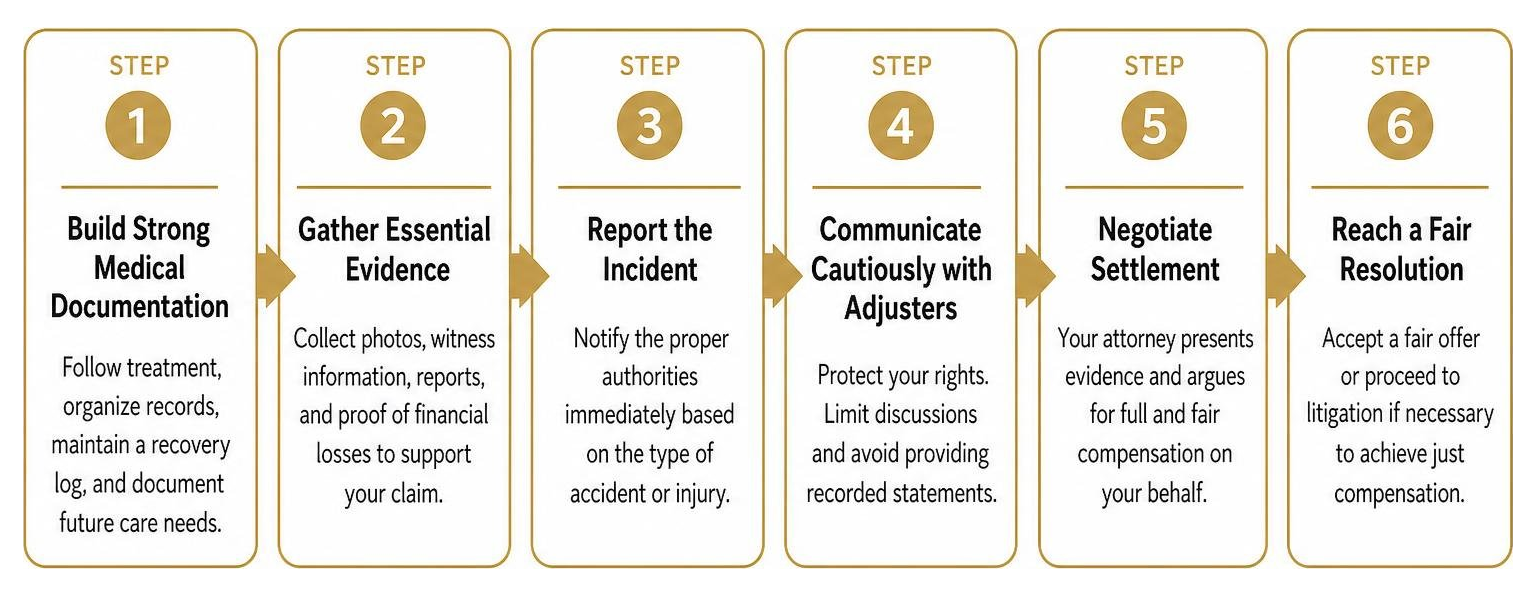
Shortly after an accident is reported, insurance adjusters representing the responsible party will contact you. While adjusters may sound polite and helpful, their main objective is to minimize the amount of money the insurance company pays out.
When interacting with insurance claims representatives, always follow these precautions:
- Refuse recorded statements: You are under no obligation to provide a recorded statement or answer detailed cross-examination questions without legal representation present.
- Stick strictly to the basic facts: Do not offer unsolicited opinions, admit partial fault, or speculate on the extent of your injuries before you reach maximum medical improvement.
- Reject premature settlement offers: Early settlement offers from insurance companies almost always under value your long-term medical costs and pain and suffering. Review our detailed guide on Mastering the Settlement Process: Maximizing Compensation and Concluding Your Personal Injury Claim before signing any liability release forms.
Step 5: Understanding How to File a Personal Injury Claim in Pennsylvania Court Actions
When pre-lawsuit insurance negotiations fail to yield fair compensation, formally initiating a civil lawsuit becomes necessary. Filing a civil action in Pennsylvania requires specific formal steps within the appropriate court jurisdiction, such as the Court of Common Pleas in Lackawanna or Luzerne County.

- Drafting the Civil Complaint: Your attorney drafts a legal document called a “Complaint.” This pleading sets forth the underlying facts, legal counts of negligence, and specific monetary damages demanded from the defendant.
- Filing with the Court Clerk: The complaint is formally docketed with the local prothonotary or clerk of court, accompanied by required court administrative fees.
- Formal Service of Summons: Sheriff deputies or professional process servers officially deliver the summons and complaint to each named defendant, establishing formal legal jurisdiction.
If you are preparing to navigate this process, review our resource on Personal Injury Attorney in Scranton and Wilkes-Barre, PA or take time to Schedule a Legal Consultation with our dedicated legal team.
Step 6: Navigate Discovery and Pre-Trial Settlement Negotiations
Once court proceedings formally commence, both parties enter the “discovery” phase. Discovery allows each side to examine the opponent’s evidence and legal theories, fostering transparency and revealing the true strength of the claim.
The discovery process involves:
- Interrogatories: Written questions served on opposing parties that must be answered truthfully under oath.
- Requests for Production of Documents: Formal demands for complete medical records, maintenance logs, phone records, and financial receipts.
- Depositions: In-person oral examinations where attorneys cross-examine parties and expert witnesses under oath before a court reporter.
As evidence comes to light, the parties often participate in formal mediation sessions or court-ordered settlement conferences to resolve the dispute prior to trial. To understand every stage of court-administered proceedings, explore The Legal Process in Personal Injury Cases: A Step-by-Step Guide.
Step 7: Proceed to Trial and Final Resolution
If settlement negotiations fail during discovery or mediation, your case will proceed to trial before a judge or jury.
At trial, both sides deliver opening statements, present expert medical and accident-reconstruction testimony, cross-examine opposing witnesses, and deliver closing arguments. The jury then deliberates to render a verdict determining legal liability and assigning financial damages. If the jury rules in your favor, a court judgment is entered, paving the way for financial recovery and formal case closure.
Critical Deadlines and Legal Rules Impacting Your Claim
Understanding procedural rules and statutory time frames is vital when evaluating how to file a personal injury claim pennsylvania. Missing a single legal deadline can permanently bar you from seeking compensation, regardless of how clear the defendant’s liability may be.
Statute of Limitations Under 42 Pa.C.S. §5524
In Pennsylvania, the statute of limitations for general personal injury claims is governed by 42 Pa.C.S. §5524. Under this statute, injured victims have exactly two years from the date the injury occurred to file a lawsuit in a court of law.
For additional insight into strict statutory time limits, consult our resource on Understanding the Statute of Limitations for Personal Injury Cases in Scranton as well as external guidance on Pennsylvania Personal Injury Statute of Limitations . Missing this explicit statutory window results in the automatic dismissal of your court filing.
Exceptions for Minors and Wrongful Death Claims
Pennsylvania statutory law provides specific variations for minor victims and wrongful death claims:
- Minor Tolling Rule (42 Pa.C.S. §5533): When a child under age 18 sustains a personal injury, the standard two-year clock does not begin ticking until the child reaches their 18th birthday. Consequently, a minor typically has until their 20th birthday to initiate personal injury litigation. However, that parents’ separate legal claims for medical expenses incurred on behalf of the minor remain subject to the general two-year deadline from the date of injury.
- Wrongful Death Claims: Wrongful death actions must be filed within two years of the date of death, which may differ from the date the initial accident or injury took place.
Application of the Discovery Rule
In limited cases, an injured person may not immediately know that they have suffered harm or that the harm was caused by someone else’s conduct—such as in complex medical malpractice cases involving latent surgical errors or hidden internal injuries.
Under Pennsylvania’s discovery rule, the two-year statute of limitations clock is paused (“tolled”) until the injured individual knows, or reasonably should have known through due diligence, that they suffered an injury caused by another party’s conduct.
However, medical malpractice claims are also governed by the Medical Care Availability and Reduction of Error (MCARE) Act, which imposes a seven-year statute of repose capping most medical malpractice claims regardless of when the injury was discovered.
Key Requirements for How to File a Personal Injury Claim in Pennsylvania Against Government Entities
Special rules apply if your injury involves a government employee, state agency, or municipal entity—such as being hit by a city bus or slipping on poorly maintained government property in Lackawanna County or Luzerne County.
Under 42 Pa.C.S. §5522, you must serve a formal written notice to the relevant government unit within six months of the date of the injury. For claims against state agencies, written notice must also be submitted to the Pennsylvania Attorney General’s office. Failing to provide this required six-month notice will bar your lawsuit, even if you attempt to file a formal complaint within the general two-year statute of limitations.
Pennsylvania’s Modified Comparative Negligence Rule
Pennsylvania operates under a modified comparative negligence system governed by 42 Pa.C.S. §7102. This law determines how damages are awarded when an injured person shares partial responsibility for an accident.
Under the 51 percent rule:
- You can recover damages as long as your percentage of fault is 50% or less.
- Your final financial recovery will be reduced in proportion to your percentage of fault. For example, if a jury determines your total losses are $100,000 but assigns you 20% fault, your financial recovery is reduced to $80,000.
- If you are found to be 51% or more at fault, you are completely barred from recovering any financial compensation.
Recoverable Damages in Pennsylvania Injury Claims
When learning how to file a personal injury claim pennsylvania, it is essential to recognize the types of financial recovery available to compensate you for your losses.
- Economic Damages: These cover direct, quantifiable financial losses, including:
- Emergency room costs, doctor visits, and hospital bills.
- Future medical expenses, physical therapy, and prescription costs.
- Past lost wages, missed employment bonuses, and diminished future earning capacity.
- Non-Economic Damages: These address non-financial, subjective impacts on your quality of life, including:
- Physical pain and suffering.
- Emotional distress, anxiety, and post-traumatic stress.
- Loss of life’s pleasures and inability to participate in hobbies.
- Permanent scarring, disfigurement, or physical disability.
To explore how these damages apply to your specific situation, review Explore Pennsylvania Personal Injury Representation Options.
Frequently Asked Questions About Filing a Claim
What is Pennsylvania’s modified comparative negligence rule and how does it affect my claim?
Pennsylvania’s modified comparative negligence rule (42 Pa.C.S. §7102) allows you to recover compensation as long as you are 50% or less at fault for the incident. Your final financial award is reduced directly by your percentage of responsibility. If you are found 51% or more at fault, you are barred from recovering any damages from the other driver or party.
How long do I have to notify a government entity before filing an injury claim in Pennsylvania?
Under 42 Pa.C.S. §5522, you must deliver formal written notice to the local municipal entity or state agency within six months of the injury date. Missing this six-month deadline will bar your claim before you can even file a formal lawsuit in court.
When does the discovery rule apply to pause the two-year deadline in Pennsylvania?
The discovery rule pauses the two-year statute of limitations when an injury or its cause cannot reasonably be discovered right away. The two-year clock begins only when the injured victim discovers—or, through reasonable diligence, should have discovered—the harm caused by another party’s legal fault.
Conclusion
Understanding how to file a personal injury claim pennsylvania requires careful attention to detail—from seeking immediate medical treatment and collecting crucial physical evidence to navigating complex court procedures and satisfying strict statutory deadlines. Taking prompt action preserves evidence, protects your rights under Pennsylvania law, and ensures insurance adjusters treat your claim fairly.
At Caputo & Mariotti, our legal team brings over 55 years of combined experience representing injured individuals and families throughout Scranton, Wilkes-Barre, Moosic, Pittston, Hazleton, Dickson City, and across Northeastern Pennsylvania. We understand the emotional and financial strain an unexpected injury causes, and we stand dedicated to securing the justice and compensation you deserve.
If you or a family member has been injured due to someone else’s negligence, do not attempt to navigate complex legal deadlines alone. To learn more about your options or discuss your case with an experienced attorney, Contact Experienced Pennsylvania Legal Counsel today for a free, no-obligation evaluation. Additional resources can also be found in A Complete Guide To Filing A Personal Injury Claim In Pennsylvania – Stonesmentor .