
The dedicated legal team of Caputo & Mariotti
Step-by-Step Guide to How to Sue a Trucking Company in Pennsylvania
July 13, 2026
What You Need to Know About How to Sue a Trucking Company in Pennsylvania
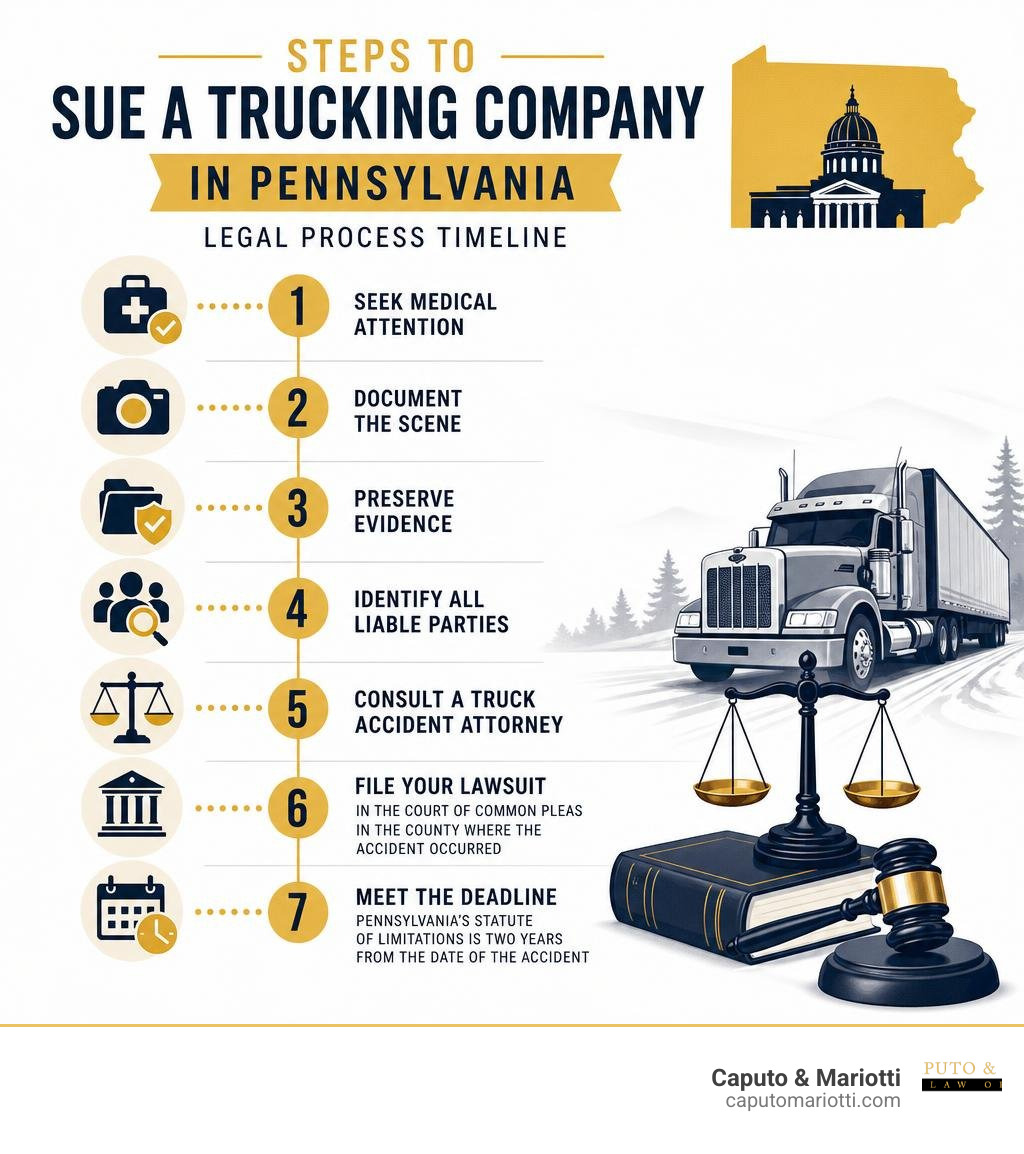
If you’re trying to figure out how to sue a trucking company in Pennsylvania, here are the core steps:
- Seek medical attention immediately after the crash
- Document the scene — photos, the truck’s DOT number, driver info, and witness contacts
- Preserve evidence — send a spoliation letter to the trucking company right away
- Identify all liable parties — the driver, the trucking company, or both
- Consult a truck accident attorney before speaking to any insurance company
- File your lawsuit in the Court of Common Pleas in the county where the accident occurred
- Meet the deadline — Pennsylvania’s statute of limitations is two years from the date of the accident
Truck accident claims in Pennsylvania are far more complex than a typical car crash. You’re up against a large commercial carrier, federal regulations, multiple insurance layers, and a legal team that often starts protecting the company’s interests within hours of the collision. The injuries are often catastrophic. The stakes are high.
And most victims don’t know where to start.
That’s exactly what this guide is for.
I’m Chris Caputo, a Pennsylvania personal injury attorney with decades of litigation experience — including complex multi-party cases — and I’ve helped injured victims pursue full compensation against some of the most well-funded defendants in the state, which is precisely the kind of fight that comes with suing a trucking company in Pennsylvania. Read on for a clear, step-by-step breakdown of everything you need to know.
Suing the Driver vs. the Trucking Company in Pennsylvania
When you are hit by an 80,000-pound tractor-trailer on Interstate 81 or Route 315, your first instinct is likely to blame the person behind the wheel. While the driver is often the direct cause of the crash, Pennsylvania law allows you to look beyond the driver’s seat. In fact, naming both the driver and the trucking company as co-defendants is usually the most strategic path to securing full compensation.
The legal mechanism that allows us to hold a trucking company responsible for its driver’s mistakes is known as vicarious liability (specifically under the doctrine of respondeat superior). This legal rule states that an employer is liable for the negligent acts of its employees, provided those acts were committed within the “scope of employment.”
However, there is a major loophole that trucking companies love to exploit: the “independent contractor” defense.
Many trucking companies deliberately label their drivers as independent contractors rather than employees to dodge liability. If a driver is truly an independent contractor, the company might argue it cannot be held vicariously liable for the crash. But here is the good news: Pennsylvania courts do not just take the company’s word for it. We look at the actual working relationship. If the trucking company controls the driver’s schedule, routes, equipment, and daily methods, we can argue they are legally an employee, opening the door to a lawsuit against the company.
Understanding these employment relationships is just one of the many intricacies of commercial truck accidents that make these cases vastly different from standard passenger vehicle claims. Navigating these dual-party claims requires a thorough analysis of employment contracts, dispatch logs, and corporate control to ensure all responsible parties are held accountable.
How to Sue a Trucking Company Pennsylvania: Direct Negligence vs. Vicarious Liability
When building a case, we don’t just rely on what the driver did wrong in the seconds leading up to the crash. We also look at what the trucking company did wrong days, weeks, or even months before the truck ever hit the road. This is where we separate vicarious liability from direct negligence.
While vicarious liability holds the company responsible for the driver’s immediate actions, direct negligence claims hold the company accountable for its own systematic failures. By pursuing both avenues, we maximize your chances of a successful recovery and uncover patterns of safety violations that can significantly increase the value of your claim.
To successfully navigate these overlapping legal theories, it is essential to understand how Pennsylvania courts assign fault. You can learn more about this process in our guide on navigating truck accident liability.
Direct Negligence Claims in How to Sue a Trucking Company Pennsylvania
Direct negligence occurs when the trucking company’s own corporate policies, or lack thereof, directly contribute to the accident. Common examples of direct negligence include:
- Negligent Hiring and Retention: Hiring a driver with a history of DUIs, severe safety violations, or an expired Commercial Driver’s License (CDL), or keeping them on the payroll after repeated safety issues.
- Negligent Training: Failing to properly train drivers on how to handle heavy rigs, secure cargo, or navigate hazardous winter weather in Northeastern Pennsylvania.
- Failure to Maintain Safe Vehicles: Deferring critical maintenance on brakes, tires, and steering systems to keep trucks on the road and maximize corporate profits.
- FMCSA Regulation Violations: Pressuring drivers to ignore federal safety rules, such as driving past their legal hourly limits, to meet unrealistic delivery deadlines.
Proving these claims requires a deep dive into the company’s internal operations. This is why understanding truck accident investigations is the most critical phase of your lawsuit. We subpoena internal emails, safety records, and training logs to prove the company put its bottom line ahead of public safety.
Vicarious Liability Under Respondeat Superior
Under respondeat superior, the trucking company is automatically liable for the driver’s negligence, even if the company itself did nothing wrong. If the driver fell asleep at the wheel, ran a red light, or was texting while driving, the company shares the blame.
The catch? The driver must have been acting within the scope of their employment. If a driver took the company semi-truck on an unauthorized, late-night joyride to a local diner while off-duty, the company might escape vicarious liability.
To help clarify the differences between these two legal approaches, consider the following comparison:
| Legal Feature | Vicarious Liability (Respondeat Superior) | Direct Negligence |
|---|---|---|
| Legal Basis | Employer is responsible for employee actions. | Company is responsible for its own actions. |
| What Must Be Proven | The driver was negligent and was acting as an employee within the scope of work. | The company breached its duty (e.g., poor maintenance, bad hiring) and caused the crash. |
| Corporate Conduct | Does not require proof of corporate wrongdoing. | Requires proof of corporate systemic failures. |
| Impact on Case | Provides access to the company’s large commercial insurance policies. | Can expose patterns of safety violations, often opening the door to punitive damages. |
To understand which strategy fits your specific situation, it is highly beneficial to have an experienced legal team evaluate the unique details of your crash and determine the most effective path forward.
Crucial Evidence and Regulations in Pennsylvania Truck Lawsuits
To win a lawsuit against a commercial carrier, you cannot rely on conflicting verbal testimony. Trucking companies and their insurers deploy rapid-response defense teams to the accident scene within hours of a crash to gather evidence, take photos, and build a narrative that minimizes their liability. To level the playing field, we must act just as quickly to preserve and analyze critical evidence.
Every commercial truck on Pennsylvania roads is subject to a mountain of state and federal regulations. Uncovering violations of these rules is often the key to unraveling the truth in truck accidents.
Preserving Electronic Logging Device (ELD) and Dashcam Data
Modern commercial trucks are essentially rolling computers. They generate massive amounts of digital evidence that can reconstruct the exact moments leading up to an accident.

This digital evidence includes:
- Electronic Logging Device (ELD) Data: ELDs automatically record a driver’s driving time, engine hours, and duty status, making it incredibly difficult for drivers to falsify their logbooks.
- The “Black Box” (Electronic Control Module): This device records vehicle speed, brake application, throttle position, and steering angles during the seconds before a collision.
- Dashcam Footage: Forward-facing and driver-facing cameras can show exactly what caused the crash and whether the driver was distracted or fatigued.
Warning: This evidence is highly temporary. Federal regulations only require trucking companies to retain Hours of Service (ELD) records for six months. Even worse, many onboard dashcams automatically overwrite footage within 30 days.
To prevent this critical data from being erased, we immediately draft and send a formal spoliation letter to the trucking company. This legal document puts the carrier on notice that they must preserve all digital, physical, and paper records related to the crash. If they destroy or overwrite evidence after receiving this letter, they can face severe sanctions in court.
The Role of Federal Regulations in How to Sue a Trucking Company Pennsylvania
The Federal Motor Carrier Safety Administration (FMCSA) sets strict safety standards that all interstate motor carriers must follow. When we prove a trucking company violated these rules, it serves as powerful evidence of negligence in a Pennsylvania court. Key regulations we investigate include:
- Hours of Service (HOS) Limits: Under federal law, commercial drivers are limited to a maximum of 11 hours of driving per day after 10 consecutive hours off duty. They must also take a mandatory 30-minute break after 8 consecutive hours of driving.
- Weight Restrictions: Commercial trucks are capped at a maximum weight of 80,000 pounds. Overloaded trucks require longer stopping distances and are highly prone to brake failure.
- Commercial Driver’s License (CDL) Standards: Drivers must meet strict medical, physical, and background requirements to operate an 18-wheeler.
Violating these rules isn’t just a minor administrative issue; it is a direct threat to public safety. For a comprehensive look at how these rules affect your personal injury lawsuit, read our guide on navigating trucking regulations.
Pennsylvania Insurance, Comparative Negligence, and Workers’ Compensation
Pennsylvania has several unique auto insurance and liability laws that directly impact your ability to recover compensation after a truck accident. Navigating these rules requires a strategic approach to ensure you do not leave money on the table. For a detailed roadmap on securing the maximum financial recovery, see our guide on maximizing compensation in truck accidents.
Overcoming Limited Tort in Truck Accident Claims
Pennsylvania is a “choice no-fault” state, meaning drivers must choose between “limited tort” and “full tort” coverage when purchasing auto insurance.
If you selected full tort, you retain the unrestricted right to sue the at-fault party for all economic losses (medical bills, lost wages) as well as non-economic damages, such as pain and suffering.
If you selected limited tort, you saved a few dollars on your monthly premium, but in exchange, you gave up your right to sue for pain and suffering unless your injuries meet the legal definition of a “serious injury.” Pennsylvania law defines a serious injury as one resulting in death, permanent serious disfigurement, or serious impairment of a body function.
Fortunately, because commercial truck accidents involve massive forces, the resulting injuries—such as traumatic brain injuries, spinal cord damage, complex fractures, and internal organ damage—almost always easily clear the “serious injury” threshold, allowing us to bypass limited tort restrictions and pursue full compensation.
How Pennsylvania’s 51% Bar Rule Affects Your Recovery
Trucking company insurance adjusters will do everything they can to shift the blame to you. They might claim you were speeding, tailgating, or lingering in the truck’s blind spot (the “No-Zone”).
Pennsylvania operates under a modified comparative negligence system with a 51% bar rule. This means:
- You can recover compensation as long as your share of the blame is 50% or less.
- Your final financial recovery will be reduced by your percentage of fault. For example, if a jury awards you $100,000 but finds you 20% at fault for the crash, your final recovery will be $80,000.
- If you are found to be 51% or more at fault, you are legally barred from recovering a single penny.
Because the stakes are so high, having an experienced legal team to counter these finger-pointing tactics is essential.
What if You Were a Truck Driver Injured on the Job?
If you are a commercial truck driver who was injured in a crash while working in Northeastern Pennsylvania, your legal options look slightly different. Instead of immediately filing a lawsuit, your primary avenue for recovery is through the state’s workers’ compensation system.
Pennsylvania’s workers’ compensation program is a no-fault system. This means you do not have to prove your employer or another driver did anything wrong to receive benefits; you only need to show that your injury occurred in the course and scope of your employment.
To protect your rights, you must follow these strict procedures:
- Report the Injury: You must notify your employer of the accident within 21 days to guarantee retroactive benefits, and absolutely no later than 120 days, or your claim will be barred.
- Seek Approved Medical Treatment: For the first 90 days of your treatment, you must see a doctor from your employer’s designated list of providers (if they have posted one).
- Gather Evidence: Document the scene, gather witness contact details, and keep detailed records of all medical evaluations and treatment plans.
- File Your Claim: If your employer denies your claim, you must file a formal claim petition with the Bureau of Workers’ Compensation.
- Navigate Appeals: If a workers’ compensation judge denies your petition, we can guide you through the formal appeals process to fight for your benefits.
Navigating this system while recovering from serious injuries can be incredibly overwhelming. Consulting a dedicated workers’ compensation lawyer ensures your medical bills are paid, your lost wages are covered, and your future is protected.
Frequently Asked Questions About Suing a Trucking Company in PA
What is the statute of limitations for a truck accident lawsuit in Pennsylvania?
In Pennsylvania, the statute of limitations for personal injury and wrongful death claims is two years from the date of the accident or death. If you do not file a formal lawsuit in the Court of Common Pleas within this two-year window, you permanently lose your right to seek compensation.
However, you should never wait until this deadline approaches. As mentioned earlier, critical electronic evidence like black box data and dashcam footage can be destroyed or overwritten in as little as 30 days. The sooner we can begin investigating, the stronger your case will be.
What damages can i recover when suing a trucking company?
When you sue a trucking company, you can pursue three main types of damages:
- Economic Damages: These are measurable financial losses, including past and future medical bills, rehabilitation costs, lost wages, loss of earning capacity, and property damage.
- Non-Economic Damages: These compensate you for physical pain and suffering, emotional distress, loss of enjoyment of life, and permanent disfigurement or disability.
- Punitive Damages: Unlike economic and non-economic damages, punitive damages are not meant to compensate you. Instead, they are designed to punish the defendant for extremely reckless or egregious conduct (such as a trucking company knowingly putting a driver with multiple active DUIs on the road) and to deter similar behavior in the future.
When should I contact an attorney after a commercial truck crash?
You should contact an attorney immediately after a crash. Trucking companies do not wait to build their defense; they have rapid-response teams on the ground within hours to protect their bottom line.
Before you speak to an insurance adjuster, sign any paperwork, or accept an early settlement offer, you need an advocate on your side. An early settlement offer is almost always a lowball figure designed to make your claim go away before you realize the full extent of your injuries. Understanding the critical role of legal representation is your first and best defense against these corporate tactics.
Conclusion
Suing a trucking company in Pennsylvania is a complex, high-stakes battle. You aren’t just fighting a driver; you are taking on multi-million dollar trucking corporations, aggressive insurance defense firms, and complicated federal safety regulations.
At Caputo & Mariotti, we bring more than 55 years of combined experience to the table. Our dedicated team is committed to standing up for injured victims in Scranton, Wilkes-Barre, Pittston, Hazleton, Dickson City, Moosic, and across Lackawanna and Luzerne Counties. We have the resources, the knowledge, and the unwavering commitment to justice needed to hold negligent trucking companies accountable and secure the maximum compensation you deserve.
Don’t let a trucking company push you around. Contact us today for a free consultation to discuss your case and learn how we can help you get your life back on track.