
The dedicated legal team of Caputo & Mariotti
Step-by-Step Guide to What to Do After a Personal Injury Accident in Pennsylvania
September 2, 2026
Essential Steps for What to Do After a Personal Injury Accident Pennsylvania
When an unexpected incident occurs on a road in Lackawanna County, a commercial property in Wilkes-Barre, or a job site in Scranton, the minutes and hours immediately following are critical. Taking appropriate, proactive steps protects both your physical well-being and your legal rights. Knowing what to do after a personal injury accident pennsylvania ensures that vital evidence is preserved and that insurance companies cannot easily undermine your potential claim.
What to Do After a Personal Injury Accident Pennsylvania at the Scene
Your top priority at the scene of an accident is emergency safety. Check yourself and others for immediate harm and contact emergency medical services right away if anyone is injured. If you are involved in a traffic collision and can do so safely, move vehicles out of the line of active traffic to prevent secondary collisions.
Once initial safety is established, scene documentation becomes paramount:
- Photograph and Video everything: Take clear photographs and video footage of physical damage, road conditions, skid marks, weather conditions, slippery floors, missing hazard signage, and visible physical injuries.
- Gather Contact Information: Collect names, phone numbers, addresses, and insurance details from all involved parties.
- Obtain Eyewitness Statements: Speak with witnesses who saw what happened. Secure their names and phone numbers so their testimony can be preserved later.
- Secure Police or Incident Reports: Always ask law enforcement to respond to traffic crashes and complete an official police accident report. For non-vehicle accidents, ensure the property manager or supervisor completes a formal incident report before you leave.
For detailed guidance tailored to specific local situations, review our guide on What To Do Immediately After An Accident In Scranton And When To Call A Personal Injury Lawyer, as well as our advice on What To Do After A Car Accident A Guide To Protecting Your Health And Legal Rights.
Seeking Medical Evaluation and Documenting Treatment
Seeking immediate medical evaluation within 24 to 48 hours of an accident is essential, even if you feel fine initially. Adrenaline can mask severe internal trauma, soft tissue damage, or concussions. Prompt care ensures your health is protected while establishing an official, time-stamped medical record connecting your injuries directly to the incident.
Continuity of care is equally crucial. Attend all follow-up appointments, follow prescribed physical therapy routines, and follow through with physician recommendations. Avoid creating treatment gaps—periods where you stop receiving care or delay seeing specialists—because insurance adjusters frequently point to gaps in care to argue that your injuries were exaggerated or caused by something else. Following established medical advice forms the foundation of strong recovery outcomes, as highlighted in our resources on Helpful Advice For Car Accident Victims.
What to Do After a Personal Injury Accident Pennsylvania when Reporting the Incident
Reporting protocols vary depending on where and how your injury occurred, but timely notification is universally required across Pennsylvania:
- Motor Vehicle Accidents: Report accidents resulting in injury, death, or severe vehicle disablement to local law enforcement immediately. You must also notify your auto insurance carrier promptly.
- Workplace Injuries: Under Pennsylvania law, you must report a work-related injury to your employer in writing within 21 days to preserve your full right to retroactive benefits. Failing to notify your employer within 120 days completely bars you from receiving workers’ compensation.
- Premises Liability (Slip and Fall): Report the event to the store manager, building owner, or landlord immediately. Insist on filing a formal written incident report and request a copy for your records.
Understanding these protocols prevents defense insurers from claiming lack of notice. For an in-depth breakdown of critical actions to avoid, explore The Dos And Donts After A Personal Injury In Northeastern Pa.
Key Pennsylvania Injury Laws Impacting Your Claim
Navigating a personal injury case in Northeastern Pennsylvania requires a clear understanding of state statutes. Pennsylvania has distinct rules regarding deadlines, fault distribution, and motor vehicle insurance elections. For a broad legal perspective, review Personal Injury Law in Pennsylvania: The Complete Guide to Your Rights and Recovery.
Statute of Limitations and Pennsylvania’s 51 Percent Comparative Negligence Rule
Under 42 Pa. C.S. Section 5524, Pennsylvania enforces a strict two-year statute of limitations for personal injury lawsuits. In most situations, you have exactly two years from the date of the injury to file a formal lawsuit in court. If you miss this deadline, you forfeit your legal right to seek compensation forever, regardless of how clear the liability may be.
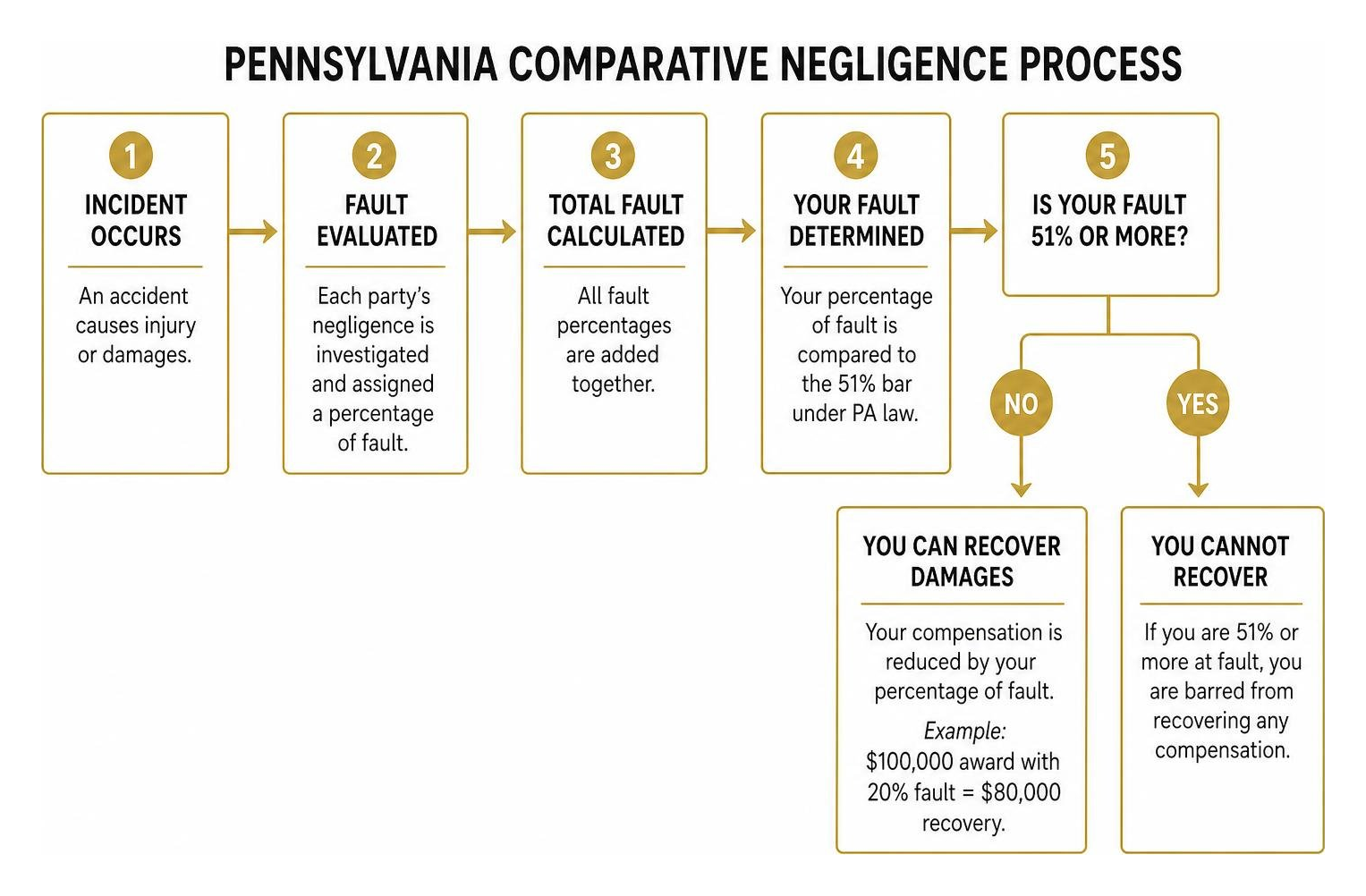
Pennsylvania also follows a modified comparative negligence rule under 42 Pa. C.S. Section 7102:
- The 51 Percent Fault Threshold: You can recover damages as long as your percentage of responsibility is 50 percent or less. If you are found to be 51 percent or more at fault, you are completely barred from receiving any compensation.
- Proportional Compensation Reduction: If you are awarded financial recovery, your payout is reduced in direct proportion to your assigned degree of fault. For example, if a court determines your total damages are $100,000 but assigns you 20 percent of the fault for speeding, your ultimate award is reduced by 20 percent to $80,000.
Choice No-Fault System: Limited Tort vs. Full Tort Insurance Options
Pennsylvania is one of a few states operating under a “choice no-fault” motor vehicle insurance system. Every vehicle owner must carry Personal Injury Protection (PIP) benefits, which cover initial medical expenses up to your policy limit, regardless of who caused the crash.
When purchasing auto coverage, drivers choose between two tort options:
- Limited Tort: Offers lower monthly insurance premiums, but surrenders your right to sue an at-fault driver for non-economic damages (pain, suffering, and emotional distress) unless your injury qualifies as a “serious bodily impairment” or meets specific statutory exceptions (such as the at-fault driver being convicted of DUI or driving an out-of-state registered vehicle).
- Full Tort: Requires slightly higher premiums, but fully preserves your unrestricted legal right to pursue compensation for all non-economic pain and suffering caused by a negligent driver, regardless of injury severity.
| Coverage Feature | Limited Tort Election | Full Tort Election |
|---|---|---|
| Premium Cost | Lower annual cost | Slightly higher annual cost |
| First-Party Medical Coverage (PIP) | Included regardless of fault | Included regardless of fault |
| Economic Damage Claims (Medical Bills / Lost Wages) | Allowed | Allowed |
| Pain and Suffering Claims | Restricted (Unless “Serious Impairment” threshold or statutory exception met) | Unrestricted right to sue for all pain and suffering |
Pennsylvania maintains high rates of limited tort selections, often because policyholders do not fully grasp the legal trade-offs. To review further insights on state options, visit What to Do for Personal Injury in Pennsylvania | FindTheLawyers.
Navigating Insurance Companies and Avoiding Costly Mistakes
Interacting with insurance adjusters requires caution. Adjusters are trained professionals working to minimize financial payouts for their employer.

Managing Insurance Adjusters and Settlement Offers
After an accident, an adjuster from the opposing insurance company will likely contact you. They may sound friendly and supportive, but their primary objective is to protect their company’s bottom line.
To protect your legal rights:
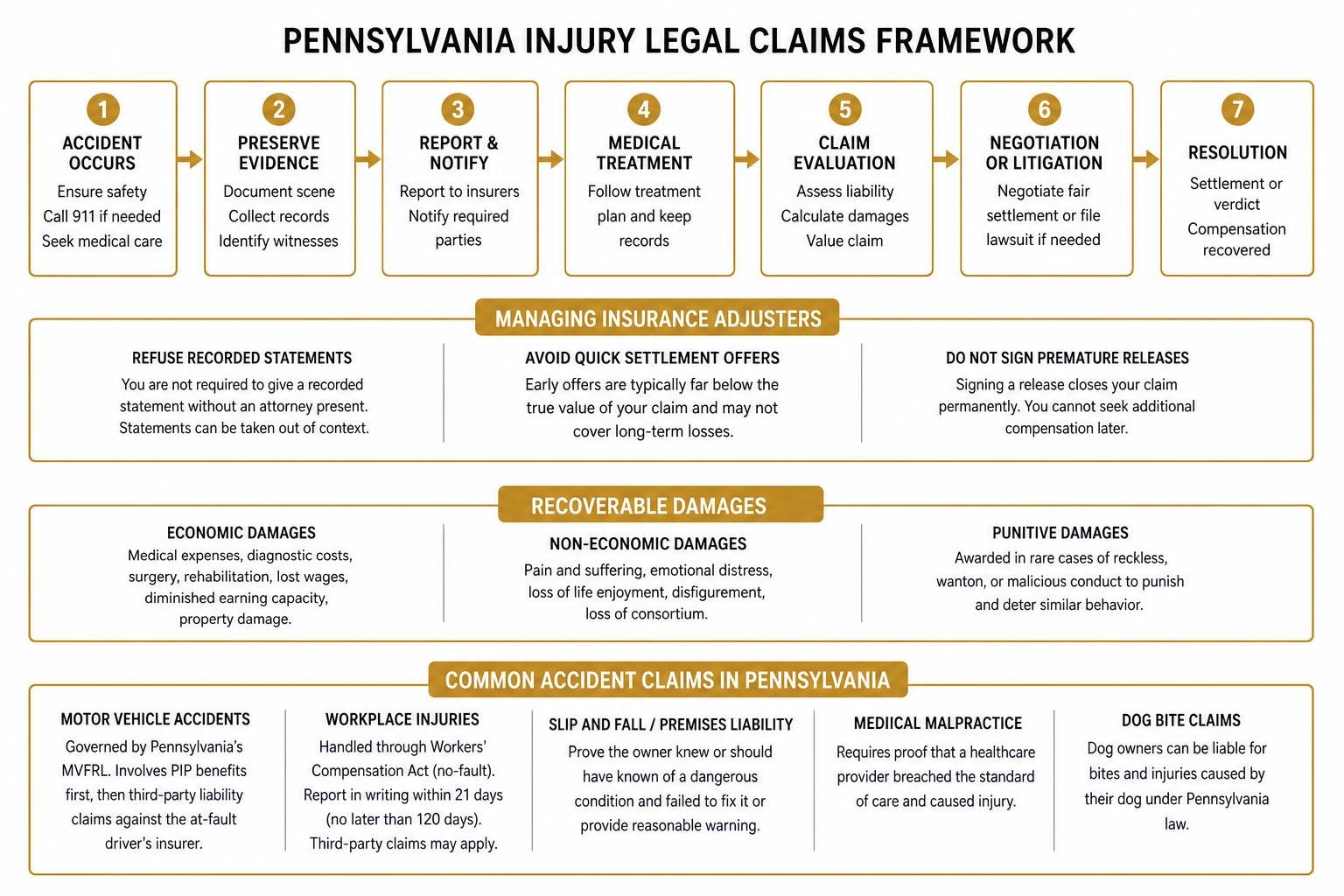
- Refuse Recorded Statements: You are not legally obligated to give a recorded audio statement to the opposing party’s insurer without an attorney present. Statements can be taken out of context to shift blame or downplay your injuries.
- Avoid Accepting Quick Settlement Offers: Initial settlement offers made shortly after an accident are almost always far below the true value of your claim. They rarely account for long-term medical treatment or full lost earning capacity.
- Do Not Sign Premature Releases: Signing a general release form closes your claim permanently. If you sign a liability waiver before reaching full recovery, you cannot ask for additional compensation later.
For strategies on handling insurance representatives, see our detailed guide on Navigating Insurance Claims After An Injury A Guide To Dealing With Insurance Companies.
Understanding Recoverable Damages: Economic, Non-Economic, and Punitive
A comprehensive personal injury claim evaluates three primary categories of damages:
- Economic Damages: Measurable, out-of-pocket financial losses resulting from the accident. These include past and future medical bills, diagnostic imaging costs, surgery fees, rehabilitation expenses, lost wages, diminished future earning capacity, and property damage repairs.
- Non-Economic Damages: Intangible, non-financial harms including physical pain, emotional anguish, loss of life enjoyment, disfigurement, and loss of consortium.
- Punitive Damages: Awarded in rare cases where the defendant’s conduct was exceptionally reckless, wanton, or malicious. Punitive damages are designed to punish the wrongdoer and deter similar conduct in the future.
We continuously fight to ensure that all three categories of damages are accurately evaluated for our clients. Learn more by viewing our complete Personal Injury Legal Services.
Specific Procedures for Common Accident Types and Legal Steps
Different types of personal injury cases in Pennsylvania involve specific procedural hurdles and statutory laws.
Procedures for Motor Vehicle, Workplace, Slip and Fall, Malpractice, and Dog Bite Claims
- Motor Vehicle Accidents: Governed by Pennsylvania’s Motor Vehicle Financial Responsibility Law (MVFRL). Resolution involves coordinating PIP first-party medical benefits before pursuing third-party liability claims against the at-fault driver’s insurance.
- Workplace Injuries: Handled primarily through Pennsylvania’s Workers’ Compensation Act under a no-fault system, meaning injured employees do not need to prove employer fault to receive benefits. Mandatory reporting requirements require notifying your employer in writing within 21 days (and no later than 120 days). Obtaining timely medical treatment creates essential medical records and documentation connecting injuries to the job. Thorough evidence gathering—including securing witness statements, incident reports, and medical records—is vital during the initial filing procedures. If benefits are denied or contested, mandatory legal appeals before the Bureau of Workers’ Compensation may be necessary. Consulting an experienced workers’ compensation lawyer ensures all reporting, documentation, evidence gathering, claim filings, and appeals are handled properly. If a third party contributed to the injury, a personal injury lawsuit can be filed alongside the claim.
- Slip and Fall / Premises Liability: Requires proving that a property owner knew or should have known about a dangerous condition (such as ice, structural defects, or spilled liquids) and failed to address it or provide reasonable warning.
- Medical Malpractice: Governed by strict filing requirements. Under Pennsylvania Rule of Civil Procedure 1042.3, a plaintiff must file a Certificate of Merit signed by an appropriate licensed medical professional within 60 days of initiating a malpractice lawsuit, confirming that the medical care fell below accepted professional standards.
- Dog Bites: Under 3 Pa. C.S. Section 459-502, dog owners face strict liability for all medical expenses caused by their animal, regardless of whether the dog had a history of aggression or prior bites.
For broader support on complex job-related injuries, access our dedicated Workers Compensation Legal Services.
Working with Legal Counsel and Case Timeline Factors
Handling a personal injury claim alone can be overwhelming. Studies consistently show that injury victims who hire legal representation receive significantly higher financial settlements than those who self-represent, even after deducting legal fees.
Most personal injury attorneys operate on a contingency fee basis. This means:
- You pay zero upfront costs or out-of-pocket legal fees.
- Attorney fees (typically ranging between 25 percent and 40 percent) are deducted directly as an agreed-upon percentage of the final settlement or court award.
- If we do not recover compensation for you, you owe no attorney fees.
How long a case takes depends on several factors: the length of your medical treatment, reaching Maximum Medical Improvement (MMI), the clarity of fault, and whether the insurance company negotiates fairly or forces the case into trial.
To learn how to evaluate attorney options, read How to Choose the Right Personal Injury Lawyer. If you need direct evaluation of your accident, schedule a Free Case Consultation.
Frequently Asked Questions About Pennsylvania Personal Injury Claims
How long do I have to file a personal injury lawsuit in Pennsylvania?
Under 42 Pa. C.S. Section 5524, the general statute of limitations for filing a personal injury lawsuit in Pennsylvania is two years from the exact date of the incident. Limited exceptions exist—such as claims involving minors or latent injuries subject to the discovery rule—but missing the two-year deadline usually destroys your right to make a legal claim.
How does limited tort differ from full tort in Pennsylvania car accidents?
Limited tort insurance lowers monthly premiums but restricts your right to seek financial recovery for pain, suffering, and emotional distress unless your injury meets the threshold of a “serious bodily impairment” or falls under specific statutory exceptions. Full tort coverage costs slightly more but guarantees your right to seek full non-economic compensation after an accident, regardless of how minor or severe your injuries are.
What compensation can I recover if I was partially at fault?
Under Pennsylvania’s modified comparative fault law (42 Pa. C.S. Section 7102), you can still recover compensation as long as your assigned fault is 50 percent or less. However, your payout will be reduced by your percentage of fault. If you are determined to be 51 percent or more at fault, you are barred from receiving any compensation.
Conclusion
Knowing what to do after a personal injury accident pennsylvania helps protect both your immediate physical health and your long-term financial security. From securing critical evidence at the scene and seeking prompt medical care to meeting strict state deadlines and handling insurance adjusters, every decision you make matters.
At Caputo & Mariotti, we bring over 55 combined years of legal experience to fighting for injured individuals across Lackawanna County, Luzerne County, Scranton, Wilkes-Barre, and surrounding communities in Northeastern Pennsylvania. Our dedicated team is committed to delivering aggressive legal representation and personal attention to help you secure the maximum compensation you deserve.
If you or a loved one has suffered an injury due to someone else’s negligence, do not navigate the legal process alone. Contact our team today for Trusted Legal Support in Northeastern PA and schedule a free, no-obligation consultation to review your claim.