

The dedicated legal team of Caputo & Mariotti
The Best Medical Malpractice Attorneys for Beginners
February 10, 2026
Understanding Medical Malpractice and Your Legal Rights
A medical malpractice attorney is a personal injury lawyer who represents patients harmed when healthcare professionals fail to provide an acceptable standard of care. These attorneys help victims prove negligence, steer complex medical-legal issues, and recover compensation for injuries caused by medical errors.
When You May Need a Medical Malpractice Attorney:
- You suffered a serious injury from a surgical error, misdiagnosis, or delayed diagnosis.
- A loved one was harmed during childbirth or died due to medical negligence.
- Your condition worsened because a doctor failed to properly diagnose or treat you.
- You received the wrong medication or dosage, causing additional harm.
- A hospital’s negligence led to infection or other preventable injuries.
Medical malpractice occurs when a healthcare provider’s negligence, failing to meet the accepted standard of care, directly causes measurable harm to a patient. It is not the same as being unhappy with treatment results or a bad medical outcome.
The scope of this problem is significant. A 2016 Johns Hopkins study found that more than 250,000 Americans die every year due to medical errors, making it the third leading cause of death in the U.S. Yet, few victims seek the justice and compensation they deserve.
These cases are exceptionally complex. You’re up against powerful hospitals and insurance companies backed by teams of lawyers. The legal process requires proving four critical elements: the provider owed you a duty of care, they breached that duty, the breach directly caused your injury, and you suffered significant damages.
As a Pennsylvania personal injury attorney with decades of experience, including as a former prosecutor and Deputy Attorney General, I bring extensive courtroom experience to every medical malpractice attorney case. Our firm fights for families to secure the compensation they need to move forward.
If you or a loved one has been harmed by a healthcare provider’s negligence, understanding your rights is the first step toward justice.
Understanding the Grounds for a Malpractice Claim
Not every negative medical outcome is malpractice. A bad outcome might be an inherent risk of a procedure, while malpractice occurs when a healthcare provider’s actions fall below the accepted “standard of care,” directly causing injury.
The “Standard of Care” is the level of skill that a reasonably prudent healthcare professional, with similar training, would have exercised under similar circumstances. When a doctor, nurse, or hospital fails to meet this standard, they may be deemed negligent.
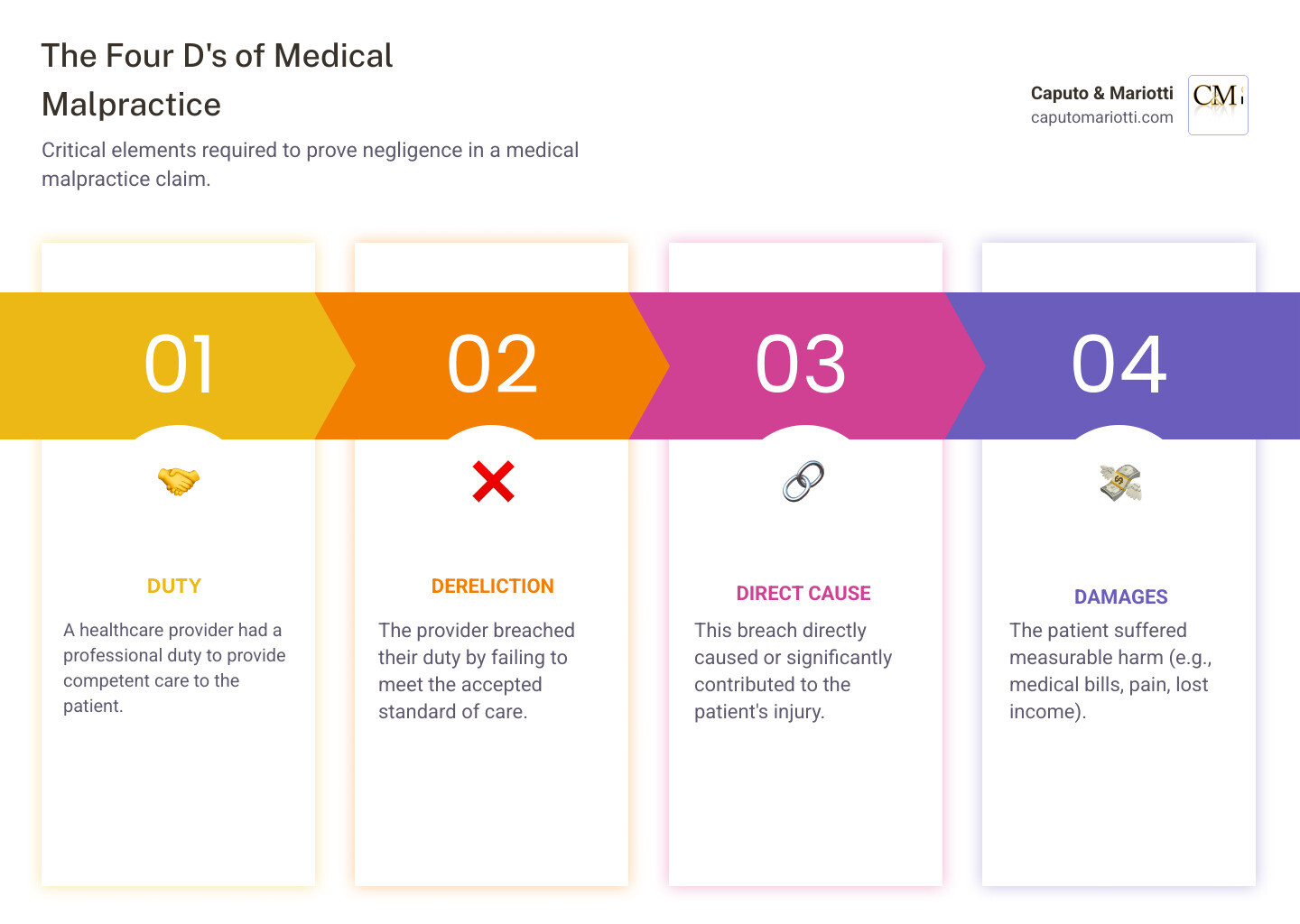
To pursue a medical malpractice claim in Pennsylvania, we must prove four key elements:
- Duty: The healthcare professional owed you a duty of care, established by the doctor-patient relationship.
- Dereliction (Breach of Duty): The provider breached that duty by failing to meet the accepted standard of care.
- Direct Cause: The breach of duty directly caused your injury or worsened your condition.
- Damages: You suffered significant physical, emotional, and financial damages as a result of the injury.
For example, if a doctor’s misdiagnosis delays a cancer diagnosis, leading to a more advanced, harder-to-treat cancer, they may have breached their duty of care, directly causing the patient’s worsened condition (damages).
Understanding these elements is vital. You can learn more about how to identify if you suffered from malpractice and get more info about the critical elements of a lawsuit.
Common Types of Medical Malpractice
Medical malpractice can take many forms, including:
- Misdiagnosis or Delayed Diagnosis: This common error occurs when a provider fails to identify a condition or delays diagnosis, causing the patient’s health to worsen. Examples include a missed cancer diagnosis or misread lab results.
- Surgical Errors: These include operating on the wrong body part, leaving instruments inside a patient, or causing nerve damage. Such errors are often clear breaches of the standard of care.
- Birth Injuries: Negligence during childbirth can cause severe, lifelong injuries to the patient or baby, like cerebral palsy or brain damage. This can stem from a delayed C-section or improper monitoring.
- Anesthesia Errors: Anesthesia errors, such as incorrect dosage or failure to monitor a patient, can lead to brain damage, coma, or death.
- Medication Mistakes: These include prescribing the wrong drug or dosage, pharmacy errors, or mistakes in administration by nurses.
- Hospital and Nursing Negligence: Hospitals may be liable for issues like inadequate staffing, infections from poor sanitation, or nursing errors like patient falls. Nursing home negligence also falls under this category.
We frequently handle these cases in Scranton, Wilkes-Barre, and throughout Northeastern Pennsylvania. You can learn about 5 common types of malpractice in Scranton, PA on our website.
The Crucial Role of Expert Witnesses
Expert witnesses are legally required in most medical malpractice cases. They provide the specialized medical knowledge needed to prove a healthcare professional deviated from the standard of care and caused an injury, which is too complex for a judge or jury to determine alone.
An expert witness’s role is to:
- Establish the accepted standard of care for the specific situation.
- Explain complex medical issues to the jury in simple terms.
- Testify whether the defendant’s actions fell below that accepted standard.
- Establish the link between the negligence and the patient’s injury.
Without credible expert testimony, winning a medical malpractice case is nearly impossible. The rare exception is when negligence is obvious, such as leaving a surgical sponge inside a patient (“res ipsa loquitur”). At Caputo & Mariotti, we work with a network of highly qualified medical experts to build strong cases for our clients across Pennsylvania.
Why You Need an Expert Medical Malpractice Attorney

When you suffer from medical malpractice, you face physical pain, emotional distress, and a complex legal system. An expert medical malpractice attorney is essential. We are here to take on the legal burden so you can focus on healing. Here’s how we help:
- Navigating the Complex Legal Process: Medical malpractice law is intricate. With our 55+ years of combined experience, we handle the complex legal procedures and technical medical details correctly.
- Fighting Powerful Opponents: We fight against well-funded insurance companies and hospital legal teams whose goal is to minimize payouts. We level the playing field and act as your advocate.
- Investigating and Gathering Evidence: We build a strong case through meticulous investigation, gathering medical records, consulting experts, and interviewing witnesses to prove negligence and causation.
- Calculating Your Full Damages: We accurately calculate all your damages—including medical expenses, lost wages, and pain and suffering—to ensure you receive fair compensation for your losses.
We work to make your case as smooth as possible. Learn about the claim process from start to finish and find out what you need to know about medical malpractice from our guides.
How Contingency Fees Make Justice Accessible
Medical malpractice lawsuits are expensive. A contingency fee arrangement removes the financial barrier for victims seeking justice.
A contingency fee means:
- No Upfront Costs: You pay no legal fees out of pocket to start or during your case.
- We Get Paid Only If You Win: Our fees are “contingent” on a successful settlement or court award. If we don’t win, you don’t owe us attorney fees.
- Aligned Interests: Our fee is a pre-agreed percentage of your compensation, so we are motivated to secure the maximum possible recovery for you.
This arrangement makes high-quality legal representation accessible to everyone, regardless of their financial situation.
Understanding the Statute of Limitations in Pennsylvania
Time is critical. Every state has a “statute of limitations,” a strict deadline for filing a lawsuit. Missing this deadline means losing your right to pursue compensation.
In Pennsylvania, the general statute of limitations for a medical malpractice claim is two years from the date the injury occurred. For wrongful death, the case must be filed within two years of the date of death.
However, Pennsylvania law includes the “discovery rule.” This exception states the two-year clock starts not when the injury occurred, but when the injury was discovered, or reasonably should have been discovered. This is important in cases where harm isn’t immediately apparent, such as a surgical instrument left inside a patient.
Despite this rule, you should contact a medical malpractice attorney as soon as you suspect negligence. Waiting can make it harder to gather evidence and build a strong case.
For more information, you can refer to resources like AllLaw’s guide on medical malpractice laws in Pennsylvania.
How to Choose the Right Medical Malpractice Attorney

Choosing the right medical malpractice attorney is a crucial decision. These cases require a lawyer with specific expertise and a deep understanding of both medical and legal complexities.
Here’s what to look for:
- Verifiable Experience in Medical Malpractice: Choose an attorney with specific experience in these unique cases. Our firm has over 55 combined years dedicated to this complex field.
- A Proven Track Record of Success: A history of favorable settlements and verdicts demonstrates capability. We are proud of our record in securing significant compensation for clients.
- Local Knowledge of Pennsylvania Laws: Your lawyer must know Pennsylvania’s specific laws and local court procedures. As a firm rooted in Northeastern Pennsylvania, we have this critical insight.
- Positive Client Testimonials: Testimonials offer insight into an attorney’s communication, compassion, and success. Our clients’ words reflect our commitment to justice.
- A Free, No-Obligation Consultation: A reputable attorney offers a free consultation to discuss your case without financial commitment. We provide this to review your situation and outline the best path forward.
We encourage you to learn how to choose the right lawyers near you to make an informed decision.
Key Questions to Ask a Potential Medical Malpractice Attorney
During your consultation, ask these questions to evaluate a lawyer’s suitability:
- What is your experience with cases like mine? Ask about their experience with your specific type of case (e.g., birth injury, misdiagnosis).
- What is your fee structure? Confirm they work on a contingency fee basis and clarify the percentage.
- Who will be handling my case directly? Find out who will be your main point of contact.
- What is your approach to settlement versus trial? A good attorney is prepared for trial. We prepare every case for trial to strengthen your negotiating position.
- What are the potential challenges in my case? An honest attorney will discuss your case’s potential weaknesses.
- What resources do you have for expert witnesses? Ask about their network of medical experts, as their testimony is vital.
Asking these questions will help you find the best malpractice attorneys for your case by starting with a thorough consultation.
Damages and Consequences of Medical Malpractice
The consequences of medical malpractice are profound, impacting every aspect of a victim’s life. A lawsuit aims to recover compensation for these wide-ranging damages.
- Physical Pain and Suffering: This includes pain from the initial injury, subsequent treatments, and chronic conditions. For example, a surgical error causing nerve damage can result in lifelong pain.
- Emotional and Psychological Distress: The emotional toll includes anxiety, depression, and PTSD. This is especially true in birth injury cases, where families face immense emotional burdens.
- Financial Instability: Malpractice leads to huge medical bills and lost income if the victim cannot work. This financial strain affects the entire family, causing instability and a reduced quality of life.
Hospitals can also be held liable for the negligence of their employees (like nurses or technicians) or for systemic failures such as inadequate staffing or poor sanitation. In Pennsylvania, you can seek compensation for hospital malpractice and sue for damages.
We understand these consequences and are dedicated to helping victims in Scranton, Wilkes-Barre, and Hazleton. Learn more about our medical malpractice legal services and how we can assist you.
What Compensation Can You Recover?
We pursue comprehensive compensation for all your losses, which fall into three categories:
- Economic Damages: These are quantifiable financial losses, including:
- Past and future medical bills
- Lost wages and earning capacity
- Rehabilitation costs
- Home modification costs
- Non-Economic Damages: These subjective losses are harder to quantify but just as real, including:
- Pain and suffering
- Emotional distress
- Loss of enjoyment of life
- Loss of consortium (for a spouse)
- Punitive Damages: In rare cases of reckless or malicious conduct, punitive damages may be awarded to punish the wrongdoer. Pennsylvania does not cap damages in medical malpractice claims, allowing for a victim’s extensive losses to be fully addressed.
Our team works to identify and calculate every damage you’ve suffered to secure the maximum compensation you deserve.
Frequently Asked Questions
Here are answers to some of the most common questions we receive about medical malpractice.
What is the difference between medical negligence and medical malpractice?
Medical negligence is a provider’s failure to meet the standard of care. It becomes medical malpractice when that negligence directly causes injury to the patient. To have a viable claim, you must prove both the negligent act and the resulting harm.
How much does it cost to hire a medical malpractice lawyer?
Our firm, like most medical malpractice attorneys, works on a contingency fee basis. This means:
- You pay no upfront fees to hire us.
- Our legal fees are a percentage of the compensation we secure for you.
- If we don’t win your case, you don’t owe us attorney fees.
This arrangement makes justice accessible without adding to your financial strain. Case costs, like expert witness fees, are advanced by our firm and then reimbursed from the final award.
How long will my medical malpractice case take to resolve?
A medical malpractice case can take months or even years to resolve. The timeline depends on several factors:
- The complexity of the case and severity of the injuries.
- The willingness of the opposing side to negotiate a fair settlement.
- The court’s schedule and procedural requirements.
While we strive for an efficient resolution, our priority is to secure the fair compensation you deserve, no matter how long it takes. We will keep you informed throughout the process.
Take the First Step Towards Justice
Experiencing medical malpractice can be a life-altering event, leaving you with physical pain, emotional scars, and significant financial burdens. But you don’t have to face these challenges alone. We hope this guide has provided you with a clearer understanding of what medical malpractice entails, the legal process involved, and why having an expert medical malpractice attorney is crucial for your fight for justice.
You have rights, and options are available to you. The statistics show that medical errors are a widespread problem, and while the legal process can seem daunting, dedicated legal professionals are here to help. Our combined 55+ years of experience, dedicated team, and unwavering commitment to justice mean we are prepared to stand by your side.
The importance of seeking expert legal guidance cannot be overstated. An experienced personal injury lawyer specializing in medical malpractice can steer your claim through its complexities, ensuring your rights are protected and you receive the compensation you deserve. Don’t wait to get the help you deserve, especially given the strict statute of limitations in Pennsylvania.
If you suspect you or a loved one has been a victim of medical malpractice in Scranton, Wilkes-Barre, or anywhere in Northeastern Pennsylvania, we are here to listen.
Schedule your free, confidential consultation today. Let us help you take the first step towards healing and justice.