

The dedicated legal team of Caputo & Mariotti
The Definitive Guide to Negligence in a Personal Injury Case
October 29, 2026
What Negligence Means for Your Injury Claim
Negligence in a personal injury case means someone failed to use reasonable care, and that failure caused an injury. To bring a claim, you generally need to show four things: the person owed you a duty of care, breached that duty, caused your injury, and left you with damages such as medical bills or lost income.
A driver who runs a red light may be negligent if the crash injures someone. If you think someone caused your injury, get medical care and save photos, witness details, and records of your losses.
I’m Chris Caputo, a Pennsylvania personal injury lawyer, and I often answer the question, “what is negligence in a personal injury case?” Since 2007, I’ve represented injured people at Caputo & Mariotti, drawing on decades of litigation experience to examine the four elements shown below.
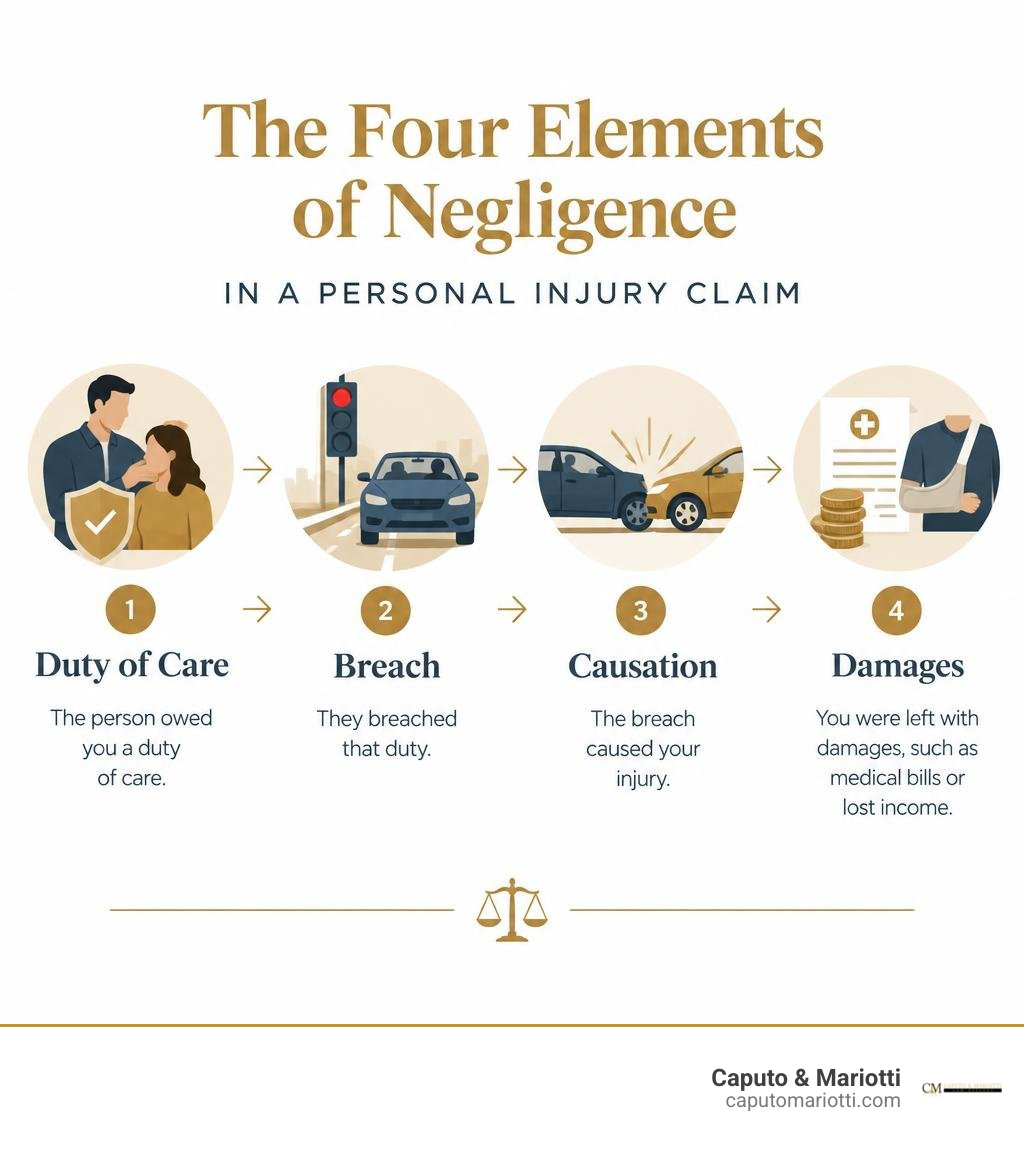
To protect your financial recovery, it helps to understand how insurance companies calculate injury settlements, how to document injuries after an accident in Pennsylvania, and how to choose a personal injury lawyer in Pennsylvania to guide your claim.
What Is Negligence in a Personal Injury Case?
Civil liability is built largely around tort law, a branch of the legal system dedicated to restoring balance when one party’s conduct harms another. At the heart of most tort actions sits a straightforward principle: individuals and entities must conduct themselves in a way that does not expose others to unreasonable risks. The legal definition of negligence centers on the failure to exercise the standard of care that an ordinarily prudent individual would have applied under identical or similar circumstances.
Civil wrongs differ fundamentally from criminal actions. While criminal law focuses on punishing offenses against the public or the state, tort law focuses on redressing civil wrongs and providing financial recovery for specific losses. Negligence can stem from active wrongdoing—such as a motorist speeding through a pedestrian crosswalk—or passive omission, such as a property owner failing to clear ice from an entrance pathway.
The Legal Definition of Negligence
In personal injury jurisprudence, the law measures conduct against the “reasonable person standard.” This standard does not demand absolute perfection, clairvoyance, or extraordinary heroism. Instead, it reflects ordinary prudence. Society operates on an implied social contract: when driving on the road, managing commercial premises, or performing complex medical procedures, everyone is expected to behave responsibly so as to avoid foreseeable harm to those around them.
When someone’s actions fall below this standard, unintentional harm occurs. Unlike intentional torts, where an individual purposefully inflicts injury, negligence involves carelessness, inattention, or substandard judgment.
Why Knowing What Is Negligence in a Personal Injury Case Matters for Liability
Understanding negligence is essential for establishing legal fault after an unexpected accident. Insurance adjusters and defense attorneys evaluate claims through the lens of liability. If you cannot establish how the other party failed to exercise reasonable care, an insurance carrier will likely deny your claim or offer a fraction of what your recovery is worth.
Clear proof of negligence forms the foundation of all successful settlement negotiations and courtroom verdicts. When dealing with complex losses, securing experienced personal injury representation ensures that your claim is properly structured, evidence is secured before it disappears, and liability is thoroughly proven.
The Four Essential Elements of a Negligence Claim

To establish liability in an injury claim, a plaintiff carries the burden of proof. Proving negligence requires satisfying four distinct legal elements. If even one element is missing, a claim fails under civil law.
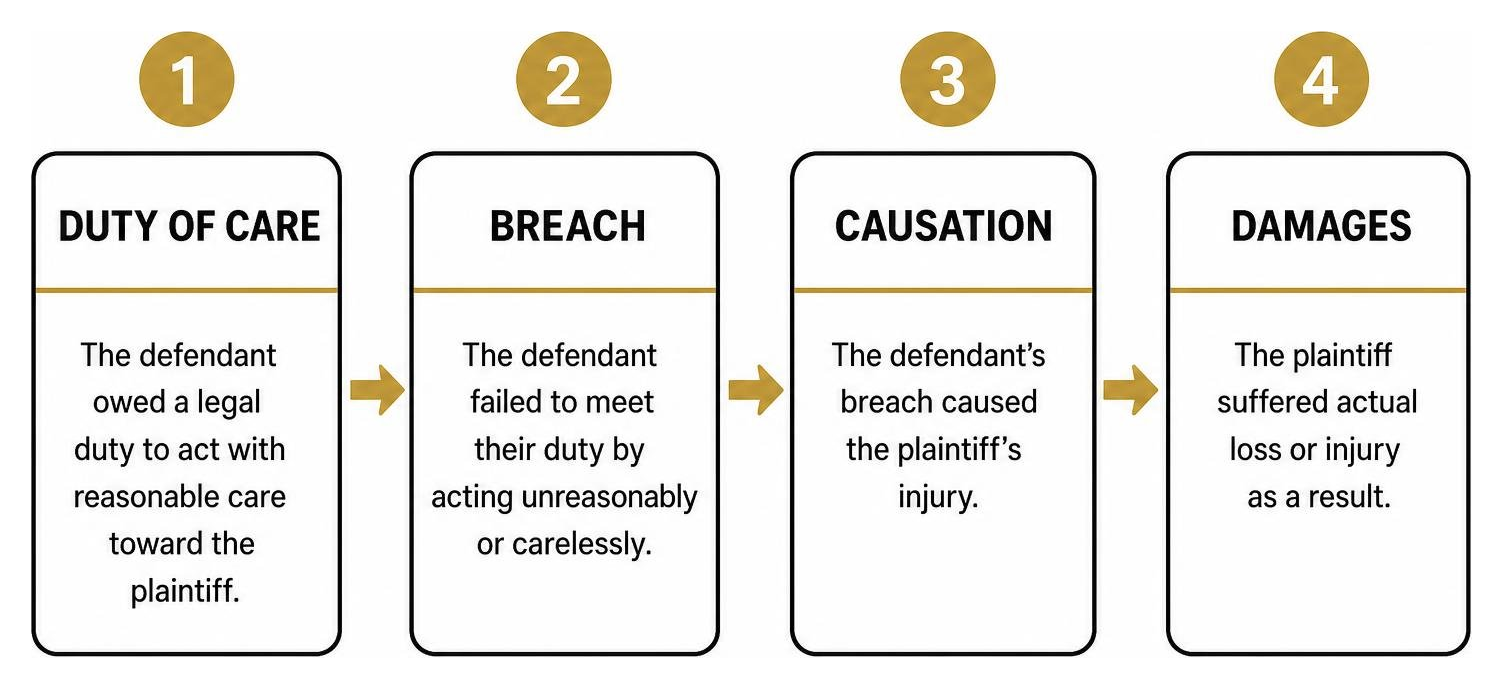
Duty of Care and the Reasonable Person Standard
A legal duty of care is an obligation that one party owes to protect others from unreasonable risks of harm. This duty arises naturally out of societal relationships, interactions, or voluntary undertakings. For example:
- Motorists owe a duty to other road users to operate their vehicles safely and follow traffic laws.
- Property owners owe invited guests and patrons a duty to maintain reasonably safe premises and warn of hidden hazards.
- Medical professionals owe patients a specialized duty to deliver treatment consistent with accepted standards of medical practice.
Courts apply recognized statutory standards of reasonable care when determining whether a legal duty existed at the time of an incident. While general members of the public are judged by the standard of a reasonably prudent individual, professionals—such as surgeons or structural engineers—are held to heightened professional standards tailored to their specialized training and industry requirements.
Breach of Duty and the Hand Formula
A breach of duty happens when a defendant’s conduct drops below the required standard of care, creating an unreasonable danger. Evaluating whether conduct constitutes a breach often involves balancing the risks against the practicality of preventing them.
In legal theory, this concept is famously framed by the Hand Formula ($B < PL$):
- $B$ (Burden): The cost, effort, and practicality of taking adequate precautions.
- $P$ (Probability): The likelihood that an accident or injury will occur.
- $L$ (Gravity of Loss): The severity of the potential injury or damage.
Under this legal framework, if the burden of taking precautions ($B$) is less than the probability of harm ($P$) multiplied by the potential severity of the injury ($L$), failing to take those precautions represents a breach of duty. For example, placing a bright warning cone near a freshly mopped floor takes minimal effort ($B$), while the probability ($P$) and severity ($L$) of a severe spinal injury from a slip-and-fall are substantial. Failing to place the cone constitutes an unreasonable breach.
Causation: Cause-in-Fact vs. Proximate Cause
Proving that a defendant breached a duty is not enough on its own; that breach must have directly caused the plaintiff’s injuries. Causation is split into two mandatory legal components:
- Cause-in-Fact (Actual Cause): Evaluated using the “but-for” test. The plaintiff must demonstrate that but for the defendant’s negligent act or omission, the injury would not have occurred.
- Proximate Cause (Legal Cause): Focuses on foreseeability. The injury must be a natural, direct, and foreseeable outcome of the defendant’s conduct, rather than the result of a bizarre or unpredictable chain of events.
If an independent, unforeseeable event occurs between the defendant’s action and the ultimate injury—known as an intervening superseding cause—it may break the chain of causation, relieving the initial party of legal liability.
Damages: Economic and Non-Economic Losses
A successful negligence claim requires proof of actual, compensable harm. A close call or near-miss—regardless of how reckless the other party’s conduct was—does not create a valid civil injury claim without actual physical, financial, or emotional loss.
Compensable losses fall into two main categories:
- Economic Damages: Tangible, out-of-pocket financial losses resulting from the injury. These include past and future medical expenses, surgical bills, prescription medications, rehabilitation costs, lost wages, and diminished future earning capacity.
- Non-Economic Damages: Intangible losses that impact quality of life, such as physical pain and suffering, emotional distress, physical disfigurement, loss of consortium, and loss of enjoyment of daily activities.
How to Prove Negligence in an Injury Claim: Step-by-Step

Proving negligence requires moving methodically through an evidence-gathering and documentation process. Insurance carriers and defense counsel will scrutinize every detail of your claim to minimize payouts.
Gathering Key Evidence: Police Reports and Medical Records
Documenting an incident immediately provides the objective factual basis needed to prove fault. Essential evidence includes:
- Official Police and Accident Reports: Law enforcement summaries, citations issued at the scene, and preliminary determinations of fault.
- Comprehensive Medical Records: Emergency room intake logs, diagnostic imaging (X-rays, MRIs, CT scans), operative notes, and physical therapy records that connect the trauma directly to the incident.
- Scene Photography and Video Footage: High-resolution photos showing vehicle positions, skid marks, property hazards, missing safety railings, and dashcam or surveillance video.
- Financial Records: Pay stubs, tax returns, and employer verification letters demonstrating missed work and lost wages.
- Treatment Journals: Detailed personal logs tracking daily pain levels, mobility restrictions, and psychological impacts.
When an injury happens on the job, the administrative process differs from standard third-party negligence lawsuits. A work injury claim requires reporting the incident to your employer within strict statutory timeframes, seeking treatment from approved medical providers, and filing the appropriate administrative petitions. For workplace accidents, working alongside a workers’ compensation lawyer ensures you navigate the no-fault administrative system, secure medical wage-loss benefits, gather coworker witness accounts, and preserve potential third-party negligence claims against at-fault contractors or equipment manufacturers.
Utilizing Eyewitness Testimony and Expert Analysis
Eyewitnesses provide neutral, credible accounts of what occurred before, during, and after an incident. Third-party statements often resolve conflicting stories between the parties involved.
In complex claims, specialized expert witnesses bridge evidentiary gaps:
- Accident Reconstructionists: Use physics, speed calculations, and crush-damage analysis to recreate collisions and demonstrate vehicle speeds and impact angles.
- Medical Experts: Testify regarding the long-term prognosis of an injury, necessary future surgical interventions, and whether pre-existing conditions were aggravated by the incident.
- Vocational and Economic Experts: Quantify lost earning capacity and project lifetime financial losses for long-term disabilities.
Steps to Proving What Is Negligence in a Personal Injury Case
Proving negligence involves four distinct steps:
- Establish Legal Duty: Identify the specific legal obligation the defendant owed under statutory or common law.
- Verify the Breach: Present physical evidence, witness accounts, and safety standard violations showing how the defendant failed to act reasonably.
- Link Causation: Use medical documentation and expert testimony to tie the defendant’s breach directly to the diagnosed injuries.
- Itemize Damages: Calculate total economic and non-economic losses with billing statements, wage records, and prognosis reports.
Navigating this evidentiary process requires legal strategy. When managing substantial losses, choosing the right personal injury lawyer ensures your case is handled with the thoroughness needed to secure full financial recovery.
Negligence Doctrines and Fault Rules: Comparative vs. Contributory Fault
When an accident occurs, liability is not always one-sided. Multiple parties may share a degree of responsibility, and states have established different legal frameworks to address shared fault.
Comparative Negligence vs. Contributory Negligence Systems
The rules governing shared fault impact the amount of financial compensation an injured plaintiff can receive.
| Legal System | Core Principle | Impact on Recovery | Typical Jurisdictions |
|---|---|---|---|
| Pure Contributory Negligence | All-or-nothing standard | If the plaintiff is even 1% at fault, they are completely barred from any financial recovery. | DC, MD, VA, NC, AL |
| Pure Comparative Fault | Strict proportional reduction | A plaintiff can recover damages even if they are 99% at fault, reduced by their exact percentage of fault. | CA, NY, FL |
| Modified Comparative Fault (50% Rule) | Proportional recovery with strict cut-off | Plaintiff can recover damages if their fault is 49% or less. Recovery is barred if fault reaches 50%. | CO, UT, GA |
| Modified Comparative Fault (51% Rule) | Proportional recovery with equal fault allowance | Plaintiff can recover if their fault is 50% or less. Recovery is barred if their fault reaches 51% or more. | PA, OH, NJ |
In Pennsylvania, courts apply the modified comparative fault 51% rule (42 Pa.C.S. § 7102). If an injured victim is determined to be 20% responsible for a collision and their total damages equal $100,000, their recovery is reduced by 20%, resulting in a final award of $80,000. However, if the plaintiff’s share of fault is determined to be 51% or higher, they cannot recover any damages from the other party.
Negligence Per Se and Res Ipsa Loquitur
Two legal doctrines can streamline the process of proving liability:
- Negligence Per Se: Applies when a defendant violates a specific public safety statute or traffic law designed to protect a specific class of people from a specific type of harm. If a driver runs a red light and causes a T-bone collision, the statutory traffic violation itself establishes a presumption of negligence, eliminating the need to prove how a reasonable person would have acted.
- Res Ipsa Loquitur (“The thing speaks for itself”): Applies when an accident is of a kind that does not ordinarily occur without negligence, the instrumentality of harm was under the defendant’s exclusive control, and the plaintiff did not contribute to the cause. A classic example involves a surgical team leaving an instrument inside a patient during surgery.
Frequently Asked Questions About Negligence in Injury Claims
How does comparative fault affect my financial compensation?
Under comparative fault doctrines, your final financial recovery is directly reduced by your percentage of responsibility for the underlying incident. In jurisdictions using modified comparative negligence systems, crossing the statutory threshold—either 50% or 51%, depending on state law—bars financial recovery entirely. Insurance carriers frequently attempt to assign disproportionate blame to injured victims to lower their payouts or eliminate liability under these threshold rules.
What is the deadline to file a negligence lawsuit?
The deadline to file a personal injury claim is determined by each state’s statute of limitations. In Pennsylvania, the standard statutory filing deadline for personal injury claims is two years from the date the injury occurred (42 Pa.C.S. § 5524). Missing this deadline forfeits your legal right to pursue compensation in court. While limited exceptions exist under the “discovery rule” for injuries that could not have been reasonably discovered right away, preserving evidence and consulting counsel promptly protects your rights.
What is the difference between ordinary negligence and gross negligence?
Ordinary negligence involves a failure to exercise reasonable care due to carelessness or inattention, such as failing to signal before changing lanes. Gross negligence involves an extreme departure from ordinary care, showing a reckless disregard for the safety and lives of others. For example, driving at twice the posted speed limit through an active school zone while under the influence of alcohol represents gross negligence. Gross negligence claims can support an award of punitive damages, which are intended to punish the wrongdoer and deter similar conduct.
Conclusion
Proving negligence requires a clear command of legal standards, thorough evidence collection, and skilled advocacy. At Caputo & Mariotti, our attorneys bring a combined 55+ years of litigation experience to every case we handle. We are committed to fighting for injury victims throughout Scranton, Wilkes-Barre, Lackawanna County, Luzerne County, and communities across Northeastern Pennsylvania.
If you or a family member suffered harm due to someone else’s carelessness, our team is ready to evaluate your claim, establish liability, and pursue the compensation you deserve. When you need a dedicated personal injury attorney in Scranton and Wilkes-Barre, contact us today to schedule a free case evaluation.
