

The dedicated legal team of Caputo & Mariotti
The Patient’s Guide to Filing a Medical Malpractice Lawsuit
April 17, 2026
When a Doctor’s Mistake Changes Your Life: What You Need to Know
How to sue a doctor is something no one expects to search for but if you or someone you love was seriously harmed by a medical provider, knowing your legal options is critical.
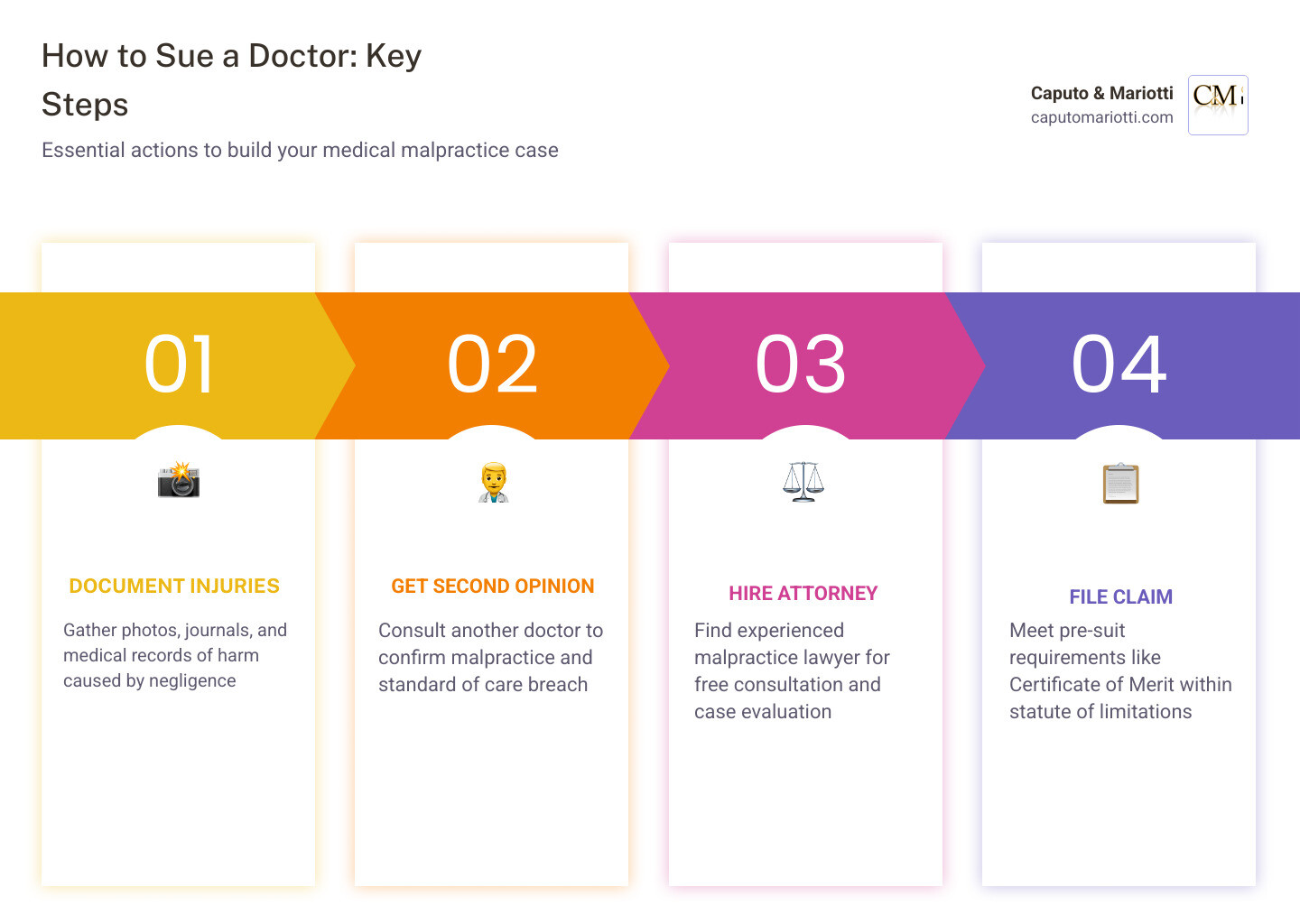
Here is a quick overview of the key steps:
- Document your injuries — photos, journals, medical records
- Seek a second opinion from another medical provider
- Consult a medical malpractice attorney (most offer free consultations)
- File within the statute of limitations — in Pennsylvania, you generally have two years
- Meet pre-suit requirements — such as filing a Certificate of Merit
- Build your case with expert testimony and evidence
- Negotiate a settlement or go to trial
Medical errors are not rare. Some researchers estimate they are the third-leading cause of death in the United States. Between 15,000 and 19,000 malpractice suits are filed every year — yet many victims never pursue the compensation they are owed, often because the legal process feels overwhelming or out of reach.
It does not have to be.
This guide walks you through the full process from recognizing malpractice to filing a claim and recovering damages in plain language.
I’m Chris Caputo, a Pennsylvania personal injury attorney with decades of litigation experience, including time spent representing hospitals and physicians before dedicating my practice to helping injured patients understand how to sue a doctor for negligence. That background on both sides of the courtroom gives me a practical perspective on what it actually takes to win these cases — and I’ll share that with you throughout this guide.
Understanding Medical Malpractice and Legal Requirements
Before we dive into the “how,” we need to talk about the “what.” Not every bad outcome in a hospital is grounds for a lawsuit. Medicine is an uncertain field, and sometimes, despite a doctor’s best efforts, a patient doesn’t get better. To successfully learn how to sue a doctor, you must understand the concept of the “medical standard of care.”
The standard of care is the legal yardstick used to measure a healthcare provider’s actions. It asks: “What would a reasonably competent doctor, with the same training and in the same situation, have done?” If your doctor deviated from this standard, they may have committed professional negligence.
To win a case, we must prove the critical elements of medical negligence lawsuits:
- Duty of Care: A doctor-patient relationship existed, meaning the doctor had a legal obligation to provide you with competent care.
- Breach of Duty: The doctor failed to meet the standard of care. They did something they shouldn’t have, or failed to do something they should have.
- Causation: This is the “link.” You must prove that the doctor’s specific mistake—not your underlying illness—directly caused your injury.
- Tangible Harm (Damages): You must have suffered actual losses, such as additional medical bills, lost wages, or permanent disability.
If you are wondering, “did I suffer medical malpractice,” look for red flags like a sudden worsening of your condition, a “never event” (like surgery on the wrong body part), or a total lack of communication from your medical team after a mistake occurs. While filing a medical malpractice lawsuit is a major decision, it is often the only way to hold a negligent provider accountable for a serious injury.
How to Sue a Doctor: Step-by-Step Legal Process

The journey of medical malpractice litigation is a marathon, not a sprint. It requires meticulous preparation and a mountain of evidence. Most people find that trying to navigate this alone is like trying to perform surgery on themselves—risky and nearly impossible.
When we begin the process of how to sue a doctor, our first goal is gathering evidence. This starts with your medical records. Under HIPAA, you have a right to copies of your records, and providers generally must supply them within 30 days. However, don’t just rely on the patient portal; you need the full, certified medical chart, including imaging disks (MRIs, CT scans) and nursing notes.
Following the 8 steps to sue a doctor, we then move toward securing expert testimony. In Pennsylvania, you cannot simply say a doctor messed up; you need another doctor in the same specialty to testify that your physician deviated from the standard of care.
| Feature | Out-of-Court Settlement | Jury Trial Verdict |
|---|---|---|
| Speed | Usually faster (months to a year) | Slower (often years) |
| Certainty | Guaranteed payout once signed | High risk; could result in $0 |
| Privacy | Often confidential | Public record |
| Average Amount | National average: $257,000 | National average: ~$1,000,000 |
Initial Steps in How to Sue a Doctor for Negligence
If you suspect something went wrong, your first priority is your health. Seek a second opinion immediately. Not only is this vital for your recovery, but it also helps document the error. A new doctor can provide insight into misdiagnosis in healthcare.
You should also:
- Start a Journal: Document your symptoms, pain levels, and how the injury affects your daily life.
- Keep a Timeline: Write down dates of appointments, what was said, and when you first noticed something was wrong.
- Preserve Evidence: Keep pill bottles, discharge papers, and even the clothes you wore if they are relevant to a surgical error.
- Avoid Social Media: Defense lawyers love to find photos of you smiling at a BBQ to argue you aren’t “really” injured.
Understanding what to know about medical malpractice early on can prevent you from making mistakes that could tank your case later.
Meeting Pre-Suit Requirements and Filing the Complaint
Pennsylvania has strict “procedural hoops” designed to filter out frivolous lawsuits. One of the most important is the Certificate of Merit. Within 60 days of filing your complaint, your attorney must file a statement confirming that a qualified medical expert has reviewed your case and believes there is a reasonable probability that the care you received fell outside acceptable professional standards.
Timing is everything. Medical malpractice in Pennsylvania is governed by a two-year statute of limitations. Generally, you have two years from the date the malpractice occurred to file. However, the “discovery rule” may extend this if the injury wasn’t immediately apparent (for example, if a surgeon left a sponge inside you and it wasn’t found for three years).
Once these requirements are met, we officially begin the medical negligence claim process by filing a formal complaint in the county where the malpractice occurred, such as Lackawanna or Luzerne County.
Proving Your Case with Expert Evidence and Documentation
Proving how to sue a doctor successfully relies heavily on the quality of your experts. Because medical cases are so technical, a jury of laypeople cannot be expected to know the nuances of neurosurgery or oncology. We bring in specialists to bridge that gap.
We handle many common types of medical malpractice in Scranton, PA, including:
- Surgical Errors: Nicking a nerve, leaving instruments behind, or operating on the wrong site.
- Anesthesia Mistakes: These are particularly terrifying and can lead to anesthesia awareness or permanent brain damage.
- Medication Errors: Administering the wrong drug or the wrong dosage, often due to a failure to check medical history.
- Failure to Diagnose: Missing the signs of a heart attack, stroke, or cancer until it is too late for effective treatment.
Whether you need a Wilkes-Barre medical malpractice lawyer or help in Scranton, the evidentiary requirements remain the same: we must show exactly how the provider’s choices led to your current suffering.
Recoverable Damages and the Role of Legal Counsel
When you win or settle a case, the compensation is divided into several categories.
Economic Damages cover the “receipts.” These are quantifiable losses like:
- Current and future medical bills related to the injury.
- Lost wages and loss of future earning capacity.
- Costs for adaptive equipment or home care.
Non-Economic Damages are more subjective but often represent the largest part of a claim. This includes “pain and suffering,” emotional distress, and loss of enjoyment of life. In Pennsylvania, there is no “cap” on these damages for most malpractice cases, meaning a jury can award what they truly feel is fair.
Punitive Damages are rare. They are only awarded if the doctor’s behavior was “willful or wanton”—meaning they acted with a reckless indifference to your safety.
Most people worry about the cost of hiring a Scranton medical malpractice lawyer. At Caputo & Mariotti, we work on a contingency fee basis. This means we front all the costs of the litigation—including those expensive expert witnesses—and you only pay us if we win your case. If we don’t recover money for you, you owe us nothing. This levels the playing field against wealthy hospital systems and insurance companies.
If you are looking for the best malpractice attorneys or a Hazleton medical malpractice lawyer, you want a team that isn’t afraid to take a case all the way to a jury verdict.
Why Professional Guidance is Essential for How to Sue a Doctor
The defense in these cases is aggressive. Doctors and hospitals are represented by high-priced legal teams whose entire job is to blame the patient or argue that the injury was an “unavoidable complication.” They may even argue that your ability to manage a lawsuit proves you aren’t as injured as you claim.
Finding the right medical malpractice lawyer is essential because of this complexity. You need someone who understands the “dual-sided” nature of these claims. At our firm, we use our 55+ years of combined experience to anticipate defense tactics before they happen.
It’s also worth noting that if your injury happened while you were on the job—perhaps you were a nurse injured by medical equipment or a delivery driver who received negligent care after a crash—you might also need a workers’ compensation lawyer to navigate the no-fault system alongside your malpractice claim. This process requires reporting the injury to your employer, seeking proper medical treatment, evidence gathering, and following the official filing process.
Frequently Asked Questions about Suing a Healthcare Provider
How long do I have to file a medical malpractice lawsuit in Pennsylvania?
In Pennsylvania, the statute of limitations is generally two years from the date of the negligent act. However, the “discovery rule” can be a lifesaver. If you couldn’t have reasonably known about the injury right away, the clock might start when you discovered (or should have discovered) the harm. For children, the rules are even more generous; a minor typically has until their 20th birthday to file a claim for pediatric malpractice. Regardless, you should contact a medical malpractice lawyer as soon as you suspect an error to ensure deadlines aren’t missed.
Can I sue a hospital or nurse in addition to the doctor?
Yes. Under the doctrine of “vicarious liability,” a hospital can often be held responsible for the negligence of its employees, including nurses, technicians, and even some doctors. You can also sue a hospital directly for “corporate negligence” if they failed to properly vet their staff, were dangerously understaffed, or didn’t have safe protocols in place.
What is the average settlement for a medical malpractice case?
While every case is unique, the national average for a medical malpractice payout (including both settlements and jury verdicts) is approximately $257,000. However, cases involving permanent disability, brain damage, or wrongful death often settle for much higher amounts, sometimes in the millions. The value of your case depends on the severity of the injury, the clarity of the negligence, and the impact on your future life. Finding the best medical negligence lawyers is the first step in getting an accurate valuation of your claim.
Conclusion
Learning how to sue a doctor is the first step toward reclaiming your life after a devastating medical error. It is a path to justice, not just for the compensation you deserve, but to ensure that the same mistake doesn’t happen to another patient in the future.
At Caputo & Mariotti, we serve the communities of Scranton, Wilkes-Barre, Dickson City, and throughout Northeastern Pennsylvania. With over 55 years of combined experience, our dedicated team has an unwavering commitment to justice for the injured. We understand the physical, emotional, and financial toll that medical negligence takes on a family.
If you believe you have been a victim of medical malpractice, don’t wait. The clock is ticking on your right to file.
Contact us today for a Free Case Evaluation. Let us put our experience to work for you.