

The dedicated legal team of Caputo & Mariotti
Understanding 3M’s Dual-Ended Combat Earplugs: Design, Purpose, and Problems
February 13, 2026
Why Thousands of Veterans Are Pursuing Legal Action Against 3M
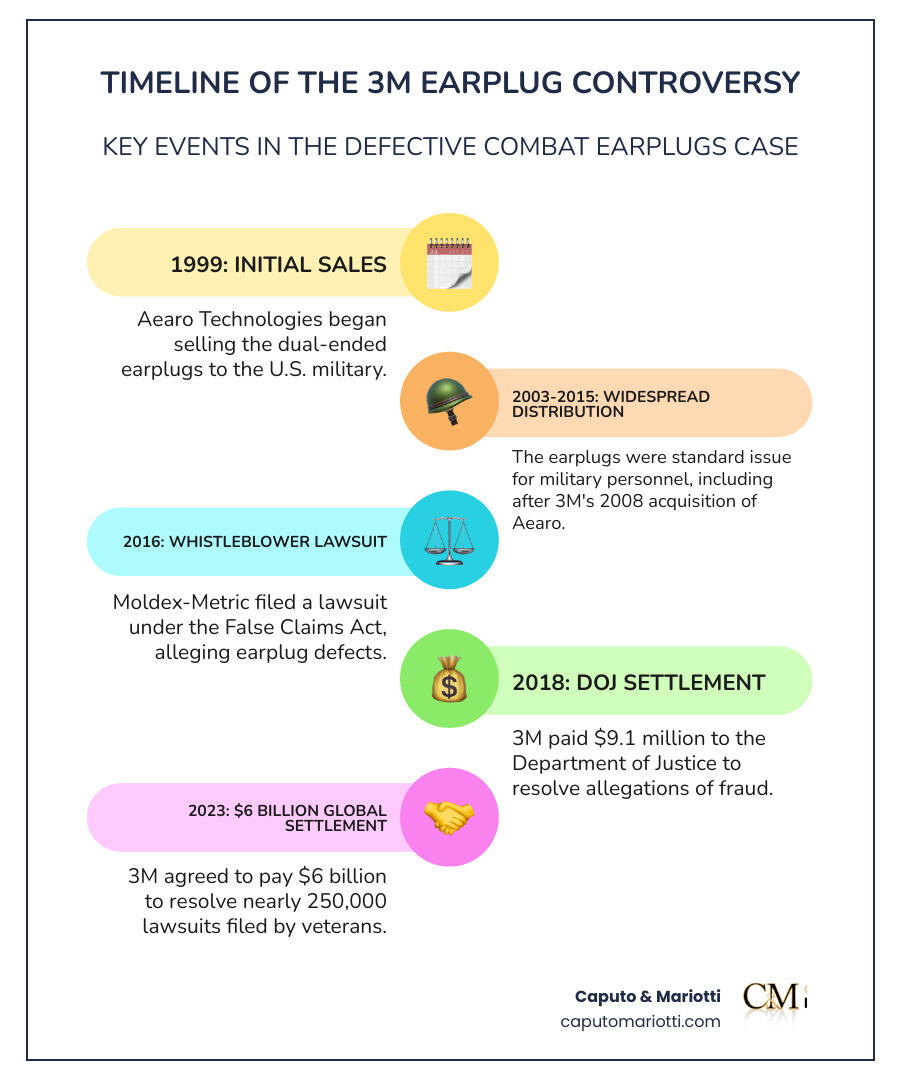
3M dual ended combat earplugs were standard-issue hearing protection for U.S. military personnel from 2003 to 2015. But instead of protecting service members from hearing damage, these earplugs allegedly caused it—leading to one of the largest product liability cases in American history.
Key Facts About 3M Dual-Ended Combat Earplugs:
- What they were: Reusable, dual-ended earplugs with an olive “closed” end and yellow “open” end
- The defect: The stem was too short to create a proper seal, allowing the earplug to loosen imperceptibly in the ear canal
- The deception: 3M allegedly knew the earplugs were defective but falsified test results and failed to warn the military
- The damage: Hundreds of thousands of veterans now suffer from hearing loss and tinnitus
- The settlement: 3M agreed to pay $6 billion to resolve nearly 250,000 lawsuits
- Earlier DOJ action: In 2018, 3M paid $9.1 million to settle allegations of knowingly selling defective earplugs to the armed services
The earplugs were designed with two settings: one to block all sound (closed position) and another to reduce loud impulse noises like weapons fire while allowing speech (open position). But according to court documents and the Department of Justice, the earplugs had a critical design flaw. They were too short to insert deeply enough into the ear canal, causing them to loosen without the wearer noticing, exposing service members to dangerous noise levels that can cause permanent hearing damage.
What makes this case particularly troubling is that 3M allegedly knew about these defects as early as 2000, when internal testing by Aearo Technologies (the original manufacturer, later acquired by 3M in 2008) revealed the earplugs didn’t perform as advertised. The company allegedly misrepresented the Noise Reduction Rating to the military—claiming the olive end had an NRR of 22 decibels when testing showed it was only 10.9, and claiming the yellow end had an NRR of 0 when it actually had an NRR of -2, potentially amplifying sound rather than reducing it.
At Caputo & Mariotti, our personal injury team has devoted years to representing people hurt by negligence, including veterans harmed by defective 3m dual ended combat earplugs. With decades of courtroom experience and a long history of winning substantial recoveries for injured clients, we know how to investigate these claims, build strong cases, and hold powerful corporations accountable when their products cause serious harm.
The Basis of a Product Liability Lawsuit: The 3M Earplug Defects
Hearing protection is a non-negotiable necessity for military personnel, especially those operating in combat zones or training environments where explosions, gunfire, and heavy machinery are commonplace. The continuous exposure to such intense noise can lead to severe, irreversible hearing damage. This is why the U.S. military sought out advanced hearing protection, leading to the widespread distribution of the 3M dual ended combat earplugs.
Our firm has seen the devastating impact that defective products can have on individuals, particularly when those individuals are serving our country. The design and subsequent failure of these earplugs are at the heart of numerous product liability claims, highlighting the critical importance of holding manufacturers accountable for the safety and efficacy of their products.
How Were the 3m dual ended combat earplugs Designed to Work?
The 3M dual ended combat earplugs, officially known as Combat Arms Earplugs, Version 2 (CAEv2), were designed with a unique, dual-ended structure to offer versatile hearing protection in dynamic military environments. This innovative design was intended to serve two distinct functions, catering to different noise conditions encountered by service members.
On one end was the olive-colored, “closed” or “blocked” tip. This end was designed to provide conventional, continuous hearing protection against steady, high-level noise, such as that from aircraft, tanks, or constant engine roar. When properly inserted, this end was meant to block out nearly all sound, offering maximum noise reduction. Aearo Technologies, the original manufacturer, claimed this end had a Noise Reduction Rating (NRR) of 22 decibels, suggesting it would significantly dampen loud noises.
The other end featured a yellow-colored, “open” or “unblocked” tip. This side was engineered for “selective attenuation.” The idea was to reduce loud impulse noises—like gunshots, artillery fire, or explosions—to safe levels, while simultaneously allowing quieter sounds, such as spoken commands, approaching vehicles, or enemy movements, to be heard. This feature was crucial for maintaining situational awareness, enabling communication among troops, and allowing service members to hear critical instructions without removing their hearing protection. The yellow end was initially claimed to have an NRR of 0, implying it would allow normal sounds through while still protecting against sudden loud blasts.
The intent was clear: provide comprehensive protection while preserving essential communication and awareness on the battlefield. Soldiers were instructed to alternate between the two ends depending on their operational needs. This design, if functional, would have been a significant advancement in military hearing protection.
What Were the Specific Defects in the 3m dual ended combat earplugs?
Despite their intended ingenious design, the 3M dual ended combat earplugs were plagued by critical defects that rendered them ineffective and, ultimately, dangerous. Our investigations into these cases reveal a pattern of design flaws and alleged corporate negligence that put our service members at grave risk.
The primary design defect centered on the earplugs’ physical structure. The stem of the earplug was found to be too short for many users, preventing proper insertion into the ear canal. This meant that even when inserted, the earplug could not achieve a deep, secure fit. Compounding this issue, the earplug’s flanges were prone to imperceptibly loosening or folding back within the ear canal. This design flaw created an improper seal, allowing hazardous levels of noise to bypass the earplug and reach the inner ear without the wearer even realizing it. Imagine being in a combat zone, believing you’re protected, only to find out later that your hearing was constantly exposed to damaging noise.
Even more troubling are the allegations that 3M, and its predecessor Aearo Technologies, knew about these defects long before the earplugs were widely distributed. Internal testing conducted by Aearo Technologies as early as 2000, years before the earplugs became standard issue, allegedly revealed that the earplugs did not perform as advertised. The company allegedly falsified test results and failed to warn the military about these critical flaws.
Specifically, the Noise Reduction Rating (NRR) was grossly misrepresented. While Aearo told the military that the olive “closed” end of the earplugs provided an NRR of 22 decibels, internal tests allegedly showed the true NRR was only 10.9. This significant discrepancy meant that service members were receiving far less protection than they believed, making them vulnerable to noise-induced hearing damage. For context, a normal conversation is about 60 decibels, while noise above 120 decibels can cause instant hearing damage, according to the Centers for Disease Control and Prevention. An average gunshot registers at about 140 decibels. If the NRR was truly 22, exposure to 140 dB would be reduced to 132.5 dB. However, with an NRR of only 10.9, the exposure would be a much higher 138.51 dB, offering minimal protection against such intense impulse noise.
Furthermore, the yellow “open” end, claimed to have a 0 NRR, allegedly had an actual NRR of -2. An NRR of -2 doesn’t just mean no protection; it suggests that the earplug could potentially amplify sound, making the situation worse for service members who relied on it to selectively reduce loud noises.
This alleged failure to warn the military about known defects, combined with the misrepresentation of performance data, forms the core of the product liability claims against 3M. Our firm is committed to pursuing justice for those who were harmed by these defective products. For more detailed information on the ongoing legal actions and what it means for veterans, please visit our page on the 3M Earplug Lawsuit.
Proving Damages in an Injury Lawsuit: Hearing Loss and Tinnitus
The consequences of using defective hearing protection in high-noise environments are profound and long-lasting. For military personnel, who are regularly exposed to some of the loudest sounds imaginable—from weapons fire and explosions to aircraft engines and heavy machinery—inadequate ear protection can lead to permanent and debilitating health issues. This section digs into the specific types of hearing damage suffered by our veterans, which form the crucial basis for compensation in a personal injury lawsuit.

The U.S. Department of Veterans Affairs (VA) reports that hearing problems are the most prevalent service-connected disability among American veterans. This stark reality underscores the pervasive nature of noise exposure in military service and the critical need for effective hearing protection. In 2022 alone, over 1.4 million people received disability compensation for hearing loss, and more than 2.7 million for tinnitus. These numbers reflect not just a medical condition, but a significant impact on quality of life, personal relationships, and overall well-being.
What is Tinnitus and How Does It Affect Quality of Life?
Tinnitus is often described as a ringing in the ears, but it can manifest as buzzing, hissing, roaring, clicking, or whistling sounds. These phantom noises can vary in pitch and intensity, sometimes being constant and at other times intermittent. For those suffering from tinnitus due to defective 3M dual ended combat earplugs, these sounds are a persistent and unwelcome reminder of their service and the alleged failure of their equipment.
The impact of tinnitus on a person’s quality of life can be severe. It can interfere with sleep, concentration, and daily activities, leading to significant distress. Many veterans with tinnitus also experience heightened anxiety and depression. According to the Hearing Health Foundation, in veterans with tinnitus, a staggering 72% had anxiety, 60% had depression, and 58% suffered from both conditions. A 2023 cohort study further found a significant correlation between tinnitus and symptoms of depression, anxiety, and somatization, which are physical effects of the mind on the body. This suggests that the constant presence of tinnitus can exacerbate existing mental health conditions or contribute to their development, creating a complex web of challenges for affected individuals.
Living with chronic tinnitus can be isolating, making it difficult to engage in conversations, enjoy quiet moments, or find peace. This constant internal noise can be a source of immense frustration and fatigue, affecting everything from personal relationships to career performance. Understanding the profound impact of this condition is crucial when assessing the damages covered in a personal injury claim. You can learn more about the Impact on daily life of tinnitus. Additional insights into the link between tinnitus and mental health can be found in this Cohort study on tinnitus and mental health.
Hearing Loss and Other Auditory Damage
Beyond tinnitus, the failure of 3M dual ended combat earplugs has led to various forms of hearing loss and other auditory damage among service members. Hearing loss can range from partial to profound, impacting a person’s ability to perceive sounds of different frequencies and volumes. Even moderate hearing loss can make it difficult to understand speech, especially in noisy environments, leading to communication challenges and social isolation.
The Centers for Disease Control and Prevention provides comprehensive information on the Types of hearing loss explained, including conductive, sensorineural, and mixed hearing loss. Many veterans who used the defective 3M earplugs suffer from sensorineural hearing loss, often caused by damage to the inner ear or auditory nerve due to prolonged or intense noise exposure. This type of hearing loss is typically permanent.
In addition to hearing loss and tinnitus, some veterans may experience Auditory Processing Disorder (APD). APD affects how the brain processes sound, even if the ears themselves are functioning normally. Individuals with APD may struggle to understand speech in noisy settings, follow complex verbal instructions, or distinguish between similar sounds. This can be particularly debilitating, affecting cognitive function and daily tasks.
The sheer volume of veterans affected by hearing problems underscores the severity of this issue. As noted, more than 1.16 million veterans received disability compensation for hearing loss in 2017, and about 1.79 million received compensation for tinnitus. These statistics are a stark reminder of the widespread impact of inadequate hearing protection on our military personnel.
When we represent veterans in these personal injury cases, we carefully assess all forms of hearing damage, including the medical costs, lost wages, pain and suffering, and the long-term impact on their quality of life. Our goal is to ensure that the compensation secured truly reflects the full extent of their injuries. For more information on What damages are covered in payouts? in these types of lawsuits, we encourage you to review our dedicated resource.
The Legal Battle: From Whistleblower Lawsuit to a $6 Billion Settlement
The journey from finding product defects to securing a multi-billion dollar settlement is a long and arduous one, especially when facing a corporate giant like 3M. This section outlines the critical legal proceedings that brought the defects of the 3M dual ended combat earplugs to light and ultimately led to a massive resolution for hundreds of thousands of affected service members. This demonstrates how personal injury and whistleblower laws are vital tools in holding powerful corporations accountable for their actions.
The Whistleblower Lawsuit and DOJ Intervention
The initial spark that ignited the massive legal firestorm against 3M came from an unexpected source: a whistleblower lawsuit. In 2016, a competitor, Moldex-Metric, Inc., filed a lawsuit under the False Claims Act. This crucial piece of legislation allows private parties, known as whistleblowers or “relators,” to sue on behalf of the federal government when they have evidence that an individual or company has defrauded the government.
Moldex-Metric’s lawsuit alleged that 3M (and its predecessor Aearo Technologies) knowingly supplied the U.S. military with defective earplugs without disclosing critical flaws. The allegations included that 3M had falsified test results to secure its exclusive contract with the Department of Defense and that the earplugs were too short to achieve a proper seal in many users’ ear canals, leading to inadequate hearing protection. These were serious allegations of fraud against the government, as the military had purchased millions of pairs of these earplugs, believing them to be effective.
The Department of Justice (DOJ) took these allegations seriously and intervened in the lawsuit. After a thorough investigation, in July 2018, the U.S. Department of Justice announced that 3M Company would pay $9.1 million to resolve the allegations that it knowingly sold defective earplugs to the armed services. While 3M made no admissions of wrongdoing or liability in this settlement, it was a significant victory. It confirmed that there was substance to the claims of defectiveness and misrepresentation. This initial settlement, while relatively small compared to the later global settlement, brought the issue into the public eye and paved the way for individual service members to pursue their own claims. The official press release from the DOJ detailing this settlement can be found here: DOJ $9.1 million settlement.
The Multidistrict Litigation (MDL) and Global Settlement
Following the DOJ settlement, thousands of individual lawsuits were filed by service members and veterans across the country, all alleging hearing damage from the defective 3M dual ended combat earplugs. To manage this influx of cases efficiently, these lawsuits were consolidated into Multidistrict Litigation (MDL) No. 2885 in the U.S. District Court for the Northern District of Florida. Multidistrict litigation is a special federal legal procedure designed to streamline the pretrial process when many similar lawsuits are filed in different federal district courts. It allows for common issues of fact and law to be handled by a single judge, preventing duplicative findy and inconsistent rulings.
The MDL quickly grew to become one of the largest in U.S. history, with nearly 250,000 claimants seeking justice. Our firm, with its deep roots in Pennsylvania and commitment to veterans’ rights, closely followed the developments in this complex litigation. Over several years, bellwether trials (test cases) were conducted, resulting in significant verdicts against 3M, further highlighting the company’s liability and the severity of the injuries suffered by service members.
Facing hundreds of thousands of lawsuits and mounting legal pressure, 3M Company agreed to a monumental global settlement. In August 2023, 3M announced it would pay $6 billion to resolve the nearly 250,000 lawsuits. This massive settlement consists of $5 billion in cash and $1 billion in 3M stock, making it one of the largest product liability settlements in history. Payments to eligible claimants are expected to run into 2029. This settlement offers a pathway to compensation for the countless veterans who suffered hearing loss and tinnitus while serving our nation. We understand that navigating the complexities of such a large settlement can be daunting. For comprehensive information and updates regarding the settlement, please refer to our detailed resource: 3M Earplug Lawsuit Settlement details.
What Veterans Harmed by 3M Earplugs Should Do Next
If you served in the U.S. military between 2003 and 2015 and used 3M dual ended combat earplugs, and you now suffer from hearing loss, tinnitus, or other auditory damage, you are not alone. The legal battle has secured a significant settlement, but there are still crucial steps you need to take to ensure you receive the compensation you deserve. This section provides actionable advice for affected individuals, guiding them on how to protect their legal rights and steer the path forward.
Understanding Your Eligibility for the Settlement
The $6 billion settlement program established by 3M is designed to compensate eligible claimants who suffered hearing injuries due to the defective earplugs. Understanding your eligibility and the process for receiving your settlement award is paramount.
The settlement agreement, specifically Master Settlement Agreement I (MSA I), outlines that eligible claimants will be paid their settlement awards on a First-In, First-Out (FIFO) basis. This means that claims processed and finalized earlier will generally receive payment before those processed later. This emphasizes the importance of acting promptly and ensuring all documentation is submitted accurately and on time.
To determine your eligibility and to participate in the settlement program, you will need to meet certain requirements outlined in court orders, such as Case Management Order No. 58. This order sets forth the general requirements for eligible claimants who wish to participate and be bound by the Combat Arms Master Settlement Agreement.
Crucially, you will need to gather and provide specific documentation to support your claim. This typically includes:
- Service Records: Proof of your military service during the qualifying period (2003-2015) and deployment to areas where the earplugs were issued.
- Medical Records: Comprehensive documentation of your hearing loss, tinnitus, or other auditory damage, including diagnoses, audiograms, and treatment history. These records are vital for establishing the extent of your injuries and their connection to the defective earplugs.
The official settlement administrators, ARCHER Systems, LLC, and BrownGreer PLC, are managing the claims process. It is essential to stay informed about official communications and deadlines from the court and administrators. Be cautious of scams; the Federal Bureau of Investigation has even been notified of attempted fraud/identity theft where callers request sensitive personal information. Official communications will not ask for such details over the phone. You can find comprehensive and official information regarding the settlement process and procedures on the dedicated website: Official settlement information.
Why You Need an Experienced Personal Injury Lawyer
Navigating a complex settlement program involving hundreds of thousands of claimants and a multi-billion dollar corporation like 3M is not something you should attempt alone. This is where the expertise of an experienced personal injury lawyer becomes invaluable.
Our firm understands the intricacies of product liability law and the specific challenges faced by veterans seeking compensation for their injuries. We can help you:
- Steer the Claims Process: The settlement program has specific rules, deadlines, and documentation requirements. We can guide you through every step, ensuring your claim is properly filed and meets all necessary criteria.
- Prove Causation: While the settlement acknowledges the link between the earplugs and injuries, demonstrating the specific connection between your military service, use of the earplugs, and your hearing damage requires careful legal strategy and medical evidence. We work with medical experts to strengthen your case.
- Calculate Damages: Determining the full extent of your damages—including past and future medical expenses, lost earning capacity, pain and suffering, and the impact on your overall quality of life—is complex. We carefully assess all factors to ensure you seek the maximum compensation you deserve.
- Protect Your Rights: As a veteran, you’ve sacrificed for our country. We believe you deserve dedicated legal representation to protect your rights against powerful corporate interests. Our team will advocate fiercely on your behalf.
Our firm, Caputo & Mariotti, has over 55 years of combined experience fighting for justice for injured individuals in Pennsylvania, including Scranton, Wilkes-Barre, and throughout Northeastern Pennsylvania, as well as in New York, New Jersey, and Ohio. We are committed to providing unwavering legal support to those harmed by negligence. Choosing the right legal representation can make all the difference in the outcome of your claim. We invite you to learn more about How to choose the right personal injury lawyer to ensure you have the best possible advocate on your side.
If you believe you were harmed by defective 3M dual ended combat earplugs, don’t delay. The window for participation in the settlement program, while open, requires timely action. We offer a free, no-obligation case evaluation to discuss your situation and explore your legal options. Contact us today for a Get a free case evaluation.
Conclusion
The 3M earplug case is a landmark example of corporate accountability for a defective product that harmed our nation’s heroes. While a major settlement has been reached, the fight for individual justice continues for many. If you served between 2003 and 2015 and now suffer from hearing loss or tinnitus, understanding your legal options is the first step toward securing the compensation you deserve. The dedicated team at Caputo & Mariotti has over 55 years of combined experience fighting for the rights of the injured. Contact our personal injury attorneys for trusted legal support.