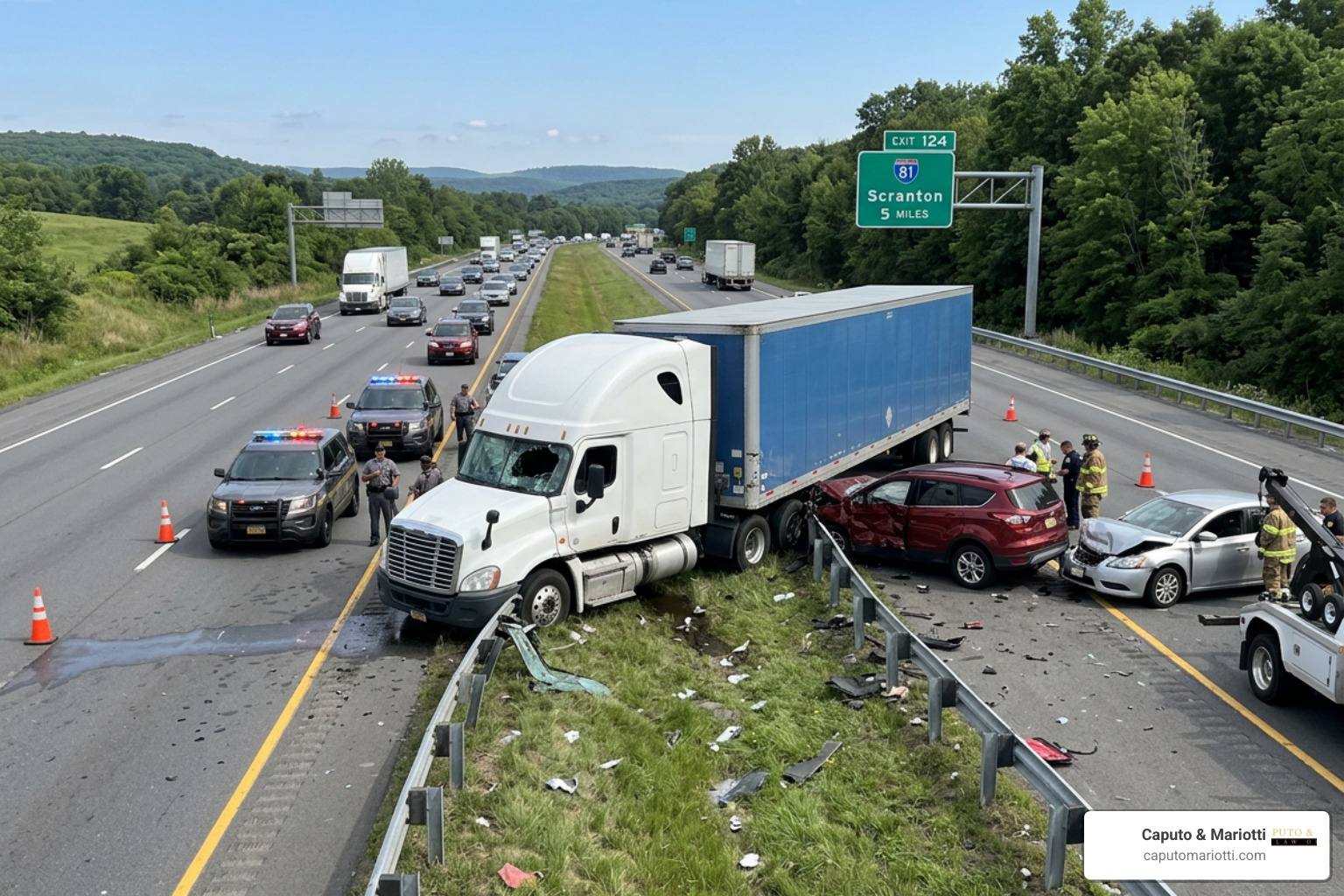

The dedicated legal team of Caputo & Mariotti
What Causes Most Truck Accidents in Pennsylvania?
July 10, 2026
What Causes Most Truck Accidents in Pennsylvania — And Why It Matters
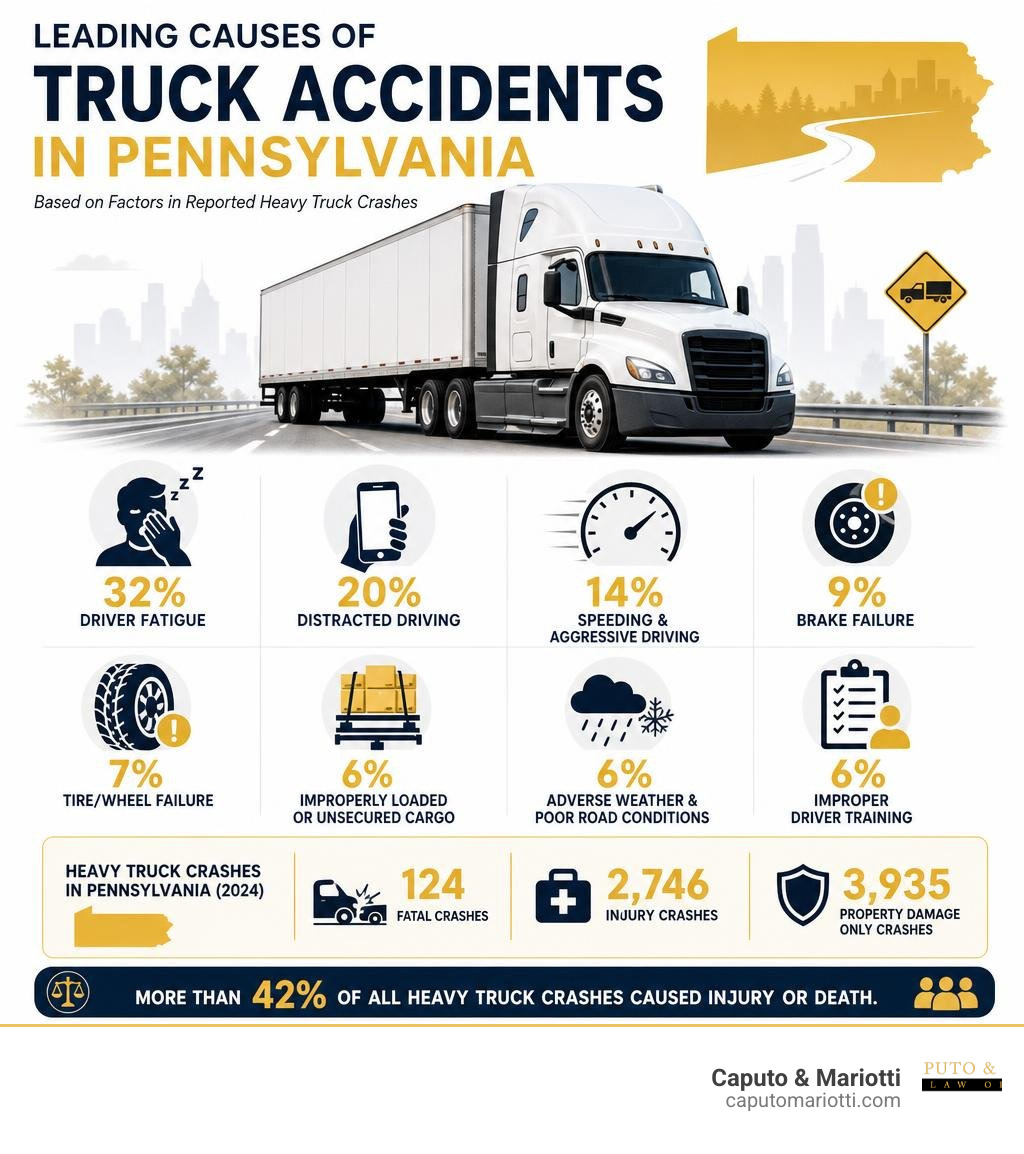
What causes most truck accidents in Pennsylvania comes down to a handful of recurring factors. Here is a quick breakdown:
| Cause | Type |
|---|---|
| Driver fatigue | Driver error |
| Distracted driving | Driver error |
| Speeding and aggressive driving | Driver error |
| Brake failure | Vehicle defect |
| Tire/wheel failure | Vehicle defect |
| Improperly loaded or unsecured cargo | Operational failure |
| Adverse weather and poor road conditions | Environmental |
| Improper driver training | Operational failure |
Pennsylvania is one of the busiest trucking corridors in the country. Thousands of commercial trucks travel its interstates and state highways every day. When something goes wrong, the results are devastating.
The numbers tell a stark story. In 2024 alone, heavy truck crashes in Pennsylvania resulted in 124 fatal crashes, 2,746 injury crashes, and 3,935 crashes involving property damage only. That means more than 42% of all heavy truck crashes caused injury or death.
The weight difference alone explains why outcomes are so severe. A fully loaded tractor-trailer can weigh up to 80,000 pounds — roughly 20 times more than the average passenger car. Even a low-speed collision can cause catastrophic harm to those in smaller vehicles. In fact, only about 2.3% of truck accident deaths were truck occupants themselves. The rest were people in passenger vehicles, pedestrians, or cyclists.
Understanding what causes these crashes is the first step toward accountability — and toward getting the compensation you deserve.
I’m Chris Caputo, a Pennsylvania personal injury attorney with over three decades of litigation experience, including complex injury and wrongful death cases involving commercial vehicle crashes. My work on what causes most truck accidents in Pennsylvania — from driver negligence to mechanical failures — gives me a clear-eyed view of how these cases unfold and how to build the strongest possible claim for victims. In the sections below, I’ll walk you through every major cause, what the data says, and what your legal options are.
Pennsylvania Truck Accident Statistics and Trends
To understand the scope of the problem in the Commonwealth, we have to look closely at the data. Pennsylvania’s geographic position makes it a vital shipping hub. Interstates like I-80, I-81, and the Pennsylvania Turnpike carry cargo between major Midwestern manufacturing centers and East Coast ports. Because of this high volume of commercial traffic, our state consistently ranks among the top states for commercial vehicle collisions.
According to the official 2023 Pennsylvania Crash Facts and Statistics report published by PennDOT, there were 7,186 crashes involving heavy trucks in Pennsylvania, resulting in 157 heavy-truck-related fatalities. This represents a sustained high rate of serious crashes over the years. For comparison, in 2022, there were 6,805 heavy truck crashes with 164 fatalities.
The following table compares the involvement of heavy trucks versus light trucks, SUVs, and vans in Pennsylvania crashes:
| Metric | Heavy Trucks (2023) | Light Trucks / SUVs / Vans (2023) |
|---|---|---|
| Total Crashes | 7,186 | 94,285 |
| Occupant Fatalities | 21 | 342 |
| Total Crash-Related Fatalities | 157 | 500+ |
| Primary Crash Role | Often the striking vehicle in multi-vehicle fatal crashes | High rate of single-vehicle run-off-road crashes |
While light trucks and passenger SUVs are involved in a far higher raw number of crashes, the fatality rate associated with heavy trucks is disproportionately high. Commercial vehicles represent only a small fraction of registered vehicles on Pennsylvania roads, yet they are involved in a massive share of highway fatalities.
The data highlights a tragic reality: when a semi-truck collides with a passenger vehicle, the occupants of the smaller vehicle bear the brunt of the impact. The physical force generated by an 80,000-pound commercial vehicle traveling at highway speeds is simply too much for standard crumple zones and airbags to fully absorb.
Driver Error: What Causes Most Truck Accidents in Pennsylvania?
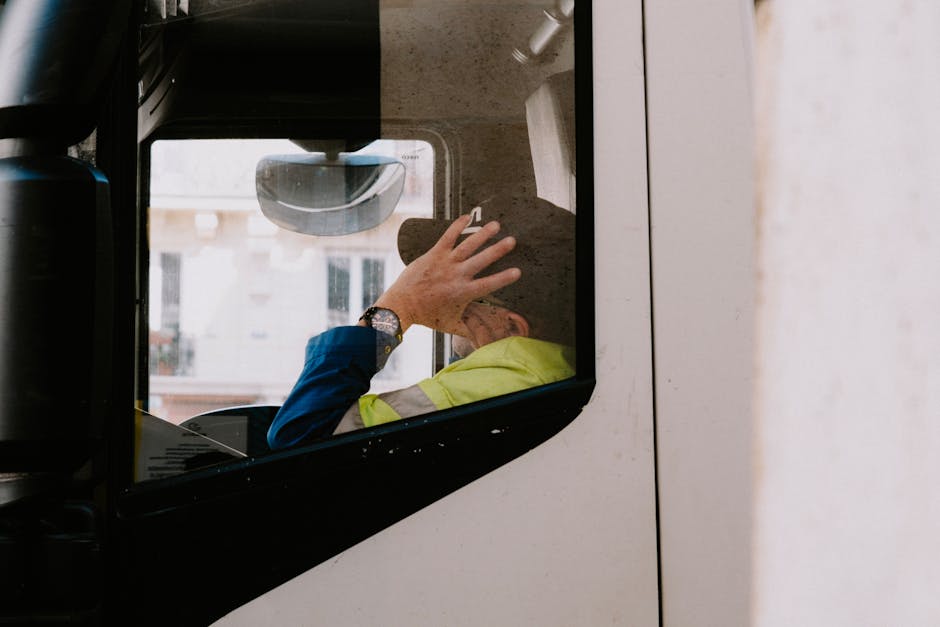
While mechanical issues and poor weather certainly play a role, driver error remains the single most common answer to the question of what causes most truck accidents in Pennsylvania. Operating a commercial vehicle requires specialized skills, intense concentration, and strict adherence to safety protocols. When a truck driver experiences a lapse in judgment or fails to follow basic traffic laws, the consequences are immediate and severe.
Driver Fatigue and Hours-of-Service Regulations
Truck drivers often work under intense pressure to meet tight delivery deadlines. This commercial pressure can lead to extreme physical exhaustion. According to data compiled by federal safety agencies, drowsy driving is a factor in more than 17% of all fatal commercial vehicle crashes.
To combat this, the Federal Motor Carrier Safety Administration (FMCSA) enforces strict hours-of-service (HOS) regulations:
- 11-Hour Driving Limit: Drivers may drive a maximum of 11 hours after 10 consecutive hours off duty.
- 14-Hour Limit: Drivers may not drive beyond the 14th consecutive hour after coming on duty.
- Rest Breaks: Drivers must take a 30-minute break after 8 cumulative hours of driving.
- 60/70-Hour Limit: Drivers cannot drive after 60/70 hours on duty in 7/8 consecutive days.
To prevent trucking companies from forcing drivers to bypass these limits, commercial trucks are equipped with Electronic Logging Devices (ELDs). However, some operators still find ways to violate these rules, or they drive while fatigued even within their legal hours. The physical toll of being awake for 18 consecutive hours degrades a driver’s reaction time to a level equivalent to a 0.05% blood alcohol concentration (BAC). At 24 hours of wakefulness, the impairment is equivalent to a 0.10% BAC—well over the legal limit for any driver.
Distracted Driving and Speeding on PA Highways
Distracted driving is a growing epidemic across all vehicle classes, but it is exceptionally dangerous when a truck driver is involved. In 2022, distracted driving was responsible for over 3,300 traffic deaths nationwide. For a truck driver, distraction can come from:
- Using mobile devices or dispatching screens
- Adjusting in-cab GPS navigation systems
- Eating or drinking while driving
At 55 miles per hour, a truck travels the length of a football field in about five seconds. If a driver looks down at a text message for just that long, they are essentially driving a massive, heavy vehicle blindfolded.
Speeding compound this danger. Commercial trucks require significantly longer stopping distances than passenger cars. Under ideal conditions, a fully loaded tractor-trailer traveling at 65 mph needs about 525 feet to come to a complete stop—almost double the distance a passenger vehicle needs. When truck drivers exceed the speed limit or drive too fast for highway conditions, they eliminate their ability to stop in time to avoid hazards.
Impaired and Aggressive Driving
Operating a commercial vehicle under the influence of alcohol, illegal drugs, or even certain prescription medications is a major safety risk. Because of the extreme danger posed by heavy trucks, the legal BAC limit for commercial driver’s license (CDL) holders in Pennsylvania is 0.04%, which is half the standard 0.08% limit for non-commercial drivers. Despite these strict limits, some drivers turn to stimulants to stay awake or alcohol to unwind, severely impairing their coordination and judgment.
Aggressive driving also contributes to many crashes in Northeastern Pennsylvania. This includes tailgating (following too closely), making unsafe lane changes without checking blind spots, and refusing to yield the right-of-way. Trucks have massive blind spots—often called “No-Zones”—on all four sides. When a truck driver maneuvers aggressively, they are highly likely to strike a smaller vehicle traveling in one of these blind spots.
Vehicle Defects and Maintenance Failures
Commercial trucks travel tens of thousands of miles every month, causing rapid wear and tear on critical mechanical systems. Trucking companies are legally obligated to maintain their fleets in pristine condition and perform regular safety inspections. Unfortunately, some companies cut corners on maintenance to save money or keep trucks on the road, directly leading to mechanical failures. For a detailed breakdown of how these issues manifest, you can read our guide on Demystifying Truck Accidents: Causes, Types, and Injuries.
How Vehicle Defects Influence What Causes Most Truck Accidents in Pennsylvania
According to the 2022 Pennsylvania Crash Facts report, vehicle-related defects are a frequent contributing factor in heavy truck accidents. The two most common mechanical culprits are:
- Tire and Wheel Failures: Tire blowouts and wheel-related defects contributed to 996 crashes in Pennsylvania in 2022. A high-speed tire blowout can cause a truck driver to lose complete control of the vehicle, leading to rollovers or multi-car collisions.
- Brake Failures: Brake-related defects contributed to 723 crashes in 2022. Because of the immense weight of a commercial vehicle, its air brake systems must function perfectly. Worn brake pads, rusted drums, or air leaks can cause catastrophic brake failure, leaving a driver unable to stop when traffic slows ahead.
Steering system failures and power train malfunctions also play a role. When a trucking company fails to perform daily pre-trip inspections or ignores worn parts flagged by drivers, they can be held legally liable for the resulting crash.
Improperly Loaded Cargo and Unsecured Trailers
How cargo is loaded inside a trailer directly affects how the truck handles on the road. Federal regulations dictate strict weight limits—no commercial vehicle can exceed 80,000 pounds without special permits—and specific securement protocols.
When cargo is improperly loaded, it can lead to:
- Overloading: An overloaded truck is harder to stop, strains the braking system, and increases the risk of tire blowouts.
- Shifting Cargo: If cargo is not securely tied down, it can shift during a turn. This sudden movement changes the truck’s center of gravity, causing the trailer to tip over or jackknife.
- Jackknife Accidents: A jackknife occurs when the trailer slides outward at an angle to the cab, often because of sudden braking or shifting weight. When a truck jackknifes, it can sweep across multiple lanes of traffic, trapping other motorists in its path.
Environmental and Roadway Hazards in Pennsylvania

Pennsylvania is famous for its unpredictable weather and challenging terrain. From the steep, winding hills of Lackawanna and Luzerne Counties to the heavy snow belts of the Pocono region, drivers must constantly adapt to changing environmental conditions.
Adverse Weather and Dangerous PA Routes
Winter storms, freezing rain, dense fog, and torrential downpours frequently impact Pennsylvania highways. When roads become slippery, a commercial truck’s stopping distance increases exponentially. Drivers who fail to reduce their speed during bad weather are highly susceptible to losing traction and sliding out of control.
Some of the most dangerous routes for truck traffic in Northeastern Pennsylvania include:
- Interstate 80 (I-80): Known for sudden winter whiteouts, heavy fog, and high-speed truck traffic.
- Interstate 81 (I-81): A major freight corridor running through Scranton and Wilkes-Barre, characterized by heavy congestion, frequent construction, and steep grade changes.
- The Pennsylvania Turnpike (I-76): Features narrow lanes, historic tunnels, and winding mountain passes that require extreme caution.
These routes feature sharp curves and steep descents that are difficult to navigate even in perfect weather. When a truck driver fails to account for these road designs, the risk of a rollover or jackknife accident rises dramatically.
Work Zones and Road Maintenance Issues
Pennsylvania’s infrastructure requires constant upkeep, resulting in active work zones across the state during much of the year. According to state statistics, there were 1,293 work zone crashes in Pennsylvania in 2022, resulting in 14 fatalities.
Work zones present unique hazards for large trucks, including:
- Narrowed lanes and sudden lane shifts
- Uneven pavement surfaces
- Abruptly slowing or stopping traffic
Furthermore, general road maintenance issues like deep potholes, deteriorated shoulders, and debris can cause a truck driver to lose control or suffer a sudden tire blowout. While government agencies are responsible for keeping roads safe, filing a lawsuit over poor road design or maintenance is highly complex due to sovereign immunity laws in Pennsylvania, which limit when and how you can sue a public entity.
Legal Liability and Seeking Compensation After a PA Truck Crash
Recovering compensation after a commercial vehicle crash is far more complicated than a standard car accident. Because multiple entities are involved in a commercial shipping operation, determining who is at fault requires a deep dive into corporate records, maintenance logs, and federal compliance history. To understand why this process is so complex, you can read our analysis on The Critical Role of Legal Representation After a Truck Accident.
Determining Fault and Navigating Comparative Negligence
In a truck accident case, liability is rarely limited to the driver alone. Depending on the cause of the crash, several parties may share fault:
- The Trucking Company: If they pressured the driver to violate safety regulations, hired an unqualified driver, or neglected fleet maintenance.
- The Cargo Loading Company: If they loaded the trailer unevenly or failed to secure the freight.
- The Vehicle/Parts Manufacturer: If a defective part (like a tire or brake component) failed under normal operating conditions.
- Third-Party Maintenance Providers: If they performed negligent repairs on the truck.
To prove liability, we must gather and preserve critical evidence quickly. This includes downloading data from the truck’s “black box” (electronic control module), obtaining ELD logs, reviewing maintenance records, and analyzing post-crash drug testing results. You can learn more about how we build these cases in our guide on Navigating Truck Accident Liability: Understanding Responsibility and Legal Strategies for Compensation.
Pennsylvania also operates under a modified comparative negligence system (51% bar rule). This means you can recover compensation as long as your share of fault for the accident is 50% or less. However, your financial recovery will be reduced by your percentage of fault. For example, if you are awarded $100,000 but found to be 20% at fault, you will receive $80,000. If your fault is determined to be 51% or more, you are legally barred from recovering any damages.
The Role of a Workers’ Compensation Lawyer for Injured Truckers
If you are a professional truck driver who was injured on the job in Pennsylvania, your path to recovery is different. Pennsylvania operates a no-fault workers’ compensation system designed to provide medical benefits and wage loss replacement to injured workers regardless of who caused the accident. To secure these benefits, injured truckers must navigate a specific legal process. An experienced workers’ compensation lawyer can guide you through each of the following critical phases:
1. Reporting the Injury
You must formally report your work-related injury to your employer. Under Pennsylvania law, you must notify your employer of the accident and your injuries within 120 days of the occurrence. However, doing so immediately is highly recommended, as any delay can give the insurance carrier a reason to dispute or delay your claim.
2. Seeking Medical Treatment
For the first 90 days following your injury, you may be required to receive treatment from a doctor chosen from your employer’s designated list of healthcare providers (if they have posted a valid list). It is vital to seek immediate medical attention, describe all your symptoms accurately, and follow all prescribed treatment plans to document the physical impact of the crash.
3. Gathering Key Evidence
Building a strong claim requires preserving critical evidence from the very beginning. This includes obtaining copies of the police accident report, collecting contact information and statements from witnesses, taking photographs of the accident scene and your injuries, and keeping detailed records of all medical diagnoses, prescriptions, and treatment plans.
4. Navigating the Filing Process
To officially secure your benefits, you must navigate the formal filing process. This involves ensuring your employer files an Employer’s Report of Occupational Injury or Disease with the Bureau of Workers’ Compensation. If your employer or their insurance carrier denies your claim, disputes your medical treatment, or issues a Notice of Temporary Compensation Payable that they later attempt to stop, you must file a formal Claim Petition. A skilled workers’ compensation lawyer will handle the complex paperwork, represent you in hearings before a workers’ compensation judge, and manage any necessary appeals to protect your rights.
Frequently Asked Questions about Pennsylvania Truck Accidents
What causes most truck accidents in Pennsylvania according to state data?
According to PennDOT and federal crash data, driver error is the leading cause of heavy truck accidents in Pennsylvania. This includes driver fatigue, distracted driving, speeding, and driving too fast for winter weather conditions. Vehicle defects—particularly tire blowouts and brake failures—are also major contributing factors, accounting for over 1,700 crashes annually.
Who can be held liable for a commercial truck crash in PA?
Liability can extend to multiple parties. This includes the truck driver (for negligent driving), the trucking company (for negligent hiring, training, or maintenance), the cargo loading crew (for improper loading), and manufacturers (for defective truck components). An experienced attorney will investigate the crash to identify all potentially liable parties and their insurance policies.
How long do I have to file a truck accident lawsuit in Pennsylvania?
In Pennsylvania, the statute of limitations for personal injury and wrongful death claims resulting from a truck accident is generally two years from the date of the crash. If you fail to file a lawsuit within this two-year window, you will lose your legal right to seek compensation. It is vital to contact an attorney as soon as possible to ensure evidence is preserved and your rights are protected.
Seek Justice with Caputo & Mariotti
When you or a loved one is injured in a truck accident, the physical, emotional, and financial toll can feel overwhelming. Trucking companies and their insurance providers employ teams of investigators and lawyers whose sole job is to minimize their liability and pay you as little as possible. You should not have to face them alone.
At Caputo & Mariotti, we bring more than 55 years of combined legal experience to your side. Our dedicated team is deeply familiar with the complex federal and state safety regulations that govern the trucking industry, and we are committed to fighting for the justice and maximum compensation you deserve. We proudly serve clients throughout Northeastern Pennsylvania, including Scranton, Wilkes-Barre, Hazleton, Pittston, Moosic, and Dickson City.
Do not let a trucking company’s negligence dictate your future. Schedule a Free Consultation with our experienced legal team today, and let us help you take the first step toward recovery.