

The dedicated legal team of Caputo & Mariotti
The Ultimate Guide to How Long Workers Comp Lasts in Pennsylvania
September 30, 2026
How Long Can Workers’ Compensation Benefits Last in Pennsylvania?
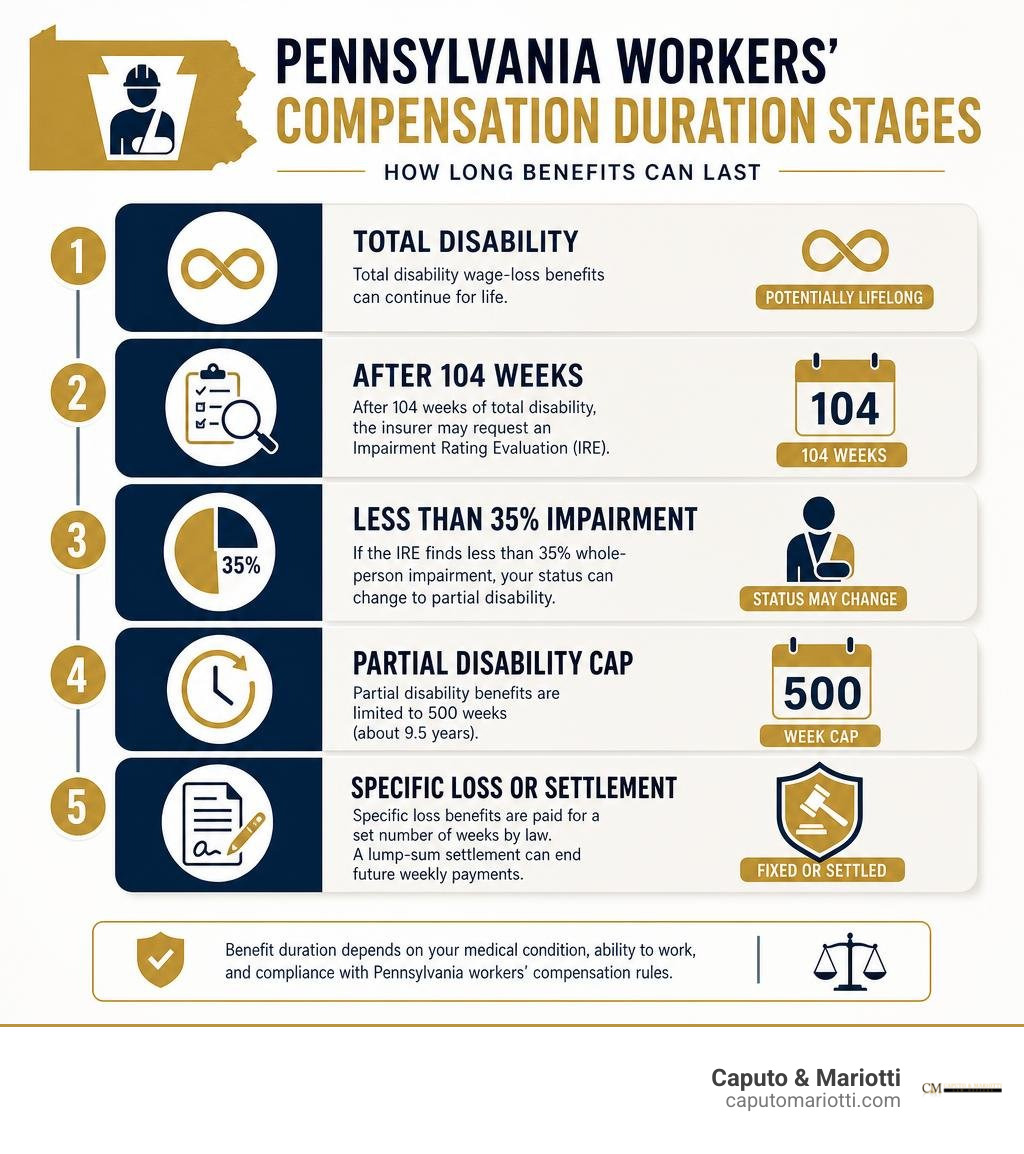
In Pennsylvania, total disability wage-loss benefits can continue for life if you remain totally disabled. But benefits can change over time:
- After 104 weeks of total disability, the insurer may request an Impairment Rating Evaluation (IRE).
- If the IRE finds less than 35% whole-person impairment, your status can change to partial disability, which has a 500-week cap – about 9.5 years.
- A permanent, specific loss, such as loss of a hand, arm, leg, or vision in one eye, is paid for a fixed number of weeks set by state law.
- A lump-sum Compromise and Release settlement can end future weekly payments if approved by a workers’ compensation judge.
The answer to how long workers comp lasts in Pennsylvania depends on the type of benefit, your medical condition, your ability to work, and whether the insurer successfully changes or ends your benefit status. Fast action also matters: report the injury promptly, protect the 120-day notice deadline, and file a Claim Petition within the applicable limitations period if benefits are denied or stopped.
I am Chris Caputo, a Pennsylvania attorney who has represented seriously injured people and families for decades in litigation against insurers and other responsible parties. When clients ask how long does workers comp last Pennsylvania, I help them understand the deadlines, medical evidence, and benefit limits that can shape their claim.
How Long Does Workers Comp Last Pennsylvania: Benefit Duration Breakdown
The Pennsylvania Workers’ Compensation Act operates as a no-fault system. This framework guarantees medical care and wage replacement to employees injured on the job, regardless of who caused the accident, while protecting employers from common-law negligence lawsuits. However, the duration of those benefits depends strictly on your disability classification, ongoing earning capacity, and adherence to statutory reporting rules.
When navigating the system, an injured employee must understand how different classifications limit or extend payment timelines. Whether you need assistance navigating workers compensation claims or resolving an insurer dispute, understanding the statutory caps on wage loss is the first line of defense.
For 2026, the maximum statewide weekly compensation rate in Pennsylvania is $1,394.00, with a statutory minimum weekly benefit of $697.00 (or 90% of your average weekly wage if your earnings are below that threshold).
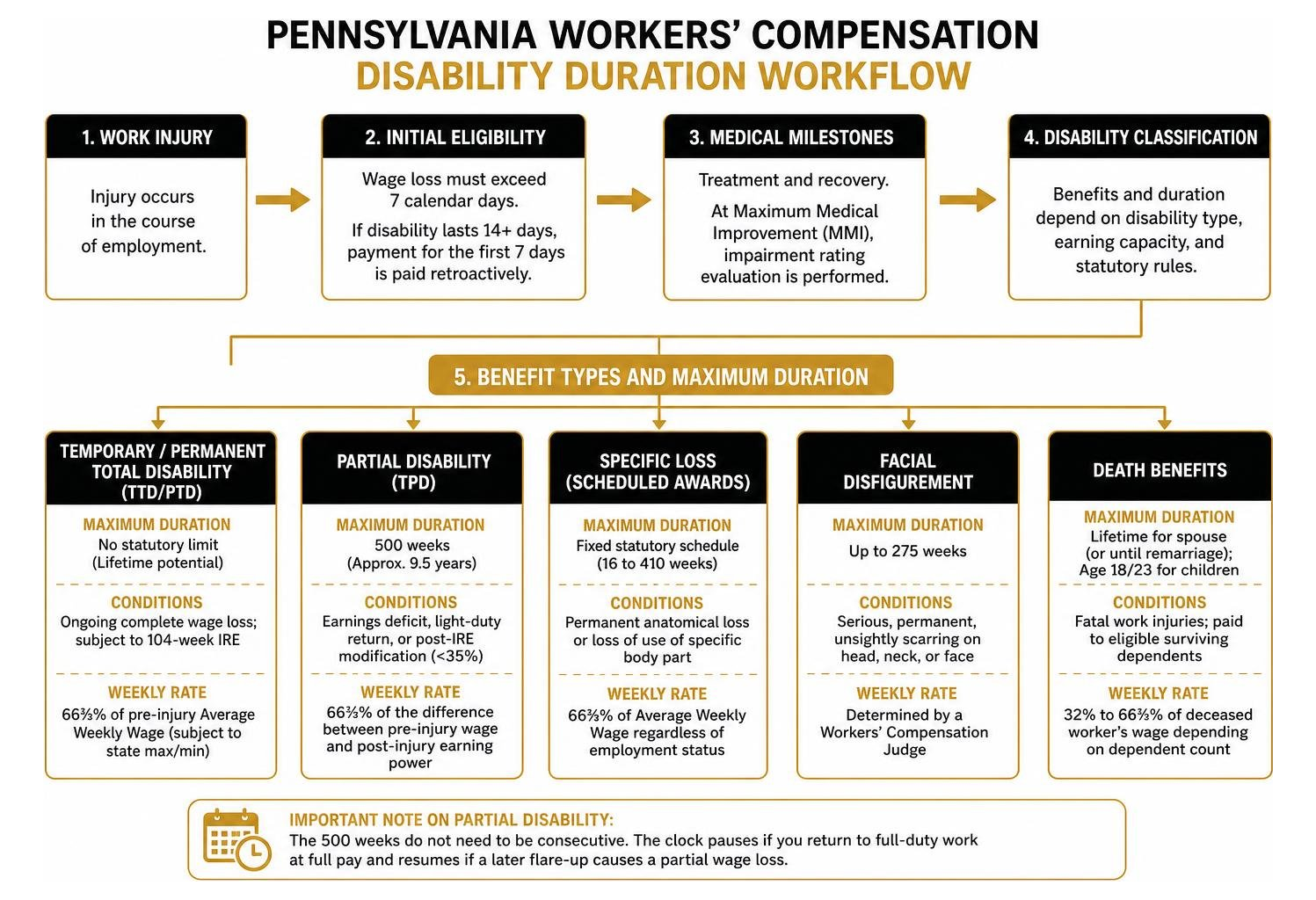
| Benefit Type | Maximum Duration | Statutory Basis / Conditions | Weekly Rate Calculation |
|---|---|---|---|
| Temporary / Permanent Total Disability (TTD/PTD) | No statutory limit (Lifetime potential) | Ongoing complete wage loss; subject to 104-week IRE | 66⅔% of pre-injury Average Weekly Wage (subject to state max/min) |
| Partial Disability (TPD) | 500 weeks (Approx. 9.5 years) | Earnings deficit, light-duty return, or post-IRE modification (<35%) | 66⅔% of the difference between pre-injury wage and post-injury earning power |
| Specific Loss (Scheduled Awards) | Fixed statutory schedule (16 to 410 weeks) | Permanent anatomical loss or loss of use of specific body part | 66⅔% of Average Weekly Wage regardless of employment status |
| Facial Disfigurement | Up to 275 weeks | Serious, permanent, unsightly scarring on head, neck, or face | Determined by a Workers’ Compensation Judge |
| Death Benefits | Lifetime for spouse (or until remarriage); Age 18/23 for children | Fatal work injuries; paid to eligible surviving dependents | 32% to 66⅔% of deceased worker’s wage depending on dependent count |
Temporary Total Disability: How Long Does Workers Comp Last Pennsylvania for Total Wage Loss?
Total disability benefits apply when an injured worker cannot perform any gainful employment due to a workplace injury. Under Pennsylvania law, total disability wage-loss compensation carries no statutory expiration date. As long as medical evidence establishes that you remain totally incapable of working, payments can theoretically continue for life.
Payments do not begin the instant an accident happens. An employee must experience wage loss for more than seven calendar days before indemnity benefits become payable. If the disability extends to 14 calendar days or longer, compensation for the initial seven-day waiting period is paid retroactively.
Maintaining total disability status requires continuous, detailed medical documentation. Insurance carriers routinely monitor claims and utilize independent medical examinations to challenge ongoing total wage loss. If an insurer attempts to cut off payments prematurely, working alongside an experienced workers’ compensation lawyer ensures your rights remain protected through proper evidence gathering and administrative hearings.
Partial Disability and the 500-Week Statutory Cap
Partial disability applies when an injured worker is capable of returning to work in some capacity (such as light-duty or part-time work) but suffers a drop in income compared to their pre-injury earnings, or when their status is converted following a medical evaluation. The duration of partial disability benefits is strictly capped by statute at 500 weeks (approximately 9.5 years).
These 500 weeks do not need to be consecutive. If you return to full-duty work at full pay, the 500-week clock pauses; if your injury flares up and causes a partial wage loss later, the clock resumes.
Under the rules outlined in the official Pennsylvania injured worker guide, partial disability checks equal two-thirds of the difference between your pre-injury average weekly wage and your current earning capacity. Once the 500-week threshold is exhausted, indemnity payments permanently stop, even if an earning deficit persists, unless the worker can legally prove a worsening of condition that warrants reinstatement of total disability status.
Medical Milestones and Impairment Rating Evaluations

A critical phase in every claim involves assessing your long-term recovery. When an injured worker reaches maximum medical improvement, medical providers determine that their condition has stabilized and further significant functional recovery is unlikely.
At this juncture, insurers often deploy medical evaluations in workers compensation to establish physical capacities, conduct vocational earning power assessments, and challenge the open-ended nature of total disability benefits.
Impairment Rating Evaluations: How Long Does Workers Comp Last Pennsylvania After 104 Weeks?
Under Section 306(a.3) of the Pennsylvania Workers’ Compensation Act, once an employee receives 104 weeks of total disability benefits, the employer or insurer gains the statutory right to request an Impairment Rating Evaluation (IRE).
Key aspects of the IRE process include:
- 60-Day Request Window: The insurer must request the IRE within 60 days following the expiration of the 104-week period to achieve an automatic modification of benefits.
- Certified Examiner: An IRE physician certified by the Bureau performs a physical examination strictly following the American Medical Association (AMA) Guides to the Evaluation of Permanent Impairment, 6th Edition, second printing.
- Whole-Person Assessment: The evaluation calculates a numerical percentage representing the degree of permanent whole-person impairment resulting directly from the work injury.
The 35% Whole-Person Impairment Threshold and Lifetime Benefits
The outcome of an IRE directly dictates how long your benefits can continue:
- Impairment Rating of Less Than 35%: The insurer can convert the worker’s status from total disability to partial disability. While the weekly benefit amount remains identical initially, this conversion triggers the 500-week countdown clock. Once those 500 weeks elapse, wage-loss benefits terminate.
- Impairment Rating of 35% or Higher: The employee remains classified under total disability, preserving their eligibility for indefinite, lifetime wage-loss benefits.
If your status is reduced to partial disability after an IRE, the law allows you to file a Petition for Reinstatement of total disability benefits if your condition deteriorates and a subsequent evaluation demonstrates that your whole-person impairment has increased to 35% or greater prior to the expiration of the 500 weeks.
Specific Loss Awards: Scheduled Benefit Durations for Permanent Injuries
When a workplace accident causes an amputation, total loss of use of a body part, or severe permanent sensory loss, Pennsylvania law provides “specific loss” benefits. These scheduled awards are paid as a fixed number of weeks regardless of whether the employee misses time from work or suffers an actual wage loss.
According to statutory guidelines detailed by LegalClarity and the Pennsylvania specific loss schedule, specific loss awards are paid at the standard compensation rate and include an additional statutory “healing period.”
Statutory Week Schedules for Amputations and Sensory Loss
The Pennsylvania Workers’ Compensation Act designates exact durations for specific losses:
- Arm: 410 weeks (plus a 20-week healing period)
- Leg: 410 weeks (plus a 25-week healing period)
- Forearm: 370 weeks (plus a 20-week healing period)
- Lower Leg: 350 weeks (plus a 25-week healing period)
- Hand: 335 weeks (plus a 20-week healing period)
- Foot: 250 weeks (plus a 25-week healing period)
- Eye (Total loss of vision): 275 weeks (plus a 10-week healing period)
- Thumb: 100 weeks (plus a 10-week healing period)
- Complete Bilateral Hearing Loss: 260 weeks (plus a 10-week healing period)
- Complete Hearing Loss in One Ear: 60 weeks (plus a 10-week healing period)
These payments are separate from temporary total disability. If an individual sustains a specific loss alongside separate, distinct injuries (e.g., losing a hand while also suffering a severe traumatic brain injury), they may be entitled to receive specific loss benefits in addition to ongoing total wage-loss compensation.
Facial Disfigurement and Dependent Death Benefits
Pennsylvania also provides specific awards for serious and permanent disfigurement of the head, neck, or face. Under Section 306(c)(22), if an injury results in an unsightly, permanent scar or deformity not usually incident to the employment, a Workers’ Compensation Judge can award up to 275 weeks of compensation. The judge evaluates the appearance, visibility, and severity of the scar in person to assign an appropriate number of weeks.
In fatal workplace accidents, death benefits provide ongoing financial support to surviving dependents:
- Surviving Spouse: Receives 51% of the deceased worker’s average weekly wage if there are no children, or up to 66⅔% if there are dependent children. Benefits continue for the spouse’s lifetime or until remarriage (upon which a lump sum of 104 weeks is paid).
- Dependent Children: Compensation continues until age 18, or age 23 if the child is enrolled as a full-time student in an accredited educational institution. Disabled children may receive support indefinitely.
- Burial Expenses: The Act mandates employer reimbursement of reasonable burial expenses up to statutory limits.
Critical Timelines, Notice Requirements, and Benefit Offsets
Failing to adhere to strict procedural deadlines can shorten or eliminate compensation entirely. When resolving workers comp claim delays, keeping track of statutory notice requirements and potential benefit reductions is essential.
21-Day and 120-Day Notice Rules and the 90-Day NTCP Window
The Pennsylvania workers’ compensation process begins with strict notice requirements:
- The 21-Day Notice Rule: You must give formal notice of your injury to your employer within 21 days of the incident to receive benefits retroactive to your first day of disability.
- The 120-Day Absolute Deadline: If notice is provided after 21 days but within 120 days of the injury, benefits become payable only from the date notice was delivered. If an employee fails to notify the employer within 120 days, the claim is completely barred under Section 311 of the Act.
- The 90-Day Panel Physician Rule: If your employer has properly posted a list of at least six designated healthcare providers, you must seek treatment with one of those providers for the first 90 days following the initial visit. After 90 days, you are free to treat with any medical provider of your choice.
- The 90-Day NTCP Investigation Window: An insurer may issue a Notice of Temporary Compensation Payable (NTCP) (Form LIBC-501). This allows the insurer up to 90 days to pay temporary wage loss while investigating the claim without officially accepting liability. If the insurer fails to file a Notice of Stopping Temporary Compensation within that 90-day window, the claim automatically converts to a fully accepted claim under a standard Notice of Compensation Payable (NCP).
Income Reductions: Social Security, Pensions, and Severance Offsets
Workers’ compensation benefits do not always exist in isolation. Under Section 204 of the Act, insurers are entitled to take legal offsets against wage-loss checks when an injured worker receives other forms of employer-funded income or government benefits.
As detailed in the Social Security Administration Pennsylvania workers’ compensation guidelines, key offset rules include:
- Social Security Disability Insurance (SSDI): Combined workers’ comp and SSDI benefits generally cannot exceed 80% of your pre-disability average current earnings.
- Employer-Funded Pensions: Insurers can reduce weekly checks by the proportion of a pension funded by the liable employer.
- Severance Pay: Insurers receive a dollar-for-dollar credit against wage-loss benefits for severance payments made by the employer.
- Unemployment Compensation: Workers cannot receive simultaneous full payments for total wage loss and unemployment. Insurers take a full dollar-for-dollar offset for any unemployment compensation collected.
Insurers must report and document these income reductions using official Bureau filings, including Form LIBC-761 (Employee’s Statement of Wages and Offsets).
Ending or Resolving Claims: Settlements vs. Statute of Limitations

A workers’ comp claim can conclude in several ways: through full medical recovery, the natural expiration of statutory caps, a formal ruling by a Workers’ Compensation Judge, or a negotiated lump-sum settlement. Reviewing our workers compensation benefits guide can help you weigh whether continuing periodic payments or settling is the right strategy.
Compromise and Release (C&R) Lump-Sum Settlements
A Compromise and Release (C&R) agreement allows an injured worker to settle their claim for a single lump-sum payout, effectively closing the case.
Under Section 449 of the Act, a C&R can resolve:
- Indemnity Only: Resolves the wage-loss portion of the claim while leaving medical benefits open for ongoing treatment.
- Full and Final Settlement: Resolves both wage-loss and future medical benefits simultaneously.
A Compromise and Release is binding only after a formal hearing before a Workers’ Compensation Judge, where the judge verifies that the injured worker fully understands that settling forfeits future weekly wage-loss checks and rights to reopen the claim. By law, attorney fees in Pennsylvania workers’ compensation matters are capped at 20% of the awarded or settled indemnity benefits.
The 3-Year Statute of Limitations for Filing Petitions
If an employer or insurer denies your claim outright or issues a Notice of Workers’ Compensation Denial, you must file a formal Claim Petition with the Bureau of Workers’ Compensation within three years of the date of injury.
For progressive conditions and occupational diseases, the three-year clock begins on the date the employee knew, or through reasonable diligence should have known, that their disability was caused by their employment. If periodic indemnity payments were previously accepted and subsequently terminated, a worker generally has three years from the date of the most recent workers’ comp payment to file a Petition for Reinstatement if their injury recurs.
Evidence Gathering and the Legal Appeals Process
Successfully pursuing or defending a claim requires thorough evidence gathering. Injured workers must secure comprehensive medical records, diagnostic imaging reports, treatment histories from physicians, and written statements from eyewitnesses who saw the accident or can corroborate workplace conditions. This documentation provides the factual foundation needed during hearings before a Workers’ Compensation Judge (WCJ).
If a WCJ issues an unfavorable decision, the administrative filing procedures allow for legal appeals. A party may appeal the judge’s ruling to the Workers’ Compensation Appeal Board (WCAB) within 20 calendar days. If the WCAB’s decision remains adverse, further legal appeals can be brought before the Commonwealth Court of Pennsylvania and, if review is granted, the Pennsylvania Supreme Court.
Frequently Asked Questions About Pennsylvania Workers’ Compensation Duration
Can total disability benefits really last for the rest of my life in Pennsylvania?
Yes. If an employee remains totally disabled and unable to perform any gainful employment, and either has an Impairment Rating Evaluation result of 35% or greater or never undergoes an IRE, total disability indemnity payments can legally continue for life.
What happens when my 500 weeks of partial disability benefits run out?
When the 500-week statutory cap on partial disability expires, all wage-loss indemnity checks cease permanently. However, reasonable, necessary, and related medical expenses continue to be covered by the insurer unless resolved via a Compromise and Release settlement. If the worker’s physical condition has drastically worsened back to total disability, a petition must be filed prior to the expiration of the 500 weeks to seek reinstatement to total disability status.
Does reaching Maximum Medical Improvement automatically stop my weekly checks?
No. Reaching Maximum Medical Improvement (MMI) simply signifies that your medical condition has plateaued. MMI alone does not grant an insurer the right to stop wage-loss benefits. To terminate or modify benefits, the insurer must provide formal notice of an earning capacity, offer a suitable job within your physical restrictions, or prevail on a Petition to Terminate, Modify, or Suspend before a Workers’ Compensation Judge.
Conclusion: Maximizing Your Workers’ Comp Rights
Understanding the timelines governing Pennsylvania workers’ compensation benefits is essential to protecting your livelihood. Whether you are facing an impending 104-week Impairment Rating Evaluation, nearing the 500-week partial disability cap, or facing a sudden petition to terminate your benefits, aggressive legal representation makes a substantial difference.
At Caputo & Mariotti, our attorneys bring over 55 years of combined experience representing injured workers across Northeastern Pennsylvania, including Scranton, Wilkes-Barre, Moosic, Dickson City, Pittston, Hazleton, and throughout Lackawanna and Luzerne Counties. Our dedicated team is committed to ensuring you receive every week of compensation you are entitled to under the law.
If you are dealing with a denied claim, an IRE notice, or questions regarding settlement options, connect with a workers’ compensation lawyer today by scheduling a free consultation to discuss your case.
