

The dedicated legal team of Caputo & Mariotti
The Ultimate Guide to Workers Comp Medical Bills in Pennsylvania
October 28, 2026
Pennsylvania Workers’ Compensation Medical Bills: What Should Be Covered
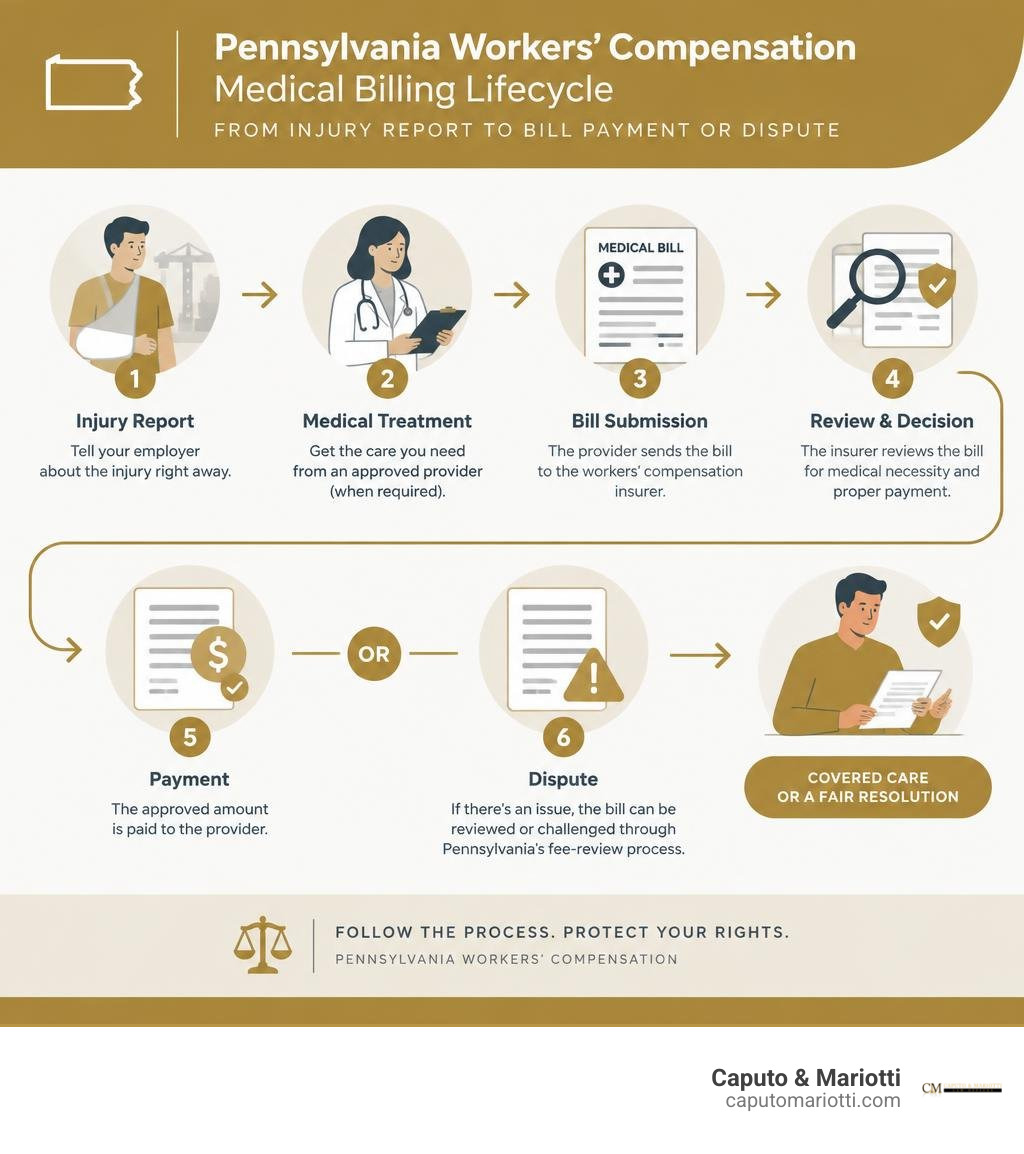
If you were hurt at work, Pennsylvania workers’ compensation should pay for reasonable and necessary treatment related to your injury. This can include doctor visits, hospital care, surgery, medicine, physical therapy, medical supplies, and prosthetic devices. You generally should not be balance billed for covered care, and a knowledgeable workers’ compensation lawyer can help you understand how workers compensation medical bills Pennsylvania rules apply to your claim.
To protect yourself:
- Report the injury promptly and keep every bill, medical report, and insurer notice.
- Follow the employer’s designated-provider rules during the first 90 days only if you received the required written notice.
- Ask the insurer why any bill was denied, reduced, or left unpaid.
- Act quickly if there is a dispute. Treatment can be reviewed for medical necessity, while providers can challenge improper payment amounts through Pennsylvania’s fee-review process.
Pennsylvania law limits what providers may charge in many cases, commonly using a percentage of Medicare rates. But a payment dispute does not always mean you owe the balance. The Workers’ Compensation Act generally bars providers from shifting covered workers compensation medical bills Pennsylvania claims to the injured worker. Injured employees often have questions regarding job security, such as whether you can be fired while on workers comp in Pennsylvania, as well as how to file a workers comp claim in Pennsylvania to protect your benefits.
I am Chris Caputo, a Pennsylvania attorney with decades of litigation experience handling serious-injury and insurance-dispute matters. At Caputo & Mariotti, I help injured people understand workers compensation medical bills Pennsylvania rules and pursue fair treatment when insurers or employers create barriers to needed care.
Navigating Workers Compensation Medical Bills Pennsylvania Rules and Coverage
Pennsylvania operates under a no-fault workers’ compensation system. This means that injured employees are entitled to comprehensive medical benefits regardless of who caused the workplace accident. In exchange for this guaranteed protection, workers generally cannot sue their employers in civil court for negligence. Understanding the full scope of workers’ compensation claims and rights ensures you do not pay out-of-pocket for mandatory care.

Under the law, an insurer must cover all reasonable, necessary, and causally related medical expenses resulting from your work injury. This includes:
- Emergency room visits, trauma care, and inpatient hospital services
- Surgical operations, anesthesia, and post-operative monitoring
- Prescription medications specifically prescribed for the work-related condition
- Physical therapy, chiropractic care, and occupational rehabilitation
- Durable medical equipment (DME), orthopedic appliances, braces, and crutches
- Artificial limbs, ocular prostheses, and ongoing maintenance or replacements
Under 77 P.S. Section 531 medical services statutes, healthcare providers are explicitly prohibited from balance billing injured workers. Balance billing occurs when a doctor or facility attempts to collect the difference between their total charge and the amount paid by the workers’ compensation insurer. In Pennsylvania, an accepted work injury relieves the employee of personal liability for covered medical care. If an insurer delays or disputes an invoice, the provider cannot demand payment from you, report the debt to credit bureaus, or pursue aggressive collection measures.
Reporting Requirements and Evidence Gathering
Securing coverage for your medical expenses begins with strict adherence to Pennsylvania reporting requirements and diligent evidence gathering:
- Injury Reporting Deadlines: Under Pennsylvania law, you must notify your employer of your work injury within 21 days to receive benefits from the date of injury. If notice is given after 21 days but within 120 days, benefits begin from the date notice was provided. Failing to report within 120 days completely bars your claim.
- Evidence Gathering: You should immediately collect and preserve critical evidence, including written incident reports, eyewitness statements from coworkers, photographs of the accident scene, and detailed logs of all symptoms and limitations.
- Documentation Management: Maintain copies of every discharge summary, prescription, out-of-work slip, and diagnostic imaging scan to substantiate the causal connection between your work duties and your medical care.
Medical Report Submissions and Doctor Reporting Requirements
For medical bills to be paid promptly, healthcare providers must follow strict administrative submission rules established by the Pennsylvania Bureau of Workers’ Compensation. The primary vehicle for these submissions is Form LIBC-9, the official Workers’ Compensation Medical Report Form.
Providers must file an initial LIBC-9 medical report with the employer or its workers’ compensation insurer within ten days of commencing treatment. Thereafter, the treating physician must submit ongoing progress reports at least once every 30 days. These periodic filings must include:
- Detailed diagnoses directly connecting your physical limitations to the workplace incident.
- Comprehensive treatment notes outlining services rendered, clinical progress, and prognosis.
- Prescriptions, referrals for diagnostic imaging (such as MRIs or CT scans), and therapy plans.
- Itemized billing statements matching standard universal claim forms (such as CMS-1500 or UB-04).
Understanding the role of medical evaluations in workers’ compensation claims is critical. If your physician fails to supply the required monthly documentation or delays submitting Form LIBC-9, the insurer is legally permitted to withhold payment until the proper documentation is received. Retaining copies of every medical note, treatment log, and doctor slip safeguards your rights if an insurer claims lack of proof.
Calculating Payment Caps for Workers Compensation Medical Bills Pennsylvania
Pennsylvania does not allow medical facilities to charge arbitrary rates for work-injury care. Instead, medical costs are controlled through statutory reimbursement limits based on state and federal schedules.
The baseline for outpatient medical reimbursement is capped at 113% of the applicable Medicare Part B rate. When a specific medical procedure does not have an established Medicare reimbursement code, Pennsylvania law mandates that the provider receive payment equal to 80% of the usual and customary charge in that geographic area, or the actual fee charged, whichever is lower. To determine what constitutes a “usual and customary charge,” the state references the 85th percentile of the FAIR Health database.
You can verify code-specific reimbursement rates via the Pennsylvania Department of Labor and Industry’s Part B Fee Schedules. Furthermore, prescription drugs are tightly regulated: pharmacy reimbursements are strictly limited to 110% of the Average Wholesale Price (AWP) using standard industry benchmarks like the Red Book, alongside mandatory National Drug Code (NDC) reporting.
Pennsylvania Fee Schedules and Medical Cost Containment
The regulatory framework governing medical costs is outlined in 34 Pa. Code Chapter 127. Workers’ Compensation Medical Cost Containment. This chapter establishes clear reimbursement boundaries across diverse medical specialties, inpatient facilities, and surgical suites.
| Service Category | Statutory Payment Calculation Benchmark | Cost Containment Rule |
|---|---|---|
| Outpatient Care & Specialists | 113% of the Medicare Part B allowance | Caps reimbursement; balance billing strictly prohibited |
| Unlisted Outpatient Procedures | Lesser of actual charge or 80% of Usual & Customary (85th percentile FAIR Health) | Protects insurers from inflated non-standard coding |
| Inpatient Hospital Admissions | 113% of Diagnostic Related Group (DRG) Grouper formula | Inpatient payments frozen to Grouper 12 version formulas |
| Prescription Medications | 110% of Average Wholesale Price (AWP) | Mandatory NDC reporting; restricts custom compounding markups |
| Out-of-State Medical Services | Medicare Part B reimbursement rate for Harrisburg, PA | Applied regardless of local out-of-state provider list prices |
Under Chapter 127, medical providers cannot engage in “unbundling”—the improper practice of separating components of a single surgical or treatment package into multiple individual billing codes to inflate payments. Similarly, insurers are prohibited from downcoding legitimate services without clear clinical justification. Inpatient hospital admissions are reimbursed using frozen Diagnostic Related Group (DRG) formulas, and medical facilities must submit regular Chargemaster electronic updates to the Bureau to maintain compliance.
Out-of-State Medical Billing and Cross-State Coverage
Injured workers in Northeastern Pennsylvania—including Lackawanna County, Luzerne County, Scranton, Wilkes-Barre, Pittston, and Hazleton—occasionally require specialized medical care located across state lines, such as advanced surgical centers in New York or New Jersey.
Under 34 Pa. Code § 127.129, out-of-state medical providers are reimbursed based on the Medicare rates applicable in Harrisburg, Pennsylvania. When out-of-state specialists treat a Pennsylvania-covered worker, their billing departments must crosswalk their procedural codes into the Pennsylvania fee containment framework. Retaining a dedicated workers’ compensation lawyer ensures that out-of-state providers bill the carrier properly, preventing billing misunderstandings from interrupting critical treatments.
Designated Provider Panels and Worker Rights
To establish control over medical expenditures immediately following an injury, Pennsylvania law allows employers to establish a list of designated healthcare providers. However, this employer control is strictly bounded by state regulations:
- The 90-Day Rule: You are only required to treat with a designated panel provider for the first 90 days following your initial visit for the work injury. After 90 days, you have the absolute legal right to switch to any doctor, specialist, or surgeon of your choosing.
- Panel Composition: The employer’s list must contain at least six valid healthcare providers. At least three must be licensed physicians, and no more than four may be coordinated care organizations (CCOs). The list must represent geographic convenience and relevant medical specialties.
- Written Rights Acknowledgment: The employer must provide written notice of your rights and duties at the time of hire and immediately after the injury occurs. You must sign a written acknowledgment. If the employer fails to obtain your written acknowledgment after an injury, the panel is legally invalid, and you may seek treatment with your own physician immediately.
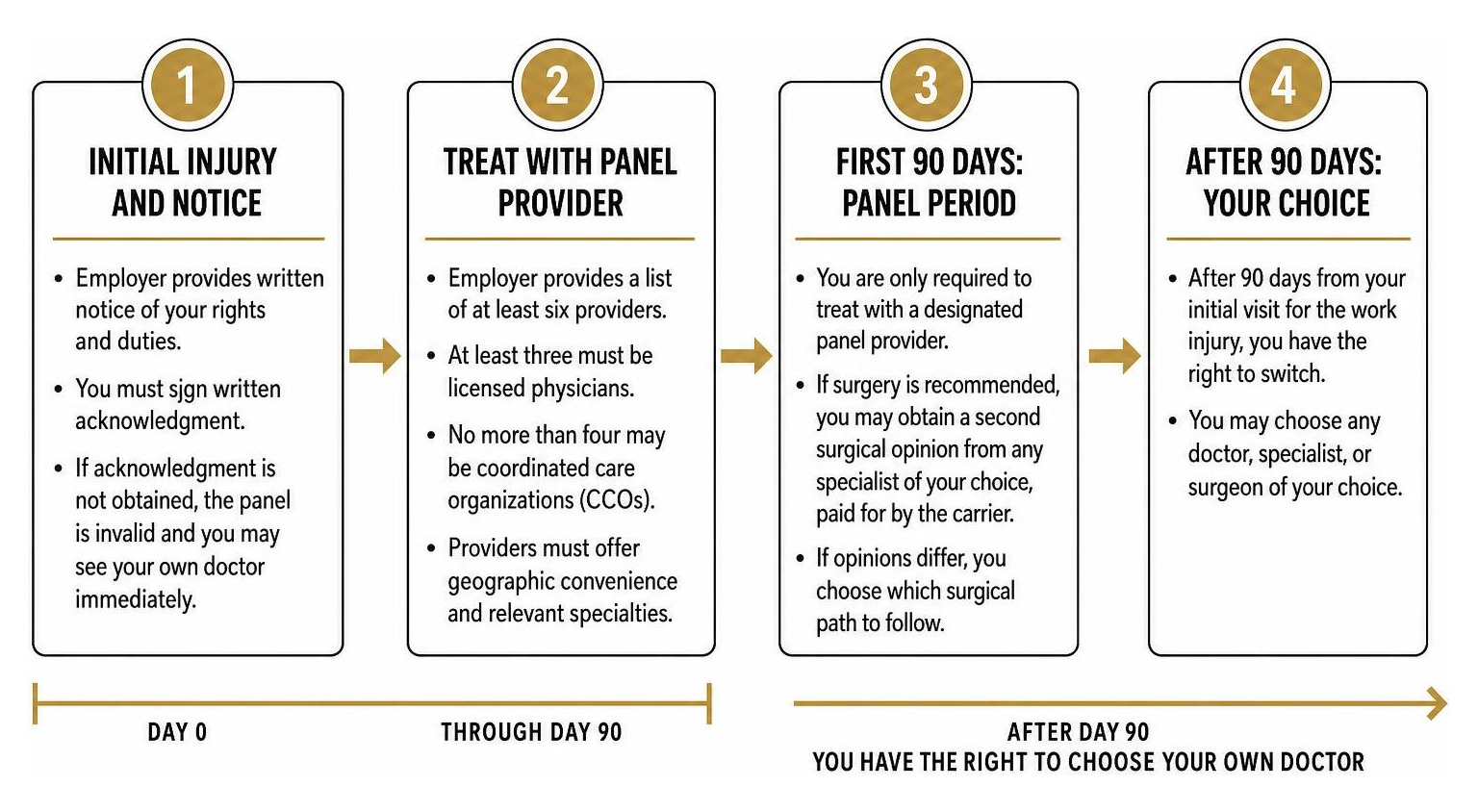
If surgery is recommended by a panel doctor during the initial 90 days, you are entitled to seek a second surgical opinion from any specialist of your choice, paid for entirely by the workers’ compensation carrier. If the second opinion differs, you have the right to choose which surgical path to follow. Following the proper procedures to file a workers comp claim in Pennsylvania guarantees that you document every notice and avoid procedural pitfalls from day one.
Managing Utilization Reviews and Payment Disputes
Even when an injury claim is accepted, insurance carriers frequently challenge individual medical treatments, physical therapy regimens, or surgical recommendations. They do this by filing a Utilization Review (UR) under 34 Pa. Code Chapter 127.

A Utilization Review assesses whether a specific medical treatment is “reasonable and necessary.” The process works as follows:
- UR Request Filing: The insurer, employer, or employee requests a review through the Bureau.
- Assignment to a URO: The state assigns the request to an authorized Utilization Review Organization (URO).
- Peer Review: The URO assigns a practicing healthcare provider in the same specialty as your treating doctor to review your medical records, diagnostic scans, and clinical history.
- Determination: The reviewer issues a formal determination declaring the treatment reasonable and necessary, or unreasonable and unnecessary.
When dealing with denied claims and benefit disputes, receiving an adverse UR determination means the insurer is no longer required to pay for that specific treatment. However, you have 30 days from the date of the determination to file a Petition for Review of Utilization Review with a Workers’ Compensation Judge (WCJ), who makes the ultimate legal decision.
The Claim Filing Process and Legal Remedies
When an insurer fails to pay valid medical bills or formally denies your injury claim, specific administrative and legal steps must be initiated:
- Filing a Claim Petition: If your work injury is denied, you must file a Claim Petition (Form LIBC-362) with the Pennsylvania Bureau of Workers’ Compensation within the three-year statute of limitations from the date of injury. The case is assigned to a Workers’ Compensation Judge for formal hearings.
- Fee Review Petitions: If the dispute is strictly over the dollar reimbursement amount between the medical provider and the insurer, the healthcare provider must file an Application for Fee Review with the Bureau within 90 days of the billing dispute.
- 30-Day Payment Deadlines: Once an insurer receives properly documented medical bills along with monthly LIBC-9 reports for an accepted claim, it has exactly 30 calendar days to either issue payment or submit an official explanation of denial.
- Penalty Petitions and Legal Appeals: If an insurer arbitrarily refuses, delays, or ignores legitimate medical invoices for an accepted injury, a workers’ compensation lawyer can file a Penalty Petition under Section 435 of the Act. A Workers’ Compensation Judge can award penalties of up to 50% of the unpaid medical bills, assess statutory interest on delayed payments, and order the insurer to pay attorney’s fees. Adverse WCJ rulings can be appealed to the Workers’ Compensation Appeal Board (WCAB) and the Commonwealth Court of Pennsylvania.
Securing experienced legal counsel highlights the importance of legal representation when facing insurance delays or contested claims.
Frequently Asked Questions About Pennsylvania Workers’ Comp Medical Bills
Can medical providers bill an injured employee directly in Pennsylvania?
No. Under 77 P.S. § 531(7), healthcare providers are prohibited from balance billing or seeking payment directly from an employee for treatment related to an accepted work injury. All payment negotiations and fee disputes must be handled directly with the workers’ compensation insurance carrier. If a provider sends you a bill or initiates collections, forward the notice immediately to your legal counsel.
What happens if an employer does not have an approved 90-day doctor list?
If your employer fails to maintain a legally compliant panel of at least six designated providers, or fails to have you sign the written acknowledgment of your rights and duties immediately following your injury, the 90-day restriction does not apply. You have the immediate right to seek medical care from your own family doctor, local specialist, or chosen hospital system in Northeastern Pennsylvania.
How long does an insurer have to pay approved medical bills?
Under Pennsylvania law, a workers’ compensation insurance company has 30 days from the date it receives complete medical bills and supporting monthly medical reports (Form LIBC-9) to issue payment. If the insurer fails to pay within this statutory window without a reasonable basis, it faces administrative penalties, statutory interest, and formal litigation before a Workers’ Compensation Judge.
Protecting Your Medical Rights After a Workplace Injury
Navigating workers’ compensation medical billing regulations requires strict adherence to statutory deadlines, precise evidence gathering, and aggressive legal advocacy when insurers attempt to avoid their payment responsibilities. Unpaid medical bills cause undue financial stress, and improper denials can delay the physical rehabilitation you need to recover your livelihood.
At Caputo & Mariotti, our attorneys bring over 55 years of combined legal experience representing injured individuals throughout Northeastern Pennsylvania, including Scranton, Wilkes-Barre, Moosic, Pittston, Hazleton, and Dickson City. We investigate your claim, hold insurance companies accountable to state fee limits, defeat improper utilization denials, and enforce statutory penalties for unpaid medical invoices.
If you or a loved one is struggling with denied or unpaid work injury expenses, contact an experienced workers’ compensation lawyer at Caputo & Mariotti today to schedule a free, confidential case evaluation.
