
The dedicated legal team of Caputo & Mariotti
How Much Is Your Forklift Injury Compensation Claim Worth?
January 9, 2026
Why Forklift Injury Compensation Matters for Pennsylvania Workers
Forklift injury compensation helps injured workers recover financial losses after workplace accidents. Here’s what you need to know:
Quick Answer: Your Compensation Options
- Workers’ Compensation – Covers medical bills and partial wages (typically 2/3 of your pay) regardless of who was at fault
- Personal Injury Lawsuit – Available when a third party (manufacturer, property owner, subcontractor) caused your injury – can include pain and suffering damages
- Both Options – You may pursue workers’ comp AND sue a third party if applicable
You were doing your job when a forklift accident you never saw coming left you with medical bills, lost wages, and an uncertain future.
The statistics paint a sobering picture. Each year, more than 20,000 forklift accidents result in serious work-related injuries. In 2023 alone, 67 workers died in forklift-related incidents. These aren’t just numbers—they represent real people whose lives changed in an instant.
Workplace forklift injuries are a significant concern in Pennsylvania, often leading to serious consequences. The good news is that Pennsylvania law provides multiple pathways to compensation. The challenge is understanding which path applies to your situation.
Many injured workers don’t realize that if a third party’s negligence contributed to the accident, they may be able to pursue additional compensation for pain and suffering, full wage loss, and future medical needs.
I’m Chris Caputo. For over two decades, I’ve helped injured workers steer complex forklift injury compensation claims in Pennsylvania. My experience has given me the insight to fight for the maximum compensation you deserve.
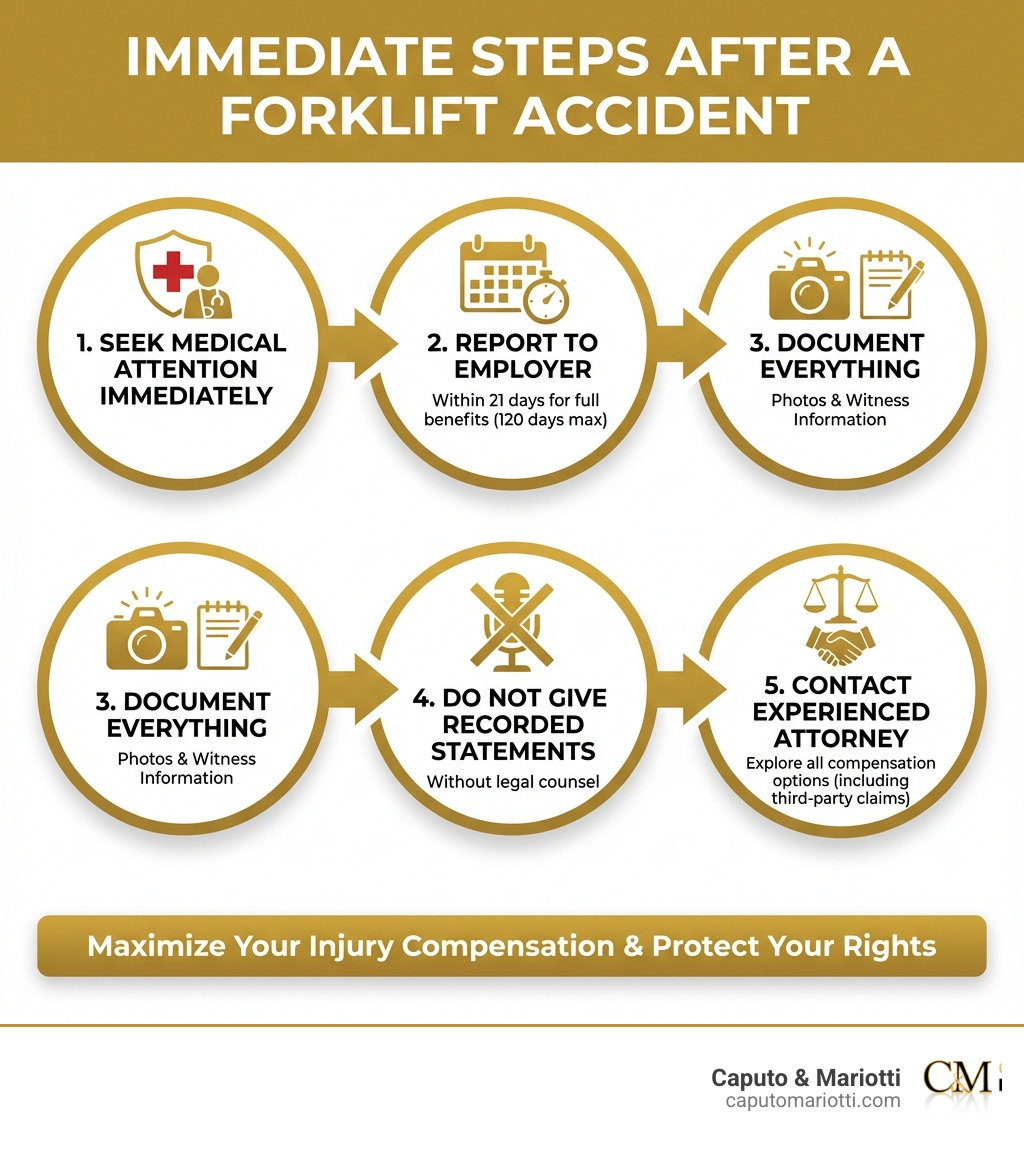
First Steps After a Forklift Accident: Protecting Your Health and Your Claim
The actions you take after a forklift accident can significantly impact your health and the strength of your forklift injury compensation claim. Your priority is your well-being, but it’s also vital to protect your legal rights.

Seek Immediate Medical Attention
Your health is paramount. Seek medical attention right away, even for seemingly minor injuries. Adrenaline can mask pain, and some serious conditions (like internal damage or concussions) aren’t immediately apparent. Prompt medical care creates an official record linking your injuries to the accident, which is crucial for your claim.
Report the Accident to Your Employer
Next, you must report the accident to your employer. In Pennsylvania, you should notify your employer within 21 days to be eligible for full workers’ compensation benefits. You have up to 120 days to report the injury and remain eligible for some benefits, but waiting can complicate your claim. Report the incident in writing if possible and keep a copy. For a comprehensive guide, see our resource on What to do if you are hurt at work.
Document Everything
Documentation is your best friend. If you are able, or if a colleague can help, gather evidence from the scene:
- Photographs: Take pictures of the forklift, the accident area, any hazardous conditions, the load, and your injuries.
- Accident Scene Details: Note the date, time, and location. Describe what happened and any contributing factors.
- Medical Records: Keep all records of treatments, diagnoses, and prescriptions to prove the extent of your injuries.
- Lost Wages: Maintain records of missed workdays and lost income.
Gather Witness Information
If anyone witnessed the accident, get their names and contact information. Witness statements can provide objective accounts and add significant weight to your claim.
Do Not Give Recorded Statements
Insurance companies may ask for a recorded statement. We strongly advise against giving one without first consulting an attorney. Adjusters are trained to ask questions that can undermine your claim. Their goal is to minimize payouts, not to ensure you receive full forklift injury compensation.
Taking these steps lays a strong foundation for your claim and protects your rights as an injured worker.
Your Legal Pathways: Workers’ Compensation vs. Personal Injury Lawsuits
Navigating the legal landscape after a forklift accident can be confusing. There are two primary avenues for compensation: workers’ compensation and personal injury lawsuits. Understanding the difference is crucial for securing the forklift injury compensation you deserve.
Here’s a quick comparison:
| Aspect | Workers’ Compensation Claim | Personal Injury Lawsuit |
|---|---|---|
| Fault Requirement | No-fault system; fault does not need to be proven. | Requires proving the fault or negligence of another party. |
| Who You Can Sue | Generally, you cannot sue your employer (exclusive remedy). | Can sue a negligent third party (not your employer). |
| Types of Damages | Medical bills, partial lost wages (approx. 2/3), specific loss benefits. Does NOT cover pain and suffering. | Medical bills, full lost wages (past & future), pain and suffering, emotional distress, loss of enjoyment of life, punitive damages (in some cases). |
| Employer Liability | Employer is liable for statutory benefits regardless of fault. | Employer is generally protected by workers’ comp exclusivity, but can be sued in rare cases of intentional misconduct or lack of coverage. |
The Process for Seeking Forklift Injury Compensation Through Workers’ Comp
Pennsylvania’s workers’ compensation system is a no-fault program. This means if you’re injured in a forklift accident on the job, you are generally entitled to benefits regardless of who was at fault. This system is a critical safety net for injured workers. For a deeper dive, visit our page on Workers’ Compensation.
Benefits typically include:
- Medical Benefits: All reasonable and necessary medical treatment for your work-related injury.
- Wage Loss Benefits: Temporary or permanent disability benefits, typically replacing about two-thirds of your average weekly wage.
- Specific Loss Benefits: For the loss or permanent loss of use of a body part.
- Death Benefits: For surviving dependents in fatal accidents.
A key aspect of workers’ compensation is the “exclusive remedy” doctrine. This generally prevents you from suing your employer for negligence. In exchange for guaranteed no-fault benefits, employees give up the right to sue their employer for additional damages like pain and suffering. Our guide to Navigating Workers’ Compensation Claims: A Step-by-Step Guide provides valuable insights.
When Can You File a Third-Party Personal Injury Lawsuit?
While workers’ compensation provides essential benefits, it doesn’t cover the full extent of your losses. It excludes pain and suffering, and wage loss benefits are capped. A third-party personal injury lawsuit is a crucial pathway to maximizing your forklift injury compensation.
A third-party lawsuit is filed against someone other than your employer who contributed to your accident, allowing you to pursue damages beyond what workers’ comp offers.
Common scenarios where a third party might be liable include:
- Defective Forklift Manufacturer: A design flaw, manufacturing defect, or inadequate warnings on the forklift.
- Negligent Property Owner: Hazardous conditions on a property not owned by your employer.
- Subcontractor Fault: An employee of another company created unsafe conditions that led to your injury.
- Other Negligent Drivers: Another vehicle operator, not employed by your company, caused the accident.
Our firm has extensive experience with Heavy Equipment Injury on the Job and can identify all liable parties.
In a Pennsylvania third-party lawsuit, the state’s modified comparative negligence rule applies. If you are found 50% or less at fault, your compensation is reduced by your percentage of fault. If you are found more than 50% at fault, you cannot recover any damages. This rule underscores the importance of strong legal representation.
It’s also important to understand subrogation liens. If you receive workers’ comp benefits and then win a third-party lawsuit, the insurer has a right to be reimbursed from your recovery. We work diligently to negotiate with the carrier to maximize the net compensation you receive.
Maximizing Your Forklift Injury Compensation: What Can You Recover?
A forklift accident can result in devastating injuries, leading to substantial financial, physical, and emotional burdens. When we pursue forklift injury compensation, our goal is to secure comprehensive compensation for every aspect of your loss.

Common injuries sustained in forklift accidents include:
- Crush Injuries: Occur when a worker is pinned or a forklift overturns, leading to internal damage, nerve damage, and severe fractures.
- Fractures: Broken bones are common, especially in the limbs, ribs, and pelvis.
- Spinal Cord Injuries: Impacts or falls can damage the spinal cord, potentially causing paralysis and long-term disability.
- Traumatic Brain Injuries (TBI): Can occur from being struck, falling loads, or overturns, resulting in cognitive impairments and memory loss.
- Amputations: In severe crush accidents, limbs may be so damaged that amputation is necessary.
- Wrongful Death: Tragically, many forklift accidents are fatal. In 2023, 67 work-related deaths were caused by forklifts.
Calculating Damages for Your Forklift Injury Compensation Lawsuit
When we pursue a personal injury lawsuit, we calculate all damages to ensure you receive maximum compensation. Damages fall into two categories: special and general.
Special Damages (Economic Damages): These are quantifiable financial losses.
- Medical Bills (Current & Future): This includes all treatment, from emergency room visits to future rehabilitation and medical equipment.
- Full Lost Wages: Compensation for all income you’ve lost, not just the two-thirds covered by workers’ compensation.
- Loss of Earning Capacity: If your injury prevents you from earning the same amount in the future, we calculate this long-term loss.
- Property Damage: If any personal property was damaged.
General Damages (Non-Economic Damages): These are subjective, non-monetary losses.
- Pain and Suffering: Compensation for the physical pain you’ve endured and will continue to endure.
- Emotional Distress: Covers psychological impacts such as anxiety, depression, and PTSD.
- Loss of Enjoyment of Life: If your injuries prevent you from participating in hobbies and activities you once enjoyed.
Calculating general damages often involves a “multiplier method.” This multiplies the total special damages by a factor (usually 1.5 to 5) based on injury severity, medical treatment, recovery time, and long-term impact. A severe, life-altering injury warrants a higher multiplier. Our attorneys fight to ensure the multiplier reflects the true extent of your suffering.
Preventing Future Tragedies: Employer and Employee Responsibilities
While we help you secure forklift injury compensation, we also believe in preventing these incidents. Forklifts are indispensable but are a leading cause of workplace injuries across Pennsylvania. A robust safety culture and strict adherence to regulations are the best defense against these dangerous incidents.
Common Accident Causes
Many forklift accidents stem from preventable issues, including:
- Inadequate Operator Training: A major factor. Untrained operators are more likely to make errors. Federal law requires all operators to be properly trained and certified.
- Overloaded or Improperly Balanced Forklifts: Exceeding capacity or improper centering can cause tip-overs and falling loads. Overturns account for about 25% of all forklift-related deaths.
- Poor Visibility or Tight Maneuvering Spaces: Obstructed views, narrow aisles, and blind corners increase the risk of collisions.
- Malfunctioning Parts or Lack of Maintenance: Forklifts require regular maintenance. Neglecting it can lead to unexpected equipment failures.
- Failure to Follow Occupational Safety Standards: Ignoring facility traffic rules or not using seatbelts are dangerous practices.
- Collisions with Other Equipment or Workers: Distraction, speeding, or lack of awareness can lead to striking co-workers.
Employer Duties
Employers have a legal and ethical duty to provide a safe work environment. This includes:
- Providing Proper Training and Certification: Employers must ensure all operators are competent and certified according to OSHA standards, specifically 29 CFR 1910.178(l)(1).
- Regular Equipment Inspection and Maintenance: A preventative maintenance schedule is crucial. Daily pre-shift inspections should be mandatory.
- Maintaining a Safe Worksite: This involves clear, well-lit aisles, repairing uneven floors, and establishing traffic patterns and pedestrian walkways.
- Following OSHA Standards: Employers must comply with all relevant OSHA standards for powered industrial trucks.
Employee Responsibilities
Employees also play a vital role in accident prevention:
- Adhere to Training: Consistently follow all safety training.
- Report Hazards: Immediately report unsafe conditions or equipment malfunctions.
- Use Personal Protective Equipment (PPE): Wear appropriate PPE as required.
- Never Operate Under the Influence: Ensure you are fit to operate heavy machinery.
By working together, employers and employees can significantly reduce forklift accident risks. For more information, the CDC offers valuable insights on Preventing Injuries and Deaths of Workers Who Operate or Work Near Forklifts.
Frequently Asked Questions about Forklift Injury Claims in Pennsylvania
After a forklift accident, you likely have many questions. Here, we address some common inquiries from injured workers in Pennsylvania.
How long do I have to file a forklift injury claim in Pennsylvania?
Understanding the time limits, or statutes of limitations, is critical for protecting your right to forklift injury compensation.
-
Workers’ Compensation Reporting Deadlines:
- You must notify your employer of your injury within 21 days to receive full benefits from the date of injury.
- You have up to 120 days to report the injury to remain eligible for benefits. Waiting longer can result in a complete loss of your right to workers’ compensation.
- If your claim is denied, you generally have 3 years from the date of injury to file a Claim Petition with the Pennsylvania Bureau of Workers’ Compensation.
-
Personal Injury Lawsuit Statute of Limitations:
- For a third-party personal injury lawsuit, you typically have 2 years from the date of injury to file. Missing this deadline almost always means losing your right to sue.
These deadlines are strict. It’s best to contact an attorney as soon as possible to ensure all steps are taken in time.
Can I be fired for filing a workers’ compensation claim?
No. In Pennsylvania, it is illegal for an employer to fire or retaliate against you for filing a workers’ compensation claim. If you believe this has happened, you may have grounds for a separate lawsuit. We are committed to upholding your rights, as outlined in our guide on Employer Responsibilities and Worker Rights in Workers’ Compensation.
It’s important to differentiate between being fired for filing a claim and being terminated for legitimate reasons (e.g., company layoffs). However, if your employer’s actions are linked to your claim, we can help you fight for justice.
What if the accident was partially my fault?
The impact of your fault depends on the type of claim:
-
Workers’ Compensation Claim: Pennsylvania’s system is “no-fault.” Even if the accident was your fault, you can still receive benefits, unless the injury was self-inflicted or resulted from a violation of the law (e.g., intoxication). Your fault generally won’t prevent you from receiving benefits.
-
Personal Injury Lawsuit: For a third-party lawsuit, Pennsylvania’s “modified comparative negligence” rule applies:
- If you are found to be 50% or less at fault, you can still recover damages, but your total compensation will be reduced by your percentage of fault.
- If you are found to be more than 50% at fault, you cannot recover any damages from the third party.
This is why a thorough investigation and strong legal advocacy are essential to maximize your forklift injury compensation.
Securing Your Future After a Forklift Injury
A forklift accident can leave you with severe injuries, mounting bills, and lost income. The path to fair forklift injury compensation is complex, involving legal intricacies, difficult insurance companies, and strict deadlines. You don’t have to face this journey alone.
The Importance of Legal Guidance
An experienced legal team is crucial for:
- Navigating Complex Claims: We understand both Pennsylvania workers’ compensation and personal injury laws. We can identify all potential avenues for compensation, including third-party claims you might not realize exist.
- Fighting Insurance Companies: Insurers aim to minimize payouts. They may deny your claim, dispute your injuries, or offer a low settlement. We have decades of experience fighting these powerful entities to protect your rights.
- Maximizing Your Compensation: We carefully calculate all your damages—economic and non-economic, present and future—to ensure your settlement reflects the full impact of your injury.
Caputo & Mariotti’s Experience
With over 55 combined years of experience, our team at Caputo & Mariotti is committed to justice for injured workers in Northeastern Pennsylvania and across the state. We serve clients in Scranton, Wilkes-Barre, Hazleton, and surrounding areas, including Lackawanna and Luzerne Counties, and understand the local legal landscape.
Protecting Your Rights – Don’t Settle for Less
Your health and financial stability are too important to leave to chance. Don’t let an insurance company dictate the terms of your recovery. If you or a loved one has suffered a forklift injury, we are here to provide the compassionate, skilled legal representation you need. We are committed to guiding you through this difficult time and ensuring you receive the compensation you deserve.
Reach out to us today for a free, no-obligation consultation. Let us help you understand your options and fight for the justice you deserve.