
The dedicated legal team of Caputo & Mariotti
How to Understand Lawsuit Eligibility for a Car Accident in Pennsylvania
June 3, 2026
What You Need to Know Before Suing for a Car Accident in Pennsylvania
If you’re wondering can I sue for a car accident in Pennsylvania, the short answer is: yes, in most cases — but eligibility depends on a few key factors.
Quick Answer: Can You Sue After a PA Car Accident?
| Factor | What It Means for You |
|---|---|
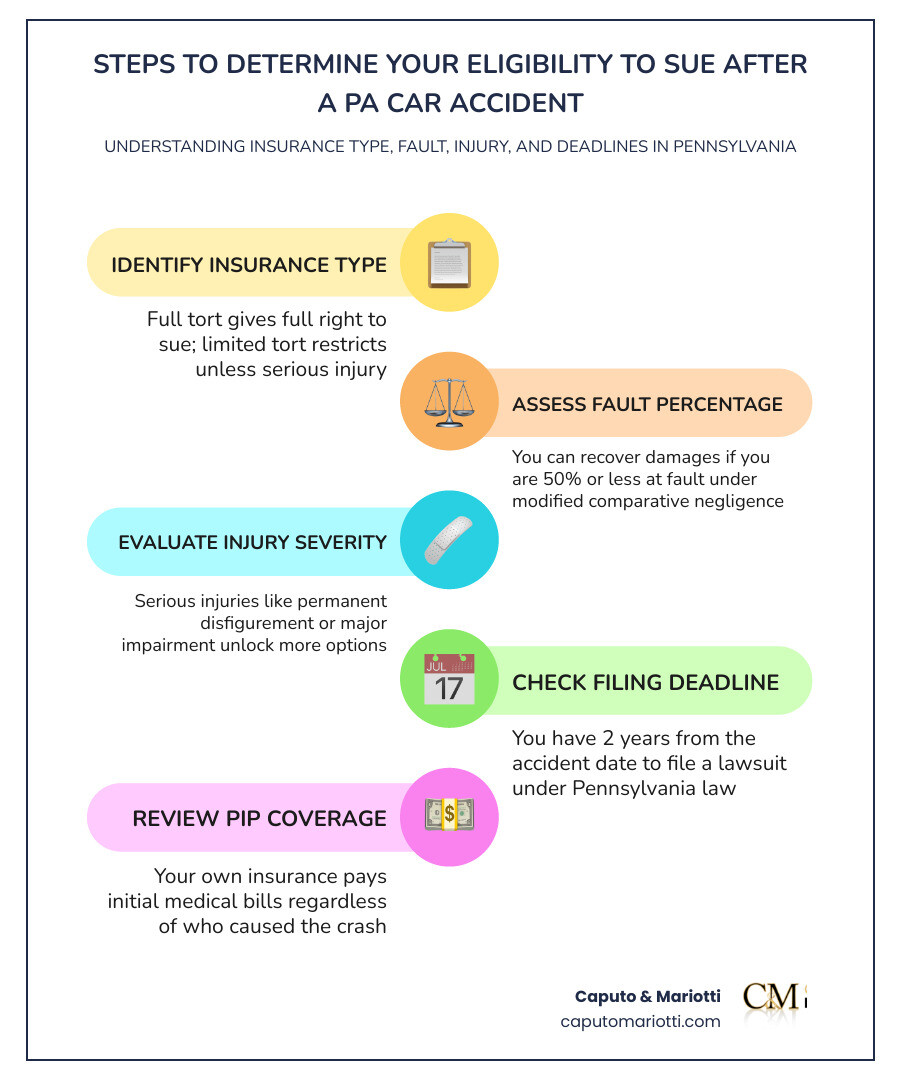
| Insurance type | Full tort = full right to sue. Limited tort = restricted unless injury is serious. |
| Fault | You can recover damages if you are 50% or less at fault. |
| Injury severity | Serious injuries (permanent disfigurement, major impairment, death) unlock more legal options. |
| Time limit | You have 2 years from the accident date to file a lawsuit. |
| PIP coverage | Your own insurance pays first, regardless of who caused the crash. |
Pennsylvania is a choice no-fault state. That means your own Personal Injury Protection (PIP) coverage pays your initial medical bills — no matter who was at fault. But depending on your policy and the severity of your injuries, you may also have the right to sue the at-fault driver for additional compensation, including pain and suffering.
The rules aren’t always simple. Your ability to sue — and how much you can recover — hinges on the type of insurance you carry, the seriousness of your injuries, and whether you file within the legal deadline.
I’m Chris Caputo, a Pennsylvania personal injury attorney with decades of litigation experience representing seriously injured accident victims across Northeastern Pennsylvania. I’ve handled hundreds of cases — from insurance disputes to complex jury trials — and I know how confusing Pennsylvania’s car accident laws can be when you’re trying to understand whether you can sue for a car accident in Pennsylvania. The sections below will walk you through everything you need to know to protect your rights.
Can I Sue for a Car Accident in Pennsylvania?

When a crash happens in the Scranton or Wilkes-Barre area, the first question on most people’s minds is, “Who is going to pay for this?” In Pennsylvania, the answer is a bit more layered than in other states. Because we are a “choice no-fault” state, your first line of defense is your own insurance policy. Every driver in PA is required to carry at least $5,000 in Personal Injury Protection (PIP) coverage. This money is there to cover your medical bills regardless of who caused the accident.
However, $5,000 doesn’t go very far in May 2026, especially with rising healthcare costs. Once you exhaust your PIP limits, you may wonder if you can i sue for a car accident in pennsylvania to cover the rest. To successfully sue, we must establish three things:
- Liability: Someone else must be at fault for the crash.
- Negligence: That person must have breached their “duty of care” (for example, by texting while driving or running a red light in Hazleton).
- Damages: You must have suffered actual losses, whether physical, emotional, or financial.
Knowing what to do if you are injured in a car accident is the first step in building a strong foundation for a potential lawsuit.
When Can I Sue for a Car Accident in Pennsylvania Under Limited Tort?
If you chose “limited tort” when you bought your insurance (usually to save about 15% on your premiums), you’ve essentially traded away your right to sue for “pain and suffering” unless your injuries meet a specific legal threshold. This is one of the most common hurdles our clients face.
To “break through” the limited tort barrier, your injury must be considered “serious.” Under Pennsylvania law, a serious injury typically involves:
- Death
- Permanent serious disfigurement (such as significant scarring)
- Serious impairment of a body function (such as the loss of use of a limb or a chronic back injury that prevents you from working)
Determining what qualifies as “serious” is often where the legal battle happens. Insurance companies will try to argue that your “minor” whiplash doesn’t count, even if it keeps you awake every night. Having an experienced car accident lawyer in PA is vital here to help document the true impact of your injuries on your daily life.
Third-Party Liability and Work-Related Accidents
Sometimes, a car accident happens while you are on the clock. If you were driving for work in Lackawanna County and got hit, the situation becomes a “hybrid” case. You are likely eligible for workers’ compensation benefits, which cover medical bills and a portion of your lost wages without you needing to prove anyone was at fault under the no-fault system.
However, workers’ comp doesn’t allow you to recover for pain and suffering. This is where a third-party claim comes in. If a random driver (not your employer or a coworker) caused the crash, you can pursue a personal injury lawsuit against them while simultaneously receiving workers’ comp.
In these cases, we act as your workers’ compensation lawyer to ensure all reporting requirements are met, medical treatment is authorized, and evidence gathering (witnesses, records) is handled thoroughly. We manage the entire process, including filing procedures, ensuring all documentation is accurate, and representing you in any necessary legal appeals. We handle the complex interplay between the no-fault workers’ comp system and the fault-based personal injury system so you can focus on healing.
Full Tort vs. Limited Tort: How Insurance Choice Affects Your Rights
The “Tort Option” you selected on your insurance policy is perhaps the single most important factor in determining can i sue for a car accident in pennsylvania.
| Feature | Limited Tort | Full Tort |
|---|---|---|
| Premium Cost | Lower (cheaper) | Higher (more expensive) |
| Medical Bills | Covered by PIP | Covered by PIP |
| Right to Sue for Pain & Suffering | Only for “Serious” injuries | For any injury |
| Property Damage Claims | Always allowed | Always allowed |
If you have Full Tort, you have an unrestricted right to seek financial recovery for all your damages, including the non-economic ones like emotional distress and loss of enjoyment of life. You don’t have to prove your injury is “serious” to ask for pain and suffering compensation.
If you are reading this and haven’t been in an accident yet, check your policy! If you have been in an accident, don’t panic if you have limited tort. There are several ways to get around those restrictions. Understanding what to do after a car accident can help you protect your rights regardless of your tort status.
Exceptions to Limited Tort Restrictions
Even if you have limited tort, Pennsylvania law provides “automatic” full tort status in certain situations. You may be able to sue for pain and suffering if:
- The at-fault driver is convicted of (or accepts ARD for) a DUI.
- The at-fault driver’s vehicle is registered in another state.
- The at-fault driver intended to injure themselves or someone else.
- You were a passenger in a commercial vehicle (like a bus or taxi).
- The at-fault driver was uninsured.
If any of these apply, the “limited tort” handcuffs come off. If you’re unsure, it’s best to contact a personal injury expert to review the specifics of your crash.
Pennsylvania’s Statute of Limitations and Critical Filing Deadlines
In the legal world, time is not on your side. Pennsylvania has a strict Statute of Limitations for car accident cases. Under 42 PA Code section 5524, you generally have two years from the date of the accident to file a formal lawsuit in court.
If you miss this deadline, you lose your right to sue forever. It doesn’t matter how badly you were hurt or how obvious the other driver’s fault was; the court will dismiss your case.
There are very few exceptions to this rule:
- Minors: If a child is injured, the two-year clock typically doesn’t start until they turn 18.
- Discovery Rule: In rare cases where an injury wasn’t immediately apparent, the clock might start when the injury was discovered (though this is difficult to prove in car accidents).
- Fleeing Drivers: If the at-fault driver hides their identity or leaves the state, the clock may be “tolled” or paused.
Don’t wait until the last minute. Evidence disappears, witnesses move away, and memories fade. Understanding the statute of limitations for personal injury cases in Scranton is vital for anyone living in Northeastern PA.
Shortened Deadlines for Government Claims
If you were hit by a PennDOT truck, a local police cruiser in Pittston, or a city bus in Wilkes-Barre, the rules change drastically. When suing a government entity, you must provide a formal notice of intent to sue within six months of the accident.
Furthermore, Pennsylvania law places “caps” on how much you can recover from the government:
- Commonwealth (State) Claims: $250,000 per person / $1,000,000 total per accident.
- Local Government Claims: $500,000 in the aggregate.
Sovereign immunity laws make these cases incredibly complex. If the government is involved, you need to act immediately.
Proving Liability and Recovering Damages in Northeastern PA
To win a lawsuit, we have to prove the other driver was negligent. This isn’t just about saying “they hit me.” We use police reports, witness statements, photos of the scene, and often accident reconstruction experts to show:
- Duty of Care: Every driver has a duty to drive safely.
- Breach: They failed that duty (speeding, distracted driving, etc.).
- Causation: Their failure directly caused your injuries.
Our Scranton car accident lawyer team is deeply familiar with the local roads—from the “Cross-Valley” Expressway (PA-309) to I-81—and we know how to investigate crashes in these specific areas.
How Can I Sue for a Car Accident in Pennsylvania if I am Partially at Fault?
Pennsylvania follows a “modified comparative negligence” rule. This is good news! It means you can still recover money even if you were partly to blame for the crash—as long as you are not more than 50% at fault.
Here is how it works: If a jury decides you were 20% at fault (maybe you were speeding slightly) and the other driver was 80% at fault (they blew a stop sign), your total award will be reduced by 20%. If your damages were $100,000, you would receive $80,000.
However, if you are found to be 51% or more at fault, you get nothing. This is why the insurance company will work so hard to shift the blame onto you.
Types of Recoverable Compensation
When you ask can i sue for a car accident in pennsylvania, what you’re really asking is “what can I get back?” We look for three types of damages:
- Economic Damages: These are the “receipt-based” losses. Medical bills, future physical therapy, vehicle repairs, and lost wages (both past and future).
- Non-Economic Damages: This covers pain and suffering, emotional anguish, loss of companionship, and loss of life’s pleasures.
- Punitive Damages: These are rare and only awarded if the at-fault driver acted with “outrageous” or “reckless” indifference (like extreme DUI or street racing).
Every case is unique. To get a better idea of what your specific claim might be worth, you should schedule a free consultation with us.
Frequently Asked Questions about PA Car Accident Lawsuits
What happens if the at-fault driver is uninsured?
If you are hit by someone with no insurance, you can’t “get blood from a stone.” This is why we always recommend carrying Uninsured/Underinsured Motorist (UM/UIM) coverage. If you have this on your policy, your own insurance company “steps into the shoes” of the at-fault driver and pays your claim. If you don’t have UM/UIM, you may have to look for other liable parties, such as a vehicle manufacturer or a bar that over-served the driver.
Can I sue the driver personally or just their insurance?
Technically, when you file a lawsuit, you are suing the individual driver. However, in 99% of cases, their insurance company provides the lawyer and pays the settlement or verdict up to the policy limits. You generally only “go after” a driver’s personal assets (like their house or savings) if their insurance isn’t enough to cover a massive judgment, which is quite rare.
Do I need a lawyer to file a lawsuit in Pennsylvania?
You aren’t legally required to have a lawyer, but going up against an insurance company alone is like bringing a toothpick to a sword fight. They have teams of adjusters and lawyers whose entire job is to pay you as little as possible. Statistics consistently show that accident victims who hire an attorney recover significantly more—often three times more—than those who handle it themselves.
Conclusion
Navigating the legal aftermath of a crash in Northeastern Pennsylvania is overwhelming. Between PIP claims, tort options, and the two-year statute of limitations, there are dozens of ways a claim can go off the rails.
At Caputo & Mariotti, we bring over 55 combined years of experience to the table. We aren’t just a big-city firm with a fancy billboard; we are part of this community, serving Scranton, Wilkes-Barre, Moosic, and the surrounding areas with an unwavering commitment to justice. We know the local courts, we know the local doctors, and we know how to fight for the maximum compensation you deserve.
If you are still asking can i sue for a car accident in pennsylvania, let us give you a definitive answer based on your specific situation. Contact a personal injury expert at Caputo & Mariotti today for a free, no-obligation case review. We don’t get paid unless we win for you.