
The dedicated legal team of Caputo & Mariotti
The Ins and Outs of Defective Product Lawsuits in Pennsylvania
July 8, 2026
What You Need to Know About a Defective Product Lawsuit in Pennsylvania
A defective product lawsuit in Pennsylvania gives injured consumers the right to seek compensation when a product causes harm due to a defect in its design, manufacturing, or labeling.
Here is a quick overview of how these claims work:
| Key Question | Quick Answer |
|---|---|
| Time limit to file | 2 years from the date of injury (in most cases) |
| Legal theories available | Strict liability, negligence, breach of warranty |
| Types of defects covered | Design, manufacturing, failure to warn |
| Who can be sued | Manufacturer, distributor, retailer, or designer |
| Damages available | Medical bills, lost wages, pain and suffering, punitive damages |
| Discovery rule | Clock may start later if injury was not immediately apparent |
Each year, more than 34,000 deaths in the United States are linked to consumer products — from everyday household goods to vehicles and medical devices. Defective products cost Americans an estimated $12 billion annually. If you or a loved one has been hurt by a dangerous product in Pennsylvania, you have legal options.
I’m Chris Caputo, a Pennsylvania personal injury attorney with decades of litigation experience, including representing clients in defective product lawsuits in Pennsylvania and other serious injury claims. Below, I’ll walk you through everything you need to know — step by step.
Key Legal Standards in a Defective Product Lawsuit Pennsylvania
When you purchase a product in Northeastern Pennsylvania, whether it is a household appliance in Scranton or a piece of heavy machinery in Hazleton, you have a legal right to expect that product to perform safely when used as intended. When a product fails and causes serious injury, Pennsylvania law provides a path to recovery.
Product liability is a specialized branch of personal injury law. To understand where these cases fit within the broader legal landscape, it helps to explore the different Types of Personal Injury Cases Exploring the Scope from Slip and Falls to Product Liability.
Generally, a plaintiff can pursue a product liability claim under three primary legal theories: strict liability, negligence, and breach of warranty. To build a successful case, we must first identify the exact nature of the product’s flaw. For a deeper dive into these categories, you can read The Ultimate Guide to Types of Defective Product Liability Claims.
Three Main Types of Product Defects
In Pennsylvania, product defects are legally grouped into three distinct categories. Determining which category your injury falls under is crucial to building a strong civil complaint. You can explore more articles on these issues in our Category: Defective Products section.
- Manufacturing Defects: These occur when an error in the manufacturing process makes a specific item differ from the manufacturer’s intended design. Even if the product was designed perfectly, a mistake on the assembly line — such as a missing bolt, a cracked component, or a contaminated batch of pharmaceuticals — makes that specific unit dangerously defective.
- Design Defects: A design defect exists when a product is manufactured exactly as intended, but the design itself is inherently dangerous. In these cases, every single unit rolling off the assembly line carries the same hazard. A classic example is a vehicle model that is prone to rolling over during normal turns or an electronic device whose battery is prone to catching fire while charging.
- Marketing Defects (Failure to Warn): Even if a product is designed and manufactured flawlessly, it can still be legally defective if the manufacturer fails to provide adequate instructions or warn consumers of non-obvious dangers. If a medication has a known, severe side effect, or if a pressure cooker can explode if opened too quickly, the manufacturer must provide clear, conspicuous warnings.
Strict Liability vs. Negligence in a Defective Product Lawsuit Pennsylvania
One of the most important concepts in a defective product lawsuit in Pennsylvania is the difference between negligence and strict liability.
In a standard negligence claim, we must prove that the manufacturer or seller failed to exercise reasonable care in designing, testing, or manufacturing the product. However, proving what went on behind closed doors at a major manufacturing facility can be incredibly difficult.
Fortunately, Pennsylvania applies strict product liability laws. Under Section 402A of the Restatement (Second) of Torts, a manufacturer or seller can be held liable for injuries caused by a defective product regardless of how careful they were. In a strict liability claim, we do not have to prove that the defendant was careless; we only need to prove that:
- The product was sold in a defective condition that made it unreasonably dangerous.
- The defect existed when it left the defendant’s hands.
- The defect directly caused your injury while you were using the product as intended or in a reasonably foreseeable manner.
The standard for proving strict liability underwent a massive shift with the landmark Pennsylvania Supreme Court ruling in Tincher v. Omega Flex, Inc.. This decision established that a plaintiff can prove a product is in a “defective condition” using one of two alternative tests:
- The Consumer Expectations Test: The product is defective if it is dangerous to an extent beyond that which would be contemplated by an ordinary consumer who purchases it, with the ordinary knowledge common to the community as to its characteristics.
- The Risk-Utility Test: The product is defective if a reasonable person would conclude that the probability and seriousness of harm caused by the product outweigh the burden or cost of taking precautions or implementing a safer alternative design.
Under Tincher, whether a product is defective is typically a question of fact for a jury to decide, making experienced courtroom advocacy more important than ever.
Breach of Warranty Claims
In addition to strict liability and negligence, an injured consumer may also bring a claim for breach of warranty. Warranties are promises made by a seller regarding the quality and performance of a product.
- Express Warranties: These are explicit promises made by the manufacturer or seller, such as written guarantees, advertising claims, or verbal statements that a product can perform a specific function safely.
- Implied Warranties: Under Pennsylvania law, products carry implied warranties even if nothing is written down. The most common is the implied warranty of merchantability, which is an unspoken guarantee that the product is fit for the ordinary purposes for which such goods are used.
The application of these warranties to everyday consumer products was heavily analyzed by the Pennsylvania Superior Court in Phillips v. Cricket Lighters (Complete Opinion), which evaluated whether a disposable utility lighter met the standards of merchantability when accessed by a young child.
Statute of Limitations and Key Exceptions in PA
If you have been injured by a defective product, you cannot afford to wait to take legal action. Pennsylvania has strict deadlines for filing civil lawsuits, known as the statute of limitations. If you miss this deadline, the court will almost certainly dismiss your case, and you will lose your right to seek compensation forever.
Under Pennsylvania law, the standard statute of limitations for a product liability lawsuit is two years from the date the injury occurred. This timeline applies to personal injury claims, wrongful death claims, and property damage claims arising from a defective product. If you have questions about how these timelines apply to your specific situation, consulting a dedicated Product Liability Lawyer is an essential first step.
However, because injuries are not always neat and immediate, Pennsylvania law provides a few critical exceptions to this two-year rule.
The Discovery Rule Exception
What happens if you are exposed to a toxic substance, or a defective medical device is implanted in your body, but the physical harm does not manifest until years down the road? This is where the discovery rule comes into play.
The discovery rule is an equitable exception that pauses (or “tolls”) the statute of limitations clock. Under this rule, the two-year timeline does not begin until the injured person knows, or through the exercise of reasonable diligence should have known:
- That they have been injured.
- That the injury was caused by another party’s conduct or a defective product.
This exception is incredibly common in cases involving:
- Asbestos Exposure: Diseases like mesothelioma or asbestosis can take decades to develop after initial exposure. The discovery rule ensures the clock only starts once a medical professional provides a formal diagnosis.
- Defective Medical Devices: If an artificial joint or medical implant slowly degrades and migrates, causing internal organ damage over several years, the statute of limitations begins when the patient discovers (or should have discovered) the device’s failure.
For more information on navigating these complex timelines, visit our Category: Product Liability page.
Construction Defects and the Statute of Repose
It is vital to distinguish between a standard product liability claim and a claim involving defective construction or improvements to real property.
While a standard product liability claim is governed by the two-year statute of limitations, construction-related defects are subject to Pennsylvania’s Statute of Repose. This is a strict 12-year limit from the date the construction or improvement to the real property was completed.
Unlike a statute of limitations, which can be extended by the discovery rule, a statute of repose is an absolute cut-off. If a defective building material or structural component causes an injury 13 years after construction ended, you cannot sue the contractor or designer, even if you only just discovered the defect.
Liability, Damages, and Defenses in Pennsylvania Product Claims
When we initiate a defective product lawsuit in Pennsylvania, our primary goals are to identify every party responsible for your injuries, calculate the full extent of your losses, and prepare to counter the legal defenses the corporate lawyers will throw our way.
Who Can Be Held Liable?
One of the greatest advantages of Pennsylvania product liability law is that liability is not limited to just the manufacturer. Anyone in the product’s chain of distribution can potentially be held strictly liable for your injuries. This includes:
- The Designer: The entity that drew up the dangerous specifications.
- The Manufacturer: The company that assembled or built the product.
- The Distributor/Wholesaler: The middleman who transported and stored the goods.
- The Retailer: The store or online merchant that sold the product to you.
By naming multiple parties in the supply chain, we ensure there is an available source of compensation, which is especially important if the original manufacturer is an overseas company or has gone bankrupt.
However, there is a major exception regarding second-hand or used products. Under Pennsylvania law, strict liability does not apply to commercial sellers of used goods. If you buy a used car or a pre-owned power tool from a second-hand dealer and are injured by a pre-existing defect, you cannot bring a strict liability claim against that dealer. You would instead have to pursue a claim based on negligence (for example, proving the dealer knew about the defect but failed to inspect or repair it before selling it to you).
If you are located in Lackawanna or Luzerne counties, our local teams can help you map out the chain of distribution. Explore your options further with our guides on Scranton Product Liability and Wilkes-Barre Product Liability.
Common Defenses Raised by Defendants
Manufacturers and insurance carriers do not simply write checks when a lawsuit is filed. They employ highly paid defense teams to defeat or minimize your claim. Common defenses we encounter include:
- Product Misuse or Alteration: The defense will argue that the product was perfectly safe, but you used it in an unforeseeable, highly abnormal way, or that you modified the product after purchase, causing the defect.
- Assumption of Risk: If the defendant can prove that you were fully aware of the specific danger posed by the product but chose to use it anyway, they may escape liability.
- Compliance with Safety Standards: Defendants often try to argue that because their product met or exceeded federal regulations or industry guidelines, it cannot be considered defective.
However, Pennsylvania law is uniquely favorable to plaintiffs on this last point. Under the landmark ruling in Sullivan v. Werner Company, the Pennsylvania Supreme Court affirmed that evidence of a product’s compliance with industry or governmental safety standards is completely inadmissible in strict product liability cases. The focus remains entirely on whether the product itself was defective, not on whether the manufacturer checked a regulatory box.
Special Rules for Workplace Injuries and Specific Products
Defective products do not just cause injuries at home; they are incredibly common in industrial and commercial settings. From heavy machinery in manufacturing plants to defective power tools on construction sites, workplace product injuries require a unique legal approach. To understand how these cases operate, read our guide on Product Liability on the Job.
Defective Products and Workers’ Compensation
If you are injured by a defective piece of equipment while working in Pennsylvania, your recovery is not limited to a single source of compensation. You actually have two potential legal avenues:
- A Workers’ Compensation Claim: Pennsylvania operates a no-fault workers’ compensation system. If you are injured on the job, you are entitled to benefits regardless of who was at fault for the accident.
- A Third-Party Product Liability Claim: While workers’ compensation prevents you from suing your employer, it does not prevent you from filing a defective product lawsuit in Pennsylvania against the third-party manufacturer, designer, or distributor of the machine that hurt you.
To secure your workers’ compensation benefits, you must navigate a strict administrative process. This includes:
Reporting Your Injury
You must report your injury to your employer within 120 days of the accident, though it is highly recommended to do so immediately to protect your rights.
Seeking Medical Treatment
You must seek treatment from an employer-approved doctor for the first 90 days of your claim to ensure your medical expenses are covered.
Evidence Gathering
We will help you gather critical evidence, including medical records, witness statements, and documentation of your lost wages, to build a strong case.
The Filing Process and Appeals
If your claim is denied or your benefits are prematurely terminated, we will handle the formal filing process and represent you in legal appeals before a Workers’ Compensation Judge.
By pursuing both a workers’ compensation claim and a third-party product liability lawsuit, we can help you recover maximum compensation for medical bills, lost wages, and pain and suffering. If you have been injured on the job, it is critical to speak with an experienced workers’ compensation lawyer who understands how these concurrent claims interact.
Special Rules for Medical Devices and Omission Claims
Certain types of products are subject to highly specific legal doctrines in Pennsylvania:
- The Crashworthiness Doctrine: In motor vehicle accidents, a defect (like a failing airbag or a collapsing seatback) might not have caused the initial collision, but it may have significantly enhanced the severity of your injuries. Under the crashworthiness doctrine, a plaintiff can hold the vehicle manufacturer liable for these “enhanced” injuries, provided we can prove a safer, alternative design was feasible.
- Deceptive Omission and the Duty to Speak: In consumer law, can a manufacturer be sued for simply staying silent about a known product defect? This issue was clarified in May 2026 by the Pennsylvania Supreme Court in Product Defects and the Duty to Speak After ‘Halpern v. Ricoh’ | Law.com. The court ruled in a 4-3 decision that a deceptive omission claim under the catch-all provision of Pennsylvania’s Unfair Trade Practices and Consumer Protection Law (UTPCPL) is only actionable if the manufacturer had an active, affirmative duty to disclose the defect at the time of sale.
Frequently Asked Questions About Product Liability
What is the Value of a Defective Product Lawsuit Pennsylvania?
There is no “one-size-fits-all” calculator for a product liability claim. The value of your lawsuit depends entirely on the severity of your injuries and the financial losses you have incurred. In a successful claim, you can recover compensatory damages, which are split into two categories:
- Economic Damages: These cover tangible, out-of-pocket financial losses, including all past and future medical bills, rehabilitation costs, lost wages, and loss of earning capacity if you can no longer work.
- Non-Economic Damages: These compensate you for the physical and emotional toll of the injury, including pain and suffering, loss of enjoyment of life, disfigurement, and loss of consortium.
In rare cases where a manufacturer acted with reckless indifference or intentional malice (for example, knowingly hiding a defect that they knew would cause fatal injuries), a jury may also award punitive damages to punish the defendant and deter similar conduct. If you are in Southern Luzerne County, you can learn more about local recovery options by visiting our Hazleton Product Liability page.
What Should I Do Immediately After a Product Injury?
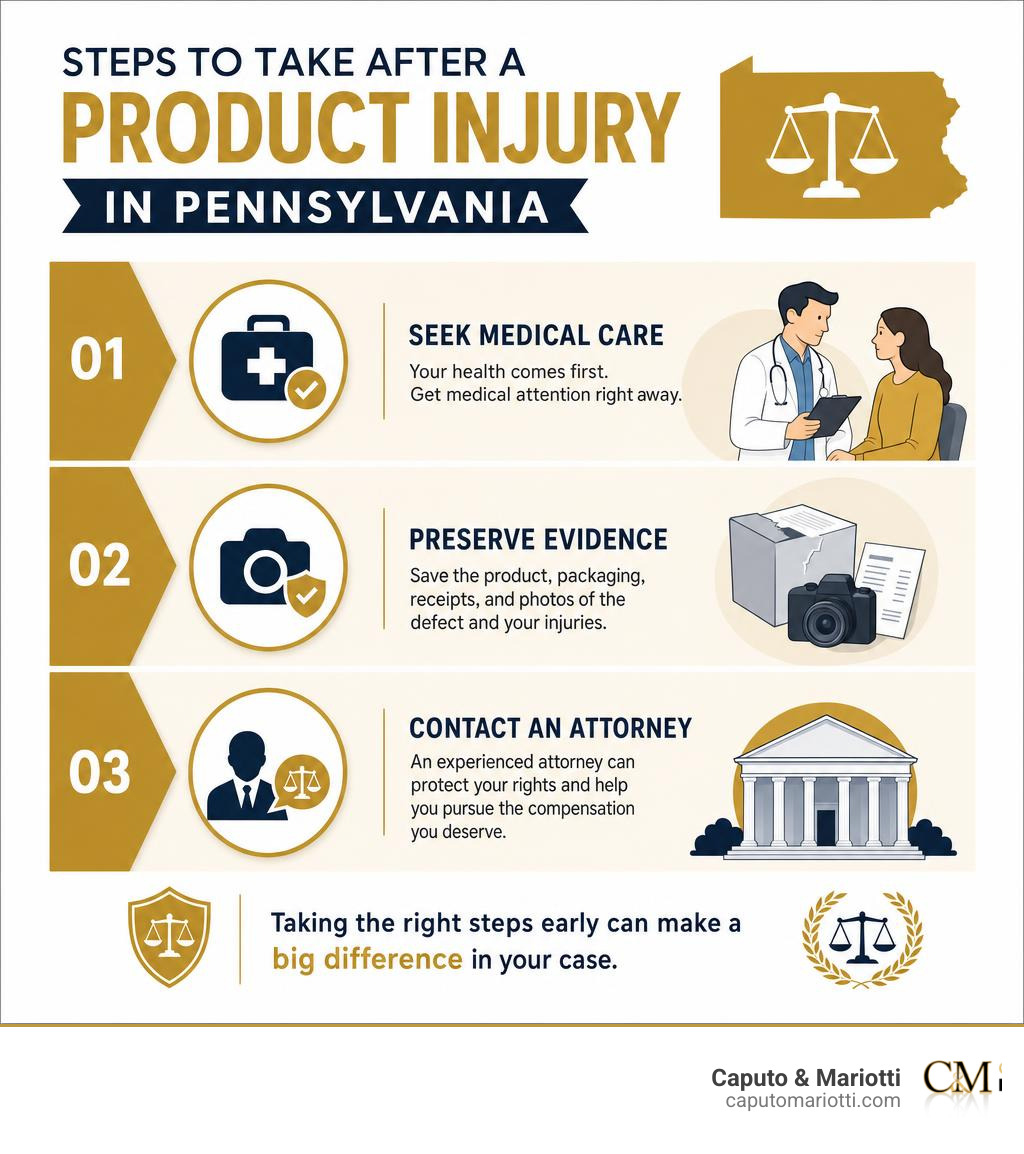
The steps you take immediately following an injury can make or break your potential lawsuit. If you are hurt by a product, try to follow these steps:
- Seek Medical Attention: Your health is the top priority. Go to an emergency room or see a doctor immediately. This ensures your injuries are treated and creates an official medical record linking your injuries to the product.
- Preserve the Evidence: Do not throw the product away. Keep the defective item, all of its packaging, the instruction manual, the receipt of purchase, and any spare parts. If possible, take photos and videos of the product and the scene of the accident before anything is moved.
- Do Not Alter the Product: Keep the product in the exact condition it was in when the injury occurred. Do not attempt to repair it, disassemble it, or send it back to the manufacturer for a “refund” or “inspection.”
- Document Everything: Keep a journal of your injuries, treatment, and daily pain levels. Save all medical bills and records of missed work.
If you reside in Northern Luzerne County, our legal team can guide you through these steps and protect your rights. Learn more at Pittston Product Liability.
Can I Sue for a Defective Second-Hand Product?
As discussed earlier, you cannot bring a strict liability claim against a commercial seller of used goods in Pennsylvania. However, you are not entirely out of luck. You can still file a lawsuit based on negligence if you can prove that the seller knew (or should have known) the product was defective and failed to repair it or warn you before the sale. Additionally, the original manufacturer of the product may still be held strictly liable if the defect was present when the product was originally manufactured and has not been altered.
Conclusion
Navigating a defective product lawsuit in Pennsylvania requires a deep understanding of complex state laws, evidentiary rules, and corporate defense tactics. When you are up against major manufacturers and multi-billion-dollar insurance companies, you need an experienced legal team in your corner.
At Caputo & Mariotti, we bring more than 55 years of combined experience to the table. Our dedicated team serves clients across Northeastern Pennsylvania — including Scranton, Wilkes-Barre, Hazleton, Pittston, Dickson City, Moosic, and throughout Lackawanna and Luzerne counties. We are deeply committed to securing justice for injured consumers and holding negligent corporations accountable.
You do not have to face this difficult journey alone. Contact us today to Schedule a Free Consultation and let us help you fight for the compensation you deserve.