

The dedicated legal team of Caputo & Mariotti
A Quick Start Guide to How Insurance Companies Calculate Injury Settlements
August 31, 2026
How Insurance Companies Calculate Injury Settlements: Economic vs. Non-Economic Damages
When evaluating a claim, an insurance adjuster’s primary objective is not to deliver fair compensation; it is to calculate the carrier’s total financial exposure and resolve the claim for the lowest defensible amount. Understanding how insurance companies calculate injury settlements requires looking past standard mathematical formulas and seeing the dual structure adjusters use to evaluate financial liability.
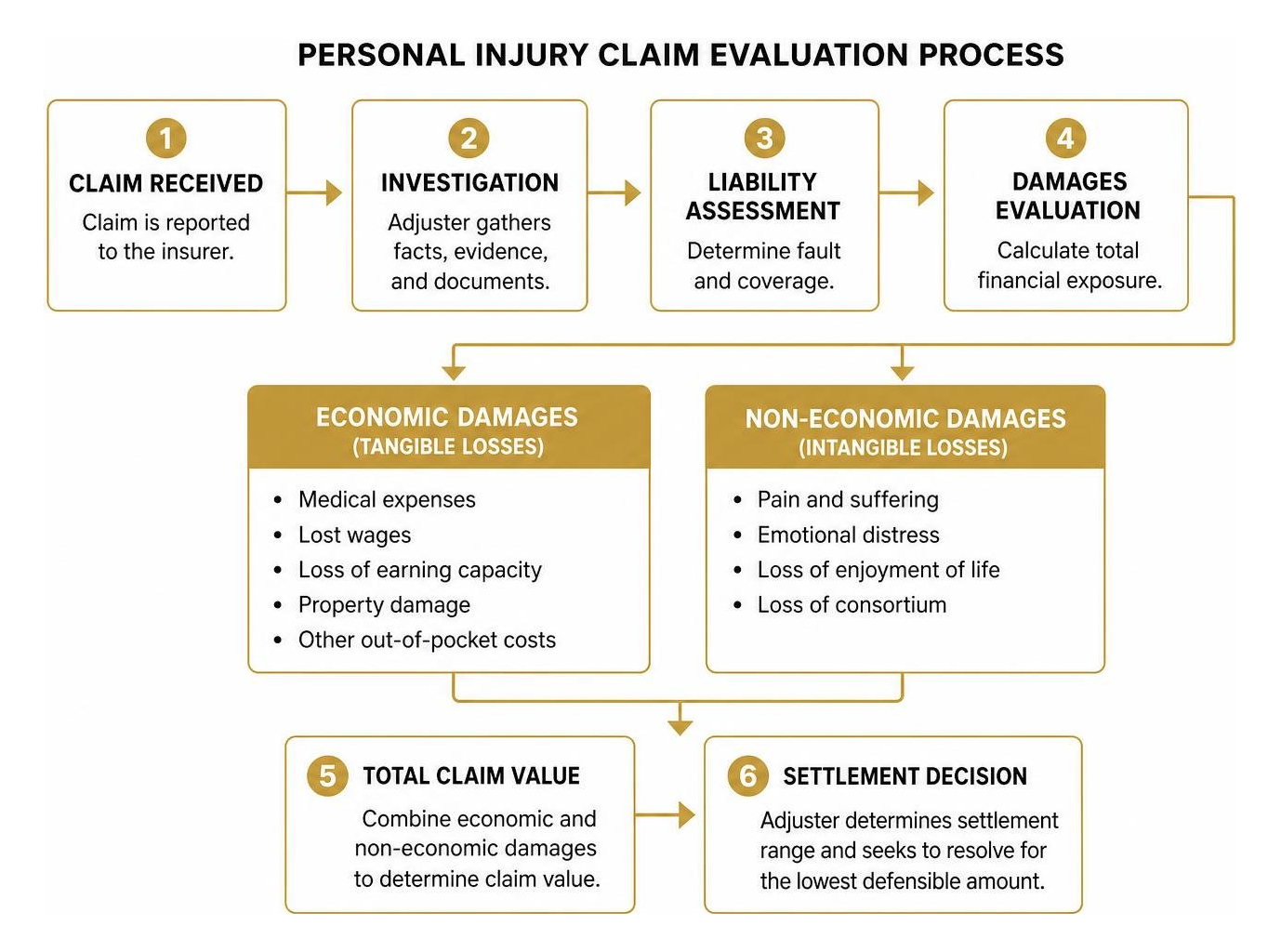
Every personal injury claim is divided into two primary categories of losses: economic damages (special damages) and non-economic damages (general damages). For a deeper breakdown of how these categories shape your claim, read our guide on Understanding Compensation in Personal Injury Cases: A Deep Dive into Damages.
Calculating Economic Damages: Tangible Financial Losses
Economic damages represent objective, verifiable out-of-pocket financial losses resulting directly from an injury. Because these costs are backed by bills, receipts, and pay stubs, they form the concrete baseline of any claim valuation.
Adjusters evaluate several specific economic damage components:
- Past Medical Expenses: Hospital visits, ambulance fees, surgical costs, diagnostic tests, physical therapy, prescription medications, and medical equipment.
- Future Medical Expenses: Anticipated treatments, future surgeries, long-term rehabilitation, continuous therapy, and ongoing pain management projected over your lifetime.
- Lost Wages: Actual income lost while missing work due to injury recovery, medical appointments, and physical limitations.
- Lost Earning Capacity: Permanent reduction in your future earning potential if an injury prevents you from returning to your previous trade or profession.
- Property Damage: Costs to repair or replace vehicles, clothing, cell phones, or personal items damaged during the incident.
- Out-of-Pocket Expenses: Direct travel costs for medical care, home modification costs, and domestic assistance hired to help during recovery.
Calculating Non-Economic Damages: Intangible Losses
Unlike economic losses, non-economic damages address the subjective, non-monetary impact of an injury on a person’s life. Because these losses lack receipts or price tags, they represent the most heavily disputed aspect of settlement negotiations.
Adjusters evaluate non-economic damages by reviewing treatment records for notes on daily impairment, pain levels, and life disruption:
- Pain and Suffering: Physical agony, discomfort, and bodily distress endured during and after the incident.
- Emotional Distress: Psychological impact, including post-traumatic anxiety, depression, sleep disruption, and fear.
- Loss of Enjoyment of Life: Inability to participate in hobbies, recreation, exercise, or family activities enjoyed prior to the injury.
- Permanent Disability and Disfigurement: Long-term scarring, loss of bodily functions, or structural physical changes.
Understanding how these intangible harms fit within broader legal frameworks across the country is critical, as detailed in How Personal Injury Settlements Work in the U.S..
Two Main Settlement Formulas: Multiplier and Per Diem Methods
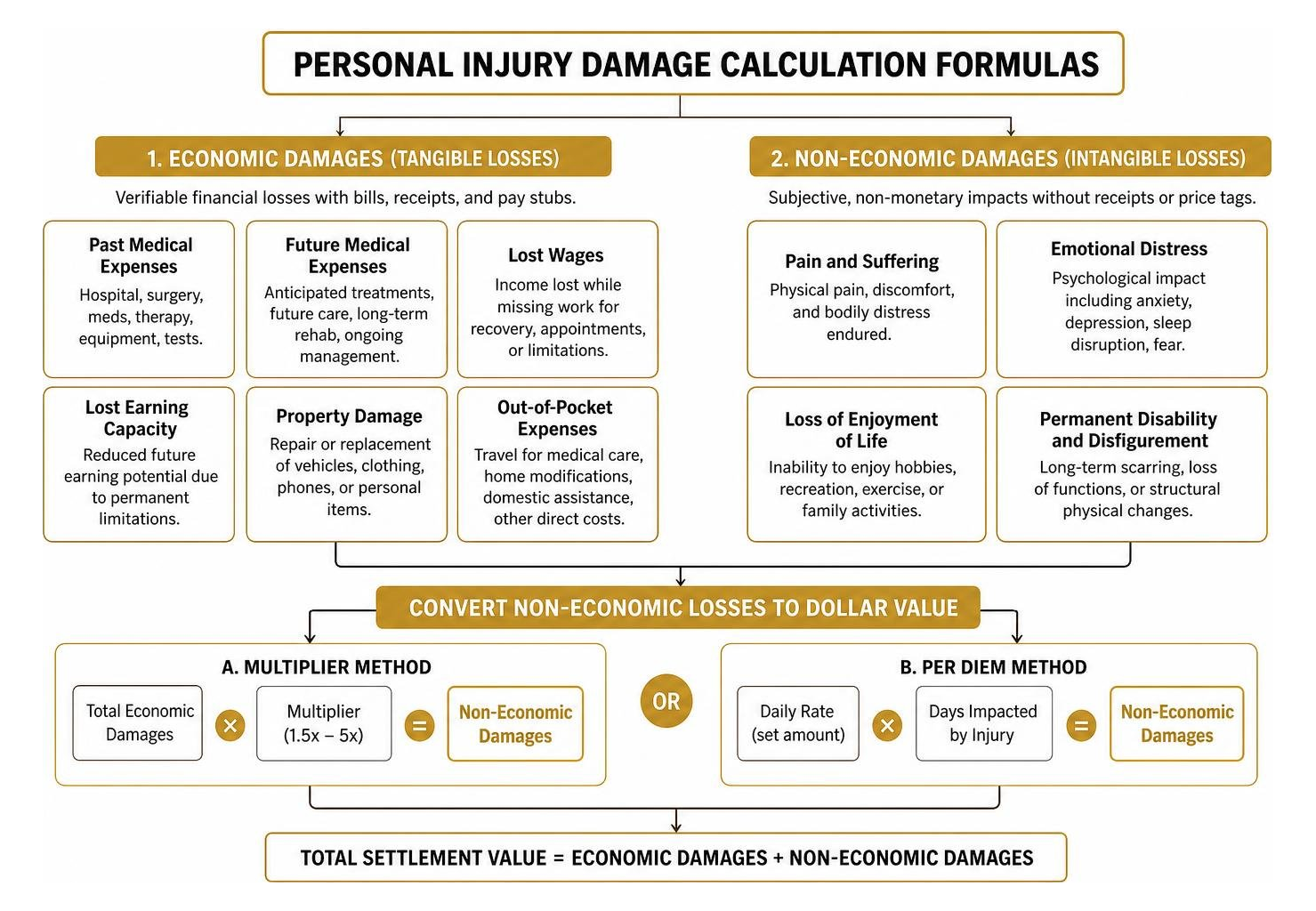
To convert subjective non-economic losses into concrete financial figures, insurance companies and attorneys rely on two primary traditional calculation formulas. These algorithms create a starting baseline before adjusters factor in legal risk, comparative negligence, or policy limits.
The Multiplier Method: How Insurance Companies Calculate Injury Settlements
The multiplier method is the most widely used formula for estimating pain and suffering. Under this framework, total medical special damages are multiplied by a number—typically ranging from 1.5x to 5x—to determine non-economic damages.
The specific multiplier chosen depends on several core variables:
- Injury Severity: Soft-tissue injuries (strains, sprains, whiplash) typically receive lower multipliers between 1.5x and 2.0x. Severe, radiologically documented injuries (bone fractures, herniated discs requiring surgery, nerve damage) command multipliers of 3.0x to 5.0x or higher.
- Treatment Duration: Short care spans lower the multiplier, while continuous, multi-month medical programs push it higher.
- Recovery Expectation: Complete recoveries lead to lower multipliers, whereas permanent structural impairments push figures toward the top of the scale.
For example, an accident victim with $10,000 in medical bills for a soft-tissue injury assigned a 1.5x multiplier would calculate $15,000 in non-economic damages, yielding a total starting valuation of $25,000. Conversely, an individual with $50,000 in medical bills from a surgical herniated disc assigned a 4.0x multiplier would calculate $200,000 in pain and suffering, yielding a initial claim baseline of $250,000.
The Per Diem Method for Daily Suffering
The per diem (per day) method assigns a specific dollar rate to every single day the victim suffers from the injury, counting from the date of the incident until they reach Maximum Medical Improvement (MMI).
The daily rate applied often mirrors the victim’s actual daily wage, under the logic that enduring daily physical pain is at least as demanding as a full day of employment.
For instance, if an injured worker earns $200 per day and takes 180 days to reach MMI, the per diem calculation yields $36,000 ($200 × 180) in pain and suffering compensation. This method is used most effectively in cases involving discrete recovery windows with clear, temporary disruption. It is rarely applied to catastrophic, lifetime-permanent conditions where long-term projections make a daily calculation impractical.
Software Algorithms and Insurance Adjuster Settlement Tactics
Modern insurance companies rarely rely solely on human intuition or simple napkin math. Today, the initial offer you receive is heavily driven by automated claim-evaluation software systems.
Automated Claims Software Valuation
Insurance carriers utilize sophisticated, computer-based valuation software such as Colossus, Claims Workbench, and Claims IQ to evaluate bodily injury claims.
Adjusters input specific ICD diagnostic codes, medical records, treatment types, and geographic location data into these systems. The software converts this information into medical severity scores and outputs a settlement offer range:
- Algorithmic Discounts: Software algorithms systematically discount soft-tissue injuries that lack objective radiological findings (such as positive MRI scans), routinely scoring them far below fair market value.
- Carrier Customization: Programs like Progressive’s Claims Workbench are tailored to produce conservative settlement figures. For example, Claims Workbench often applies multipliers of just 0.75x to 1.5x medical bills for soft-tissue injuries, whereas fair jury trial benchmarks typically range from 1.5x to 2.0x. You can learn more about carrier software evaluation through the Progressive Injury Settlement Calculator.
- Attorney Track Records: Software programs like Colossus track whether a claimant is represented by legal counsel and evaluate that specific attorney’s historical willingness to take cases to trial.
Common Adjuster Negotiation Tactics
Insurance adjusters operate under strict corporate performance metrics focused on claim closure speed and minimizing financial payouts. Understanding their playbook allows you to resist lowball offers:
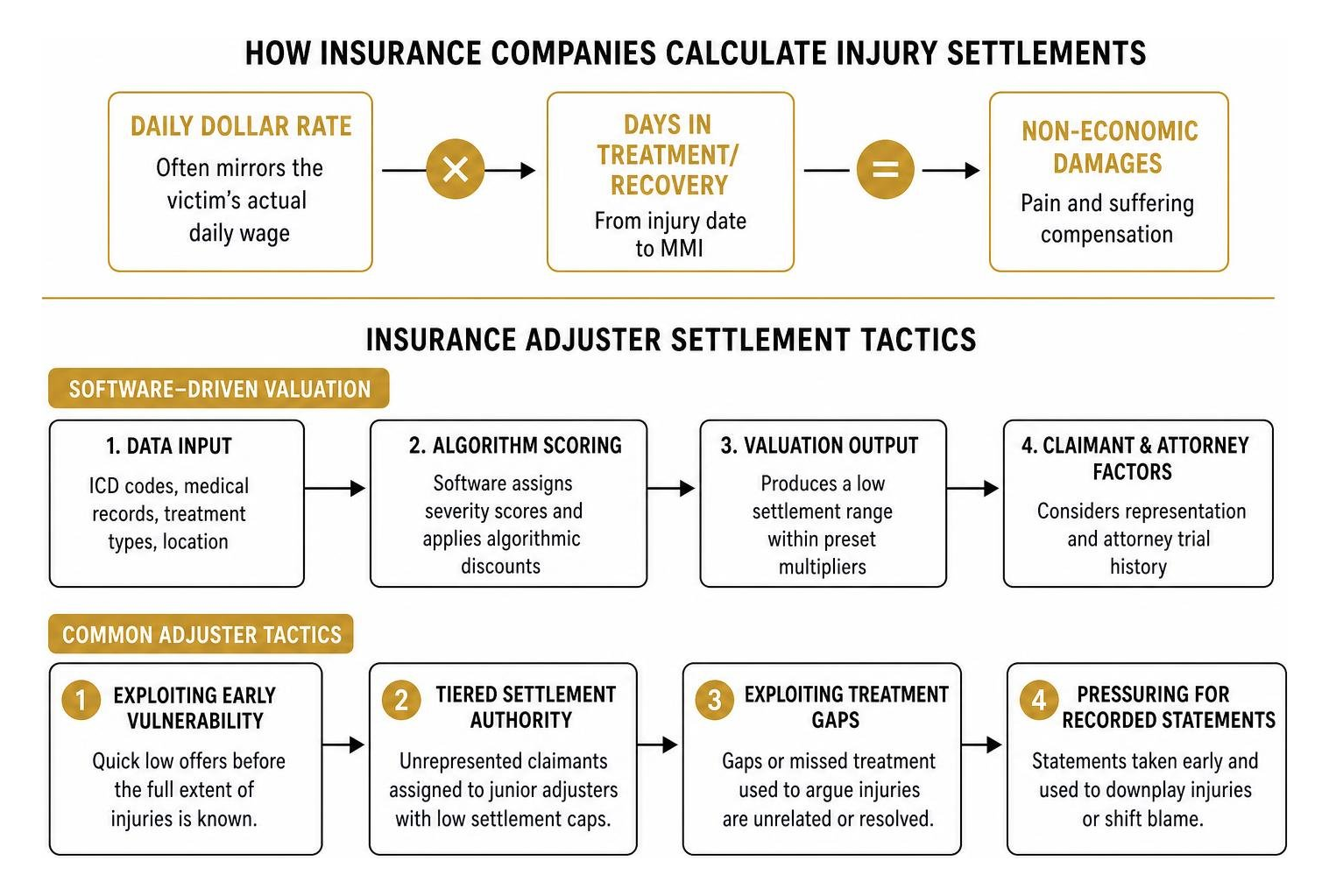
- Exploiting Early Vulnerability: Adjusters often present quick initial settlement offers within days of an accident. Industry data reveals that an insurance company’s first offer is typically 45 to 65 percent below true fair value. These initial offers aim to take advantage of immediate financial stress before the full extent of your injury is known.
- Tiered Settlement Authority: Unrepresented claimants are routinely assigned to junior adjusters whose settlement authority is strictly capped (often between $25,000 and $50,000). These adjusters literally lack the legal authority to pay fair value on moderate-to-severe claims.
- Exploiting Treatment Gaps: Adjusters actively comb medical files for breaks in care. A two-week gap between an accident and your first doctor visit, or missed physical therapy sessions, will be weaponized to argue your injuries were un-related or resolved.
- Pressuring for Recorded Statements: Adjusters frequently ask unrepresented victims for recorded statements early in the claim process, taking casual comments out of context to allege shared fault or downplay symptom severity.
To understand how to protect your rights during these interactions, read our overview on Your Rights Against Insurance Companies.
Fault Rules, Policy Limits, and Liens That Cap Settlement Payouts
Even when economic and non-economic damages are properly calculated, outside legal and financial caps dictate how much money you can actually recover.
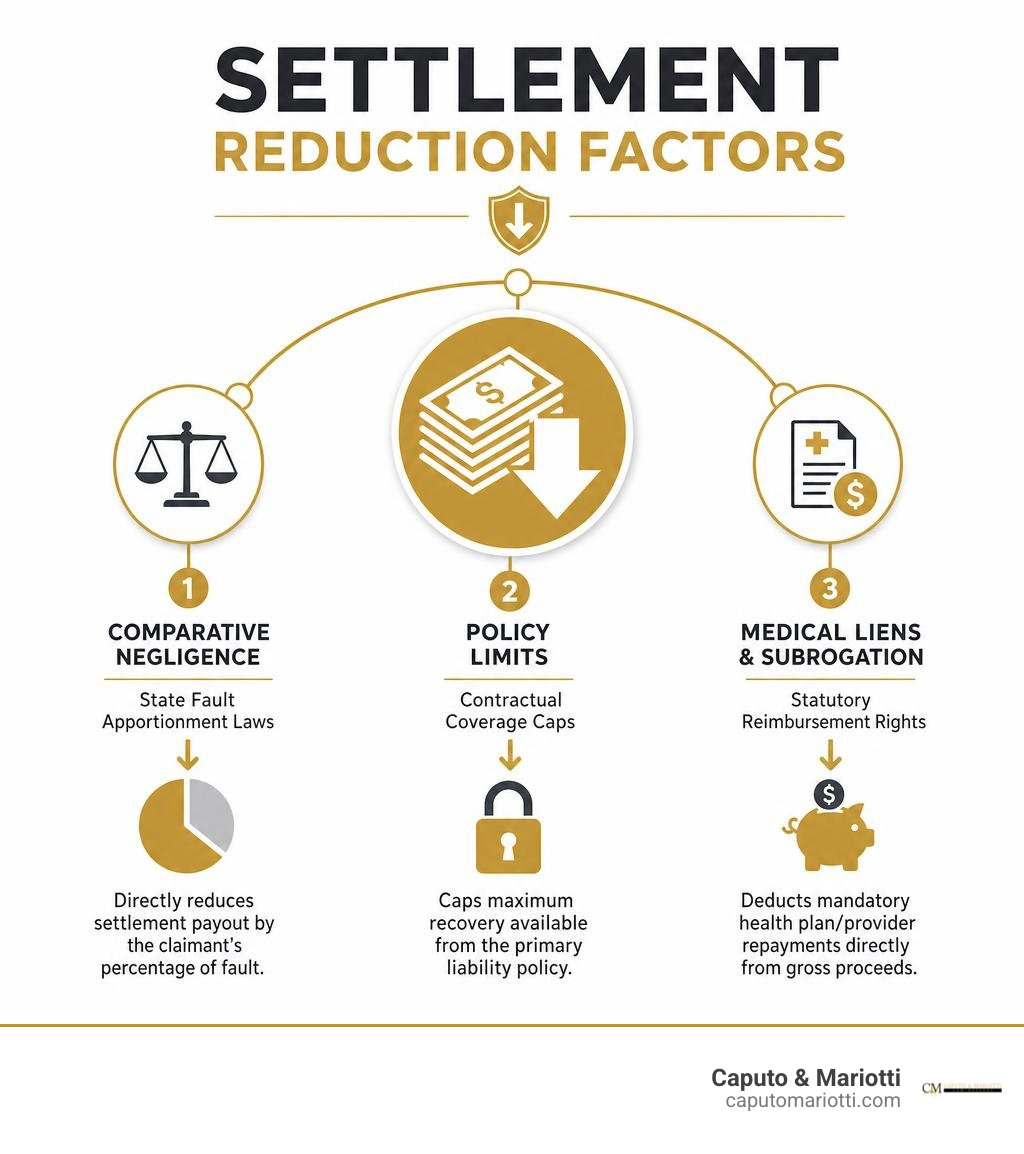
| Factor | Legal Mechanism | Impact on Final Settlement Payout |
|---|---|---|
| Comparative Negligence | State Fault Apportionment Laws | Directly reduces settlement payout by the claimant’s percentage of fault. |
| Policy Limits | Contractual Coverage Caps | Caps maximum recovery available from the primary liability policy. |
| Medical Liens & Subrogation | Statutory Reimbursement Rights | Deducts mandatory health plan/provider repayments directly from gross proceeds. |
| Paid vs. Billed Rules | Howell Rule / State Case Law | Limits medical economic damage recovery to actual amounts paid rather than full billed charges. |
Comparative Negligence and Shared Liability
Your ultimate financial recovery depends heavily on your share of responsibility for an accident:
- Modified Comparative Fault (51% Bar): In modified comparative fault states like Pennsylvania, an injured party can recover financial damages as long as their share of fault is 50% or less. If you are found 51% or more at fault, you are legally barred from recovering any compensation. If you are assigned 40% fault for an accident with $100,000 in total damages, your settlement offer is reduced by 40%, yielding a maximum potential payout of $60,000.
- Pure Comparative Fault: States following pure comparative fault allow injured parties to recover damages even if they are 99% at fault, though their payout is reduced proportionally by their share of liability.
- Contributory Negligence: In a small handful of jurisdictions, bearing even 1% of fault completely bars any recovery.
Insurance Policy Limits, Subrogation, and Medical Liens
A claim’s actual payout is also constrained by coverage caps and post-settlement reimbursement demands:
- Policy Limit Caps: Insurance policy limits establish a hard ceiling on payout amounts. If an at-fault driver carries a state-minimum $30,000 bodily injury policy limit, the primary insurer will not pay above $30,000 regardless of whether your actual damages equal $150,000.
- Underinsured Motorist (UIM) Coverage: When an at-fault driver’s policy limits are insufficient to cover your damages, your own Underinsured Motorist (UIM) policy can provide additional coverage to bridge the financial gap.
- Subrogation and Medical Liens: Health insurance plans, Medicare, Medicaid, and medical providers hold legal rights to seek reimbursement from your gross settlement. These liens must be resolved before any funds are distributed to you.
- Billed vs. Paid Amounts (The Howell Rule): How medical expenses are valued varies significantly depending on state law. In California, for example, under Howell v. Hamilton Meats & Provisions (52 Cal.4th 541), recovery for past medical expenses is strictly limited to the discounted amount actually paid by health insurance, rather than the original billed charge. In Pennsylvania, however, attorneys can often use the full billed amounts during negotiations to demonstrate the true severity of an injury.
Building Critical Medical Evidence to Maximize Settlement Value

An insurance claim is only as strong as the objective evidence supporting it. To overcome automated software lowball settings and force adjusters to offer fair compensation, you must present undeniable proof of your injuries.
For step-by-step guidance on gathering evidence and managing your claim, explore Navigating Insurance Claims After an Injury: A Guide to Dealing with Insurance Companies.
Diagnostic Proof and How Insurance Companies Calculate Injury Settlements
To maximize how insurance adjusters value your claim, focus on obtaining objective medical evidence:
- Objective Diagnostic Imaging: Claims involving MRI-documented injuries (such as herniated discs, torn ligaments, or joint damage) are valued 2.5 to 4 times higher by insurance algorithms than claims based solely on physical examinations or subjective pain complaints.
- Specialist Medical Care: Adjusters place greater weight on treatment provided by orthopedists, neurologists, and pain management specialists compared to routine care from general practitioners or initial urgent care facilities.
- Treatment Consistency: Following your doctor’s treatment plan without gaps or unapproved breaks prevents adjusters from arguing that your injuries resolved or were caused by something else.
The Value of Legal Representation in Settlement Negotiations
Navigating insurance negotiations unrepresented puts injured victims at a clear disadvantage against trained corporate adjusters. Research consistently shows the impact of hiring legal counsel:
- 3.5x Higher Recovery: Industry data reveals that represented claimants recover approximately 3.5 times more compensation than unrepresented individuals, even after deducting attorney fees.
- Bypassing Junior Adjusters: Retaining an attorney automatically escalates your file out of low-authority junior adjuster queues and into senior claims departments equipped with higher settlement limits.
- Contingency Fee Protections: Personal injury representation operates on a contingency fee model, meaning you pay zero upfront costs or legal fees unless your lawyer successfully recovers money for you. Learn how this model protects you in The Importance of Contingent Fees.
To see how thorough legal representation elevates claim values locally, read our guide on Maximizing Compensation: Key Steps in a Northeastern PA Personal Injury Case.
If your injury occurred on the job, the recovery process works under different rules. A specialized workers’ compensation lawyer can guide you through Pennsylvania’s no-fault system. This includes adhering to strict employer reporting deadlines, seeking treatment with approved medical providers, gathering witness statements and treatment records, preserving injury and financial documentation such as incident reports, wage records, medical bills, work restrictions, mileage logs, and benefit notices, filing formal claim petitions, and navigating administrative appeals if benefits are denied.
Frequently Asked Questions About Injury Settlement Calculations
Why is the insurance company’s initial settlement offer usually low?
Initial offers are intentionally anchored low—often 45% to 65% below fair value—to take advantage of early financial stress and test your willingness to settle quickly. Unrepresented files are also handled by junior adjusters with strict settlement caps using software calibrated to minimize payouts.
How does comparative fault reduce an injury settlement amount?
Under comparative fault rules, your gross settlement is reduced directly by your percentage of fault. For example, if your case is worth $100,000 but you are found 30% at fault, your settlement offer is reduced by 30%, resulting in a final payout of $70,000. In Pennsylvania, if your fault reaches 51%, you are barred from recovering damages.
What is the difference between billed medical costs and paid medical expenses?
Billed medical costs represent the original gross amount billed by healthcare providers. Paid medical expenses are the lower, discounted amounts actually accepted by providers after health insurance adjustments. Depending on state law, insurers may calculate economic damages using the paid amount or use billed totals to gauge injury severity.
Protecting Your Rights and Maximizing Your Recovery
Understanding how insurance companies calculate injury settlements reveals a simple truth: insurance adjusters are focused on protecting their corporate bottom line, not making sure you receive a fair outcome. From automated software algorithms like Colossus to early lowball offers, insurance carriers rely on established systems designed to minimize payouts.
At Caputo & Mariotti, our legal team brings over 55 combined years of experience protecting the rights of injured individuals across Northeastern Pennsylvania, including Scranton, Wilkes-Barre, Lackawanna County, and Luzerne County. We understand the tactics insurance companies use to undervalue claims, and we know how to build the evidence needed to demand maximum compensation.
If you or a loved one has suffered an injury, do not navigate complex insurance calculations alone. Schedule a Free Consultation with our office today, or learn more about our trusted legal representation by visiting our guide on Personal Injury Legal Support in Scranton and Wilkes-Barre. Let our experienced team fight for the full financial recovery you deserve.