

The dedicated legal team of Caputo & Mariotti
A Quick Start Guide to PA Warehouse Worker Injury Claims
October 7, 2026
Essential Elements of a Warehouse Worker Injury Claim Pennsylvania Workers Should Know
To secure benefits through a warehouse worker injury claim in Pennsylvania, an injured worker must establish that the injury arose in the course and scope of employment, report the incident to an authorized employer agent within statutory deadlines, obtain objective diagnostic medical care, and file for statutory wage-loss and medical benefits. Under Pennsylvania’s mandatory no-fault workers’ compensation framework, employees receive prompt medical coverage and wage-loss protection without needing to prove employer negligence, in exchange for relinquishing civil lawsuits against their employers.
Successfully securing and protecting these benefits requires strict adherence to statutory procedures: immediate injury reporting, consistent medical treatment, rigorous evidence gathering (including witness statements, surveillance preservation, and employment records), thorough diagnostic documentation, proper claim filing, and legal appeals before a Workers’ Compensation Judge (WCJ) when claims are denied. For a comprehensive overview of these administrative stages, review our guide to navigating workers compensation claims a step by step guide. Consulting an experienced workers’ compensation lawyer ensures your rights remain fully protected throughout the administrative process.
For employees laboring in logistics centers, fulfillment hubs, and freight terminals throughout Northeastern Pennsylvania—including facilities across Scranton, Wilkes-Barre, Pittston, Hazleton, and Dickson City—injuries occur through several primary mechanisms:
- Acute Trauma: Sudden incidents such as forklift collisions, falling freight, or acute disc herniations caused by heavy lifting.
- Repetitive Motion Disorders: Cumulative trauma to the spine, shoulders, wrists, or knees resulting from thousands of daily repetitive reaches, scans, and package transfers.
- Mandatory Safety Equipment Hazards: Physical conditions caused or accelerated by required personal protective gear, such as foot disorders stemming from rigid steel-toed boots.
Reporting Requirements Under Section 311
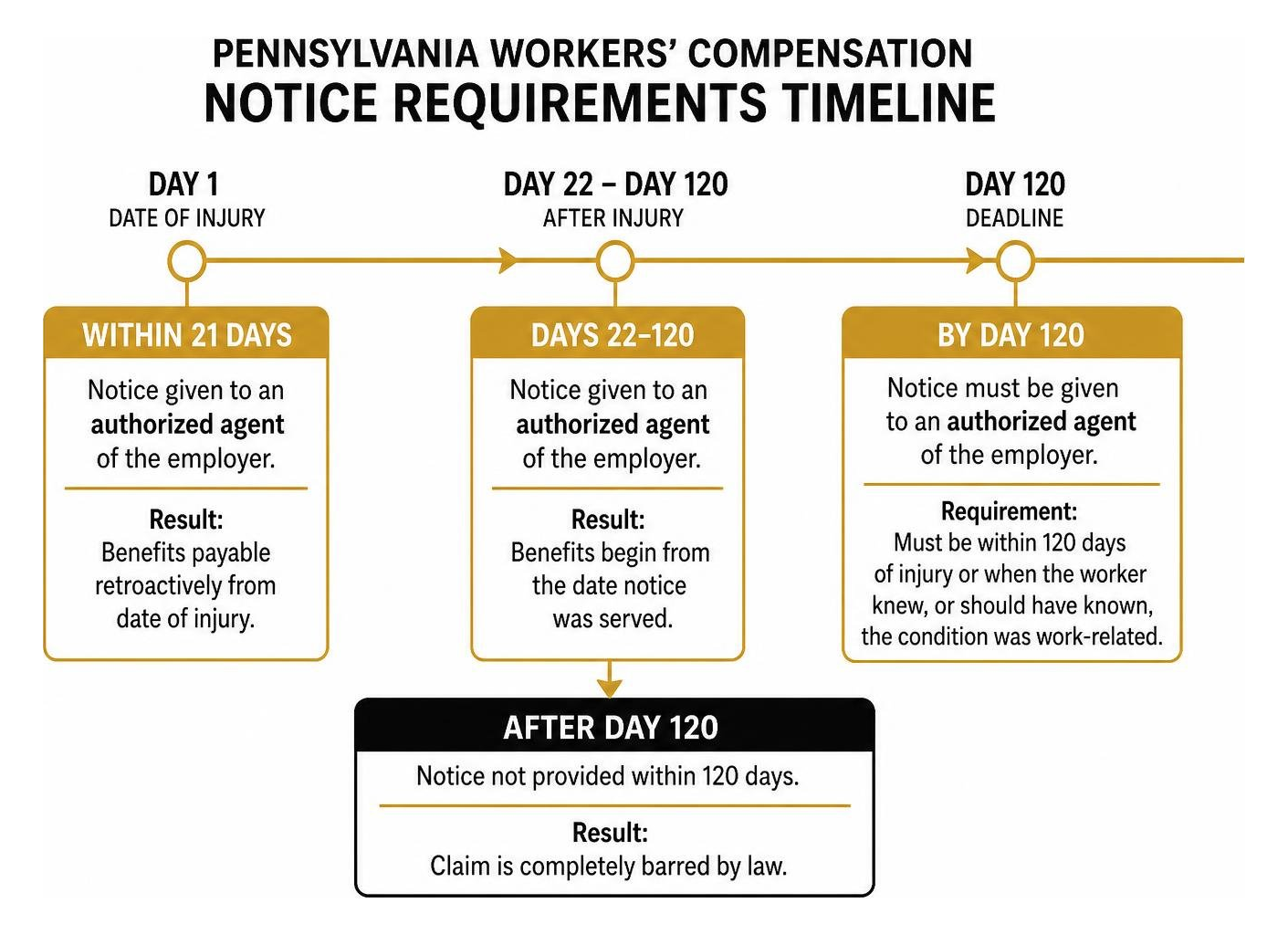
Under Section 311 of the Pennsylvania Workers’ Compensation Act (77 P.S. § 631), an injured employee must give formal notice of the injury to the employer within 120 days of its occurrence, or within 120 days of when the worker knew, or by the exercise of reasonable diligence should have known, that the condition was work-related. If notice is provided within 21 days, benefits are payable retroactively from the date of injury. If notice is given between day 22 and day 120, benefits only commence from the date notice was served. If notice is not provided within 120 days, the claim is completely barred by law.
Critically, Pennsylvania courts enforce strict standards regarding who can receive this notice. The statute dictates that notice must be given to an authorized agent of the employer—such as a designated direct supervisor, plant manager, safety director, or human resources representative. Reporting an injury exclusively to a peer, lead worker, or line co-worker does not satisfy statutory notice requirements because non-supervisory colleagues lack the legal agency to receive official notices on behalf of the company.
The consequences of improper reporting were clearly illustrated in Penske Logistics v. Workers’ Compensation Appeal Board (2015). In that case, the Commonwealth Court of Pennsylvania reversed a workers’ compensation award because the claimant failed to provide legally sufficient notice within the mandatory 120-day window. The claimant had slipped on ice in the yard and mentioned the fall to shipping clerks and coworkers, while merely sliding written documents under locked office doors without confirming receipt by an authorized supervisor. The court ruled that informal mentions to unauthorized personnel do not meet the legal threshold of Section 311, leaving the injured worker with no financial recovery.
Medical Treatment and Diagnostic Documentation
Securing workers’ compensation benefits requires proving legal and medical causation. Where the causal link between the workplace incident and the physical disability is not obvious (such as a gradual onset back injury or an internal joint derangement), the worker must present unequivocal medical testimony from a qualified physician.
Treating medical providers must substantiate their clinical diagnoses through objective diagnostic testing, such as:
- Magnetic Resonance Imaging (MRI): Identifying disc herniations, annular tears, soft-tissue tears, and nerve root compression.
- Electromyography and Nerve Conduction Studies (EMG/NCS): Confirming cervical or lumbar radiculopathy, carpal tunnel syndrome, or peripheral nerve impingement.
- Diagnostic Radiographs (X-rays) & Computed Tomography (CT): Documenting fractures, joint instability, or severe degenerative changes.
A treating physician must clearly state that, within a reasonable degree of medical certainty, the physical job duties or specific trauma caused the disabling condition. To understand how insurance companies evaluate these diagnostic records, review the role of medical evaluations in pa workers compensation claims.
Evidence Gathering: Witnesses, Records, and Facility Documentation
Building a compelling workers’ compensation claim requires comprehensive evidence gathering immediately following an incident. Critical evidentiary elements include:
- Eyewitness Statements: Securing written or recorded recollections from coworkers, forklift operators, and dock leads who observed the event or witnessed immediate physical distress.
- Surveillance and Facility Video: Requesting formal preservation of closed-circuit television (CCTV) footage covering aisles, loading docks, and sorting lines before standard recording loops overwrite the data.
- Employment and Maintenance Logs: Obtaining equipment inspection records, shift rosters, telematics reports, and incident logs that corroborate the exact time, physical environment, and equipment involved in the injury.
Filing Process and Legal Appeals Before a WCJ
Once an injury is reported, the employer’s workers’ compensation insurance carrier has 21 days to accept or deny the claim by issuing a Notice of Compensation Payable (NCP), Notice of Temporary Compensation Payable (NTCP), or Notice of Workers’ Compensation Denial (Form LIBC-496).
If the insurer denies the claim or issues an improper benefit calculation, the worker must formally initiate the legal process by filing a Claim Petition with the Pennsylvania Bureau of Workers’ Compensation. The petition is assigned to a Workers’ Compensation Judge (WCJ) in the appropriate county jurisdiction. During litigation, both parties present medical depositions, cross-examine witnesses, and submit legal briefs. If the WCJ issues an adverse decision, the injured worker has the right to file legal appeals to the Workers’ Compensation Appeal Board (WCAB) and subsequently to the Commonwealth Court of Pennsylvania.
Navigating Pre-Existing Conditions and Temporary Aggravation
A common point of dispute in warehouse injury claims involves pre-existing, asymptomatic conditions such as degenerative disc disease, arthritis, or congenital anatomical variations. Under Pennsylvania law, an employer takes an employee as it finds them. If a workplace event or repetitive job requirement aggravates, accelerates, or worsens a pre-existing condition into a disabling state, the resulting disability is fully compensable as a “work-related aggravation.”
However, establishing an aggravation claim requires precise medical evidence distinguishing between the baseline condition and the acute workplace exacerbation.
| Claim Factor | Work-Related Aggravation | Natural Progression of Pre-Existing Condition |
|---|---|---|
| Legal Compensability | Fully compensable under the PA Workers’ Compensation Act | Not compensable |
| Medical Evidence Required | Unequivocal medical proof linking increased pathology/symptoms to work duties | Medical evidence showing symptoms stem entirely from underlying pathology |
| Duration of Benefits | Payable as long as the work-induced aggravation causes wage loss; closes when baseline is reached | No benefits payable |
| Diagnostic Findings | New structural changes or objective clinical worsening beyond prior imaging | Baseline degenerative wear consistent with age and natural degeneration |
The legal boundaries of workplace aggravations were reinforced in Rodolfo Perez-Martinez v. Dart Container Corporation of Pennsylvania (2026). In that case, the Commonwealth Court affirmed that a warehouse worker who developed severe sesamoiditis from wearing mandatory steel-toed boots was entitled to a closed period of benefits rather than ongoing, open-ended compensation. The claimant had a high-arch foot structure that made wearing rigid footwear painful, leading to inflammation of the sesamoid bones.
The court held that although the required footwear caused a compensable aggravation, diagnostic imaging (X-rays, ultrasounds, and MRIs) revealed no permanent structural bone damage. Once orthotic inserts relieved the acute inflammation and the worker returned to baseline physical health, the temporary aggravation had fully resolved, justifying the termination of ongoing wage-loss benefits.
Credibility of Medical Testimony and Temporal Proximity
In Pennsylvania workers’ compensation litigation, Workers’ Compensation Judges possess exclusive authority over witness credibility and evidentiary weight. When a claim petition is contested, the judge must weigh the testimony of the claimant’s treating doctor against the opinions of the employer’s Independent Medical Examiner (IME).
A recurring issue before WCJs is medical causation based primarily on “temporal proximity”—the assumption that because symptoms appeared shortly after a work shift, the work necessarily caused the injury. Pennsylvania courts have repeatedly held that temporal proximity alone is legally insufficient to establish causation for complex internal injuries. Treating doctors must provide a comprehensive biomechanical rationale, supported by physical examination findings and diagnostic imaging, to substantiate their opinions. When disputes arise regarding medical credibility or claim denials, workers can examine strategies for navigating workers compensation challenges denied claims and benefit disputes to protect their rights before a judge.
Wage Loss Calculations and Concurrent Employment
Wage-loss benefits under the Pennsylvania Workers’ Compensation Act are designed to replace a portion of lost income and are calculated based on the employee’s Average Weekly Wage (AWW). Under Section 306 of the Act, disability benefits are categorized into two primary forms:
- Temporary Total Disability (TTD): Awarded when an employee is completely unable to perform any gainful employment due to a work-related injury. TTD benefits are generally calculated at 66⅔% of the pre-injury AWW (subject to annual statutory maximums and minimums). TTD benefits have no statutory time limit, provided the claimant remains totally disabled.
- Temporary Partial Disability (TPD): Awarded when an injured worker returns to modified or lower-paying work, or retains partial earning capacity. TPD benefits equal two-thirds of the difference between the pre-injury AWW and current earning capacity, subject to a strict statutory cap of 500 weeks.
For an overview of available benefits and statutory protections under the state system, visit our comprehensive workers compensation legal resource.
Wage Calculations in a Warehouse Worker Injury Claim Pennsylvania With Multiple Jobs
Many logistics associates in Northeastern Pennsylvania work a secondary job—such as part-time retail, security, or transportation services—to supplement their income. Under Section 309 of the Act, when a worker suffers an injury while employed by multiple employers concurrently, wages from all employers are pooled together to establish a combined pre-injury Average Weekly Wage.
This concurrent wage principle was analyzed in Amazon.com Services, LLC & Sedgwick CMS v. T.R. Carlson (2025). In that matter, a warehouse worker suffered a work-related cervical spine injury while lifting heavy boxes at a fulfillment facility. However, the claimant also maintained a secondary part-time job that fell within physical work restrictions, which the claimant continued performing after the injury.
The Commonwealth Court held that because the worker continued to earn income from concurrent employment, the claimant was not entitled to Temporary Total Disability benefits. Instead, Temporary Partial Disability benefits were awarded. Benefits were calculated by subtracting ongoing earnings from the secondary position from the pooled pre-injury Average Weekly Wage. The decision underscores that maintaining concurrent employment directly impacts the classification of benefits, shifting an injured worker from uncapped total disability to partial disability subject to the 500-week cap.
Modified-Duty Job Offers and Shift Conflicts
When a warehouse employee is placed on restricted duty by a physician, employers often attempt to mitigate wage-loss exposure by offering light-duty or modified positions (such as inventory auditing, light assembly, or administrative tasks).
Under Pennsylvania law, an employer may modify or suspend workers’ compensation wage-loss benefits if they offer a legally “available” and medically suitable job within the claimant’s documented physical restrictions. If an employee refuses a valid modified-duty position without good cause, they risk forfeiting their ongoing disability payments.
Crucially, Pennsylvania courts distinguish between medical inability to perform a job and personal preferences. If an employer offers a light-duty position on an alternate shift (such as transitioning a day-shift worker to an overnight shift) that fully accommodates all physical limitations, refusing the position due to personal scheduling conflicts, childcare preferences, or transportation issues generally does not constitute good cause. Workers must carefully evaluate these offers and understand employer responsibilities and worker rights in workers compensation before declining an accommodation.
Frequently Asked Questions About PA Warehouse Work Injuries
What happens if I report my warehouse injury to a coworker instead of a supervisor?
Under Section 311 of the Pennsylvania Workers’ Compensation Act, notice must be served upon the employer, a designated supervisor, a foreman, or an authorized management agent. Telling a line coworker, peer lead, or union steward who lacks supervisory authority does not satisfy statutory notice requirements. If 120 days pass without proper notice to an authorized management representative, your claim will be permanently barred, regardless of how severe the injury is.
Can I receive wage loss benefits if I continue working a second job?
Yes, but you will typically receive Temporary Partial Disability (TPD) rather than Temporary Total Disability (TTD) benefits. In Pennsylvania, wages from all concurrent employers are combined to calculate your pre-injury Average Weekly Wage (AWW). If you remain medically capable of working your second job, the earnings from that position are deducted from your total pre-injury AWW, and you receive two-thirds of the wage loss difference, subject to the statutory 500-week cap.
What is the deadline to report a work injury under Pennsylvania law?
You must report your injury to an authorized employer representative within 120 days of the incident or within 120 days of when you reasonably knew the condition was work-related. To receive retroactive benefits dating back to the exact day of injury, you must report the incident within 21 days. Failing to report within 120 days results in a complete forfeiture of all workers’ compensation benefits.
Conclusion
A warehouse injury can disrupt your livelihood, leaving you facing substantial medical bills, lost wages, and aggressive pushback from insurance carriers. Navigating strict statutory notice deadlines, proving medical causation for complex or pre-existing conditions, and calculating accurate concurrent wage rates require skilled legal guidance.
At Caputo & Mariotti, our dedicated legal team brings a combined 55+ years of experience advocating for injured workers and accident victims throughout Northeastern Pennsylvania, including Scranton, Moosic, Wilkes-Barre, Pittston, Hazleton, Dickson City, Lackawanna County, and Luzerne County. Our scranton workers compensation lawyers are committed to securing the full wage loss and medical compensation you deserve under the law.
If you or a loved one suffered an injury in a warehouse, fulfillment center, or industrial distribution facility, do not let technical reporting errors or insurance denials compromise your future. Contact our office today for a free, confidential consultation to discuss your case.
