

The dedicated legal team of Caputo & Mariotti
An Honest Review of Medical Negligence Lawyers in NEPA
June 10, 2026
When Medical Care Goes Wrong in Northeastern Pennsylvania, You Have Legal Rights
If you’re looking for a medical negligence lawyer in NEPA, here’s what you need to know right away:
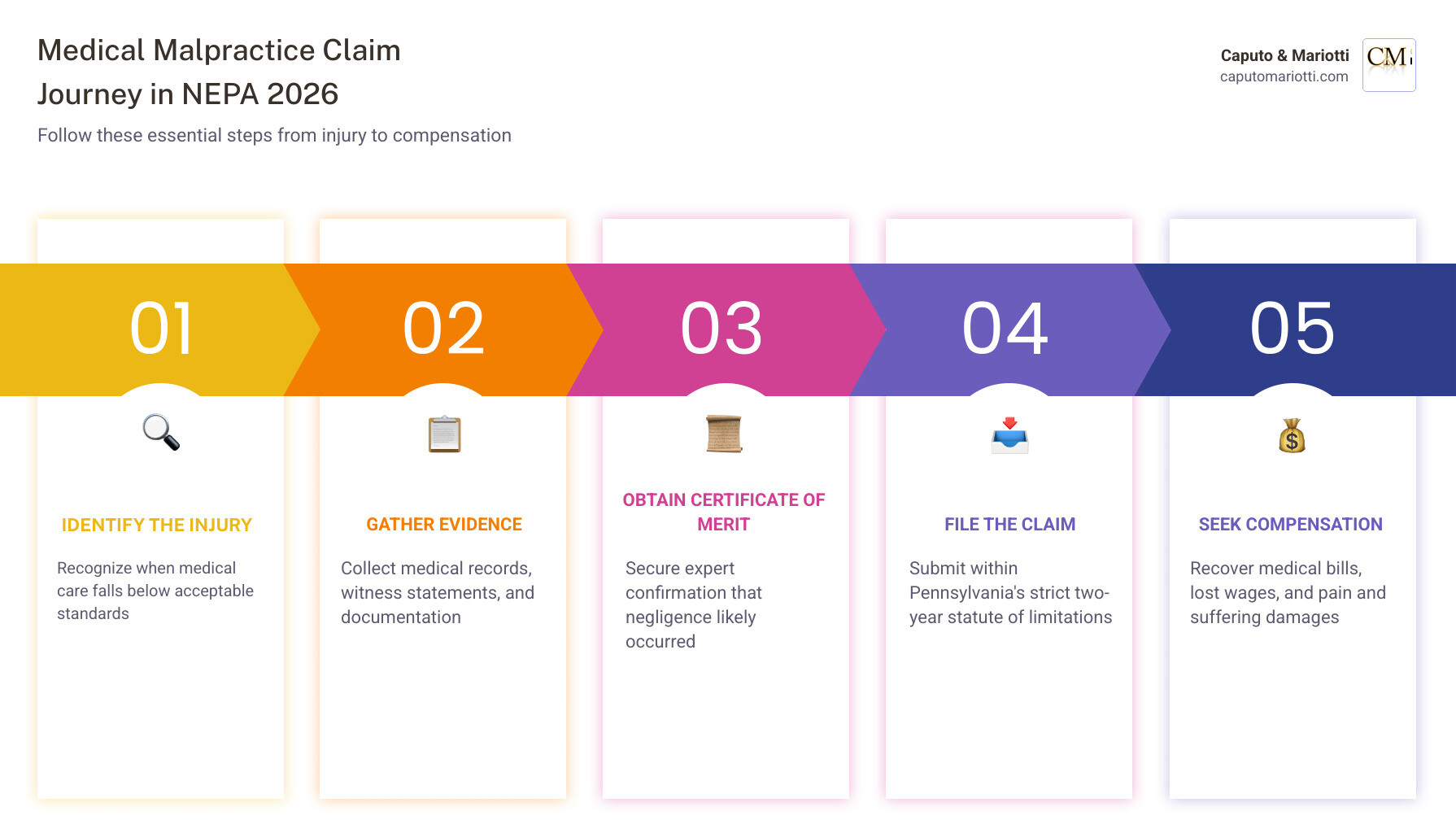
- You have 2 years from the date of injury (or discovery) to file a claim in Pennsylvania
- You can recover medical bills, lost wages, pain and suffering, and more
- A Certificate of Merit from a qualified medical expert is required before your case can proceed
- Most attorneys work on contingency — you pay nothing unless you win
- Free consultations are available — speaking with a lawyer costs you nothing and protects your rights
Medical errors happen more often than most people realize. In 2023 alone, there were 1,485 medical malpractice filings across Pennsylvania (according to data from the Unified Judicial System of Pennsylvania), with 47 of those originating right here in Luzerne County. Behind each of those numbers is a real person — someone who trusted a doctor, a hospital, or a care team, and was let down.
When that happens, it’s not just a medical problem. It’s a legal one.
Navigating the NEPA court system, dealing with hospital insurance carriers, and building a credible case against a healthcare provider is genuinely difficult. The process is complex, the rules are strict, and the other side has experienced legal teams working to minimize what you’re owed.
That’s exactly why having the right attorney matters.
I’m Chris Caputo. I’ve been a Pennsylvania personal injury and medical malpractice attorney since 1994, and before that I served as an Assistant District Attorney and Deputy District Attorney in Lackawanna County, prosecuting hundreds of complex cases. Since founding Caputo & Mariotti in 2007, I’ve dedicated my practice to helping people harmed by negligence — including victims of medical errors across Northeastern Pennsylvania — recover the compensation they deserve. As a medical negligence lawyer serving NEPA, I’ve seen how these cases unfold, and I’ll walk you through everything you need to know below.
Understanding Medical Negligence vs. Malpractice in Pennsylvania
While people often use the terms interchangeably, there is a technical distinction that matters when you are building a legal case. In our experience, understanding these nuances is the first step toward identifying if you have suffered medical malpractice.
What is Medical Negligence?
Medical negligence occurs when a healthcare provider—whether it is a doctor, nurse, or technician—commits an act or fails to take an action that diverges from generally accepted standards of medical care. Essentially, it is a mistake made by a professional who should have known better. However, negligence alone does not always equal a lawsuit. For a claim to be valid, this negligence must lead to actual patient injury.
What is Medical Malpractice?
Medical malpractice is the legal vehicle used to hold a professional accountable for negligence. It is the “realized” version of negligence that results in harm. To win a malpractice case in Scranton or Wilkes-Barre, we must prove four specific elements:
- Duty: A provider-patient relationship existed.
- Breach of Duty: The provider failed to meet the “standard of care” (what a reasonably competent peer would have done in the same situation).
- Causation: This specific breach directly caused your injury.
- Damages: You suffered actual physical, emotional, or financial harm.
It is also important to touch on informed consent. In Pennsylvania, you have the right to be fully informed about the risks and benefits of a procedure. If a doctor fails to warn you of a specific risk and that risk occurs, it may be grounds for a claim, even if the procedure itself was performed “correctly.” For more details, see our guide on what to know about medical malpractice.
Common Types of Cases Handled by a Medical Negligence Lawyer NEPA

In Northeastern Pennsylvania, our local hospitals and clinics are generally staffed by dedicated professionals. However, systemic issues like understaffing or simple human error can lead to devastating results. Here are the common types of medical malpractice we see in our region:
Birth Injuries
These are perhaps the most heartbreaking cases we handle. Negligence during labor and delivery can result in lifelong conditions such as cerebral palsy, Erb’s palsy, or brain damage due to oxygen deprivation. Often, these injuries are preventable if a C-section is performed timely or if fetal distress is properly monitored.
Surgical Errors
While every surgery carries risks, some errors are inexcusable. These include “never events” like performing surgery on the wrong body part, leaving surgical instruments inside a patient, or damaging internal organs due to poor technique.
Misdiagnosis and Delayed Diagnosis
When a doctor fails to recognize symptoms of a serious condition, the window for effective treatment can close. We frequently see cases involving misdiagnosis or late diagnosis of cancer, strokes, or heart attacks. In these instances, the delay itself is what causes the ultimate harm or wrongful death.
Medication Mistakes
Whether it’s a doctor prescribing the wrong dosage or a nurse administering the wrong medication, pharmacy and hospital errors can be fatal. This includes failing to check for dangerous drug interactions or known allergies.
Hospital-Acquired Infections and ER Errors
Unsanitary conditions can lead to sepsis or MRSA. Similarly, the nature of the Emergency Room in hospitals like those in Wilkes-Barre or Scranton can lead to rushed decisions and missed diagnoses of life-threatening events like pulmonary embolisms.
Proving Liability and Recovering Damages in NEPA Courts
Winning a medical malpractice case in Northeastern Pennsylvania requires a strategic approach. The courts in Lackawanna and Luzerne Counties are rigorous, and the burden of proof lies entirely on the plaintiff (the injured party).
Recoverable Damages
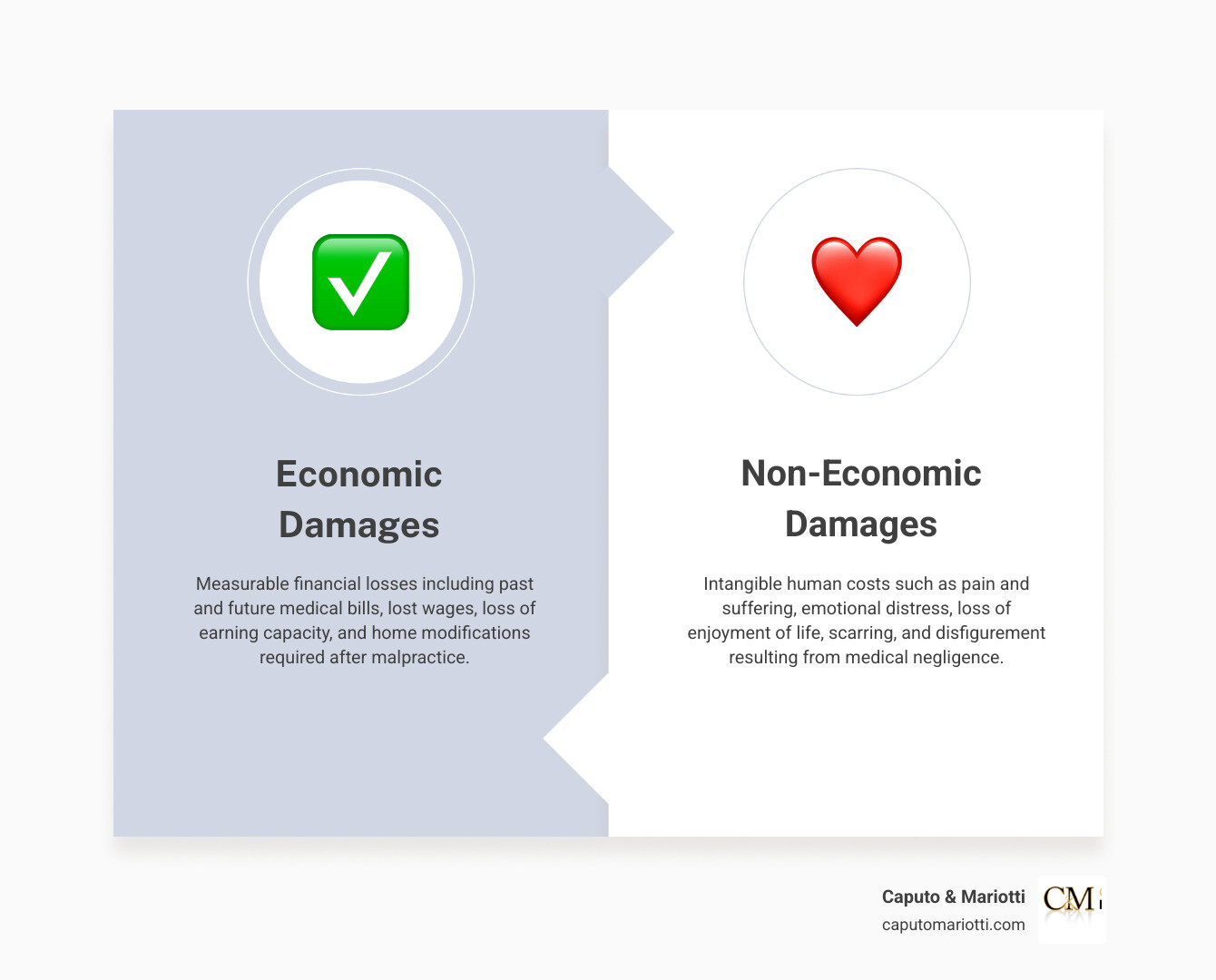
When we take on a case, we look at the full spectrum of how the injury has changed your life. Damages are generally split into two categories:
| Damage Type | What it Covers | Examples |
|---|---|---|
| Economic | Measurable financial losses | Medical bills (past and future), lost wages, loss of earning capacity, home modifications. |
| Non-Economic | Intangible human costs | Pain and suffering, emotional distress, loss of enjoyment of life, scarring, and disfigurement. |
| Punitive | Punishment for the defendant | Only awarded in cases of “outrageous” or “reckless” conduct to deter others. |
To ensure you receive the full value of your claim, we act as your attorney lifeline, coordinating with life-care planners and economists to project the true cost of your care over the coming decades.
Proving Liability with a Medical Negligence lawyer NEPA
The “Standard of Care” is the benchmark for every case. We don’t just say a doctor was wrong; we have to prove it using high-level evidence.
- Certificate of Merit: Under Pennsylvania law, we must file a document within 60 days of the complaint stating that a qualified medical expert has reviewed your records and believes there is a reasonable probability that the care fell below professional standards. Without this, your case will be dismissed.
- Medical Experts: These are the “heavy hitters” in your case. We work with board-certified physicians who can explain to a jury exactly where the defendant went wrong. The elements of a negligence lawsuit rely heavily on this expert testimony.
- Evidence Gathering: This involves securing original medical records, pharmacy logs, hospital staffing charts, and internal communications.
Statute of Limitations and Timelines for a Medical Negligence Lawyer NEPA
Time is not on your side in these cases. In Pennsylvania, the statute of limitations is generally two years from the date the negligence occurred.
However, we often apply the Discovery Rule. This allows the clock to start when you reasonably should have discovered the injury. For example, if a surgical sponge was left inside you in 2024 but didn’t cause symptoms until 2026, the two-year clock might start in 2026.
It is important to note that Pennsylvania also has a statute of repose, which generally bars any claim filed more than seven years after the incident, regardless of when it was discovered (with some exceptions for minors or cases of active concealment).
As for the timeline, filing a medical malpractice lawsuit is a marathon, not a sprint. Most cases in NEPA take between 1 to 3 years to resolve. We explain the full claim process here, but suffice it to say that thoroughness beats speed every time when your future is on the line.
Intersecting Claims: Medical Errors and Workers’ Compensation

Sometimes, medical negligence occurs while you are already being treated for a work-related injury. This creates a complex overlap between malpractice law and the Pennsylvania workers’ compensation system.
If you were injured on the job in Scranton or Pittston and the doctor provided by your employer (or their insurance) commits an error that worsens your condition, you may have two separate paths for recovery.
- Workers’ Compensation: This is a no-fault system. You don’t have to prove your employer was “negligent” to get benefits. If you are injured at work, you are entitled to medical treatment and a portion of your lost wages.
- Medical Malpractice: If the treatment for that work injury was negligent, you may also sue the medical provider for damages not covered by workers’ comp, such as full pain and suffering.
Navigating this requires an experienced workers’ compensation lawyer who understands how to manage insurance offsets and subrogation liens. You must follow strict reporting requirements—notifying your employer within 21 to 120 days—and keep meticulous documentation of all medical treatment. Our team handles the complex filing procedures and critical evidence gathering, such as obtaining witness statements and medical records. If your claim is denied, our team handles the legal appeals process to ensure your medical bills are paid while we simultaneously investigate the potential negligence claim.
Frequently Asked Questions about NEPA Medical Negligence
How long does a typical medical malpractice case take to resolve in Northeastern Pennsylvania?
In our experience, a case typically takes 18 to 36 months. The first year is usually spent gathering records and securing the Certificate of Merit. The following year involves “discovery,” where we depose the doctors and nurses involved. If a settlement isn’t reached, a trial date is set, which depends on the court schedules in Lackawanna or Luzerne County.
What should I do if I suspect a loved one was a victim of medical negligence?
First, seek a second medical opinion to stabilize their health. Second, request a complete copy of their medical records immediately—sometimes records “change” once a lawsuit is mentioned. Third, document everything: dates, names of staff, and the progression of symptoms. Finally, contact a medical negligence lawyer in NEPA for a free case evaluation.
Can I recover compensation if I am partially at fault for my condition?
Pennsylvania follows a “modified comparative negligence” rule. This means you can still recover damages as long as you are not more than 50% responsible for the harm. For example, if a jury finds you were 20% at fault for not following post-op instructions, but the surgeon was 80% at fault for a mistake, your total award would be reduced by 20%.
Conclusion: Justice for Northeastern Pennsylvania Families
Medical negligence doesn’t just cause physical pain; it shatters the trust we place in the people who are supposed to heal us. At Caputo & Mariotti, we believe that when that trust is broken, the responsible parties must be held accountable.
With over 55 years of combined experience serving the Scranton, Wilkes-Barre, and Hazleton areas, our team has the resources to go up against large hospital systems and their insurance carriers. We are small enough to provide the personal attention your family needs during a crisis, but experienced enough to secure the multi-million dollar results that complex cases require.
We don’t represent big corporations; we represent neighbors. Whether you are dealing with a birth injury in Moosic or a surgical error in Lackawanna County, our commitment to justice is unwavering.
If you suspect you have been harmed, don’t wait. The clock is already ticking on your right to file. Contact us today for a free, no-pressure consultation. We’ll give you an honest assessment of your case and help you understand what you need to know about malpractice in Scranton.