

The dedicated legal team of Caputo & Mariotti
In Depth Guide to Pennsylvania Construction Worker Injury Claims
September 16, 2026
Pennsylvania Construction Worker Injury Claims: What to Know First
A construction worker injury claim pennsylvania usually starts with reporting the injury to your employer right away and seeking workers’ compensation benefits. If another company, subcontractor, property owner, or equipment maker caused the harm, a separate personal injury claim may also be possible.
Construction work carries serious risks, including falls, struck-by accidents, machinery injuries, electrocution, and trench collapses. OSHA reported that construction accounted for about 21% of private-sector worker deaths in 2016.
For a quick starting point:
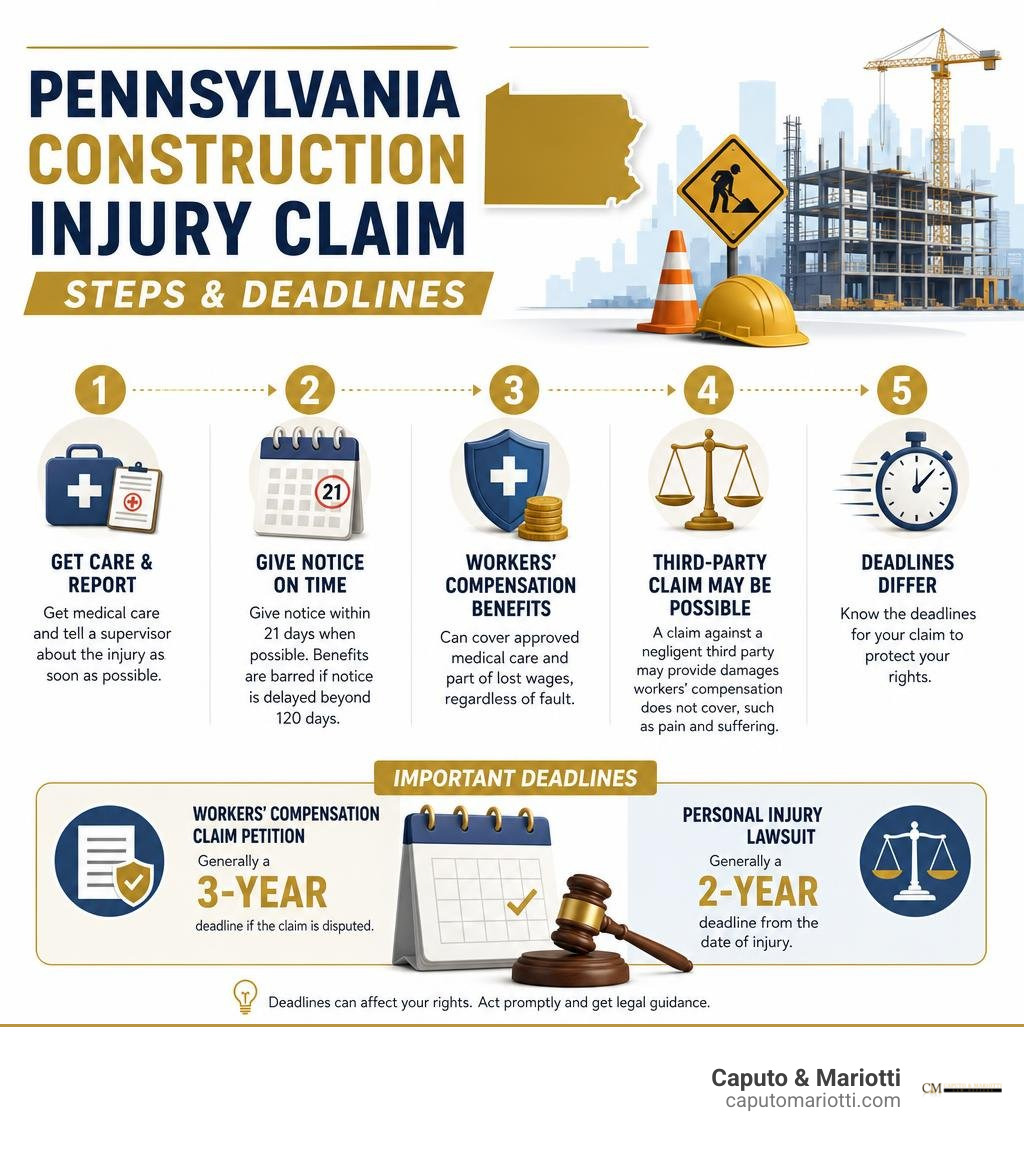
- Get medical care and tell a supervisor about the injury as soon as possible.
- Give notice within 21 days when possible. Pennsylvania generally bars workers’ compensation benefits if notice is delayed beyond 120 days.
- Workers’ compensation can cover approved medical care and part of lost wages, regardless of fault.
- A claim against a negligent third party may provide damages workers’ compensation does not cover, such as pain and suffering.
- Deadlines differ: a disputed workers’ compensation claim petition generally has a three-year deadline, while most Pennsylvania personal injury lawsuits have a two-year deadline.
I am Chris Caputo, a Pennsylvania personal injury attorney who has represented seriously injured people and families since 1994, including those navigating a construction worker injury claim pennsylvania. My experience in complex litigation and injury cases informs the practical guidance that follows.
Common Worksite Hazards and Employer Immunity Rules
Construction sites across Northeastern Pennsylvania—from commercial builds in Scranton and Wilkes-Barre to infrastructure projects throughout Lackawanna County and Luzerne County—are bustling, high-risk work spaces. Common worksite hazards include scaffolding collapses, unguarded fall hazards, electrocution risks, trench cave-ins, and heavy machinery accidents. When heavy equipment fails or is operated negligently, devastating harm can result; for more details on your rights in those situations, read our overview on Heavy Equipment Injury on the Job: Your Legal Rights and How to Seek Compensation. Knowing What to Do If You’re Hurt at Work is critical to protecting your health and financial future.
When a job site accident happens, workers often ask whether they can sue their direct employer. In Pennsylvania, the short answer is usually no. The Pennsylvania Workers’ Compensation Act, originally enacted by the state legislature in 1915, created a “no-fault” trade-off. Under this framework, covered employees receive mandatory medical expense payments and wage loss benefits without having to prove their employer was negligent. In exchange, employers receive statutory immunity from standard personal injury lawsuits brought by their workers.
This no-fault rule means that even if an employer’s ordinary negligence created a dangerous condition, the injured worker is generally restricted to recovering benefits through workers’ compensation rather than filing a traditional civil lawsuit.
Intentional Misconduct Exceptions to Immunity
While employer immunity under Pennsylvania law is broad, it is not absolute. There is a very narrow legal exception: intentional misconduct. If an employer engages in intentional, deliberate, or reckless actions knowing that serious injury or death is virtually certain to result, the statutory shield of immunity can be bypassed.
Examples of conduct that might cross this legal high bar include:
- An employer consciously removing safety guards from hazardous machinery or refusing to provide required protective hard hats purely out of malice or deliberate defiance of safety mandates.
- Ordering a worker into an un-shored, unsafe trench after being warned by inspectors that immediate collapse is imminent.
- Intentionally exposing workers to toxic chemicals without protective equipment while misleading them about the extreme hazard.
When an employer’s actions rise to the level of gross negligence or intentional harm, an experienced workers’ compensation lawyer can evaluate whether filing an independent civil lawsuit directly against the employer is viable alongside administrative benefit petitions.
Navigating the Process of a Construction Worker Injury Claim Pennsylvania
Pursuing a construction worker injury claim pennsylvania requires strict adherence to administrative rules, strict reporting deadlines, and statutory medical care guidelines. Understanding the distinction between wage benefits and medical care ensures you do not inadvertently forfeit your right to financial recovery. For a detailed breakdown of injured worker protections under state law, consult our resource on Got Hurt on the Job in PA: A Worker’s Guide to Compensation and official state publications like WORKERS’ COMPENSATION AND THE INJURED WORKER.
Under Pennsylvania’s no-fault system, workers’ compensation coverage begins on your very first day of employment, regardless of pre-existing conditions. Key procedural components include:
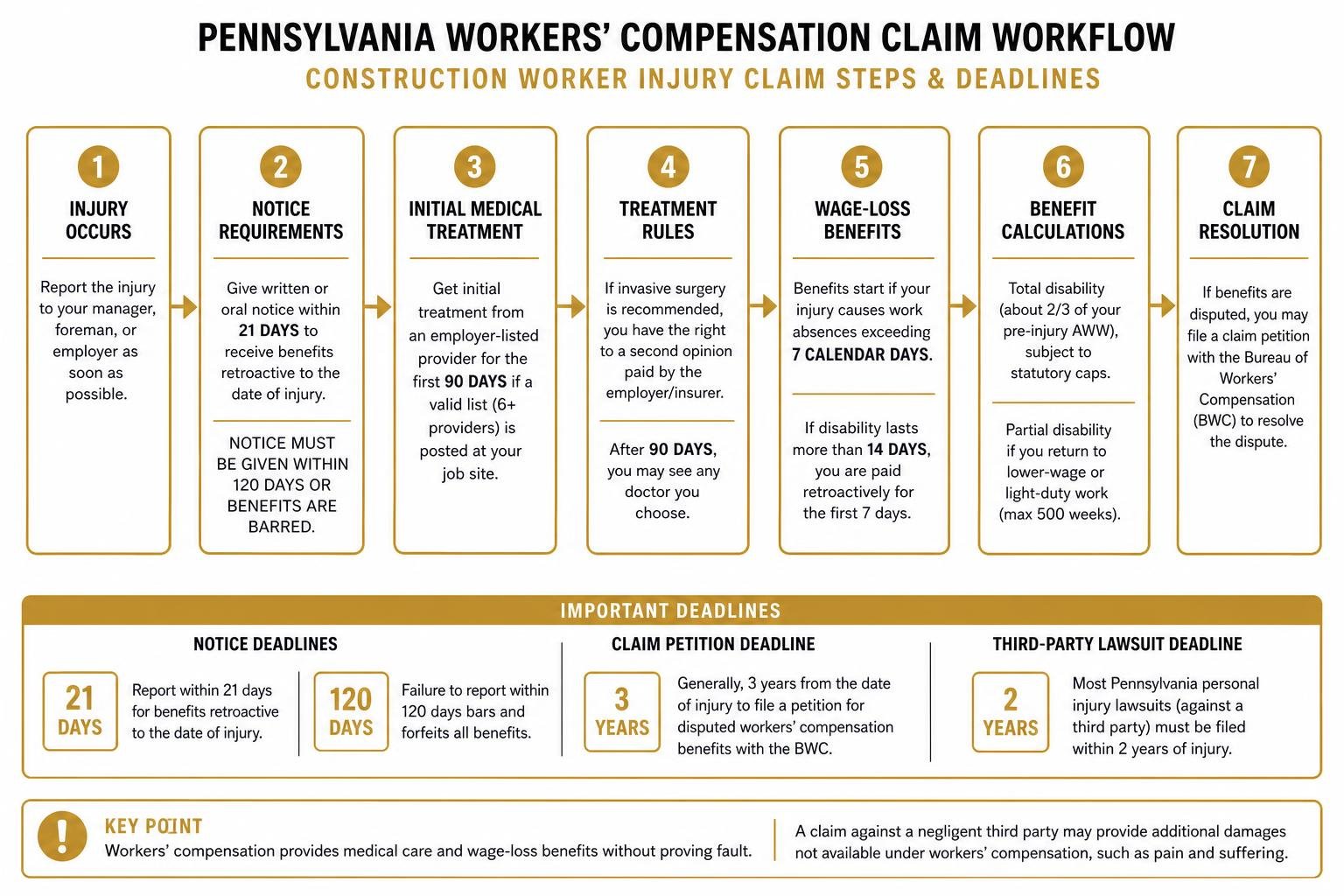
- Reporting Requirements: You must report your workplace injury to a manager, foreman, or employer supervisor as quickly as possible. To receive benefits retroactive to the exact date of injury, written or oral notice must be given within 21 days. Under Section 311 of the PA Workers’ Compensation Act, if notice is not provided within 120 days, compensation is completely barred and forfeited.
- Medical Treatment Rules: If your employer has posted a valid list of at least six approved health care providers in a conspicuous area at your job site, you must seek initial medical treatment from one of those listed providers for the first 90 days following your first visit. If invasive surgery is recommended, you have the right to seek a second opinion paid for by the employer or insurer. After 90 days, you are free to treat with any doctor of your choosing. Balance billing by medical providers for covered treatments is illegal under state law.
- Wage-Loss Calculations: Wage-loss payments kick in if your injury causes work absences exceeding seven calendar days. If your disability lasts more than 14 days, you receive retroactive compensation for the initial seven-day waiting period. Total disability payments equal roughly two-thirds of your pre-injury Average Weekly Wage (AWW), subject to statutory caps. If you return to modified or light-duty work at a lower wage, you may receive partial disability compensation, which is capped at a maximum of 500 weeks.
- Impairment Rating Evaluations (IRE): After receiving total disability benefits for 104 weeks, an insurer may request an IRE. If an examining physician determines your whole-body impairment is under 35% according to American Medical Association guidelines, your status changes to partial disability, starting the 500-week cap.
Reporting and Documentation for a Construction Worker Injury Claim Pennsylvania
Thorough evidence gathering and meticulous documentation form the backbone of a successful construction worker injury claim pennsylvania. From the moment an incident occurs on a job site in Pittston, Hazleton, or Dickson City, preserving physical and written evidence is paramount.
Essential evidence gathering includes:
- Witness Statements: Collect contact details and written accounts from fellow construction workers, site subcontractors, or bystanders who saw the incident happen.
- Medical Records: Keep comprehensive files of emergency room visits, physician treatment notes, diagnostic scans (X-rays, MRIs), and prescription orders.
- Site Photos and Incident Logs: Document unsafe machinery, missing guardrails, collapsed scaffolding, or defective safety equipment before the job site condition is altered.
When disputes arise—such as an insurer issuing a denial or failing to pay medical bills—a formal dispute process begins. The employer or insurer files a First Report of Injury (FROI) to establish the claim within the Workers’ Compensation Automation and Integration System (WCAIS). If contested, the worker files a Claim Petition for Workers’ Compensation (Form LIBC-362).
Key administrative forms available via the PA Department of Labor & Industry’s portal for WC Claim Forms | Department of Labor and Industry | Commonwealth of Pennsylvania include:
- Form LIBC-362 (Claim Petition): Formal filing used when benefits are denied. It requires specific details regarding the injury description, weekly wage, concurrent employment details, proof of service, and specific damage categories. Notably, Form LIBC-362 asks whether disfigurement or serious scarring occurred on the head, face, or neck, as these specific body areas are individually compensable under PA law.
- Form LIBC-336 (Supplemental Agreement): Document used to record agreed changes in disability status or payment amounts.
- Form LIBC-751 (Notification of Suspension or Modification): Issued by insurers when modifying or stopping benefits. Insurers must serve this form to the claimant and the Bureau of Workers’ Compensation within seven days of the effective date.
If an insurer denies a claim, a Workers’ Compensation Judge (WCJ) assigned by the Workers’ Compensation Office of Adjudication (WCOA) hears testimony, reviews medical records, and issues a binding legal decision. Unfavorable decisions can be formally appealed to the Workers’ Compensation Appeal Board (WCAB). The general statute of limitations to file a disputed claim petition is three years from the date of injury.
Sole Proprietor Notice Requirements After Erie v. Heater
A critical legal development occurred in the milestone 2026 Supreme Court of Pennsylvania decision, Erie Insurance Co. v. Heater, D. (WCAB); Apl. of: Heater, Supreme Court of Pennsylvania, 2026. This ruling clarified notice standards for self-employed individuals and sole proprietors operating on construction sites.
In construction, many tradespeople operate as sole proprietors without a corporate entity structure. In Erie v. Heater, a self-employed roofing contractor suffered a severe neck fracture in a ladder fall. Because the contractor served as both the employer and the employee, a dispute arose over whether telling their own insurance agent or realizing their own injury satisfied the statutory 120-day notice rule under Section 311 of the Workers’ Compensation Act.
The Pennsylvania Supreme Court affirmed that sole proprietors do not possess a separate corporate entity shield. Therefore, to protect insurers against stale or uninvestigated claims, a sole proprietor who suffers a work injury must directly notify their workers’ compensation insurance carrier within 120 days of the accident. Failing to provide direct written notice to the insurer within 120 days results in complete forfeiture of compensation rights. If you are an independent subcontractor or sole proprietor, maintaining immediate written communication with your insurance provider following a job site injury is legally required.
Third-Party Personal Injury Lawsuits and Bystander Claims
While workers’ compensation protects employers from direct negligence suits, construction projects almost always involve multiple independent entities—including general contractors, independent subcontractors, site owners, equipment rental companies, and product manufacturers. When a entity other than your direct employer causes or contributes to an injury, you can pursue a third-party personal injury lawsuit alongside your workers’ compensation claim.
Furthermore, construction safety hazards frequently spill over into public spaces. Passersby, motorists, and pedestrians walking near job sites in urban hubs like Scranton or Wilkes-Barre can be hurt by falling materials, unsecured debris, or machinery spills. Site developers and property owners owe a duty of reasonable care to the public. Injured bystanders are fully entitled to file civil personal injury lawsuits to recover economic and non-economic damages.
For more resources on construction litigation and job site liability, explore our legal categories covering Construction Accidents and general Workplace Injury.
| Claim Feature | Workers’ Compensation Claim | Third-Party Personal Injury Lawsuit |
|---|---|---|
| Fault Requirement | No-fault system; fault does not matter | Must prove negligence or strict liability |
| Employer Immunity | Employer is immune from civil suit | Direct employers immune; third parties are NOT immune |
| Recoverable Damages | Medical bills and ~66% of lost wages; specific loss | 100% wage loss, future earning capacity, medical expenses, pain & suffering |
| Pain and Suffering | Not available | Fully recoverable |
| Filing Deadline | 3 years to file Claim Petition (120-day notice limit) | 2-year statute of limitations from date of injury |
Legal Options for a Construction Worker Injury Claim Pennsylvania Involving Third Parties
When pursuing a third-party claim, an injured construction worker opens the door to financial remedies that are unavailable under workers’ compensation.
Key third-party liability avenues include:
- Product Liability Claims: If a scaffolding board snaps, a crane cable snaps, or a power tool malfunctions due to design or manufacturing defects, a product liability lawsuit can be brought against the equipment manufacturer.
- Negligent Subcontractors: On busy sites, a subcontractor from a different company might drop tools from an overhead rig or operate a forklift recklessly, hitting a worker from another crew.
- Property Owner Negligence: Hazardous conditions known to property owners but hidden from working crews can trigger premises liability claims.
In a successful third-party lawsuit, recoverable damages include full reimbursement of all lost wages (un-capped), lost future earning capacity, full medical care expenses, loss of consortium, and full compensation for physical pain, emotional suffering, and mental anguish.
Frequently Asked Questions
Can I sue my employer for a construction site injury in Pennsylvania?
Generally, no. Under Pennsylvania’s no-fault workers’ compensation law, employers receive statutory immunity from standard employee negligence lawsuits in exchange for providing no-fault medical and wage loss benefits. However, an exception exists if your employer engaged in intentional misconduct—deliberately causing harm or consciously forcing you into an immediate, known danger. Additionally, you can sue negligent third parties (such as equipment manufacturers or independent subcontractors) who contributed to your injury.
What damages are recoverable in a PA construction injury lawsuit?
While standard workers’ compensation covers medical costs, a percentage of lost wages, specific loss (such as loss of sight, hearing, or limb use), and head/neck disfigurement, civil third-party personal injury lawsuits offer broader financial recovery. Third-party claims allow you to seek 100% of past and future lost income, full medical bills, compensation for permanent disability or physical scarring, and non-economic damages for pain, suffering, and emotional distress.
How long do I have to report a construction site injury in Pennsylvania?
You should report a construction injury to your employer immediately. To receive benefits retroactive to the exact date of injury, notice must be given within 21 days. Under Section 311 of the PA Workers’ Compensation Act, if notice is not provided within 120 days, your claim is completely barred. If your benefits are denied, you have three years from the date of injury to file a formal Claim Petition (Form LIBC-362). For third-party personal injury lawsuits, Pennsylvania enforces a strict two-year statute of limitations from the date of the accident.
Conclusion

Navigating a construction worker injury claim pennsylvania requires overcoming tight notice deadlines, filing technical administrative petitions, and recognizing when a third-party lawsuit can secure full compensation for pain and suffering. Whether you are dealing with employer insurance denials, negotiating wage loss calculations, or pursuing third-party equipment manufacturers, taking swift legal action protects your recovery.
At Caputo & Mariotti, our legal team brings over 55 years of combined experience standing up for injured workers and families across Northeastern Pennsylvania—including Scranton, Wilkes-Barre, Lackawanna County, Luzerne County, Moosic, Pittston, Hazleton, and Dickson City. We treat every client like family, offering personalized advocacy and fighting tirelessly for justice against insurance carriers and negligent companies.
If you or a loved one suffered a severe job site injury, do not navigate complex state laws alone. Explore our specialized Workers’ Compensation legal services or seek dedicated Scranton personal injury legal support. Contact us for a free consultation today to speak directly with an experienced attorney about your case.