

The dedicated legal team of Caputo & Mariotti
Step-by-Step Guide to Car Accident Fault Laws Pennsylvania
July 17, 2026
What You Need to Know About Car Accident Fault Laws in Pennsylvania
Car accident fault laws in Pennsylvania are unlike most other states — and understanding them could mean the difference between full compensation and getting nothing at all.
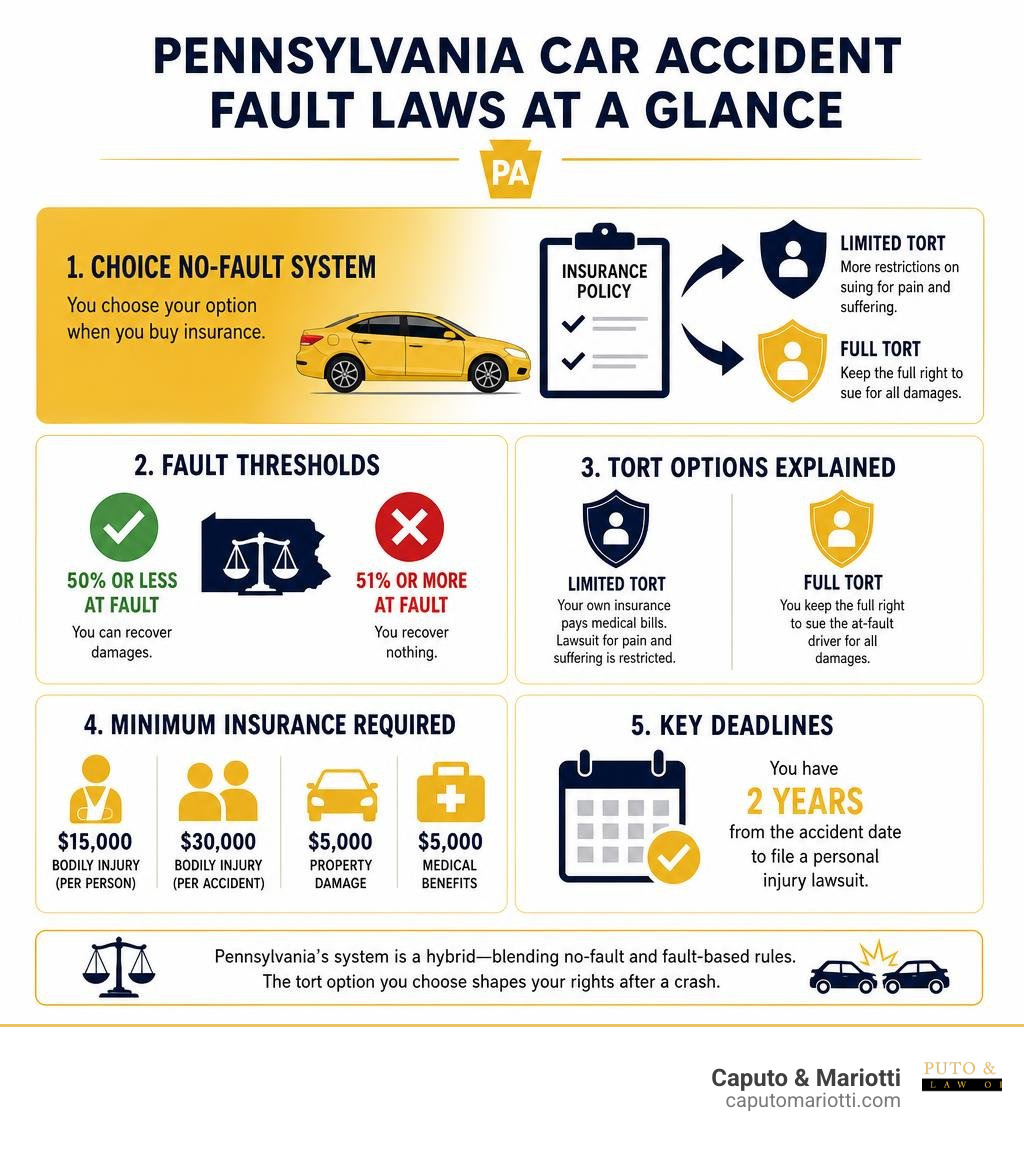
Here is a quick overview of how Pennsylvania’s system works:
| Key Rule | What It Means |
|---|---|
| Choice No-Fault State | You choose limited tort or full tort coverage when you buy insurance |
| Limited Tort | Your own insurance pays medical bills; suing for pain and suffering is restricted |
| Full Tort | You keep the full right to sue another driver for all damages |
| Modified Comparative Negligence | You can recover damages if you are 50% or less at fault |
| 51% Bar Rule | If you are 51% or more at fault, you recover nothing |
| Statute of Limitations | You have 2 years from the accident date to file a personal injury lawsuit |
| Minimum Insurance Required | $15,000/$30,000 bodily injury, $5,000 property damage, $5,000 medical benefits |
Pennsylvania’s system is a hybrid — it blends no-fault and traditional fault-based rules in a way that confuses even experienced drivers. The tort option you chose when you signed your insurance policy quietly shapes every right you have after a crash. Most people don’t realize that until it’s too late.
I’m Chris Caputo, a Pennsylvania personal injury attorney with decades of experience litigating car accident fault laws in Pennsylvania — including cases against insurance companies that deny or underpay valid claims. If you’ve been hurt in a crash, this guide will walk you through exactly how Pennsylvania’s fault rules apply to your situation.
How Car Accident Fault Laws Pennsylvania Determine Liability
Determining who is responsible for a motor vehicle collision in Pennsylvania requires looking closely at the legal concept of negligence. In the eyes of the law, fault isn’t just a matter of pointing fingers; it is a structured determination of whether a driver breached their legal duty of care, causing injuries and financial damages to someone else.

Every driver on Pennsylvania roads owes a duty of care to everyone else sharing the road—other motorists, passengers, and pedestrians. This duty requires drivers to operate their vehicles in a reasonably safe manner and obey all traffic regulations. To establish liability under car accident law basics, an injured victim must prove four core legal elements:
- Duty: The at-fault driver owed a duty of care to keep others safe.
- Breach: The driver breached that duty through a careless or unlawful action.
- Causation: The driver’s breach of duty directly caused the collision.
- Damages: The victim suffered actual physical, psychological, or financial injuries as a result.
In places like Scranton, Wilkes-Barre, and Hazleton, our local police officers, insurance claims adjusters, and civil court juries look at physical evidence, witness statements, and vehicle damage to piece together how a crash occurred and who holds the legal liability.
Negligence Per Se and Traffic Violations
One of the fastest ways to establish liability in a Pennsylvania personal injury lawsuit is through the doctrine of negligence per se. Under this legal principle, if a driver violates a safety statute and that violation directly causes an accident, the driver is automatically presumed to have acted negligently.
For example, under 75 Pa. C.S. § 3714, careless driving is defined as driving a vehicle in careless disregard for the safety of persons or property. If a driver is cited for careless driving or reckless behavior at the scene of a crash in Luzerne County, that citation can serve as powerful evidence of negligence per se in a civil claim.
Other common statutory violations that trigger negligence per se include:
- Drunk Driving (DUI): Pennsylvania enforces strict Blood Alcohol Concentration (BAC) limits. The limit is 0.08% for most adult drivers, 0.04% for commercial drivers, and a near-zero tolerance limit of 0.02% for minors. Driving under the influence is a direct breach of a motorist’s duty of care.
- Distracted Driving and Paul Miller’s Law: Effective June 5, 2025, Pennsylvania implemented “Paul Miller’s Law,” which bans all handheld device usage while driving—even when stopped at a red light or caught in traffic. If a driver is caught texting, holding their phone, or typing on a screen, they face fines and, more importantly, immediate exposure to negligence per se liability if their distraction causes a crash.
Left-Turn Collisions and Intersection Accidents
Intersections are the sites of more than half of all non-highway traffic accidents nationwide, and many of these incidents involve left-turning vehicles. Under Pennsylvania Vehicle Code Section 3322, drivers making a left turn must yield the right-of-way to oncoming traffic that is within the intersection or close enough to constitute an immediate hazard.
Because of this strict duty to yield, a driver making a left turn is almost always presumed to be at fault if a collision occurs. However, this presumption is not absolute. Pennsylvania’s rules allow for shared negligence. For instance, a left-turning driver might not bear 100% of the fault if they can prove that the oncoming driver was speeding excessively, ran a red light, or was heavily distracted by their phone.
Gathering immediate evidence, such as securing witness statements in car accidents, is crucial in these intersection disputes. A neutral witness who saw an oncoming car accelerate to beat a yellow light can help shift a portion of the liability away from the turning driver.
Pennsylvania’s Choice No-Fault Insurance and Tort Options
When it comes to auto insurance, Pennsylvania stands out with its unique choice no-fault system. Governed by the Motor Vehicle Financial Responsibility Law (MVFRL) under 75 Pa. C.S. Chapter 17, this system requires every driver to carry first-party medical benefits.
This means that if you are injured in a car crash in Northeastern Pennsylvania, your own auto insurance policy pays for your medical bills and immediate out-of-pocket expenses up to your coverage limits, regardless of who caused the accident. This is known as Personal Injury Protection (PIP).
However, the “choice” part of Pennsylvania’s law comes down to the tort option you select when purchasing or renewing your auto insurance policy:
| Feature | Limited Tort Coverage | Full Tort Coverage |
|---|---|---|
| Premium Cost | Approximately 15% lower | Higher monthly premiums |
| Medical Expenses | Covered by your PIP policy | Covered by your PIP policy |
| Right to Sue for Pain & Suffering | Prohibited (unless a “serious injury” or exception applies) | Unrestricted right to sue the at-fault driver |
| Economic Damages Recovery | Fully allowed (lost wages, medical bills exceeding PIP) | Fully allowed |
| Default Rule | If no choice is made, you default to Full Tort | Must actively sign a waiver to choose Limited Tort |
If you or a loved one did not actively choose a tort option when you bought your policy, Pennsylvania law conclusively presumes you have full tort coverage.
Mandatory Minimum Insurance Requirements
To legally operate a vehicle in Pennsylvania and maintain PennDOT compliance, every driver must carry at least the following minimum insurance coverage limits:
- Medical Benefits: Minimum of $5,000. This is the first-party PIP coverage that pays your medical bills after a crash.
- Bodily Injury Liability: Minimum of $15,000 per person and $30,000 per accident. This covers injuries you cause to other people.
- Property Damage Liability: Minimum of $5,000. This pays for repairs to other vehicles or property you damage.
While these minimums are required by law, they are often insufficient to cover the actual costs of a major collision. If you are injured by an underinsured driver, or if your medical bills quickly exceed $5,000, you will need to look to other avenues of compensation, which is where a skilled car accident lawyer in PA can guide you.
Exceptions to Limited Tort Under Car Accident Fault Laws Pennsylvania
If you chose a limited tort policy to save money on your monthly premiums, you might think you have given up your right to seek compensation for your pain, suffering, and loss of life enjoyment. However, car accident fault laws in Pennsylvania outline specific exceptions where a limited tort policyholder can “step over” the restriction and file a lawsuit for non-economic damages.
These crucial exceptions include:
- The Serious Injury Threshold: If your injuries result in death, permanent severe disfigurement, or the serious impairment of a bodily function, you are legally upgraded to full tort status.
- DUI Conviction: If the at-fault driver is convicted of driving under the influence (or accepts Accelerated Rehabilitative Disposition/ARD), your limited tort restriction is waived.
- Out-of-State Vehicles: If the at-fault driver was operating a vehicle registered in another state (such as New York or New Jersey) at the time of the crash, you retain full tort rights.
- Pedestrians and Motorcyclists: If you were hit while walking, riding a bicycle, or operating a motorcycle, you are not bound by your auto policy’s limited tort limitation.
- Uninsured Drivers: If the person who hit you was driving an uninsured vehicle, you can seek full tort damages.
- Intentional Harm: If the other driver intentionally caused the crash to hurt you, the limited tort restriction does not apply.
Understanding how these exceptions apply to your specific situation is vital. You can learn more details in our guide on how to understand lawsuit eligibility for a car accident in pennsylvania.
Work-Related Car Accidents and Workers’ Compensation
If your car accident happened while you were performing duties for your job—such as delivering goods, traveling between work sites in Lackawanna County, or running errands for your employer—your injury claim becomes a hybrid of car accident law and workers’ compensation law.
Pennsylvania’s workers’ compensation system is also a no-fault system, meaning you are entitled to benefits regardless of who caused the crash. However, navigating a work-related crash requires strict adherence to specific legal procedures:
- Reporting: You must report the accident and your injuries to your employer within 120 days (ideally immediately) to protect your rights.
- Medical Treatment: For the first 90 days, you may be required to treat with a healthcare provider from your employer’s designated list of doctors.
- Evidence Gathering: It is essential to secure witness statements, police accident reports, and comprehensive medical records.
- Filing Process: If your employer or their insurance carrier denies your claim, you must file a claim petition with the Bureau of Workers’ Compensation.
Because insurance companies often try to shift liability between the auto insurer and the workers’ compensation carrier, having an experienced workers’ compensation lawyer on your side is critical to ensure your medical treatments are fully paid and your lost wages are replaced.
Modified Comparative Negligence and Shared Fault Rules
What happens if you were partially to blame for your own car accident? In Pennsylvania, sharing the blame does not automatically mean you lose your right to financial compensation.

Under the Pennsylvania modified comparative negligence statute, codified at 42 Pa. C.S. § 7102, our state follows the 51 percent bar rule. This rule allows an injured victim to recover damages from another negligent party as long as the victim’s own liability is not greater than the negligence of the defendant(s).
In plain terms:
- If you are 50% or less at fault, you can still recover compensation, but your final payout will be reduced by your percentage of blame.
- If you are 51% or more at fault, you are completely barred from recovering any damages from the other driver.
Apportioning Blame Under Car Accident Fault Laws Pennsylvania
To understand how modified comparative negligence works in real life, let’s look at a simple example. Suppose you are driving through an intersection in Moosic or Dickson City. Another driver runs a red light and broadsides your car. However, the other driver’s insurance company proves that you were speeding at the time, which prevented you from swerving to avoid the collision.
If a jury determines your total damages are $100,000, but they find you were 20% at fault for speeding while the other driver was 80% at fault for running the red light:
- Your compensation is reduced by 20% ($20,000).
- You will receive a final award of $80,000.
Because every percentage point of fault directly translates to thousands of dollars lost, insurance adjusters use aggressive tactics to shift as much blame onto you as possible. They might take your recorded statements out of context or argue that your injuries were pre-existing. Knowing how to handle the at-fault persons insurance company after a car accident is essential to protect your claim from being unfairly devalued.
Critical Steps to Take After a Pennsylvania Car Crash
The steps you take immediately following a collision in Northeastern Pennsylvania are critical to protecting both your physical health and your future legal rights under car accident fault laws in Pennsylvania.
If you are involved in a collision, try to remain calm and follow these actionable steps:
- Ensure Safety First: Move your vehicle out of the flow of traffic if possible, turn on your hazard lights, and check yourself and your passengers for injuries.
- Call 911: Report the accident to local police or the Pennsylvania State Police immediately. A formal police report is one of the most vital pieces of evidence in any insurance dispute.
- Document the Scene: Use your phone to take photos and videos of vehicle damage, license plates, road conditions, skid marks, traffic signals, and any visible injuries.
- Exchange Information: Collect names, phone numbers, insurance policy details, and driver’s license numbers from all motorists involved.
- Gather Witness Contact Info: If anyone stopped to help, ask for their name and phone number. Their unbiased statements can protect you if the other driver tries to lie about what happened.
- Seek Medical Attention: Even if you feel fine or believe your injuries are minor, visit an emergency room, urgent care clinic, or your primary doctor right away. Adrenaline can mask severe internal injuries or concussions.
- Notify Your Insurer: Contact your insurance company to report the accident, but stick strictly to the basic facts. Do not admit fault or guess how the crash occurred.
For a comprehensive guide on navigating this stressful process, read our detailed article on what to do after a car accident a guide to protecting your health and legal rights.
Reporting Requirements and Statutes of Limitations
In Pennsylvania, you are legally required to report a car accident to the police if the crash resulted in injury, death, or vehicle damage severe enough that a car cannot be safely driven from the scene. If police officers do not investigate the accident, you must file a Driver’s Accident Report Form with PennDOT within five days of the crash.
Furthermore, you must keep strict legal deadlines in mind:
- Personal Injury Lawsuits: Under 42 Pa. Cons. Stat. § 5524(2), the statute of limitations for filing a personal injury lawsuit is two years from the exact date of the collision.
- Wrongful Death Claims: If a loved one tragically passes away due to a car crash, the two-year statute of limitations clock starts running on the date of their death, not the date of the accident.
- Claims Against Government Entities: If your accident involved a state-owned vehicle (like a PennDOT plow) or a local government vehicle (like a Scranton city bus), you must file a formal notice of intent to sue within six months of the accident date. Missing this deadline will permanently bar you from recovering compensation.
Frequently Asked Questions About Pennsylvania Car Accidents
Is Pennsylvania a pure no-fault state?
No. Pennsylvania is a “choice no-fault” state. While every driver must carry first-party medical benefits (PIP) to cover their own initial medical bills regardless of fault, drivers still choose between limited tort and full tort coverage. This choice determines whether they retain the unrestricted right to sue an at-fault driver for non-economic damages like pain and suffering.
What happens if I am partially at fault for a crash in Pennsylvania?
Pennsylvania follows a modified comparative negligence rule with a 51% bar. You can still recover compensation as long as your share of the blame is 50% or less. However, your final financial recovery will be reduced by your exact percentage of fault. If you are found to be 51% or more at fault, you cannot recover any damages from the other driver.
What are the penalties for a hit-and-run in Pennsylvania?
Leaving the scene of an accident involving injury or death is a severe offense in Pennsylvania. Under Title 75 Section 3742:
- If the hit-and-run results in serious bodily injury, it is a third-degree felony carrying a mandatory minimum of 90 days in prison and a minimum fine of $1,000.
- If the hit-and-run results in a fatality, it escalates to a second-degree felony carrying a mandatory minimum of three years in prison and a minimum fine of $2,500.
Conclusion
Navigating car accident fault laws in Pennsylvania can feel like trying to solve a puzzle where the pieces are constantly shifting. Between choice no-fault insurance rules, limited tort exceptions, and complex comparative negligence calculations, a single misstep can cost you the financial recovery you need to heal and rebuild your life.
At Caputo & Mariotti, we serve injury victims throughout Northeastern Pennsylvania—including Scranton, Moosic, Pittston, Wilkes-Barre, and Hazleton. Our dedicated team brings combined 55+ years of experience and an unwavering commitment to justice to every single case we handle. We know how insurance companies operate, and we know how to fight back to protect your rights.
If you or a loved one has been injured in a collision, do not try to handle the insurance companies alone. Contact a trusted scranton car accident lawyer at Caputo & Mariotti today for a free, no-obligation consultation, and let us help you secure the justice and compensation you deserve.