

The dedicated legal team of Caputo & Mariotti
The Ultimate Guide to Medical Malpractice in Pennsylvania
June 8, 2026
When Healthcare Causes Harm: What Medical Malpractice in Pennsylvania Really Means
What is medical malpractice in Pennsylvania? Here is the short answer:
Medical malpractice in Pennsylvania occurs when a licensed healthcare provider delivers care that falls below the accepted standard — and that failure directly causes injury to the patient.
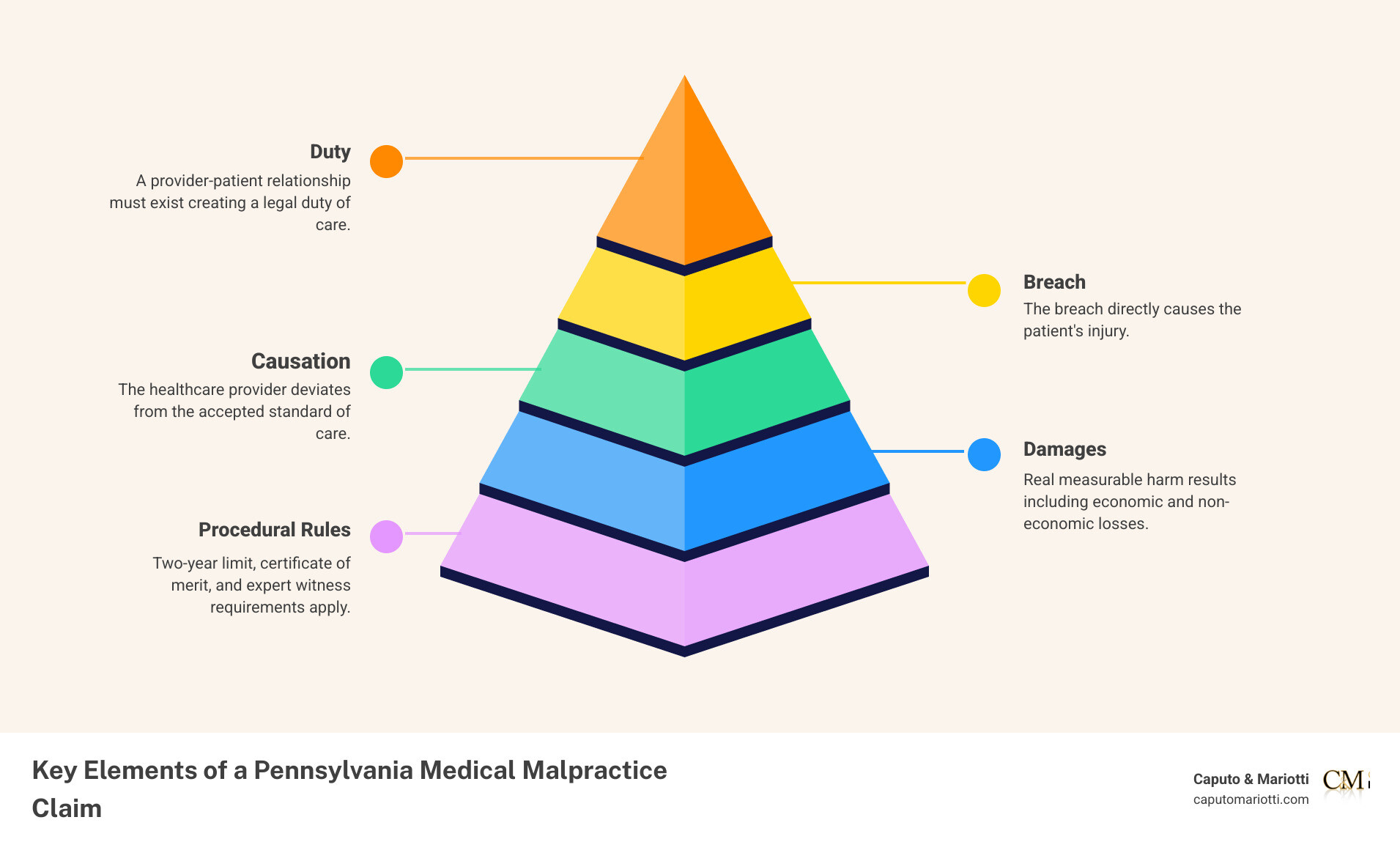
To have a valid claim, four things must be true:
- Duty — A provider-patient relationship existed
- Breach — The provider deviated from the accepted standard of care
- Causation — That deviation directly caused your injury
- Damages — You suffered real, measurable harm as a result
Not every bad medical outcome is malpractice. A poor result alone does not mean your doctor did something wrong. The law asks a specific question: would a reasonably competent provider in the same specialty have acted differently under the same circumstances?
Pennsylvania adds extra procedural rules on top of these four elements — including a two-year statute of limitations, a mandatory certificate of merit, and strict expert witness requirements — that make these cases far more complex than a typical personal injury claim.
If you or a loved one in Northeastern Pennsylvania has been seriously harmed by a healthcare provider, understanding these rules is the first step toward protecting your rights.
I’m Chris Caputo, a Pennsylvania personal injury attorney admitted to practice since 1994, with decades of litigation experience handling complex negligence and injury claims — including cases where patients have suffered serious harm due to what is medical malpractice in Pennsylvania and how the law responds to it. Early in my career, I also represented hospitals and medical professionals in malpractice defense, giving me a deep, inside understanding of how these cases are fought — and won.
Understanding What is Medical Malpractice Pennsylvania Law
When we talk about what is medical malpractice pennsylvania law, we have to look at the Medical Care Availability and Reduction of Error (MCARE) Act. This state law governs how malpractice claims are handled and sets the rules for everything from how much you can recover to who can testify as an expert.
In Pennsylvania, the legal standard for a doctor isn’t perfection; it’s “reasonableness.” We use a peer-comparison model. This means the court looks at what a reasonably competent doctor in the same field would have done in the same situation. If you were treated by a cardiologist in Scranton, the law compares their actions to what other competent cardiologists would have done.
It is also important to note that Pennsylvania holds specialists to a higher standard than general practitioners. If a doctor holds themselves out as an expert in a specific field, the law expects them to possess the higher level of skill and knowledge common to that specialty.
If you are wondering if your specific situation fits the bill, you can learn more about What Qualifies as Medical Malpractice Under Pennsylvania Law? and take our guide on Did I Suffer Medical Malpractice? Here Is How to Identify It.
The Four Essential Elements of a Malpractice Claim
To win a case, we have to prove four specific things. Think of these as the four legs of a table—if one is missing, the whole case collapses.
1. Duty of Care
This is usually the easiest part to prove. If a doctor agreed to treat you and you agreed to be treated, a “provider-patient relationship” existed. This relationship creates a legal duty for the provider to treat you according to the accepted standard of care.
2. Breach of Duty
This is the heart of the matter. We must prove the provider “breached” their duty by doing something they shouldn’t have done (like operating on the wrong knee) or failing to do something they should have (like ordering a necessary biopsy). This is where we look at The Critical Elements of Medical Negligence Lawsuits to see exactly where the provider went off the rails.
3. Causation
This is often the hardest element to prove. We must show that the doctor’s mistake was the “proximate cause” of your injury. The defense will often argue that your injury was caused by a pre-existing condition or was an unavoidable complication of the procedure. In Pennsylvania, we sometimes use the “increased risk of harm” theory—arguing that the doctor’s negligence significantly increased the risk that you would suffer the harm you ultimately did.
4. Actual Damages
You must have suffered actual harm. A “near miss” where a doctor almost gave you the wrong medicine but caught it in time isn’t malpractice because there were no damages. Damages can be physical, emotional, or financial.
Building a winning strategy requires Making Your Case: The Medical Negligence Claim Process Explained so that every piece of evidence is lined up to prove these four points.
Procedural Requirements: Statute of Limitations and Certificates of Merit
Pennsylvania has some of the strictest procedural rules in the country. If you miss a deadline or forget a specific document, the court could throw your case out before it even starts.
The Two-Year Deadline
Generally, you have two years from the date of the injury to file a lawsuit. This is known as the Statute of Limitations. However, Pennsylvania also uses the “Discovery Rule.” If you couldn’t have reasonably known you were injured right away (for example, if a surgeon left a sponge inside you and it didn’t cause symptoms for three years), the two-year clock might not start until you discover the injury.
The Certificate of Merit
Within 60 days of filing your lawsuit, Pennsylvania law requires us to file a “Certificate of Merit” in accordance with the Pennsylvania Rules of Civil Procedure. This is a document signed by an attorney stating that a qualified medical expert has reviewed your records and believes there is a “reasonable probability” that the care you received fell below professional standards. Without this, your case will be dismissed.

For a deeper dive into these technical hurdles, check out The Patient’s Guide to Filing a Medical Malpractice Lawsuit.
Recoverable Damages and Compensation Limits
If we prove your case, what kind of compensation can you expect? In Pennsylvania, we break damages down into three categories.
Compensatory Damages
These are designed to “make you whole” again.
- Economic Damages: These are the measurable financial losses. This includes medical bills (past and future), lost wages, and the cost of household help or physical therapy.
- Non-Economic Damages: These are for things that don’t have a price tag, like pain and suffering, emotional distress, and loss of enjoyment of life. Unlike many other states, Pennsylvania has no cap on compensatory damages.
Punitive Damages
These are rare and are only awarded if the provider’s conduct was “willful, wanton, or recklessly indifferent.” Punitive damages are capped at two times the amount of your compensatory damages. Interestingly, under the MCARE Act, 75% of punitive damages are paid into the state’s MCARE Fund, while the plaintiff receives the remaining 25%.
| Damage Type | Description | PA Limit/Cap |
|---|---|---|
| Economic | Bills, wages, future care | No Cap |
| Non-Economic | Pain, suffering, distress | No Cap |
| Punitive | Punishment for gross negligence | 2x Compensatory |
Navigating these financial complexities is why having Medical Malpractice in Pennsylvania: Your Attorney Lifeline is so vital to ensuring you get the full value of your claim.
Frequently Asked Questions

What is Medical Malpractice Pennsylvania Expert Witness Requirements?
In Pennsylvania, you almost always need an expert witness. Under the MCARE Act, an expert must generally be a licensed physician who is board-certified in the same or a similar specialty as the defendant. They must also spend a significant amount of their professional time in active clinical practice or teaching. We can’t just hire any doctor; we need someone who understands the exact nuances of the procedure or diagnosis in question.
What is Medical Malpractice Pennsylvania Discovery Rule?
The discovery rule is a “tolling” mechanism. It pauses the two-year statute of limitations clock until the moment the patient knows—or reasonably should have known—that they were injured and that the injury was caused by someone else’s conduct. This is crucial in cases of Misdiagnosis in Healthcare: What You Need to Know and How to Protect Your Rights, where the error might not be apparent for months or years.
What are common examples of medical malpractice in Pennsylvania?
We see a wide variety of cases in the Scranton and Wilkes-Barre areas. Some of the most common include:
- Surgical Errors: Operating on the wrong site or leaving foreign objects behind.
- Misdiagnosis: Failing to recognize signs of a heart attack or cancer.
- Birth Injuries: Failing to perform a timely C-section, leading to cerebral palsy.
- Medication Mistakes: Administering the wrong dose or a drug the patient is allergic to.
You can read more about these in our guide to 5 Common Types of Medical Malpractice in Scranton, PA and How a Lawyer Can Help.
Comprehensive Legal Support: Workers’ Compensation and Personal Injury
While we are experts in medical negligence, our team at Caputo & Mariotti also provides extensive support for those injured on the job. If you’ve been hurt at work, you may need a workers’ compensation lawyer to navigate Pennsylvania’s complex no-fault system.
Unlike a malpractice claim, you don’t have to prove your employer was “negligent” to get workers’ comp benefits. We help our clients through every step of the process:
- Reporting: Pennsylvania law has strict reporting requirements—usually, you must notify your employer within 21 to 120 days of the injury to protect your right to benefits.
- Medical Treatment: We help you navigate the list of “authorized” providers your employer may require you to see for the first 90 days of your claim.
- Evidence Gathering: Our team assists in collecting witness statements, surveillance footage, and medical records to prove the injury occurred within the “scope of employment.”
- The Filing Process: We ensure all formal petitions and documentation are filed correctly with the Bureau of Workers’ Compensation to avoid delays or denials.
- Appeals: If your claim is denied, we represent you in front of a Workers’ Compensation Judge to secure the benefits you deserve.
Whether it is a doctor’s mistake or a warehouse accident, our goal remains the same: getting you the resources you need to recover.
Conclusion
At Caputo & Mariotti, we have seen the devastating impact medical errors have on families in Scranton, Wilkes-Barre, and throughout Northeastern Pennsylvania. With over 55 years of combined experience, our team knows the “ins and outs” of what is medical malpractice pennsylvania law. We have been on both sides of the aisle, and we use that knowledge to provide unwavering advocacy for our clients.
If you believe you have been a victim of medical negligence, don’t wait. The clock is ticking, and the procedural requirements are too complex to handle alone. Contact our medical malpractice team today for a free consultation. We are here to listen to your story, evaluate your records, and help you fight for the justice you deserve.