

The dedicated legal team of Caputo & Mariotti
Medical Treatment Denied: Your Path to Justice
March 2, 2026
Denied Medical Treatment: Grounds for a Medical Malpractice Lawsuit
When a doctor, hospital, or health insurance company wrongfully denies medical treatment, the consequences can be devastating. If this denial of care leads to injury or a worsened condition, it may be grounds for a medical malpractice or personal injury lawsuit. Understanding when a denial of treatment becomes a legal liability is the first step toward seeking justice.
If you were harmed after being denied medical treatment, you may have a case if:
- An Emergency Room Denied Care: Federal law (EMTALA) requires hospitals to provide stabilizing treatment in emergencies. A violation that causes harm can be the basis for a lawsuit.
- A Doctor Wrongfully Refused Treatment: While doctors can sometimes refuse new patients, abandoning an existing patient or wrongfully denying care that leads to injury can constitute medical malpractice.
- An Insurer’s Denial Caused Harm: If an insurance company’s wrongful denial of a claim leads to a delay in care and subsequent injury, you may have a bad faith or personal injury claim.
Countless patients face improper denials of care every year. Whether it’s an emergency room refusing to stabilize you, a doctor abandoning an existing patient, or an insurer wrongfully denying coverage for necessary treatment, these situations can be life-threatening. When treatment is denied or delayed, the consequences can be severe, leading to worsened conditions or even death.
Holding negligent providers accountable through a lawsuit can help you get the justice you deserve.
I’m Chris Caputo. Since 2007, I’ve fought for people harmed by medical negligence, including cases of denied medical treatment and insurance bad faith. My firm has helped hundreds of clients secure millions in compensation, and we are here to help you understand your options and fight for the justice you deserve.
EMTALA Violations: Suing a Hospital for Denying Emergency Care
In a medical emergency, you shouldn’t have to worry about being turned away from a hospital. In the past, a practice known as “patient dumping”—where hospitals refused to treat patients who couldn’t pay—led to tragic outcomes. This prompted federal intervention.
To combat this, Congress enacted the Emergency Medical Treatment and Active Labor Act (EMTALA). This 1986 federal law ensures that nearly all hospitals receiving Medicare funds cannot turn away patients with medical emergencies, regardless of their insurance status or ability to pay. EMTALA was designed to prevent hospitals from “dumping” patients with emergency medical conditions or patients in active labor.
If you or a loved one has suffered harm because a hospital in Pennsylvania or our other service areas violated EMTALA, it could form the basis of a personal injury or medical malpractice claim. Our team at Caputo & Mariotti is here to help you understand your rights. Learn how a Personal Injury Attorney in Scranton, PA: Trusted Legal Support After an Accident can assist you.
How EMTALA Violations Lead to Lawsuits
EMTALA imposes specific legal duties on hospitals. A failure to meet these duties that results in harm can be grounds for a lawsuit:
- Appropriate Medical Screening Exam: The hospital must provide a medical screening exam to determine if an emergency medical condition exists. This exam must be sufficient to identify a true emergency and cannot be delayed to ask about your insurance or ability to pay.
- Stabilizing Treatment: If an emergency medical condition is found, the hospital must provide treatment to stabilize your condition, ensuring it is unlikely to get materially worse. For a patient in active labor, this means delivering the baby or ensuring a safe transfer.
- Appropriate Transfer: If the hospital lacks the facilities to stabilize you, they must arrange an appropriate transfer to another facility that can. This means the receiving facility has agreed to accept you and the transfer is carried out safely with qualified personnel and equipment.
If a hospital fails to meet these obligations and a patient is harmed, they can be held liable for violating federal law. This failure to provide care can be a key component of a medical malpractice lawsuit for denied medical treatment.
What Constitutes an ‘Emergency Medical Condition’?
Under EMTALA, an “emergency medical condition” is defined broadly as a condition with acute symptoms so severe (including severe pain) that the absence of immediate medical attention could reasonably be expected to result in:
- Placing the health of the individual (or a pregnant patient and their unborn child) in serious jeopardy.
- Serious impairment to bodily functions.
- Serious dysfunction of any bodily organ or part.
This broad definition covers a wide range of critical health issues. For example, a patient with severe chest pain, acute psychiatric symptoms, or substance abuse withdrawal could all qualify if their condition places their health in serious jeopardy.
When a Doctor’s Refusal to Treat Becomes Medical Malpractice
While EMTALA provides crucial protections in emergencies, the rules for filing a lawsuit differ in non-emergency settings. It’s important to understand these distinctions, as they determine whether a denied medical treatment constitutes medical negligence.

Generally, a private doctor’s office has more leeway to refuse treatment than an emergency room because the doctor-patient relationship is typically voluntary. However, legal and ethical boundaries still apply. If a refusal of care leads to harm, it could be medical malpractice. If you believe you’ve been harmed, learn if you Did I Suffer Medical Malpractice? Here is How to Identify It.
When a Refusal May Be Grounds for a Lawsuit
In non-emergency contexts, a doctor-patient relationship creates a duty of care. While a doctor can refuse a new patient or end a relationship under specific circumstances, they cannot simply abandon a patient. A refusal to provide care may be considered medical malpractice if:
- It Constitutes Patient Abandonment: A doctor with an existing relationship with a patient cannot terminate care without providing reasonable notice and helping the patient find alternative care, especially if the patient requires ongoing treatment.
- It Breaches the Standard of Care: If a doctor refuses to provide a medically necessary treatment that a reasonably skilled doctor would have provided, and this refusal causes harm, it can be grounds for a lawsuit.
- It Is Based on Illegal Discrimination: Refusing treatment based on protected characteristics is illegal and can be the basis for legal action.
Conversely, a doctor can generally refuse treatment if it falls outside their expertise (and they provide a proper referral), if a patient is disruptive, or if the patient requests treatment that is not medically necessary. Understanding these distinctions is key to determining if you have a valid malpractice claim.
Steps to Take to Build Your Denied Medical Treatment Lawsuit
Being denied medical treatment can be a frightening and frustrating experience, especially when you believe the denial is wrongful and has led to further harm. Whether it’s a doctor refusing necessary care or an insurance company denying a claim, taking the right steps is crucial to protecting your health and preparing a potential legal claim.

When you’re facing a wrongful denial, prompt action can make a significant difference in the outcome of a future lawsuit. It’s important to gather documentation and understand the avenues for appeal. If you’re dealing with the aftermath of an injury and a subsequent treatment denial, our firm can help you steer the complexities of insurance claims. Learn more about Navigating Insurance Claims After an Injury: A Guide to Dealing with Insurance Companies.
How to Prepare Your Legal Claim
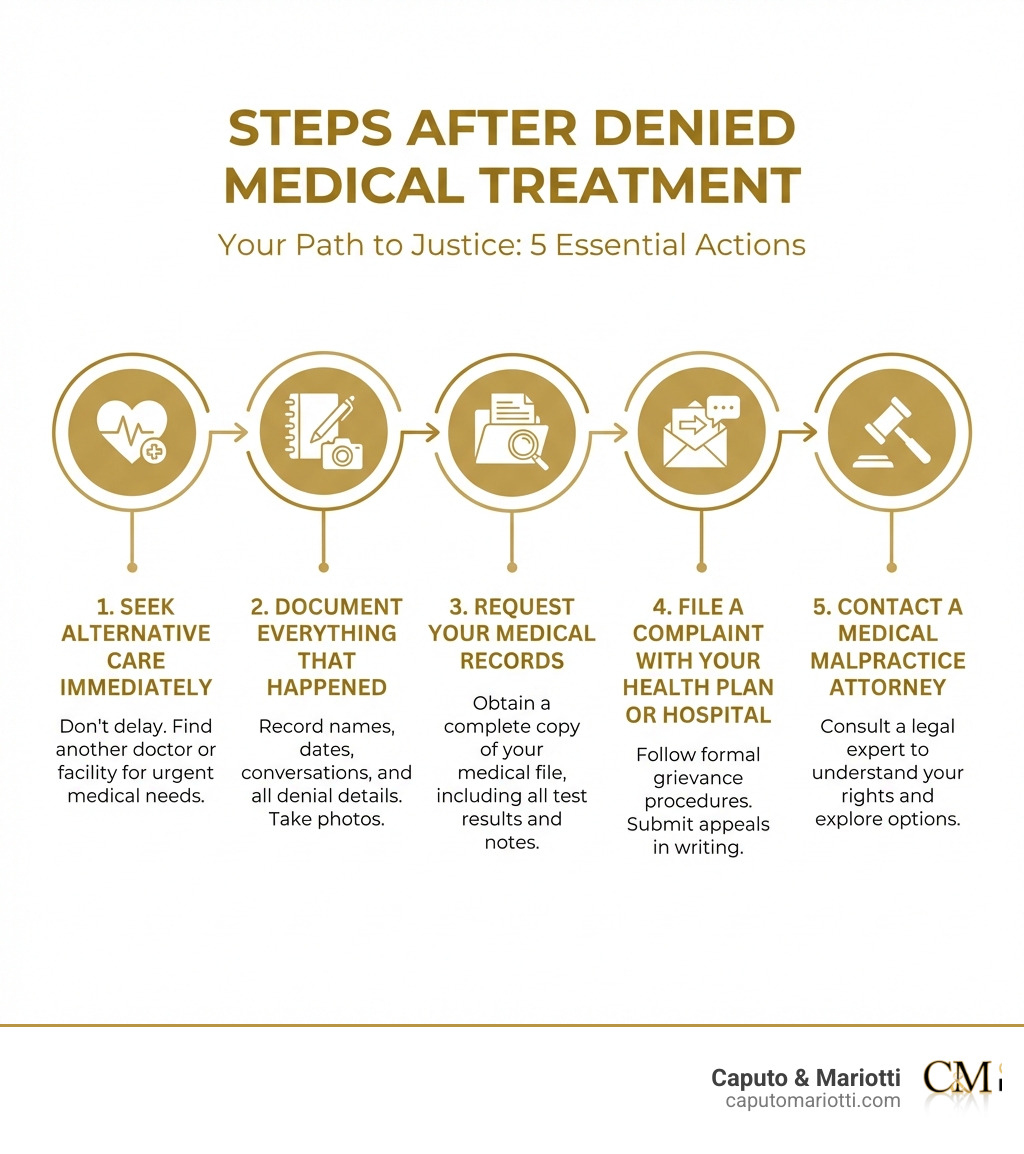
If you believe you have been wrongfully denied medical treatment, here are the immediate steps you should take to build your case:
- Seek Alternative Care Immediately: Your health is the top priority. From a legal perspective, seeking alternative care also helps establish that the denied treatment was necessary and documents the timeline of your injury and damages.
- Document Everything: Keep a detailed record of all interactions related to the denial. This includes dates, times, names of individuals you spoke with, what was said, and any reasons given for the denial. This documentation is critical evidence for a lawsuit.
- Request Your Medical Records: Obtain copies of all your medical records related to the denied treatment. This includes physician’s notes, test results, consultation reports, and any hospital records. These documents will be vital for any legal action.
- File an Official Complaint:
- For Hospital Denials (especially emergency rooms): If you believe your EMTALA rights were violated, you can file a complaint with the Centers for Medicare & Medicaid Services (CMS).
- For Doctor’s Office Denials: You can report the doctor to the state medical board in Pennsylvania.
- For Insurance Denials: Follow the appeals process outlined below.
- Contact a Personal Injury or Medical Malpractice Lawyer: If the denial of treatment resulted in injury, worsened your condition, or caused other damages, consulting with an experienced attorney is critical. We can evaluate your case, help you understand your legal options, and guide you through the process of seeking justice. Don’t hesitate to Contact a Scranton personal injury lawyer for a consultation.
Insurance Denial vs. Treatment Denial
It’s important to distinguish between a denial of payment by your health insurance company and a direct denial of care by a medical provider. While both can prevent you from receiving necessary treatment, they can lead to different types of lawsuits.
- Denial of Payment (Insurance Denial): This occurs when your health plan refuses to cover the cost of a medical service. If this denial was made in bad faith and caused you harm, you may have a claim against the insurer.
- Internal Appeal: Your first step is to file an internal appeal directly with your insurance company, which they are legally required to process.
- External Review: If the internal appeal fails, you can request an external review. An independent third party will review your case, and their decision is legally binding on the insurer.
- Denial of Care (Treatment Denial): This happens when a doctor or hospital refuses to provide medical services directly. As discussed, this can be illegal in emergency situations (EMTALA violations) or if it constitutes abandonment of an existing patient, potentially leading to a medical malpractice lawsuit.
The harm caused by delay, whether from an insurance denial or a direct treatment denial, can be severe. Delays can lead to a worsening of your condition, permanent injury, or even death. In such cases, you may have grounds for a personal injury or medical malpractice lawsuit. We stand ready to protect your rights versus insurance companies and negligent providers.
How a Lawyer Can Help with Your Denied Medical Treatment Claim
When you’ve been wrongfully denied medical treatment and suffered harm as a result, the legal process can seem daunting. This is where an experienced medical malpractice or personal injury attorney becomes an invaluable ally. Our firm, Caputo & Mariotti, specializes in advocating for victims of medical negligence across Northeastern Pennsylvania, including Scranton, Wilkes-Barre, Hazleton, Pittston, and Dickson City. We understand the complexities of these cases and are committed to helping you seek justice.
A medical malpractice lawyer can assess your situation, investigate the circumstances of your denied treatment, and determine if you have a viable claim. We can help you steer the legal system, gather crucial evidence, and fight for the compensation you deserve. To understand the types of cases we handle, visit Medical Malpractice Lawyers in Scranton, PA: What You Need to Know.
Proving Malpractice in a Denied Medical Treatment Case
To succeed in a medical malpractice lawsuit stemming from denied medical treatment, we must prove four key elements of negligence:
- Duty of Care: We must establish that the healthcare provider (doctor, hospital, or other medical professional) owed you a duty of care. This duty arises once a doctor-patient relationship is established, or when you present to an emergency room with an emergency medical condition.
- Breach of Duty: Next, we must demonstrate that the provider breached this duty of care. This means showing that the provider’s refusal to treat you fell below the accepted standard of care for medical professionals in similar circumstances. For instance, an EMTALA violation would constitute a breach.
- Causation: It’s not enough to show that a duty was breached; we must also prove that this breach directly caused your injuries or a worsening of your condition. This involves demonstrating a direct link between the denial of treatment and the harm you suffered.
- Damages: Finally, we must prove that you suffered actual damages as a result of the negligence. These can include medical expenses (past and future), lost wages, pain and suffering, emotional distress, and other losses.
Proving these elements requires a thorough investigation, often involving expert medical testimony to establish the standard of care and how it was violated. Our firm has experience in building strong cases for our clients. For more detailed information, see The Critical Elements of Medical Negligence Lawsuits.
Why You Need an Experienced Attorney
Navigating a denied medical treatment case is complex. Hospitals and insurance companies have vast resources to defend against claims. You need a formidable advocate on your side. Here’s how an experienced attorney from Caputo & Mariotti can help:
- Case Evaluation: We will review your records and the details of the denial to assess the strength of your case.
- Expert Witnesses: We work with a network of medical experts to establish the standard of care and prove it was violated.
- Negotiation with Insurers: We handle all communications and negotiations with the at-fault parties to secure a fair settlement.
- Litigation Experience: If a settlement isn’t possible, our experienced trial lawyers are prepared to fight for you in court.
Choosing the right legal representation can significantly impact the outcome of your case. We invite you to learn more about How to Choose the Right Personal Injury Lawyer in Scranton and find strategies for Maximizing Your Personal Injury Compensation in Scranton.
Frequently Asked Questions about Denied Treatment Lawsuits
Can I sue a hospital for refusing to treat me?
Yes, if the refusal occurred in an emergency, violated EMTALA, or was an act of medical negligence that caused you harm, you may have grounds for a lawsuit. A medical malpractice attorney can evaluate your case to determine if the hospital’s actions fell below the accepted standard of care and led to your injuries. We can help you understand your legal options in Pennsylvania.
What is the difference between a doctor refusing a new patient and denying treatment?
A doctor in private practice can generally choose not to accept new patients, for reasons such as not accepting their insurance, not specializing in their condition, or simply not taking new clients. Denying treatment, however, typically refers to refusing necessary care to an existing patient or anyone in an emergency. This can lead to legal liability if it constitutes abandonment of an existing patient or a violation of federal laws like EMTALA, and if it causes harm or worsens a patient’s condition.
How much does it cost to hire a lawyer for a denied treatment case?
Most personal injury and medical malpractice lawyers, including our team at Caputo & Mariotti, work on a contingency fee basis. This means you pay nothing upfront for our legal services. Our fee is a percentage of the final settlement or award we secure for you. If we don’t win your case, you don’t pay us. This arrangement allows you to pursue justice without financial risk. Learn more about the importance of contingent fees and how they can benefit you.
Caputo & Mariotti: Your Advocates for Justice
If you or a loved one has suffered due to denied medical treatment, you don’t have to fight alone. The experienced attorneys at Caputo & Mariotti are dedicated to protecting patient rights and securing the compensation you deserve. With a deep understanding of medical malpractice law in Pennsylvania, we are prepared to be your strongest advocates. Our offices serve clients across Northeastern Pennsylvania, including Scranton, Wilkes-Barre, Hazleton, Pittston, and Dickson City. Contact us today for a free, no-obligation consultation to discuss your case.