

The dedicated legal team of Caputo & Mariotti
Detailed Guide to Estimating Your Personal Injury Case Value
October 23, 2026
Start With the Losses You Can Prove
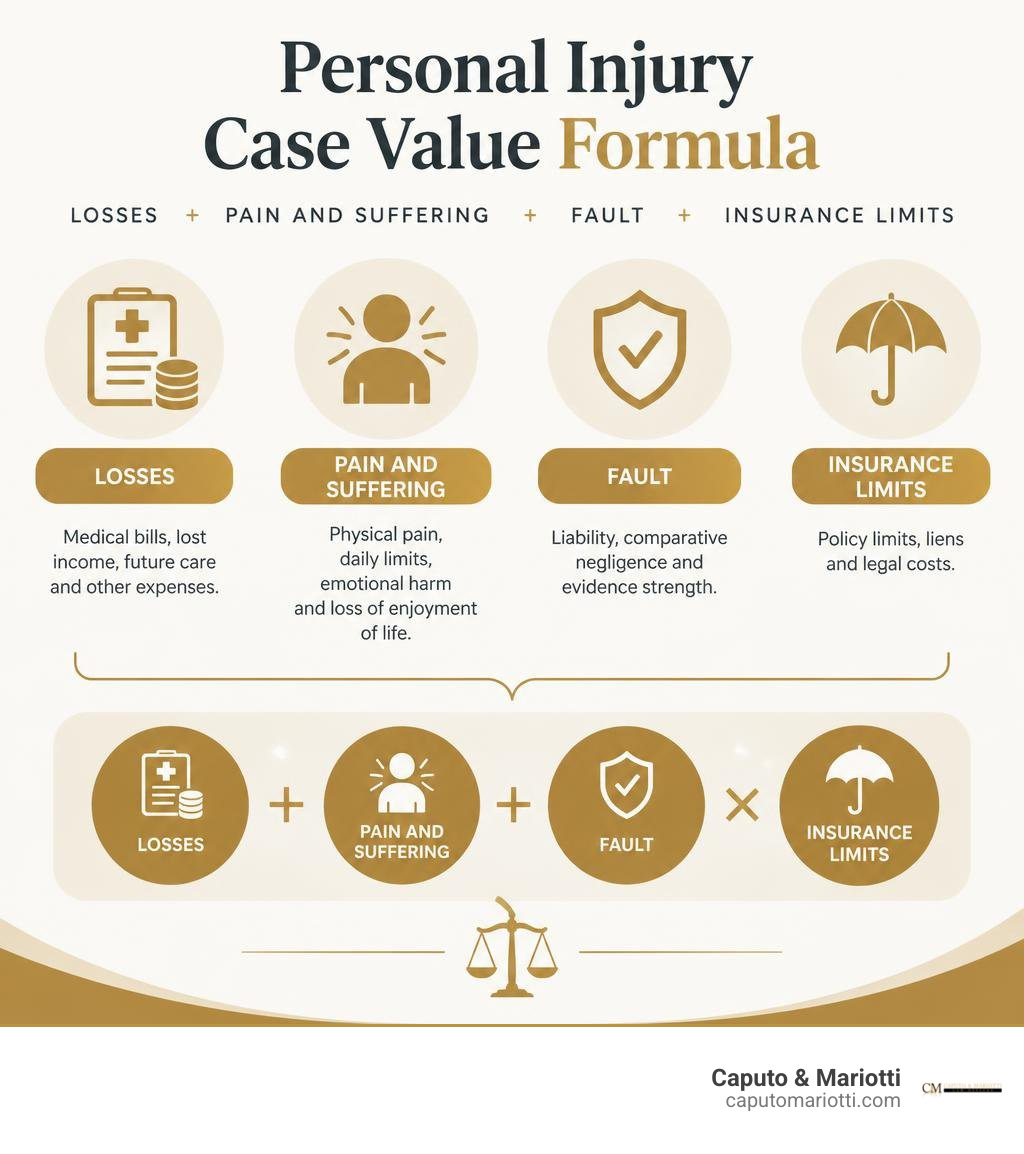
How much is my personal injury case worth? Start by adding your medical bills, lost income, future treatment needs, and other out-of-pocket costs. Then account for pain and suffering, the strength of the evidence, your share of fault, and the insurance coverage available. There is no fixed payout chart, but this approach gives you a useful starting range.
A simple estimate looks like this:
- Add economic damages: medical care, missed work, future care, and related expenses.
- Estimate non-economic damages: physical pain, daily limits, emotional harm, and loss of enjoyment of life.
- Adjust for key limits: disputed liability, comparative negligence, policy limits, liens, and legal costs.
National settlement averages can be misleading. A mean can be pushed up by a few very large verdicts, while a median often better reflects a typical case. Your medical records, diagnosis, recovery time, ability to work, and evidence showing who caused the injury matter far more than a generic online number.
I am Chris Caputo, a Pennsylvania personal injury attorney who has represented injured people and families in serious injury and wrongful death cases since 2007. With decades of courtroom and litigation experience, I help clients answer the practical question, how much is my personal injury case worth, based on the facts and proof in their own case.
To better understand your legal options, explore our guides on how to file a personal injury claim in Pennsylvania, the fundamentals of personal injury law, and what to do after a personal injury accident.
How Much Is My Personal Injury Case Worth? Understanding Core Valuation Factors
When evaluating an injury claim in Lackawanna County, Luzerne County, or anywhere in Northeastern Pennsylvania, we look at several core legal and financial elements. A claim is not valued solely on the pain you feel; it is valued on what can be proven with credible evidence.
The foundational pillars of claim valuation include:
- Liability Strength: Can you prove the defendant acted negligently? When fault is clear, settlement negotiations start from a position of strength.
- Available Insurance Coverage: No matter the severity of your injuries, insurance policy limits often create an initial cap on what an insurer will pay without pursuing personal assets.
- Injury Severity and Permanence: Objective medical evidence—like MRI scans, surgical reports, and physician prognosis notes—carries significantly more weight than self-reported symptoms.
- Quality of Documentation: Thorough records detailing every medical visit, lost wage statement, and physical limitation directly prevent insurance adjusters from minimizing your recovery.
Calculating Economic Damages: How Much Is My Personal Injury Case Worth in Tangible Losses?
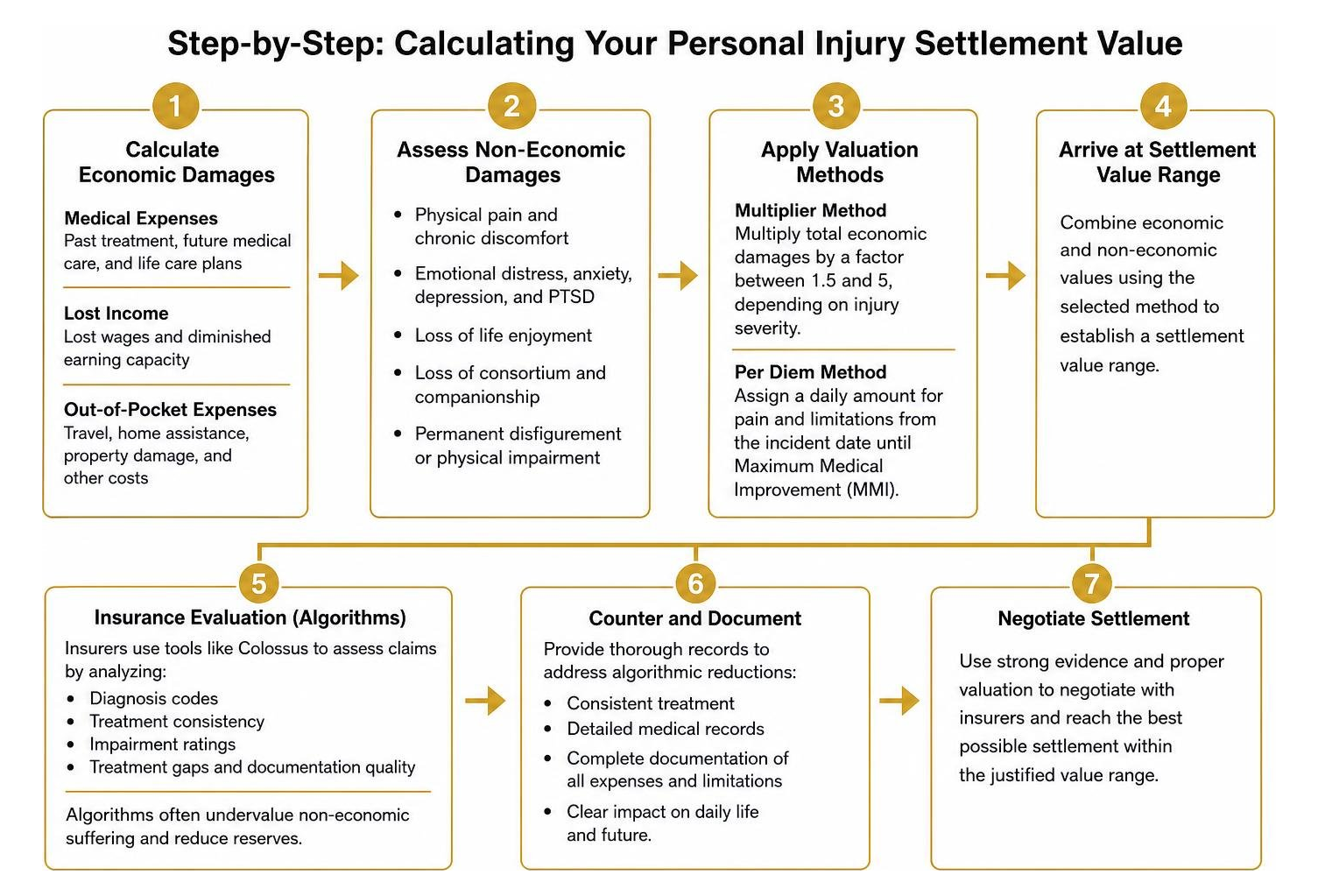
Economic damages represent direct financial losses resulting from an accident. Because these losses come with receipts, bills, and paystubs, they serve as the baseline of any injury claim.
Tangible losses generally encompass:
- Past Medical Expenses: Ambulance transport, emergency room treatment, surgery, physical therapy, diagnostic imaging, and prescription medications.
- Future Medical Care: Anticipated surgeries, ongoing physical therapy, durable medical equipment, and home modifications, often calculated through a comprehensive life care plan.
- Lost Wages and Diminished Earning Capacity: Income lost while recovering, alongside reductions in your long-term ability to earn a living due to permanent physical restrictions.
- Out-of-Pocket Expenses: Travel costs for medical appointments, home assistance services, and property damage.
To build a compelling claim, meticulous record-keeping is critical. Following the ultimate guide to documenting injuries after an accident ensures that every dollar spent on recovery is properly accounted for.
Pain and Suffering Multipliers: How Much Is My Personal Injury Case Worth Beyond Medical Bills?
Non-economic damages compensate you for the human cost of an accident. Unlike medical bills, these harms do not come with an invoice. Instead, they reflect how an injury has altered your daily life.
Key elements of non-economic damages include:
- Physical pain and chronic discomfort
- Emotional distress, anxiety, depression, and post-traumatic stress
- Loss of life enjoyment, including the inability to participate in hobbies or family activities
- Loss of consortium and companionship
- Permanent disfigurement or physical impairment
A thorough understanding of these intangible harms is essential; exploring understanding compensation in personal injury cases provides deeper insight into how courts and insurers assess non-economic losses.
Methods for Calculating Personal Injury Settlement Value
Attorneys and insurers rely on specific frameworks to translate physical injuries and emotional suffering into a dollar figure. While online settlement calculators can provide helpful orientation ranges, understanding the underlying math is critical.
The Multiplier Method vs. Per Diem Calculation
Two standard calculation methods are widely used in personal injury practice:
- The Multiplier Method: This approach multiplies total economic damages (primarily medical bills) by a factor between 1.5 and 5, depending on the severity of the injury. Minor soft-tissue strains typically use a multiplier between 1.5 and 2, moderate injuries requiring surgery or prolonged physical therapy warrant a 2 to 3 multiplier, and severe, permanent, or catastrophic injuries justify multipliers of 4, 5, or higher.
- The Per Diem Method: This method assigns a specific dollar amount to each day you experience pain and limitations, from the date of the incident until you reach Maximum Medical Improvement (MMI). The daily rate often mirrors the victim’s daily wage.
How Insurance Adjusters and Colossus Software Evaluate Claims
Insurance companies do not evaluate claims purely out of goodwill. Major carriers utilize automated claims algorithms, such as Colossus, to determine settlement ranges. These programs scan medical records for specific diagnosis codes, treatment consistency, and impairment ratings while systematically attempting to undervalue non-economic suffering.
If there are treatment gaps, delayed medical visits, or vague physician notes, the algorithm lowers the settlement reserve. Understanding how insurance companies calculate injury settlements allows us to anticipate these algorithmic reductions and submit evidence structured to counter automated lowball offers.
Average Settlement Amounts by Injury Type and Case Category
Settlement values vary widely based on the underlying category of the incident and the severity of the sustained harm. Across the United States, the overall median settlement is approximately $48,855, with mean averages hovering around $445,408 due to multi-million-dollar catastrophic outcomes.
| Injury Severity Tier | Typical Multiplier | Settlement Range Benchmark | Key Injury Examples |
|---|---|---|---|
| Minor | 1.5x – 2.0x | $3,000 – $25,000 | Whiplash, minor sprains, contusions |
| Moderate | 2.0x – 3.5x | $25,000 – $100,000 | Herniated discs, non-surgical fractures, concussions |
| Severe | 3.5x – 5.0x | $100,000 – $500,000 | Multiple complex fractures, spinal fusions, moderate TBI |
| Catastrophic | 5.0x – 10.0x+ | $500,000 – $25,000,000+ | Spinal cord paralysis, severe TBI, amputations, wrongful death |
Motor Vehicle, Truck, and Motorcycle Accidents
Motor vehicle collisions represent a large share of injury claims in Scranton, Wilkes-Barre, and across Interstate 81 and the Pennsylvania Turnpike.
- Car Accidents: Car accident settlements feature an average mean of $212,325, with a median around $25,000. Minor soft-tissue or whiplash claims settle for less, while surgical disc injuries command higher payouts.
- Commercial Truck Accidents: Due to the severe physical impact and extensive commercial insurance policies, truck collision settlements average $817,425, with a median of $137,500.
- Motorcycle Crashes: Because riders lack structural protection, motorcycle accidents frequently result in severe orthopedic injuries and road rash, averaging $545,165 with a median of $115,000.
Reviewing what damages you can claim in car and truck accident lawsuits highlights the various vehicular recovery avenues available under Pennsylvania law.
Slip and Fall, Workplace, and Medical Malpractice Claims
- Slip and Fall (Premises Liability): Property owners must keep walkways safe. Slip and fall claims carry an average settlement of $250,872, with a median around $60,000.
- Workplace Injuries and Third-Party Claims: Pennsylvania’s workers’ compensation system operates on a no-fault framework, providing medical expense coverage and partial wage-loss benefits without requiring proof of employer negligence. Employees must report injuries to their employer within 21 days (and no later than 120 days) to preserve their rights. Injured workers must treat with employer-designated panel physicians for the initial 90 days. Gathering evidence—such as incident reports, witness statements, and complete medical records—is vital for filing a formal claim petition or navigating appeals before a Workers’ Compensation Judge. When an injury involves equipment failure, discovering how much your forklift injury compensation claim is worth demonstrates how third-party negligence lawsuits can proceed alongside workers’ compensation claims. If you encounter claim denials or dispute hearings, partnering with a dedicated workers’ compensation lawyer helps protect your benefits.
- Medical Malpractice Claims: Claims involving diagnostic errors, surgical mistakes, or birth injuries require extensive expert testimony and frequently yield substantial recoveries due to lifelong disability.
Severe Spinal Cord Injuries and Traumatic Brain Injuries
Catastrophic claims require specialized economic analysis:
- Traumatic Brain Injuries (TBI): Mild concussions may resolve in months, but moderate to severe TBIs average $1,561,066, with a median settlement of $350,000.
- Spinal Cord Injuries: Injuries involving paraplegia or quadriplegia consistently demand settlements ranging from $1 million to over $25 million to fund decades of specialized round-the-clock medical care.
Claimants can also consult tools like the Personal Injury Settlement Calculator 2026 — Estimate Your Case Value to examine how permanent impairments elevate case ranges.
Key Variables That Impact Settlement Payouts and Net Recovery
Gross settlement figures do not equal what you take home. Multiple legal rules and statutory obligations influence your ultimate recovery.

Pennsylvania Comparative Negligence and Policy Limits
Under Pennsylvania’s modified comparative fault rule (42 Pa.C.S. § 7102), an injured party can recover damages only if their share of negligence does not exceed 51%. If you are determined to be 20% responsible for a motor vehicle collision, your overall recovery is reduced by 20%. If your fault is found to be 51% or higher, recovery is barred completely.
Furthermore, settlements are practical matters tied to insurance coverage. If a negligent driver carries only the state-mandated minimum auto liability policy ($15,000 per person), recovering more requires personal asset attachment or tapping into your own Underinsured Motorist (UIM) coverage. Implementing proven steps for maximizing compensation in a Northeastern PA personal injury case ensures every available insurance layer is identified.
Medical Liens, Legal Fees, and Your Final Take-Home Amount
Personal injury attorneys typically work on a contingency fee agreement, meaning legal fees (usually 33.3% to 40% depending on whether the case resolves through pre-trial negotiation or courtroom litigation) are deducted directly from the gross recovery.
Before funds are disbursed, statutory and contractual liens must be satisfied:
- Health insurance subrogation claims (private insurers, Medicare, Medicaid)
- Outstanding hospital or provider balances
- Workers’ compensation subrogation liens
Injury victims typically keep between 60% and 70% of their gross settlement after fees, expenses, and negotiated liens. Skilled legal counsel works directly with lienholders to negotiate reductions on medical claims, ensuring that the injured individual retains the highest possible portion of their settlement.
Frequently Asked Questions About Personal Injury Case Value
Should I accept the first settlement offer from an insurance company?
Generally, no. Initial settlement offers from insurance companies are nearly always below fair value. Insurers extend quick settlements before the full extent of your injuries is known, hoping you will release all legal claims before discovering ongoing medical needs. Reviewing the dos and donts after a personal injury will help protect your claim during early communications.
How long does it take to settle a personal injury claim?
Settling an injury case typically takes anywhere from 3 to 18 months. Straightforward claims with clear liability and resolved medical treatment may conclude in 3 to 6 months. Complex cases involving severe injuries, surgical recovery, disputed liability, or trial proceedings can take 1 to 3 years. We never recommend settling until you have reached Maximum Medical Improvement (MMI), ensuring all future medical needs are accounted for.
What is the statute of limitations for filing an injury lawsuit in Pennsylvania?
In Pennsylvania, the statute of limitations for personal injury and medical malpractice claims is generally two years from the date the injury occurred (42 Pa.C.S. § 5524). If you fail to file a lawsuit within this two-year statutory window, you permanently forfeit your right to recover compensation for your losses.
Conclusion: Securing Maximum Compensation for Your Injuries
Determining the true value of your personal injury case requires thorough evidence collection, accurate economic projections, and a detailed understanding of Pennsylvania negligence laws. At Caputo & Mariotti, we bring combined 55+ years of experience to every claim we handle throughout Scranton, Wilkes-Barre, Moosic, Pittston, Hazleton, Dickson City, and surrounding communities.
Studies show that represented claimants recover substantially more than unrepresented individuals navigating the insurance process alone. If you or a loved one has suffered an injury due to someone else’s negligence, our experienced personal injury attorneys are prepared to help. Contact us today to schedule a free consultation and let us evaluate your claim.