
The dedicated legal team of Caputo & Mariotti
How to Pursue Both Workers’ Comp and Third-Party Personal Injury Claims in PA
October 29, 2026
Workers’ Comp vs. a Personal Injury Lawsuit in Pennsylvania: Can You Pursue Both?
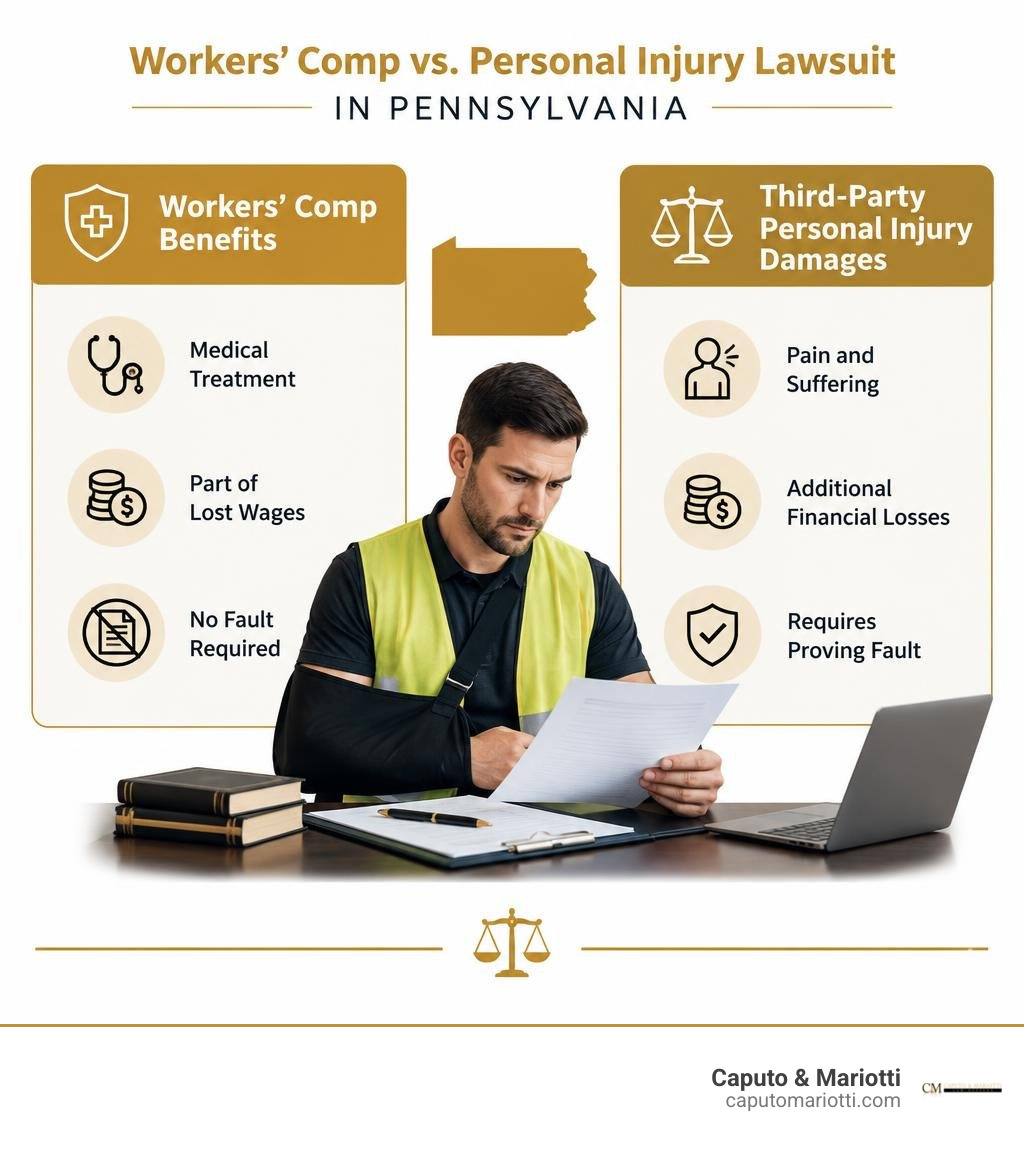
Yes, you may be able to pursue both claims after a workplace injury in Pennsylvania. Workers’ compensation can pay medical bills and part of your lost wages without requiring you to prove fault. If someone other than your employer caused the injury, a personal injury lawsuit may also let you seek damages that workers’ comp does not cover, including pain and suffering.
For example, a worker hurt by a negligent driver while on the job may have a workers’ comp claim and a lawsuit against the driver. The claims have different deadlines and can affect each other’s payouts, so it helps to identify any third party early.
I’m Chris Caputo, a Pennsylvania personal injury attorney who has litigated injury and insurance claims for decades. In this guide to workers’ comp versus a personal injury lawsuit in Pennsylvania, I’ll explain how the two paths work together and what to watch for before settling either claim.
Workers comp vs personal injury lawsuit pennsylvania terms made easy:
- can i be fired while on workers comp pennsylvania
- how long does workers comp last pennsylvania
- workers comp denied claim pennsylvania
Key Differences: Workers Comp vs Personal Injury Lawsuit Pennsylvania
When you suffer a serious injury on the job across Northeastern Pennsylvania—whether in Scranton, Wilkes-Barre, Hazleton, or Moosic—understanding your legal avenues is critical. Workers’ compensation and personal injury lawsuits are distinct legal pathways governed by separate statutory frameworks, procedural rules, and standards of recovery.
To understand the core differences between an administrative compensation claim and a traditional civil tort, review this straightforward comparison:
| Feature | Pennsylvania Workers’ Compensation | Personal Injury Lawsuit |
|---|---|---|
| Fault Requirement | No-fault system (negligence does not matter) | Fault-based (must prove defendant was negligent) |
| Who You Can Sue | Your employer / their insurance carrier | At-fault third parties (drivers, contractors, manufacturers) |
| Medical Expenses | 100% of reasonable and necessary medical care | Full compensation for past, ongoing, and future medical treatment |
| Lost Wages | Partial wage loss (typically about 66.6% up to state caps) | 100% of past lost income and loss of future earning capacity |
| Pain & Suffering | Not recoverable | Fully recoverable (physical pain, emotional distress, loss of life’s pleasures) |
| Punitive Damages | Never available | Available in cases of egregious, willful, or reckless conduct |
| Primary Forum | Bureau of Workers’ Compensation / Administrative Law Judges | Pennsylvania Courts of Common Pleas or Federal District Court |
While the workers’ compensation system ensures prompt financial relief for basic needs, a third-party claim addresses the full human cost of an accident. Consulting a qualified workers’ compensation lawyer allows injured employees to evaluate whether their circumstances qualify under the step-by-step guide to Pennsylvania workers’ comp injuries covered while simultaneously exploring civil remedies.
No-Fault Benefits vs. Fault-Based Negligence
The defining distinction between these two avenues lies in how liability is established. Under the Pennsylvania Workers’ Compensation Act, the administrative system operates entirely on a no-fault basis. You do not need to demonstrate that your employer acted carelessly, violated safety regulations, or failed to maintain a safe working environment. As long as your injury arose in the course and scope of your employment, you are entitled to statutory benefits. Even if your own accidental misstep contributed to the incident, your recovery remains secure, provided the harm was not intentionally self-inflicted or caused by illegal intoxication.
In contrast, civil personal injury actions in Pennsylvania are strictly fault-based. To prevail in the Court of Common Pleas in Lackawanna County or Luzerne County, an injured plaintiff bears the legal burden of proving four fundamental elements of negligence: duty, breach, causation, and actual damages. Furthermore, civil claims are subject to Pennsylvania’s comparative negligence statute (42 Pa.C.S. § 7102). If an injured plaintiff is partially responsible for the accident, their financial recovery is reduced in proportion to their percentage of fault. If the plaintiff is found to be more than 50% at fault, they are barred from any financial recovery whatsoever.
Recoverable Damages: Workers Comp vs Personal Injury Lawsuit Pennsylvania
The scope of recoverable compensation differs dramatically between an administrative claim and a personal injury lawsuit:
- Medical Treatment: Workers’ compensation covers all reasonable, necessary, and related medical expenses with no deductibles or copays, subject to the Pennsylvania statutory medical fee schedule. A personal injury lawsuit demands payment for all past and projected lifetime medical treatments without administrative fee-schedule caps.
- Wage Loss Benefits: Workers’ compensation pays total or partial disability benefits, typically calculated at roughly two-thirds of your average weekly wage up to statutory maximums. A civil lawsuit seeks full recovery of 100% of all gross lost wages, including bonuses, overtime, fringe benefits, and permanent reductions in earning capacity.
- Non-Economic Damages: Workers’ compensation provides zero compensation for pain, mental anguish, physical impairment, or loss of enjoyment of life. In stark contrast, learning about recoverable damages in a PA personal injury case shows that non-economic damages often constitute the most significant portion of a civil financial award.
- Punitive Damages: Never awarded in workers’ comp, punitive damages can be pursued in a personal injury action if the defendant exhibited gross negligence or reckless indifference.
Can You Sue Your Employer Outside of Pennsylvania Workers’ Compensation?
Many injured workers ask whether they can directly sue their employer for creating an unsafe work environment. Under Pennsylvania law, the baseline rule is that you cannot sue your direct employer in a civil lawsuit for workplace injuries.
Exclusive Remedy Rule and Statutory Protections
Section 303(a) of the Pennsylvania Workers’ Compensation Act establishes the “exclusive remedy” rule. This statutory provision acts as a legal compromise enacted more than a century ago: employees gain guaranteed, immediate no-fault benefits for on-the-job injuries, while employers receive complete immunity from common-law civil tort actions.
Because of this immunity, an employee cannot file a civil lawsuit against their employer or a co-worker for ordinary negligence, even if the employer failed to fix a known hazard or violated general workplace safety standards. The trade-off is clear: the worker receives guaranteed wage and medical support without having to prove fault, but gives up the right to sue the employer for non-economic damages like pain and suffering. For a detailed breakdown of these legal limits, read our analysis on suing an employer in addition to workers’ comp in PA.
Narrow Exceptions to Employer Immunity
While the exclusive remedy rule is robust, Pennsylvania courts recognize rare, highly specific exceptions where an employer’s statutory immunity is pierced:
- Intentional Torts and Physical Assault: If an employer or corporate officer intentionally harms an employee, the shield of immunity may not apply. However, the legal standard is exceptionally high; proving ordinary recklessness or gross negligence is insufficient.
- Fraudulent Concealment: If an employer deliberately conceals an occupational illness, toxic exposure, or severe workplace risk, aggravating the worker’s medical condition, civil tort liability may arise.
- Uninsured Employers: If an employer fails to maintain mandatory workers’ compensation insurance coverage, they forfeit their statutory immunity. The injured worker can collect benefits from the Pennsylvania Uninsured Employers Guaranty Fund (UEGF) and simultaneously file a direct civil lawsuit against the uninsured employer.
- Dual Capacity Doctrine: In rare circumstances where an employer acts in a completely separate legal capacity toward the employee—such as manufacturing a defective consumer product that injures the worker outside their standard duties—a narrow civil claim may be considered.
How Third-Party Personal Injury Claims Work Alongside Workers’ Comp
While your employer is generally shielded from direct litigation, third parties—unrelated individuals or separate corporate entities—enjoy no such statutory immunity. A third-party personal injury claim can be filed simultaneously alongside your ongoing workers’ comp claim whenever an outside party’s negligence caused or contributed to your injury.

Common Third-Party Workplace Accidents in PA
In many modern workplaces across Lackawanna and Luzerne Counties, multiple companies and contractors operate side by side. Common third-party scenarios include:
- Motor Vehicle Collisions: Delivery drivers, traveling healthcare workers, or sales representatives injured in transit due to the negligence of another driver on roads like I-81 or the Pennsylvania Turnpike.
- Defective Machinery and Equipment (Product Liability): Workers injured by malfunctioning industrial machines, defective safety harnesses, power tools lacking safety guards, or faulty scaffolding can sue the equipment designer, manufacturer, or distributor.
- General Contractor and Subcontractor Negligence: Multi-employer construction sites where an employee of one subcontractor is injured by the negligence of a general contractor or a different trade subcontractor.
- Premises Liability Claims: Workers who slip, trip, or fall while performing maintenance, deliveries, or services on commercial property owned or managed by a negligent third-party property owner.
- Toxic Exposure: Exposure to dangerous chemicals, industrial solvents, or asbestos caused by external suppliers or product manufacturers.
Coordinating Settlements: Workers Comp vs Personal Injury Lawsuit Pennsylvania Liens and Subrogation
Pursuing both claims provides the greatest potential recovery, but coordinating them requires strategic precision. Under Section 319 of the Pennsylvania Workers’ Compensation Act, a workers’ compensation insurance carrier holds an absolute right of subrogation. This means the workers’ comp insurer has a statutory lien against any recovery obtained from a third-party lawsuit to recover the medical and wage benefits they paid out on your behalf.
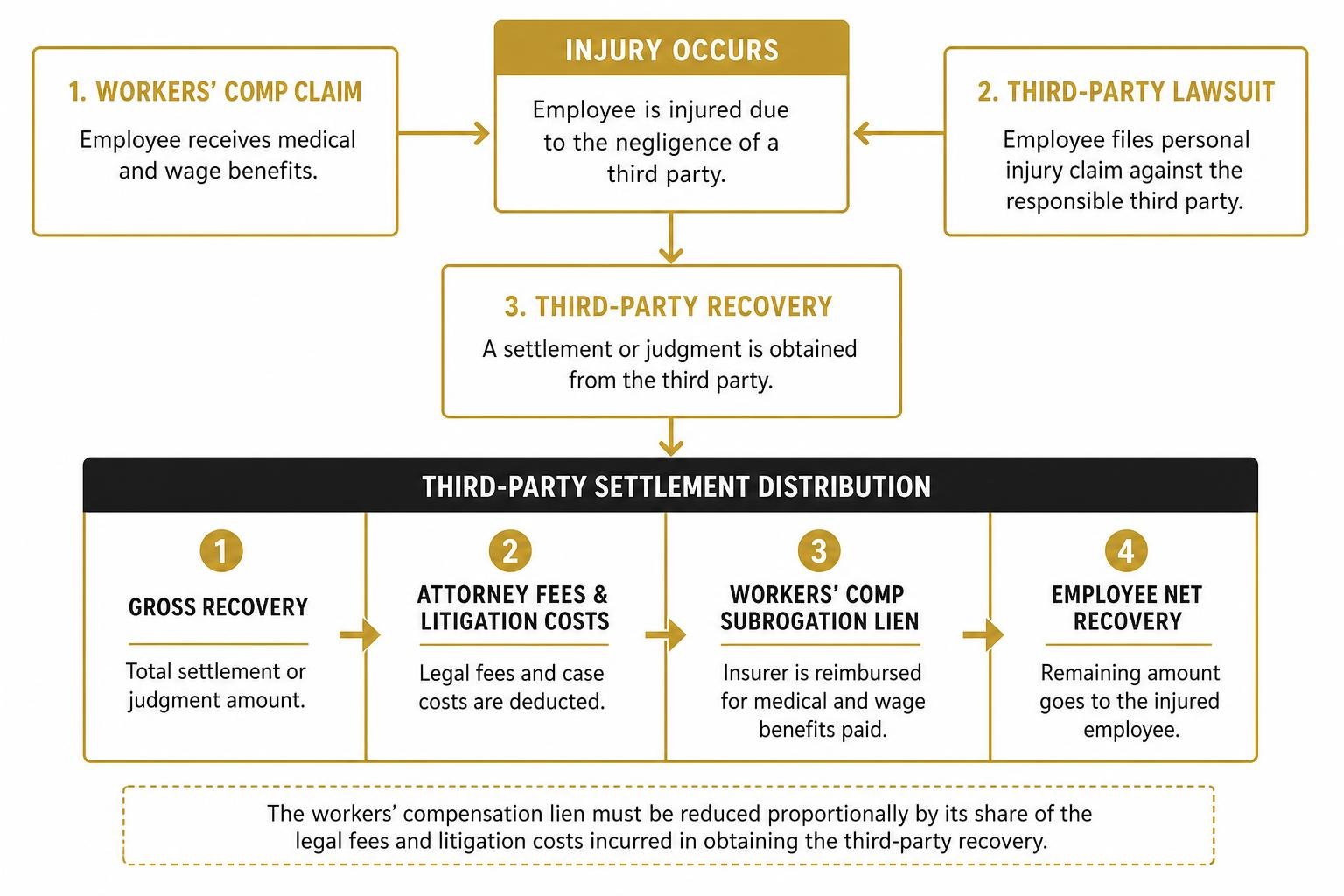
Navigating this lien is where skilled legal representation proves indispensable. When calculating settlements, the workers’ compensation carrier must reduce its lien proportionally by its share of the legal fees and litigation costs incurred in obtaining the third-party recovery.
Furthermore, our legal team can negotiate a Compromise and Release (C&R) agreement in the workers’ comp case while resolving the personal injury claim. Understanding how insurance companies calculate injury settlements ensures that liens are minimized, preventing unexpected insurance reimbursement demands and maximizing the net financial recovery in your pocket.
Navigating Deadlines and the Legal Process in PA Work Injury Cases
Managing both an administrative workers’ compensation claim and a civil personal injury lawsuit requires adhering to two distinct sets of procedural rules, statutory deadlines, and evidentiary standards.
Reporting Requirements and Strict Deadlines
Prompt injury notification is the first critical step in protecting your rights under Pennsylvania law:
- Employer Notice (21 & 120 Days): You should report your injury to a supervisor within 21 days so benefits can be awarded retroactively from the date of injury. If you fail to provide formal notice within 120 days of the accident (or from the date a doctor confirms your condition is work-related), your claim is completely barred.
- Workers’ Comp Claim Petition Deadline (3 Years): If an employer or insurer denies your claim or fails to accept liability through a Notice of Compensation Payable (NCP), you have three years from the injury date to file a formal Claim Petition with the Bureau of Workers’ Compensation.
- Personal Injury Statute of Limitations (2 Years): Under 42 Pa.C.S. § 5524, the statute of limitations for personal injury lawsuits in Pennsylvania is strictly two years from the date the accident occurred. Missing this window permanently extinguishes your right to sue third-party tortfeasors.
Medical Treatment Requirements Under PA Law
Securing prompt and properly documented medical care is vital for your health and your legal claim. Under the Pennsylvania Workers’ Compensation Act, if your employer maintains a posted list of at least six designated healthcare providers (a panel list) and you signed the required statutory acknowledgment, you must treat with a panel provider for the first 90 days following your injury. After 90 days, you are free to treat with any physician of your choice. In a concurrent third-party personal injury lawsuit, your medical records, diagnostic imaging, and treatment plans serve as essential evidence to establish the full extent of your economic and non-economic damages.
Evidence Gathering and Documentation
Building a robust case across both administrative and civil forums requires thorough evidence gathering immediately following an accident, including:
- Incident and Police Reports: Official employer accident reports, OSHA logs, and police crash reports documenting how and when the incident occurred.
- Eyewitness Statements: Detailed contact information and statements from co-workers, subcontractors, or bystanders who witnessed the incident or observed hazardous site conditions.
- Scene and Equipment Documentation: Photographs and video footage of the accident scene, defective tools, malfunctioning machinery, or unsafe property conditions before they are altered or repaired.
- Comprehensive Medical Records: Emergency room charts, physician notes, surgical reports, physical therapy logs, and diagnostic test results linking your specific injuries directly to the incident.
- Wage and Financial Records: Pay stubs, tax returns, and W-2 forms demonstrating pre-injury average weekly wages, lost overtime, and diminished future earning capacity.
The Filing Process, WCJ Hearings, and Legal Appeals
The administrative workers’ compensation process operates independently of the county court system. When a dispute arises over a denied claim or contested benefits, the matter is assigned to a Workers’ Compensation Judge (WCJ) within the Pennsylvania Workers’ Compensation Office of Adjudication (WCOA).
The WCJ conducts formal evidentiary hearings, takes live testimony, reviews medical depositions from treating and examining physicians, and issues a binding written decision. Either party can appeal an adverse ruling to the Workers’ Compensation Appeal Board (WCAB), and further to the Commonwealth Court of Pennsylvania. The procedural steps and timelines involved in these proceedings are outlined in our guide on workers’ comp duration in Pennsylvania.
In contrast, a third-party personal injury action is filed in the Court of Common Pleas or Federal District Court. This path involves formal civil complaints, written discovery, depositions, expert witness disclosures, pre-trial motions, and potentially a jury trial. Coordinating both claims through skilled legal representation ensures your evidence and testimony remain unified across both proceedings.
Frequently Asked Questions About PA Workplace Injury Claims
Can I receive pain and suffering damages from PA workers’ comp?
No. The Pennsylvania Workers’ Compensation Act does not provide any financial compensation for non-economic damages, such as physical pain and suffering, emotional distress, loss of life’s pleasures, or scarring that does not affect the head, face, or neck. To recover pain and suffering damages, you must be able to identify and file a personal injury claim against a negligent third party who contributed to your accident.
What happens if a defective machine caused my workplace injury?
If you were injured by a dangerous or defective machine, tool, or industrial vehicle at work, you have two concurrent legal remedies. First, you receive workers’ compensation wage loss and medical benefits from your employer’s insurer without proving fault. Second, you can retain our firm to file a strict product liability lawsuit against the manufacturer, designer, and distributor of the defective machinery for total economic and non-economic damages.
Do I have to pay back my workers’ compensation benefits if I win a lawsuit?
Yes, under Section 319 of the Pennsylvania Workers’ Compensation Act, the workers’ compensation insurance company has a subrogation lien against your third-party civil recovery for the medical bills and wage loss benefits they paid. However, the insurer cannot simply take the entire amount. Under Pennsylvania law, the insurer must reduce its lien to pay its proportionate share of your legal fees and litigation expenses. An experienced attorney will aggressively negotiate this lien to minimize the payback and maximize your net recovery.
Conclusion
Suffering an injury on the job in Northeastern Pennsylvania can disrupt your livelihood, your health, and your family’s financial security. Choosing between workers’ compensation and a personal injury lawsuit is rarely an either-or decision. When a third party shares responsibility for your workplace accident, pursuing both claims simultaneously provides the full financial recovery you need and deserve.
At Caputo & Mariotti, we bring more than 55 years of combined legal experience to the table, fighting for injured workers throughout Scranton, Moosic, Wilkes-Barre, Pittston, Hazleton, Dickson City, and across Lackawanna and Luzerne Counties. Our dedicated team understands the complex interplay between administrative workers’ compensation proceedings and civil tort litigation, aggressively coordinating your claims to protect your benefits while holding negligent third parties accountable.
If you or a loved one has been hurt at work, do not leave valuable compensation on the table. Contact our office today to schedule a consultation with our experienced Pennsylvania personal injury and workers’ compensation attorneys and let us build a comprehensive strategy for your recovery.