

The dedicated legal team of Caputo & Mariotti
Step-by-Step Guide to Pennsylvania Workers’ Comp Injuries Covered
October 26, 2026
Understanding What Injuries Are Covered by Workers Comp Pennsylvania
When an accident happens during your shift, figuring out the scope of coverage is the critical first step. Under official guidelines from the Pennsylvania Department of Labor & Industry, the Pennsylvania Workers’ Compensation Act establishes a mandatory, no-fault system. This means that if you sustain an injury in the course and scope of your employment, you are eligible for statutory medical benefits and wage-loss compensation regardless of whether you or your employer made an honest mistake.
To qualify, an injury must arise during work activities or further the business affairs of your employer. Coverage begins on your very first day on the job—whether you are full-time, part-time, or seasonal. Understanding what to do if you’re hurt at work ensures you do not inadvertently compromise your benefits by missing critical early steps, such as reporting the accident promptly and seeing an authorized medical provider.
Acute Trauma and Repetitive Motion: What Injuries Are Covered by Workers Comp Pennsylvania?
Workplace injuries generally fall into two broad buckets: acute, sudden trauma and cumulative repetitive motion injuries.
Acute trauma includes unexpected, violent, or sudden physical events, such as:
- Bone fractures, joint dislocations, and crushed limbs
- Torn ligaments, tendon ruptures, and severe sprains or strains
- Traumatic brain injuries (TBIs) and concussions
- Puncture wounds, lacerations, and severe workplace burns
- Spinal cord damage and herniated discs from slips, trips, or falls
These acute incidents are frequent in high-risk environments, where workers often need to pursue claims for construction site injuries following falls from scaffolding or equipment failures.
Conversely, repetitive motion injuries develop over weeks, months, or years due to continuous physical strain. Conditions such as carpal tunnel syndrome, cubital tunnel syndrome, chronic bursitis, tendinitis, and degenerative spinal conditions from ongoing heavy lifting are fully compensable under Pennsylvania law. As long as reliable medical evidence demonstrates that your daily job duties caused the wear and tear, you have a valid claim.
Evaluating Pre-Existing Conditions: What Injuries Are Covered by Workers Comp Pennsylvania?
One of the most common reasons insurance carriers deny claims is by asserting that an injury is simply a “pre-existing condition.” However, Pennsylvania workers’ compensation law provides absolute protection for the material aggravation of pre-existing injuries or degenerative issues.
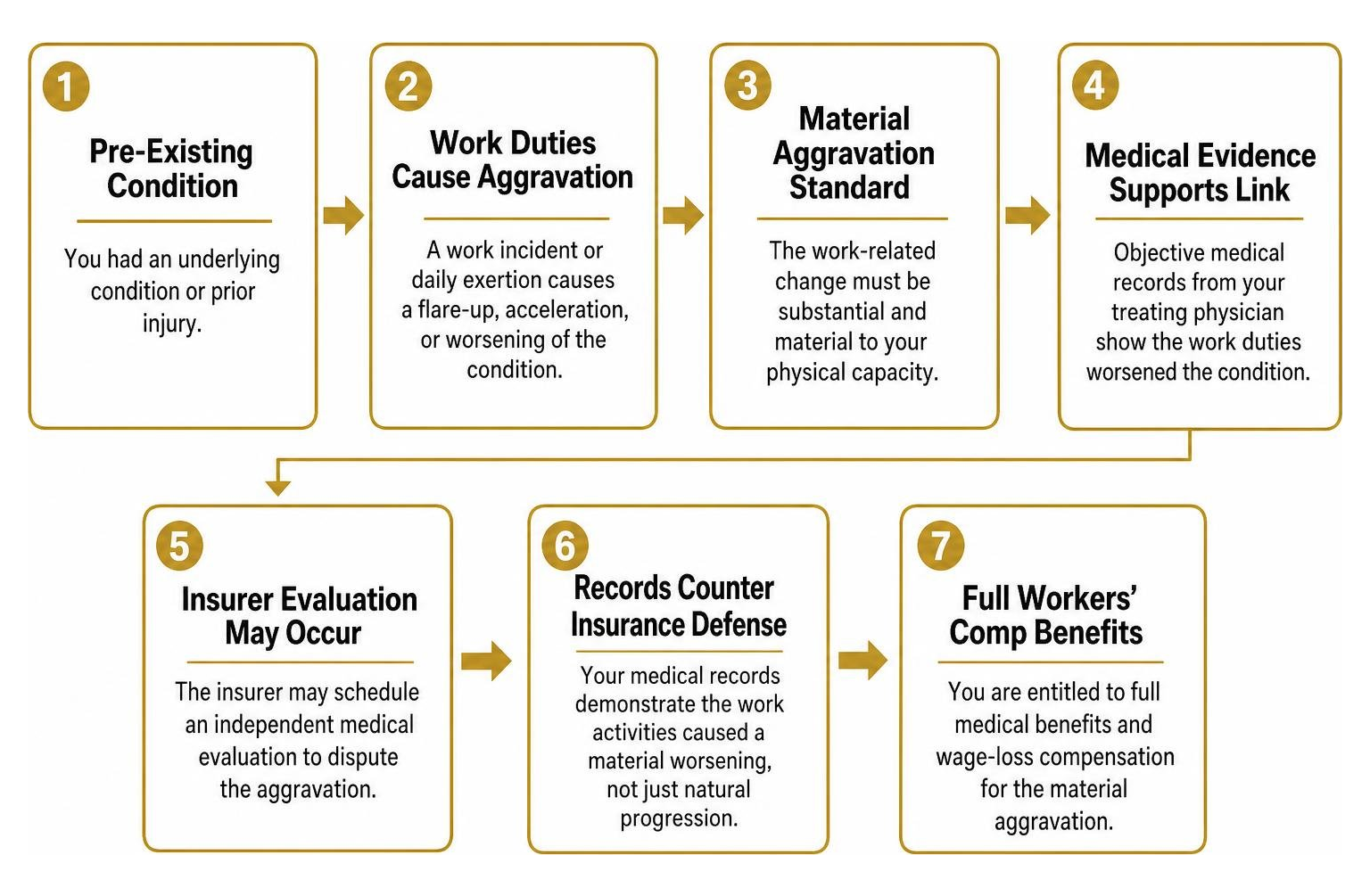
If you had an underlying condition—such as arthritis, a prior lumbar surgery, or an old shoulder dislocation—and your work duties cause a flare-up, acceleration, or worsening of that condition, you are entitled to full coverage. The standard is whether the work incident or daily exertion caused a substantial material change in your physical capacity.
In these disputed cases, insurers frequently schedule mandatory medical assessments. Knowing how to handle independent medical evaluations is critical, as insurance doctors often attempt to attribute all your current disability to prior health issues rather than the recent work trauma. Working with a dedicated workers’ compensation lawyer helps ensure your treating physician’s objective medical records properly counter these insurance defense tactics.
Occupational Diseases and Cumulative Work Illnesses

Beyond immediate physical trauma, the law covers illnesses contracted due to exposure to hazardous industrial, chemical, or biological environments. Section 108 of the statutory text of the Pennsylvania Workers’ Compensation Act explicitly defines what constitutes a compensable occupational disease.
For an occupational disease to be covered, the condition must result from exposure related to your employment and satisfy specific legal latency parameters. Under the general rule, disability or death from an occupational disease must occur within 300 weeks of your last exposure to the hazard in the workplace. When dealing with complex exposure histories, navigating claims for occupational diseases requires thorough chemical exposure documentation, industrial hygiene assessments, and expert medical testimony.
Respiratory, Toxic, and Hearing Loss Conditions
The Pennsylvania Workers’ Compensation Act explicitly identifies a series of hazardous diseases resulting from toxic exposure, including:
- Silicosis, asbestosis, and coal workers’ pneumoconiosis (black lung): Caused by prolonged inhalation of silica dust, asbestos fibers, or coal mine dust. Under the statute, claims for certain progressive lung diseases require demonstrating at least two years of Pennsylvania workplace exposure during the ten-year period preceding the disability.
- Occupational hearing loss: Compensable when prolonged exposure to hazardous occupational noise causes permanent, binaural sensorineural hearing impairment.
- Toxic chemical poisoning: Including documented exposure to lead, mercury, arsenic, benzene, carbon monoxide, or organic solvents.
- Bloodborne pathogens and infectious diseases: Specifically providing a statutory presumption for first responders, nurses, and emergency medical personnel who contract hepatitis C or tuberculosis.
- Firefighter cancer presumption: Recognizing that exposure to smoke, carcinogens, and hazardous combustion products places firefighters at elevated risks for specific cancers and cardiovascular diseases.
Psychological and Stress-Related Workplace Claims
Psychological injuries are covered under Pennsylvania workers’ comp, but the evidentiary hurdles depend heavily on the classification of the claim:
- Physical-Mental Injuries: A physical workplace injury leads to a psychological impairment (for example, severe chronic pain from a spinal fracture causing major clinical depression). These require proving that the physical trauma directly caused the mental condition.
- Mental-Physical Injuries: A psychological stressor causes an acute physical symptom (such as extreme workplace distress inducing a heart attack or stroke).
- Mental-Mental Claims: Pure psychological conditions, such as post-traumatic stress disorder (PTSD), caused by purely mental stimuli without any accompanying physical impact.
For pure mental-mental claims, Pennsylvania requires the claimant to prove they were exposed to abnormal working conditions. Ordinary workplace friction, disciplinary reprimands, or typical job stress are legally insufficient. However, witnessing a catastrophic violent event, surviving an armed robbery, or facing extreme and unprecedented workplace trauma meets this high legal standard.
Specific Loss, Travel Rules, and Statutory Exclusions

Under the Pennsylvania system, the law recognizes that certain injuries cause permanent loss regardless of whether they completely prevent you from working. Consulting a skilled workers’ compensation lawyer ensures you do not miss out on statutory awards specifically designated for permanent physical loss or severe cosmetic disfigurement.
Specific Loss and Disfigurement Benefits
Specific loss benefits are paid as a designated number of weekly payments for the total, permanent loss (or loss of use for all practical intents and purposes) of specific body parts:
- Amputation or permanent loss of use: Hands, forearms, arms, feet, lower legs, legs, thumbs, fingers, and toes.
- Sensory loss: Permanent, total loss of hearing in one or both ears, or the complete loss of vision in an eye.
- Serious facial disfigurement: Permanent, unsightly scars or burns located on the head, face, or neck.
These benefits are paid even if you return to work immediately at full wages, providing financial recovery for the permanent physical detriment suffered.
Off-Site Injuries and the Coming-and-Going Rule
Generally, accidents that occur while you are commuting to and from your fixed place of employment are excluded under Pennsylvania’s coming-and-going rule. However, multiple crucial exceptions exist:
- Traveling employees: Workers whose employment requires constant travel (such as sales representatives, service technicians, or delivery drivers) are typically covered from the moment they leave home until they return, provided they do not engage in a distinct personal detour.
- Special mission exception: If your employer directs you to perform a special errand, pick up supplies, or execute a task outside your regular working hours or location.
- Employer-provided transportation: If the employer provides, pays for, or mandates the specific vehicle used for travel.
- Employer premises: Injuries sustained on the employer’s parking lot, walkways, or access routes immediately before or after a shift.
Injuries Excluded from Coverage
While Pennsylvania is a no-fault system, the statute creates narrow exceptions where compensation must be denied:
- Intentional self-infliction: Injuries sustained from deliberate attempts to harm oneself.
- Intoxication or illegal drug use: If the employer proves that the employee’s intoxication or illegal substance use was the direct and primary cause of the accident.
- Violation of the law: Injuries sustained while actively committing a misdemeanor or felony.
- Personal animosity: Attacks or altercations motivated by purely personal disputes unrelated to work duties.
While you cannot sue your direct employer in civil court for ordinary negligence, you can pursue third-party claims if a negligent contractor, equipment manufacturer, or reckless driver caused your injuries. Learning about lawsuits beyond workers’ compensation allows you to pursue pain and suffering damages alongside your workers’ compensation benefits.
Reporting, Medical Treatment, Evidence Gathering, and the Filing Process
Securing your statutory workers’ compensation benefits requires strict adherence to mandatory procedural steps, from the moment an injury occurs through formal legal proceedings.
Mandatory Reporting Requirements and Deadlines
Pennsylvania enforces strict statutory timelines that dictate whether you remain eligible for wage-loss and medical compensation:
- The 21-Day Notice Rule: You should give formal notice of your injury to a supervisor, manager, or human resources representative within 21 days of the accident to receive wage-loss benefits retroactive to your first day of missed work.
- The 120-Day Absolute Deadline: Notice must be provided no later than 120 days from the date of the injury (or from when you reasonably knew your condition was work-related). Failure to report within 120 days permanently bars your claim under Pennsylvania law.
Authorized Medical Treatment and the 90-Day Rule
If your employer maintains a posted list of at least six designated healthcare providers (a panel list) that complies with statutory posting requirements, you must treat with one of those designated providers for the first 90 days following your initial visit. If emergency care is necessary, you may seek immediate treatment at the nearest emergency department. After 90 days—or if your employer failed to provide a valid panel list—you have the legal right to treat with any healthcare provider of your choice. Throughout treatment, objective medical evaluations assess your recovery until you reach maximum medical improvement.
Evidence Gathering and Case Documentation
Proving the connection between your injury and your employment demands robust, contemporaneous evidence, including:
- Written Incident Reports: Written records detailing the exact date, time, location, and mechanics of the accident.
- Medical Records and Diagnostic Imaging: Doctor’s notes, operative summaries, physical therapy logs, X-rays, and MRI scans establishing your physical restrictions.
- Witness Statements: Contact information and testimony from co-workers or bystanders who observed the incident or your immediate distress.
- Wage Documentation: Pay stubs, tax records, and Average Weekly Wage (AWW) statements to verify correct disability benefit calculation rates.
The Claim Filing Process and Legal Appeals
If your employer’s insurance carrier refuses to accept liability or files a formal Notice of Denial (Form LIBC-496), you have up to three years from the date of injury to initiate litigation. Understanding the procedural rules for filing a workers’ comp claim petition with the Pennsylvania Bureau of Workers’ Compensation ensures your case proceeds to an assigned Workers’ Compensation Judge (WCJ). The WCJ will conduct evidentiary hearings, review medical depositions, and issue a binding decision. If either party disagrees with the judge’s ruling, an appeal can be filed with the Workers’ Compensation Appeal Board (WCAB) and subsequent appellate review pursued before the Pennsylvania Commonwealth Court.
Frequently Asked Questions about Pennsylvania Workers’ Comp Injuries
Can I receive workers’ comp if the accident was my fault?
Yes. Pennsylvania operates under a no-fault system. Unless the injury was intentionally self-inflicted, caused by statutory intoxication, or occurred while violating the law, your own negligence—such as tripping over your own feet or misjudging a step—does not disqualify you from receiving full medical and wage benefits.
Are remote or work-from-home injuries covered in Pennsylvania?
Yes, provided the injury occurred within the course and scope of your employment. If you slip and fall while moving between your desk and a printer or suffer a repetitive strain injury while performing daily telecommuting duties, you are covered. The central legal challenge is establishing clear documentation that the activity directly served your employer’s business at the moment of injury.
What should I do if my injury claim is disputed or denied?
If your employer’s insurance carrier issues a Notice of Workers’ Compensation Denial (Form LIBC-496), your benefits will not start automatically. You must file a formal Claim Petition with the Bureau of Workers’ Compensation to have your case heard by a workers’ compensation judge. Immediately gather witness statements, assemble complete medical treatment records, and protect your rights by scheduling a case consultation with experienced legal counsel.
Conclusion: Protecting Your Rights Under PA Workers’ Compensation Law
Dealing with a severe workplace injury, accumulating medical bills, and navigating aggressive insurance adjusters can quickly become overwhelming. The insurance company’s goal is often to minimize payouts, delay approvals, or dispute the severity of your medical conditions.
At Caputo & Mariotti, we bring over 55 combined years of dedicated legal experience representing injured individuals and families throughout Northeastern Pennsylvania, including Lackawanna County, Luzerne County, Scranton, Moosic, Pittston, Wilkes-Barre, Hazleton, and Dickson City. We know the medical proof, legal strategies, and procedural rules necessary to counter insurance denials and secure the maximum compensation you deserve. If you or a loved one has suffered an injury on the job, contact our experienced Scranton workers’ compensation representation today to discuss your rights and pursue full justice.