

The dedicated legal team of Caputo & Mariotti
The Complete Guide to Pennsylvania Workers Comp Settlement Amounts
October 29, 2026
What a Pennsylvania Workers’ Comp Settlement Could Mean for You
A lump-sum settlement can give you money now, but it may end your right to future wage or medical benefits. Before accepting an offer, compare it with the benefits you may still receive: weekly payments, treatment costs, and any award for a permanent injury. There is no standard Pennsylvania workers comp settlement amount. The value depends on your wages, injury, recovery, and what rights the agreement asks you to give up.
Most settlements use a Compromise and Release agreement, which a workers’ compensation judge must approve. An offer may be easier to judge once your doctors have a clearer picture of your recovery and future care needs.
I’m Chris Caputo, a Pennsylvania injury attorney who has litigated and settled hundreds of injury cases involving serious harm and insurance claims. If you are evaluating a potential workers comp settlement in Pennsylvania, this guide will help you weigh a lump sum against the benefits you may be giving up.

Key resources for understanding your rights include learning whether you can be fired while on workers comp in Pennsylvania, how long workers comp lasts in Pennsylvania, and how to file a workers comp claim in Pennsylvania.
Understanding Average Pennsylvania Workers Comp Settlement Payouts
When navigating the aftermath of a workplace injury, one of the most pressing questions is what a fair financial recovery looks like. In Pennsylvania, workers’ compensation operates as a strict no-fault system. This means you do not need to prove your employer was negligent to receive wage-loss and medical support, but you are generally barred from suing your employer directly for workplace accidents.
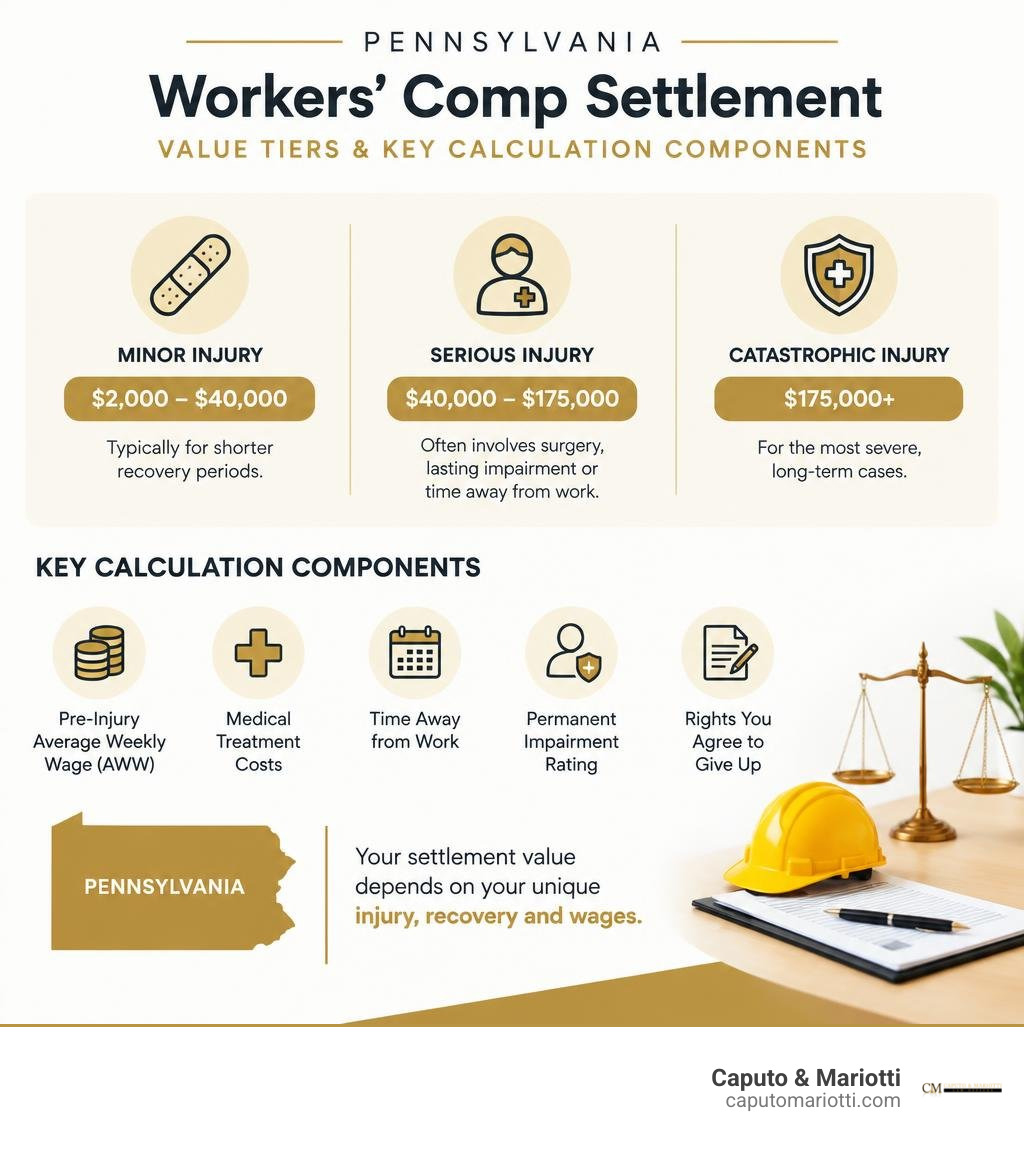
Across the Commonwealth, standard claims that resolve without extensive litigation typically settle anywhere between $2,000 and $40,000. However, when an injury involves surgery, permanent impairment, or prolonged time away from work, settlements frequently range from $40,000 to $175,000, with catastrophic claims reaching even higher sums. To evaluate where your case falls within this spectrum, it is crucial to understand the foundational workers’ compensation benefits provided under the Pennsylvania Workers’ Compensation Act.
Factors That Impact Your Pennsylvania Workers Comp Settlement Value
Settlement figures are not pulled out of thin air. Insurance carriers and judges look at several concrete elements when determining the value of a claim:
- Pre-Injury Average Weekly Wage (AWW): Higher wage earners receive higher weekly indemnity payments, which significantly increases total exposure for the insurer.
- Extent and Permanence of the Injury: Catastrophic damage, structural joint damage, or nerve trauma carry substantially higher values than soft-tissue strains.
- Need for Future Medical Care: If your condition requires ongoing prescriptions, future surgeries, physical therapy, or durable medical equipment, those anticipated lifetime expenses must be funded in a full settlement.
- Litigation Posture and Dispute Strength: Claims where the insurer has filed a petition to terminate, modify, or suspend benefits carry different negotiation dynamics than uncontested claims.
- Legal Guidance: Statistical data shows that retaining experienced legal representation often results in settlements that are 30% to 40% higher on average compared to unrepresented claimants.
Working closely with a dedicated workers’ compensation lawyer ensures that every element of your financial loss—from unbilled mileage to future surgical estimates—is properly leveraged during negotiations.
Common Work Injuries and Typical Settlement Ranges
The physical toll of your injury serves as the cornerstone of your payout value. Common compensable workplace injuries across Pennsylvania industrial, warehouse, and office settings include:
- Lumbar Spine and Neck Injuries (Cervical/Lumbar Strains, Disc Herniations, Spinal Fusions): Non-surgical disc herniations often settle between $25,000 and $60,000. When complex surgeries such as a lumbar fusion or discectomy are required, settlements regularly rise between $75,000 and $180,000.
- Shoulder and Rotator Cuff Tears: Moderate shoulder tears resolving with physical therapy or arthroscopic debridement often range from $20,000 to $50,000. Full rotator cuff tears or total shoulder replacements often yield settlements between $50,000 and $125,000.
- Knee and Lower Extremity Trauma: Meniscus repairs or arthroscopic interventions often settle between $15,000 and $40,000, whereas total knee replacements can command $60,000 to $130,000.
- Repetitive Stress Injuries (Carpal Tunnel Syndrome): Carpal tunnel releases typically resolve in the $15,000 to $35,000 range per affected wrist.
- Traumatic Brain Injuries (TBI) and Neurological Damage: Severe cognitive impairments or brain trauma requiring long-term specialized care can result in substantial settlements exceeding $200,000 to $450,000.
How Pennsylvania Calculates Workers’ Compensation Settlement Values
A settlement is fundamentally an advance buyout of the insurer’s future exposure for your wage loss (indemnity) and medical care. The starting point for any calculation begins with Pennsylvania statutory benefit calculations.

Average Weekly Wage Calculations and Statutory Benefit Caps
Pennsylvania calculates your compensation rate using your pre-injury Average Weekly Wage (AWW). The AWW evaluates gross earnings from the four 13-week quarters preceding the injury, incorporating regular wages, overtime, bonuses, and wages earned from concurrent secondary employment.
For claims in 2026, Pennsylvania utilizes a tiered sliding scale to establish weekly temporary total disability rates:
- Standard Benefit Rate: If two-thirds (66.67%) of your AWW falls between the statewide maximum and the minimum threshold, your weekly benefit is exactly 66.67% of your AWW.
- Maximum Weekly Cap: For 2026, the maximum weekly compensation cap is set at $1,394.00. High-wage earners making over $2,091.00 per week are capped at this maximum rate.
- Minimum Floor: Workers earning lower wages receive the statutory floor of $697.00 per week, or 90% of their actual AWW if their regular weekly wage is below that threshold.
The 104-Week Impairment Rating Evaluation and the 500-Week Cap
Under Pennsylvania law, once an injured employee has received 104 weeks (two full years) of total disability payments, the insurance carrier can request an Impairment Rating Evaluation (IRE). This examination must be conducted by a qualified physician using the most recent edition of the American Medical Association (AMA) Guides to the Evaluation of Permanent Impairment.
- The 35% Impairment Threshold: If the IRE physician determines that your whole-person impairment rating is less than 35%, the insurance carrier can file to convert your status from total disability to partial disability.
- The 500-Week Clock: While total disability benefits have no statutory expiration date in Pennsylvania, partial disability benefits are capped at a maximum of 500 weeks (roughly 9.6 years).
This conversion is a critical leverage point. Once your benefits are capped at 500 weeks, the insurer’s total financial liability is limited. Therefore, reaching a settlement before or right after you reach maximum medical improvement (MMI) requires strategic evaluation to maximize your financial security before the 500-week countdown diminishes the insurer’s exposure.
Scheduled Loss Awards and Permanent Disability Values
Not all workers’ compensation claims are purely tied to ongoing wage loss. If you suffer the permanent loss of use of a specific body part, Pennsylvania law provides “specific loss” benefits. These are statutory awards designed to compensate you for the permanent anatomical or functional loss of a body member, separate from whether you return to work.
Understanding the role of medical evaluations is critical, as a clear medical opinion establishing a permanent “loss of use for all practical intents and purposes” is required to secure a specific loss award.
Pennsylvania Specific Loss Chart for Body Part Injuries
Specific loss awards are calculated by multiplying your weekly workers’ compensation rate by the statutory number of weeks assigned to that specific body part, plus an additional statutory “healing period.”
The following table highlights the statutory payable weeks and maximum 2026 payout potential (based on the maximum weekly cap of $1,394.00) for complete losses under Pennsylvania law:
| Body Part / Injury Type | Statutory Scheduled Weeks | Healing Period Weeks | Maximum Statutory Payout (2026 Cap) |
|---|---|---|---|
| Total Loss of Arm | 410 Weeks | 20 Weeks | $571,540.00 |
| Total Loss of Leg | 410 Weeks | 25 Weeks | $571,540.00 |
| Total Loss of Hand | 335 Weeks | 20 Weeks | $466,990.00 |
| Total Loss of Foot | 250 Weeks | 25 Weeks | $348,500.00 |
| Total Loss of Eye (Sight) | 275 Weeks | 10 Weeks | $383,350.00 |
| Total Loss of Hearing (Both Ears) | 260 Weeks | N/A | $362,440.00 |
| Total Loss of Thumb | 100 Weeks | 10 Weeks | $139,400.00 |
| Total Loss of Index Finger | 50 Weeks | 6 Weeks | $69,700.00 |
To explore dynamic calculations and individual body part schedules, you can consult a comprehensive Pennsylvania Workers’ Comp Settlement Chart (2026).
Future Medical Expenses and Medicare Set-Aside Considerations
Settlements often require you to decide whether you want to close out only your wage-loss benefits (“indemnity-only settlement”) or close out both wage-loss and future medical rights (“full Compromise and Release”).
If you settle your future medical care, you become personally responsible for paying all future doctor visits, medications, injections, and surgeries related to that injury. Private health insurance policies often contain exclusions for work-related conditions, making it essential to accurately project lifetime healthcare expenses.
If you are a Medicare beneficiary, or have a reasonable expectation of enrolling in Medicare within 30 months of settlement, federal law requires that Medicare’s interests be protected. In these cases, a Medicare Set-Aside (MSA) arrangement must often be calculated and approved by the Centers for Medicare & Medicaid Services (CMS). An MSA reserves a dedicated portion of your settlement funds in an interest-bearing account used exclusively for future injury-related medical care that Medicare would otherwise cover.
Pennsylvania Workers’ Compensation Claims Process and Settlement
Reaching a favorable settlement requires establishing a solid legal and evidentiary record from the beginning of your claim. Understanding the mandatory procedural stages protects your rights throughout the process.
Reporting the Workplace Injury
Under the Pennsylvania Workers’ Compensation Act, providing prompt notice of your injury to your employer or supervisor is essential. You must report the injury within 21 days of the incident for wage-loss benefits to begin retroactively from the date of disability. If you fail to provide notice within 120 days, your claim is completely barred under Pennsylvania law.
Medical Treatment and Panel Physicians
Securing prompt and documented medical treatment is vital for both your health and your legal claim. If your employer has posted a designated list of at least six healthcare providers (a panel list) and you signed the required acknowledgment, you must treat with an authorized panel physician for the first 90 days of treatment. After 90 days—or immediately if the employer failed to maintain a valid panel—you have the right to select your own treating doctor.
Evidence Gathering and Documentation
Insurance companies routinely scrutinize and dispute workers’ compensation claims. Preserving detailed evidence is critical to proving your entitlement to benefits and maximizing settlement leverage:
- Incident and Injury Reports: Copies of official written accident reports submitted to your employer.
- Witness Statements: Written or recorded accounts from coworkers or third parties who saw the accident occur.
- Medical Records and Diagnostic Reports: MRI scans, surgical notes, physical therapy logs, and physician restrictions demonstrating the direct causal link between your job duties and your physical condition.
- Wage and Earnings Records: Paystubs, W-2 forms, and overtime records necessary to calculate an accurate Average Weekly Wage.
The Claim Filing Process and Legal Appeals
If your employer or their insurer denies your claim by issuing a Notice of Workers’ Compensation Denial, you must formally initiate litigation. You protect your claim by filing a formal Claim Petition with the Bureau of Workers’ Compensation within the three-year statute of limitations. A Workers’ Compensation Judge (WCJ) will preside over evidentiary hearings, receive medical testimony, and render a decision. If an adverse decision is issued, either party may pursue a legal appeal to the Workers’ Compensation Appeal Board (WCAB) and subsequently the Commonwealth Court of Pennsylvania.
The Compromise and Release Agreement and Approval Process
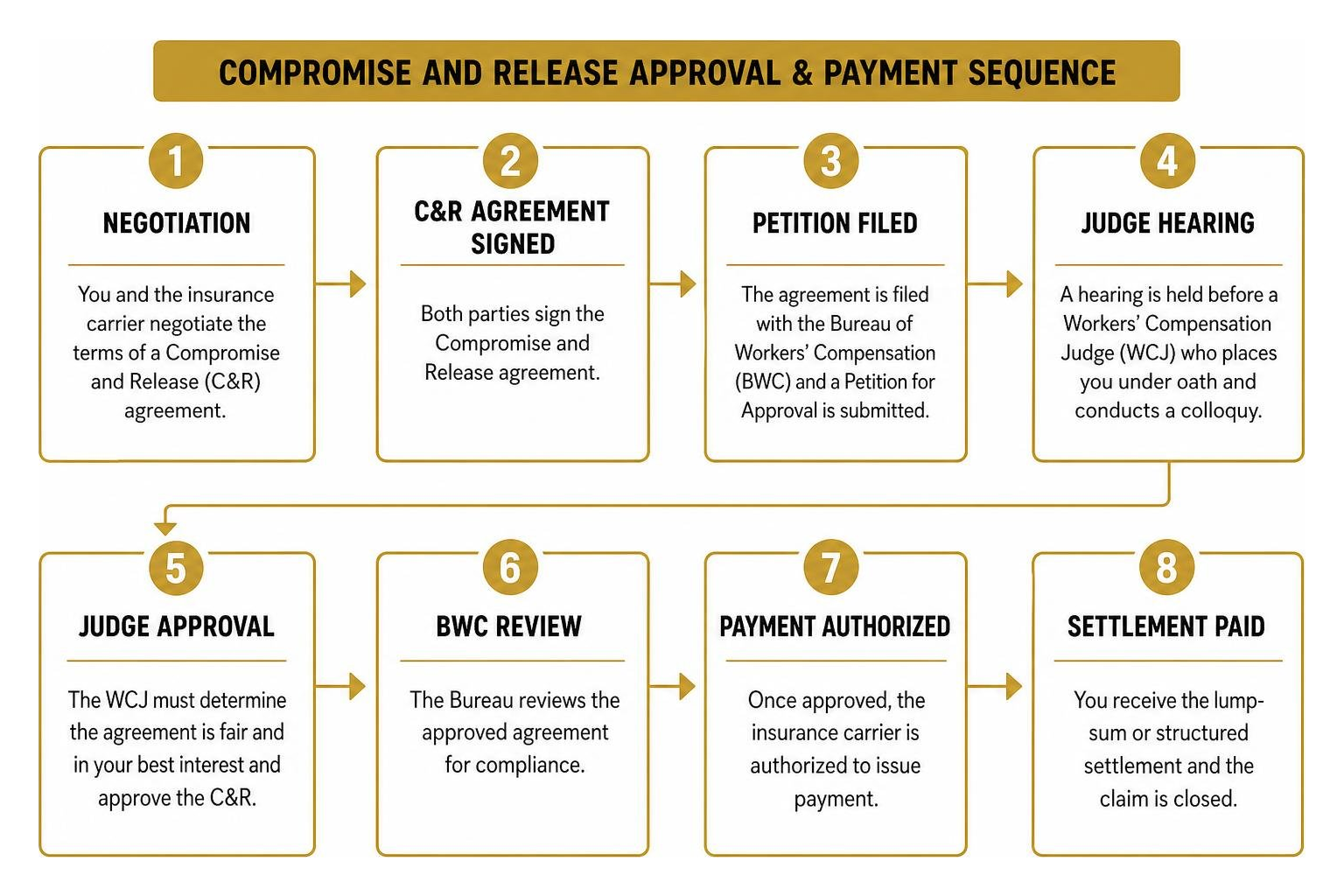
In Pennsylvania, voluntary settlements are formalized through a legal contract called a Compromise and Release (C&R) Agreement. A C&R legally ends the insurance carrier’s liability in exchange for a negotiated lump sum or structured payout.
Under Pennsylvania law, early informal compromises that bypass administrative oversight are invalid. A historical Attorney General legal opinion affirmed that Section 407 of the Workers’ Compensation Act strictly voids any unapproved settlement or agreement entered into prior to statutory waiting periods that compromises an injured worker’s mandated benefits. This procedural protection ensures that no insurer can pressure an injured worker into an unfair, private payout without official scrutiny.
When to Consider a Lump-Sum Pennsylvania Workers Comp Settlement Agreement
Deciding when to accept a settlement requires careful strategy. A lump-sum agreement is typically considered under the following circumstances:
- You Have Reached Maximum Medical Improvement (MMI): Once your medical condition has stabilized, doctors can accurately project future medical costs and functional limitations.
- You Wish to Avoid Ongoing Litigation: If the insurer is fighting your claim with independent medical exams (IMEs) or vocational earning capacity assessments, settling eliminates the risk of an adverse judicial decision.
- You Plan a Career Transition or Retirement: A lump-sum payout allows you to start a new business, retrain in an alternative field, or transition into retirement without reporting weekly earnings to an insurance carrier.
Mandatory Workers’ Compensation Judge Hearing and Approval
A Compromise and Release agreement is not legally binding simply because both parties signed the document. Pennsylvania law mandates that a formal hearing be held before a Workers’ Compensation Judge (WCJ).
During the hearing, the judge will place you under oath and conduct an extensive colloquy. The judge must verify that:
- You have read and fully comprehend the terms of the agreement.
- You understand that you are permanently giving up specific legal rights (such as future weekly checks or medical payments).
- You are entering into the settlement voluntarily and have not been coerced.
Once the judge determines you understand the full legal consequences, they will issue a formal written Decision and Order approving the Compromise and Release.
Frequently Asked Questions About Pennsylvania Workers Comp Settlements
Are Pennsylvania Workers Comp Settlements Taxable?
No. Under Section 104(a)(1) of the Internal Revenue Code (IRC), workers’ compensation benefits and lump-sum settlements awarded for job-related injuries are fully exempt from federal income tax. Furthermore, the Pennsylvania Department of Revenue does not levy state or local income taxes on workers’ compensation settlements.
The only notable exception occurs when a claimant receives both Social Security Disability Insurance (SSDI) and workers’ comp payments simultaneously, which may trigger a federal offset calculation. Properly drafting the C&R agreement with specific amortization language can minimize or eliminate this offset.
What Are the Critical Deadlines to File and Report a Claim in PA?
Strict statutory deadlines govern every Pennsylvania work injury:
- 21-Day Notice Rule: You must report your injury to your employer within 21 days of the incident to ensure your wage-loss benefits are retroactive to the date of disability.
- 120-Day Absolute Bar: If you fail to give formal notice to your employer within 120 days of the injury, your claim is completely barred under Pennsylvania law.
- 3-Year Statute of Limitations: If your employer or their insurer denies your claim, you have exactly 3 years from the date of injury to protect your rights by filing a timely workers’ comp claim petition with the Bureau of Workers’ Compensation.
How Long Does It Take to Receive Payment After Settlement Approval?
Following your Compromise and Release hearing, the Workers’ Compensation Judge typically drafts and circulates the formal approval order within several business days to two weeks.
Under Pennsylvania law, the insurance carrier has 20 days from the date the judge’s written order is circulated to issue your payment. If the insurer fails to deliver payment within this 20-day statutory window, your attorney can file a Penalty Petition against the insurer, which may result in statutory interest and penalties of up to 50% on the delayed funds. Payments are distributed either via direct deposit or paper check delivered through certified mail.
Conclusion
Navigating a workers’ compensation claim while managing severe physical pain and financial stress can feel overwhelming. At Caputo & Mariotti, our legal team brings more than 55 years of combined legal experience fighting exclusively for injury victims across Northeastern Pennsylvania, including Scranton, Wilkes-Barre, Hazleton, Pittston, Dickson City, and Moosic. We understand the tactics insurance companies use to undervalue long-term disability, and we are committed to helping you secure every dollar you are owed.
If you are considering a settlement offer or need help with a contested injury claim, contact our seasoned Northeastern Pennsylvania workers’ compensation attorneys today to schedule a free consultation and let us protect your future.
