

The dedicated legal team of Caputo & Mariotti
Don’t Let Liens Ruin Your Pennsylvania Personal Injury Settlement
July 20, 2026
What Is a Personal Injury Settlement in Pennsylvania — and How Much Will You Actually Keep?
A personal injury settlement in Pennsylvania often looks very different on paper than what ends up in your pocket. You might hear a headline number — say, $100,000 — and assume that’s what you’ll receive. But after attorney fees, case expenses, and medical liens are resolved, your actual take-home amount can be significantly lower.
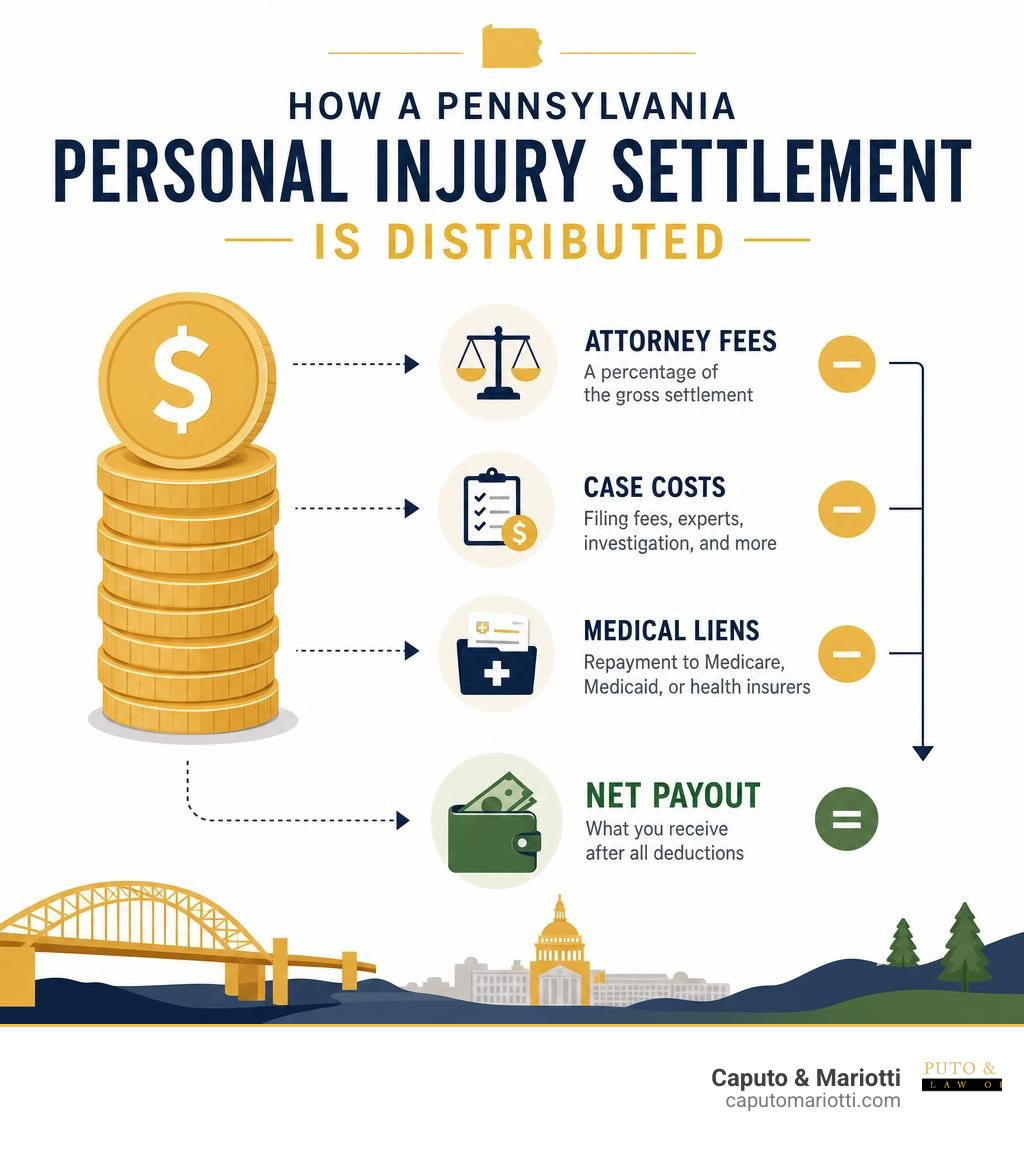
Here’s a quick snapshot of what shapes your net recovery:
| Factor | What It Means for You |
|---|---|
| Gross settlement | The total amount agreed upon with the insurance company |
| Attorney fees | Typically 33%–40% of the gross, under PA Code Rule 1.5 |
| Case expenses | Filing fees, expert witnesses, investigation costs |
| Medical liens | Medicare, Medicaid, or health insurer reimbursement claims |
| Net payout | What you actually receive after all deductions |
The gap between gross and net can be significant. And one of the biggest — and most overlooked — factors eating into your recovery is liens: legal claims placed on your settlement by health insurers, Medicare, or Medicaid to recoup medical costs they paid on your behalf.
Most injured Pennsylvanians don’t learn about liens until after a settlement is reached. By then, the surprises can be painful.
I’m Chris Caputo, a Pennsylvania personal injury attorney with over 30 years of litigation experience, including decades of trying and settling cases involving personal injury settlement in Pennsylvania disputes against insurance companies. In this guide, I’ll walk you through exactly how liens work, how to fight them, and how to protect the recovery you’ve earned.
Personal injury settlement pennsylvania terms to know:
- personal injury lawyer scranton pa
- no win no fee personal injury lawyer pa
- free personal injury consultation scranton pa
What Factors Determine a Personal Injury Settlement Pennsylvania Value?
Every personal injury case in Northeastern Pennsylvania is unique. Whether you were rear-ended on Interstate 81 in Scranton, slipped on untreated ice in a Wilkes-Barre parking lot, or suffered an injury in a Pittston warehouse, the value of your case depends on several critical variables.
When evaluating a potential personal injury settlement in Pennsylvania, we look at both the tangible economic losses and the intangible human toll of your injuries. To understand how these components fit together, it helps to review our guide on Understanding Compensation in Personal Injury Cases: A Deep Dive into Damages.
Economic vs. Non-Economic Damages
In Pennsylvania, compensation is legally divided into two primary categories: economic and non-economic damages. For a broader look at how these legal principles function, refer to A Comprehensive Guide to Personal Injury Law.
- Economic Damages: These are the quantifiable, out-of-pocket financial losses you incur because of the accident. They include:
- Past and Future Medical Expenses: Every bill from Geisinger Community Medical Center or Wilkes-Barre General Hospital, including emergency room care, surgeries, physical therapy, prescription medications, and projected future medical care.
- Property Damage: The cost to repair or replace your vehicle, as well as personal items damaged in the accident (such as a cell phone or laptop).
- Lost Wages and Lost Earning Capacity: The income you lost while recovering, plus the long-term impact on your ability to earn a living if your injuries result in a permanent disability.
- Non-Economic Damages: These represent the non-monetary, subjective impact of your injuries. Because there are no receipts for these losses, they are calculated using insurance formulas or presented directly to a jury. They include:
- Pain and Suffering: The physical pain and mental anguish you endure daily.
- Loss of Enjoyment of Life: The inability to participate in hobbies, family activities, or daily pleasures.
- Embarrassment and Humiliation: Frequently associated with visible scarring or disfigurement.
Average vs. Median Verdicts in PA
When clients ask us about the “average” personal injury settlement in Pennsylvania, we always caution them about how statistics can be misleading. According to statewide jury verdict studies, the average personal injury jury verdict in Pennsylvania is $903,705.00. However, the median compensatory award is $45,000.00.
Why is there such a massive gap between these two numbers?
The average is heavily skewed by rare, multi-million dollar “mega-verdicts” — such as an $85,000,000 verdict in a high-profile Philadelphia case. The median represents the exact middle point of all cases, meaning half of all awards are below $45,000 and half are above. For a realistic look at how these numbers translate to auto accidents, you can read about the Average Car Accident Settlement in Pennsylvania (2026).
Furthermore, plaintiffs only receive a monetary award from the jury in 38% of personal injury cases that go to trial in Pennsylvania. This statistic highlights the risk of bypassing a fair settlement to go to trial without experienced legal representation.
The Hidden Deductions: How Liens and Fees Reduce Your Payout
When an insurance company agrees to pay a settlement, they write a check for the “gross” recovery amount. However, you cannot simply deposit this check into your personal bank account. First, a series of legally mandated deductions must be made. If you want a trusted advocate to guide you through this process, a Scranton Personal Injury Lawyer from our team can help protect your financial interests.

How Liens Impact Your Net Personal Injury Settlement Pennsylvania Payout
A medical lien is a legal demand for repayment held by a healthcare provider, health insurance company, or government program (like Medicare or Medicaid). Under federal and Pennsylvania law, if these entities paid for medical treatments related to your accident, they have a right of subrogation. This means they can demand reimbursement directly from your personal injury settlement.
- Medicare and Medicaid Liens: These are super-liens backed by federal law. If you do not resolve a Medicare or Medicaid lien before distributing settlement funds, both you and your attorney can be held personally liable, and Medicare can cut off your future benefits.
- ERISA Health Plans: Many private employers offer health insurance through ERISA self-funded plans. These plans often contain highly aggressive subrogation clauses that demand 100% reimbursement from your settlement.
One of the most valuable services we provide is lien negotiation. We don’t accept the initial lien amount at face value. We meticulously audit the billing records to ensure the insurer is only charging for treatment directly related to the accident. We then negotiate with the providers and insurers to reduce the lien amounts, directly increasing the net take-home amount that goes into your pocket. To understand why having a local advocate makes such a difference in these negotiations, read Why You Need a Personal Injury Lawyer in Scranton PA.
Attorney Fees and Case Expenses
The other primary deductions from a gross settlement are attorney’s fees and litigation expenses.
In Pennsylvania, personal injury lawyers work on a contingency fee basis. This means we do not charge any upfront legal fees. Instead, our fee is a pre-agreed percentage of the gross recovery — typically 33.3% for cases settled before filing a lawsuit, and up to 40% if the case requires formal litigation or a trial. These fees are strictly governed by Pennsylvania Code Rule 1.5, which requires all contingency fees to be reasonable and outlined in a written agreement.
Case expenses are separate from attorney’s fees. These are the actual costs incurred to build and litigate your case, such as:
- Filing fees for court documents
- Fees to obtain medical records and police reports
- Hiring expert witnesses (such as accident reconstructionists or medical experts)
- Deposition court reporter fees
When choosing a law firm, it is vital to clarify whether case expenses are deducted before or after the attorney’s fee percentage is calculated, as this can impact your final payout. You can learn more about how this works by reading The Legal Process in Personal Injury Cases: A Step-by-Step Guide.
How Shared Fault and Tort Elections Impact Your Recovery
Understanding liability and insurance policy limits is essential for setting realistic settlement expectations. In Pennsylvania, the minimum bodily injury liability coverage required by law is only $15,000 per person and $30,000 per accident. If you are hit by a driver carrying only the state minimums, your recovery may be limited unless you have Underinsured Motorist (UIM) coverage on your own policy. For a deeper dive into maximizing your recovery, check out Maximizing Your Personal Injury Compensation in Scranton.

Modified Comparative Negligence (51% Bar)
What happens if you were partially to blame for the accident? Under Pennsylvania’s modified comparative negligence statute (42 Pa.C.S. § 7102), the state enforces a 51% bar rule.
You can recover damages as long as your share of the fault is 50% or less. However, your total compensation will be reduced proportionally by your percentage of blame. If you are found to be 51% or more at fault, you are legally barred from recovering any compensation.
- Example: If a jury determines your total damages are $100,000, but finds you were 20% at fault for the accident (e.g., for speeding slightly through an intersection), your final award is reduced by 20%, leaving you with a net recovery of $80,000 before fees and liens.
Limited Tort vs. Full Tort Elections
If your injury involved a motor vehicle, your settlement options are heavily dictated by the insurance election you made when purchasing your auto policy:
- Full Tort: This option gives you unrestricted rights to seek financial compensation for all economic and non-economic damages, including pain and suffering, regardless of the severity of your injury.
- Limited Tort: This option is less expensive but restricts your ability to sue for pain and suffering (non-economic damages) unless your injury meets the legal definition of a “serious impairment of a body function” (the serious injury exception). Under limited tort, you can still recover 100% of your out-of-pocket medical bills and lost wages, but recovering compensation for physical pain and emotional distress is a much steeper uphill battle.
Maximizing Your Personal Injury Settlement Pennsylvania Recovery
To protect your claim and maximize your net payout, you must take proactive steps from day one:
- Seek Immediate Medical Attention: Gaps in treatment are the number one excuse insurance adjusters use to devalue claims.
- Preserve Every Piece of Evidence: Keep scene photos, witness contact info, physical items, and even minor receipts (like parking fees for doctor visits).
- Avoid Social Media: Insurance investigators regularly monitor public profiles to find photos or posts they can use to argue that your injuries are not as severe as you claim.
- Reject Early Lowball Offers: Insurers want to settle quickly before the full extent of your medical needs is known. Once you sign a release, your case is closed permanently.
Rejecting lowball offers can lead to dramatic results. For example, in a notable Philadelphia case, a plaintiff rejected a $40,000 insurance settlement offer. By taking the case to trial and utilizing a “forever verdict” strategy — explaining to the jury that the plaintiff could never return to court if her condition worsened — her attorney secured an $866,711.00 jury award. You can read the full case analysis here: Here’s How a Phila. Attorney Turned a $40K Settlement Offer Into a Nearly $900K Damages Award | Law.com .
The Settlement Process: Timelines and Payment Structures
Statistically, 90% to 96% of personal injury cases in Pennsylvania are settled out of court rather than going to a jury trial. The typical timeline to resolve a personal injury settlement ranges from 6 to 18 months, depending on the complexity of the liability and how long it takes you to reach Maximum Medical Improvement (MMI).
Lump Sum vs. Structured Settlements
When you resolve your case, you must choose how your settlement funds will be distributed:
| Feature | Lump Sum Settlement | Structured Settlement |
|---|---|---|
| Payment Frequency | Single, one-time payment | Scheduled periodic payments (monthly, annually, or custom intervals) |
| Access to Funds | Immediate, complete access to all net proceeds | Delayed, controlled access based on a set schedule |
| Tax Advantages | Injury compensation is tax-free, but future investment gains are taxable | Entire payout, including interest grew inside the annuity, remains 100% tax-free |
| Best Suited For | Resolving immediate debts, minor to moderate injury claims | Minors, catastrophic injuries requiring lifelong medical care |
The Timeline: From Agreement to Check
Once both parties agree to a settlement figure, the administrative process begins. Typically, it takes 2 to 6 weeks for the physical check to clear and for the funds to be disbursed to you.
Under Pennsylvania insurance regulations, insurance carriers have strict deadlines for handling claims:
- 10 Days to acknowledge a claim and provide necessary forms.
- 30 Days to complete an investigation and accept or deny liability.
- 45-Day Updates must be sent to you if the investigation is delayed.
- Additionally, PA law requires insurers to formally notify you when they mail a settlement check of $1,000 or more to your attorney, ensuring absolute transparency.
Special Rules for Minor Children
If the injured victim is a child under the age of 18, Pennsylvania law enforces strict safeguards. Any settlement involving a minor child that exceeds $10,000 must receive formal court approval from a judge.
A judge will review the settlement terms to ensure they are in the child’s best interest. The court will typically order that the funds be placed into a restricted, interest-bearing bank account that cannot be accessed by anyone (including the parents) until the child turns 18, or structured into an annuity to pay for college or future living expenses.
Frequently Asked Questions About Pennsylvania Injury Settlements
Navigating the aftermath of an accident can be overwhelming. To help you understand your options, we’ve compiled answers to some of the most common questions we hear at our Scranton and Wilkes-Barre offices. For a broader overview of the local legal landscape, read Understanding Personal Injury Claims in Scranton: A Comprehensive Guide.
Are personal injury settlements taxable in Pennsylvania?
Generally, no. Under federal IRS rules and Pennsylvania state tax codes, compensatory damages received for physical injuries or physical sickness are excluded from gross income. This means you do not pay taxes on money awarded for medical bills, lost wages, or pain and suffering, whether received via a lump sum or a structured settlement.
What is the statute of limitations for filing a personal injury claim in Pennsylvania?
Under 42 Pa.C.S. § 5524, the statute of limitations for filing a personal injury claim in Pennsylvania is two years from the date of the accident or injury. If you miss this deadline, you permanently lose your right to seek compensation.
There are narrow exceptions, such as the discovery rule (if an injury could not have been reasonably discovered immediately) and the minor exception (minors have until their 20th birthday to file a claim). However, because evidence disappears and memories fade, you should never delay. To learn more about how this timeline applies locally, read Understanding the Statute of Limitations for Personal Injury Cases in Scranton.
How does workers’ compensation interact with a personal injury claim?
If you are hurt on the job in Northeastern Pennsylvania, your primary source of recovery is the Pennsylvania workers’ compensation system. This is a no-fault system, meaning you do not have to prove your employer was negligent to receive benefits. To successfully navigate this system, you must understand the key phases of a claim:
- Reporting the Injury: You must report your injury to your employer within 21 days to receive retroactive benefits, and no later than 120 days from the date of the accident, or your claim may be permanently barred.
- Medical Treatment: Under PA law, if your employer has posted a list of designated healthcare providers, you must seek treatment from one of these providers for the first 90 days following your injury.
- Evidence Gathering: Building a strong case requires diligent evidence gathering. This includes securing medical records, obtaining witness statements, documenting the accident scene, and keeping a detailed log of your symptoms and limitations.
- The Filing Process: If your employer or their insurer denies your claim, your workers’ compensation lawyer must initiate the formal filing process by submitting a Claim Petition to the Pennsylvania Department of Labor and Industry, which begins the litigation and appeal process before a workers’ compensation judge.
If a negligent third party (someone other than your employer or a co-worker) caused your workplace accident — such as a negligent driver hitting your delivery truck — you can file a third-party personal injury lawsuit in addition to your workers’ compensation claim. However, the workers’ compensation insurance carrier will hold a subrogation lien against your third-party personal injury settlement to recoup the medical benefits and wage loss payments they paid to you.
Conclusion
A personal injury settlement is about more than just a single gross number; it is about securing the net recovery you need to rebuild your life. Navigating the complex web of medical liens, insurance formulas, and comparative fault rules requires experienced, local advocacy.
At Caputo & Mariotti, we bring a combined 55+ years of experience to every case we handle. Our dedicated team is deeply rooted in Northeastern Pennsylvania, serving clients in Scranton, Wilkes-Barre, Moosic, Pittston, Hazleton, Dickson City, and throughout Lackawanna and Luzerne counties. We are committed to fighting insurance companies to ensure you keep the maximum amount of your settlement.
Don’t let medical liens or aggressive insurance adjusters ruin your recovery. Schedule a free consultation with our experienced legal team today, and let us help you secure the justice and compensation you deserve.