

The dedicated legal team of Caputo & Mariotti
How Long Does a Personal Injury Case Take in PA? A Comprehensive Guide
October 5, 2026
How Long Does a Personal Injury Case Take in Pennsylvania?
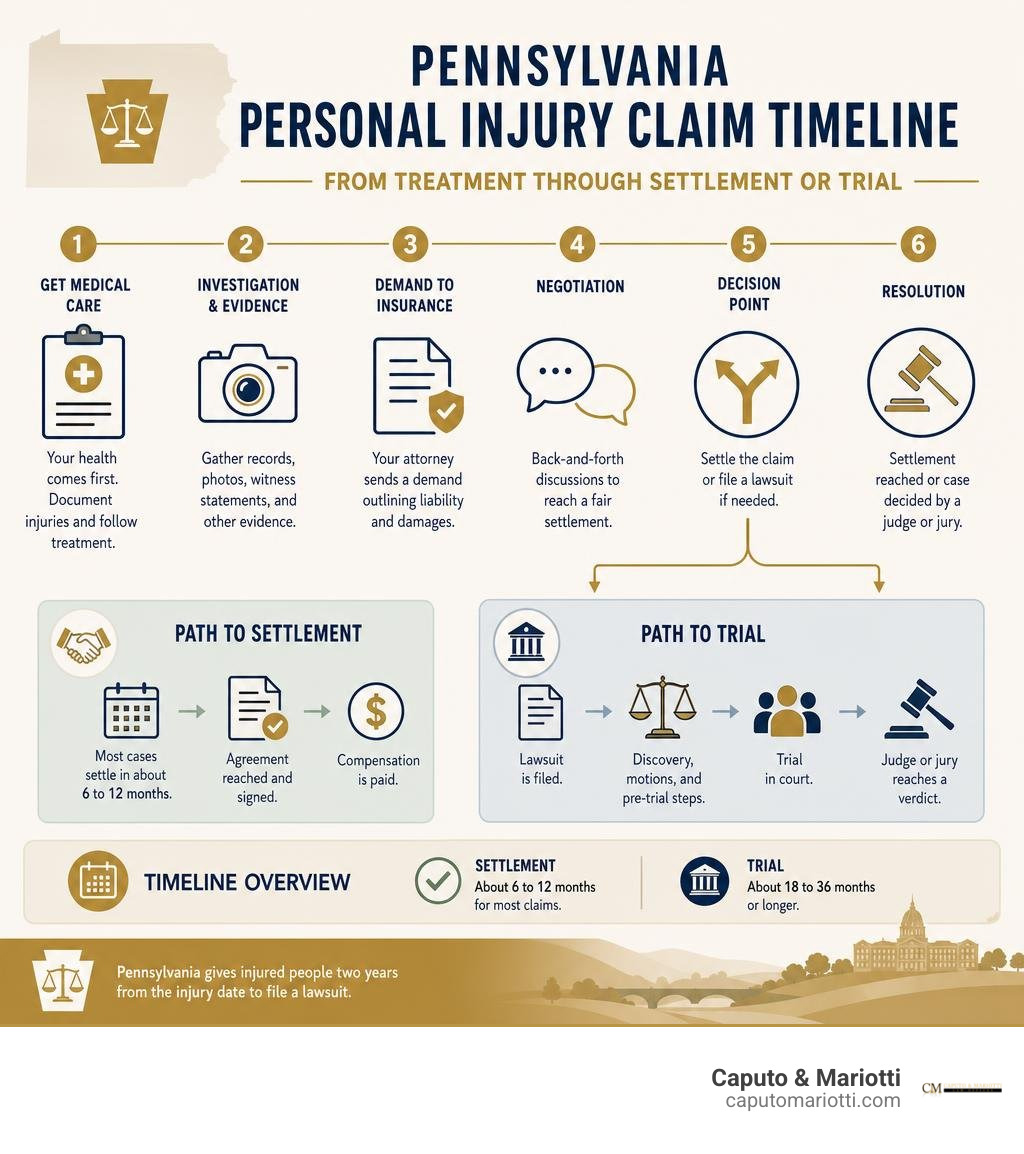
Most Pennsylvania personal injury claims settle in about 6 to 12 months. If a lawsuit is needed and the case goes to trial, resolution often takes 18 to 36 months or longer. The best first step is to get medical care, preserve evidence, and speak with an attorney before accepting an insurer’s first offer.
Your timeline depends on when your medical condition becomes clear, whether fault is disputed, the insurance company’s response, and the local court schedule. Pennsylvania generally gives injured people two years from the injury date to file a lawsuit, so waiting too long can put your claim at risk.
I am Chris Caputo, a Pennsylvania personal injury attorney since 1994 who has handled hundreds of injury, wrongful death, and insurance bad-faith cases. I help clients understand how long does a personal injury case take Pennsylvania and what can be done to move a claim forward without settling for less than it is worth.
Easy how long does a personal injury case take pennsylvania glossary:
Overview of How Long Does a Personal Injury Case Take Pennsylvania

When an unexpected injury disrupts your routine, one of the most pressing questions is how soon you can resolve the legal claim and secure fair compensation. In Pennsylvania, the path from injury to resolution follows defined procedural steps, but the overall duration depends heavily on whether your case resolves through direct settlement negotiations, mandatory arbitration, or formal trial proceedings. Understanding the legal process in personal injury cases helps manage expectations and prevents settling prematurely.
The table below outlines standard resolution timeframes across different resolution paths under Pennsylvania civil practice:
| Resolution Path | Typical Duration | Primary Factors Influencing Duration |
|---|---|---|
| Direct Pre-Litigation Settlement | 6 to 12 Months | Time needed to reach maximum medical improvement (MMI), complete medical records collection, and complete insurer negotiations. |
| Pennsylvania Mandatory Arbitration | 6 to 9 Months | Available for civil claims seeking $50,000 or less; uses an expedited hearing schedule before a panel of attorneys. |
| Full Litigation & Jury Trial | 18 to 36+ Months | Formal discovery, depositions, independent medical exams, pre-trial motions, and county court docket schedules. |
Pre-Litigation Timelines: How Long Does a Personal Injury Case Take Pennsylvania for Early Settlement?
Over 95% of personal injury matters across Pennsylvania resolve through settlement negotiations before ever entering a courtroom. Pre-litigation claims typically require 6 to 12 months to reach a finalized payout.
This phase begins with your medical treatment and continues until your treating physicians determine that your condition has stabilized. Once full medical records and billing statements are compiled, our team drafts and submits a formal demand package to the at-fault party’s insurance carrier. Insurance carriers in Pennsylvania typically take 30 to 45 days to review the demand and issue an initial response. Successfully mastering the settlement process requires balancing timely follow-ups with enough patience to counter low initial settlement offers.
Litigation to Verdict: How Long Does a Personal Injury Case Take Pennsylvania in Court?
If an insurance company disputes liability or refuses to offer adequate compensation, filing a formal civil lawsuit becomes necessary. When a complaint is filed in county courts—such as the Lackawanna County Court of Common Pleas in Scranton or the Luzerne County Court of Common Pleas in Wilkes-Barre—the case shifts into a formal litigation track that typically takes 18 to 36 months to reach a verdict.
Court backlogs, formal motion schedules, and trial availability determine the exact pace. Preparing for trial involves complex procedural requirements, and successfully navigating personal injury trials ensures every piece of evidence, witness testimony, and expert opinion is organized for court presentation.
Mandatory Arbitration for Claims Under $50,000
To reduce court congestion and expedite smaller civil disputes, Pennsylvania operates a compulsory statutory arbitration program in many judicial districts for cases where the amount in controversy does not exceed $50,000 (with specific limits established by local county rules).
Under this system, the case is presented before a panel of three local practicing attorneys rather than a judge and jury. The arbitration process significantly shortens the litigation timeline, often delivering a resolution within 6 to 9 months of filing. Following the panel’s award, either party has a statutory 30-day window to file an appeal de novo, which allows the case to proceed to a full jury trial if the arbitration award is contested.
Key Stages of the Pennsylvania Personal Injury Timeline

Every personal injury claim progresses through a series of structured milestones. Knowing what happens at each stage helps avoid surprises as your claim develops.
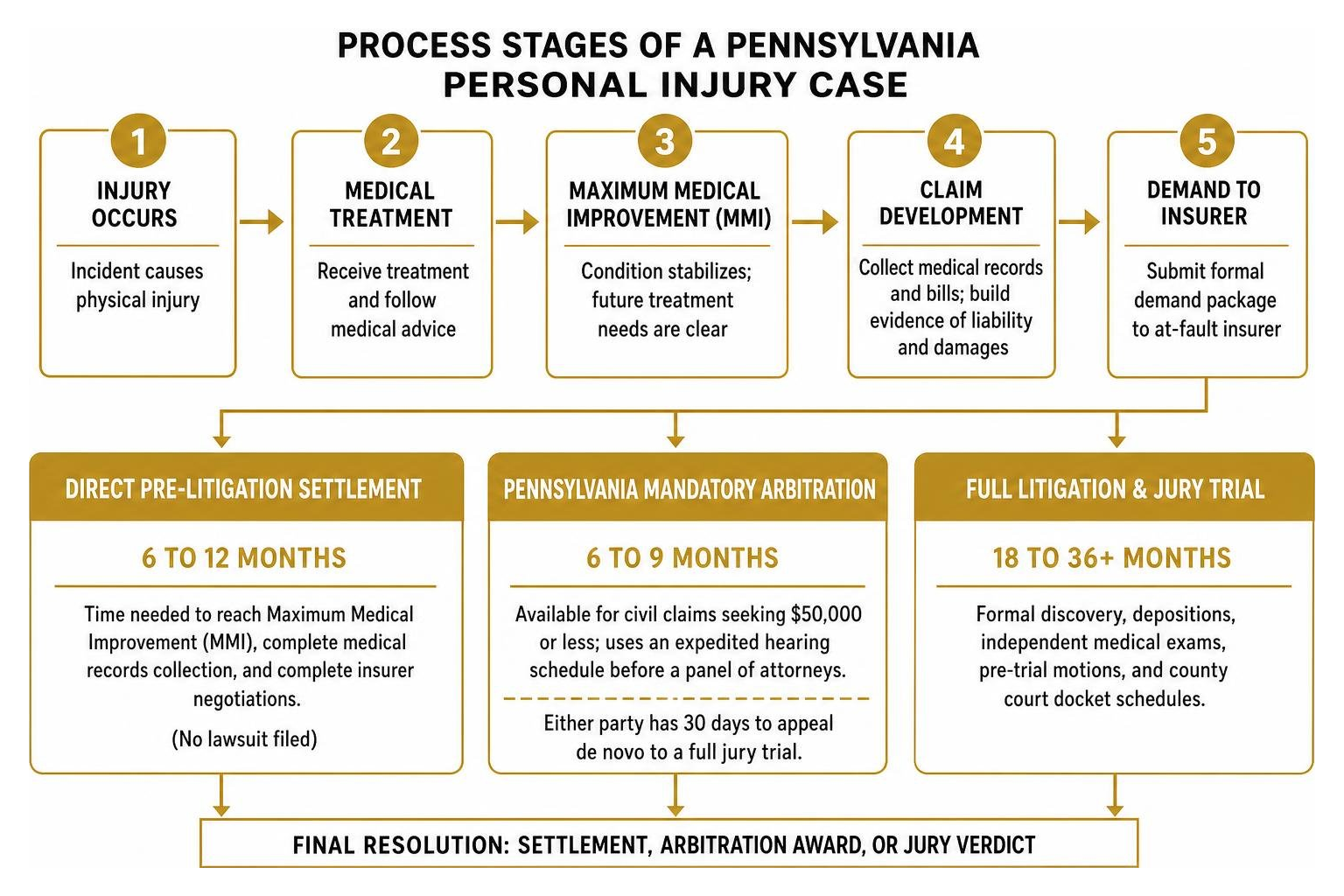
A successful claim relies on establishing negligence and documenting losses. Recognizing the role of evidence in personal injury claims is vital during each of the following phases:
Medical Treatment and Maximum Medical Improvement (MMI)
The foundational phase of any injury claim is your physical recovery. Attorneys advise against negotiating a settlement until you have reached Maximum Medical Improvement (MMI)—the point where your medical condition has fully stabilized and further recovery or treatment needs are clearly understood.
Settling before reaching MMI creates serious financial risk. If you settle while still undergoing diagnostic testing or physical therapy, you cannot reopen your claim later to recover the cost of future surgeries or permanent care needs.
The Discovery Phase, Depositions, and Pre-Trial Motions
Once a formal complaint is filed and served upon the defendants, the litigation enters the discovery stage, which typically spans 6 to 12 months. During discovery, both parties exchange information through:
- Written Interrogatories: Formal written questions requiring sworn, written responses regarding the accident, injuries, and background.
- Requests for Production of Documents: Exchanging medical files, maintenance logs, phone records, and incident reports.
- Depositions: Sworn oral testimony taken before a court reporter where attorneys question plaintiffs, defendants, eyewitnesses, and treating doctors.
- Expert Witness Reports & IMEs: Submitting expert analyses regarding economic losses or accident reconstruction, alongside Independent Medical Examinations (IMEs) requested by the defense.
Following discovery, attorneys may argue pre-trial motions, such as motions for summary judgment, asking the court to rule on specific legal issues before trial begins.
(Note: If your injury occurred in the workplace, claims follow distinct administrative rules. In those scenarios, working with a qualified workers’ compensation lawyer is essential. Pennsylvania workers’ compensation operates as a no-fault system requiring prompt injury reporting to employers within strict 21-to-120-day windows. The process demands specific medical treatment guidelines under designated employer physician lists for the first 90 days, thorough evidence gathering involving witness statements and objective medical records, precise filing procedures with the Bureau of Workers’ Compensation, and structured legal appeals before Workers’ Compensation Judges and the Workers’ Compensation Appeal Board).
Major Factors Affecting Case Duration in Pennsylvania
No two personal injury matters progress at the exact same speed. The specific facts surrounding your accident dictate how quickly the matter can resolve. For an overview of how case types differ, reviewing various types of personal injury cases can provide helpful clarity.
Severity of Injuries and Case Complexity
Cases involving catastrophic harm—such as spinal cord trauma, traumatic brain injuries, or complex fractures—take longer to value and resolve than minor soft-tissue claims. Determining long-term economic damages, lost future earning potential, and lifelong medical costs requires consulting medical professionals, life-care planners, and economic analysts.
Similarly, complex liability cases involving multiple defendants, commercial trucking companies, defective consumer products, or medical malpractice require exhaustive investigations, which extend the overall timeline.
Pennsylvania Two-Year Statute of Limitations
Under Pennsylvania law, an injured person generally has two years from the date of the incident to file a personal injury lawsuit. Failing to file within this statutory window permanently forfeits your legal right to pursue compensation through the court system.
While rare exceptions exist—such as the “discovery rule” for latent injuries or the tolling of deadlines for minors until their 18th birthday—it is crucial to understand understanding the statute of limitations for personal injury cases early so your legal team has sufficient time to investigate, collect records, and draft formal pleadings.
Insurance Company Delay Tactics and Settlement Calculations
Insurance adjusters evaluate claims using internal assessment formulas designed to minimize company payouts. Understanding how insurance companies calculate injury settlements helps explain why carriers often delay responses, request redundant documentation, or make low initial offers to pressure claimants facing growing medical bills. A focused legal strategy counters these delays and keeps the claim moving forward.
Frequently Asked Questions About Pennsylvania Personal Injury Timelines
How long does a personal injury trial usually last in Pennsylvania courts?
Once jury selection begins, the actual trial in a Pennsylvania personal injury case typically lasts 3 to 7 court days. Highly complex matters with multiple expert witnesses may extend to two weeks or more. During this time, both sides present opening statements, examine witnesses, submit physical exhibits, deliver closing arguments, and await jury deliberations.
Does a medical malpractice claim take longer than a car accident case in Pennsylvania?
Yes. Medical malpractice cases in Pennsylvania frequently take 2 to 4 years to reach completion. Under Pennsylvania civil procedure rules, plaintiffs must obtain and file a formal Certificate of Merit supported by a qualified medical expert within 60 days of filing the complaint. The extensive review of medical charts, complex depositions of healthcare personnel, and intensive expert witness disclosures make medical malpractice litigation longer than a typical vehicle accident claim.
Can I expedite my personal injury case settlement?
While you should never sacrifice full compensation for a hasty payout, you can help keep your claim on track by:
- Attending all scheduled medical appointments and following therapy plans closely.
- Retaining all receipts, out-of-pocket expense logs, and wage loss documentation.
- Promptly sharing any communications received from insurance carriers with your legal team.
- Avoiding discussions of your accident or recovery on social media platforms.
Conclusion
Resolving a personal injury claim in Pennsylvania requires legal knowledge, careful preparation, and the patience to hold insurance carriers accountable. With over 55 years of combined legal experience, the legal team at Caputo & Mariotti serves injured individuals throughout Northeastern Pennsylvania, including Scranton, Wilkes-Barre, Pittston, Hazleton, Dickson City, Moosic, Lackawanna County, and Luzerne County.
If you or a loved one has suffered an injury, we are ready to guide you through every stage of the legal process. Schedule a free personal injury consultation today to discuss your case timeline, explore our comprehensive personal injury legal services, or connect directly with an experienced personal injury attorney in Scranton and Wilkes-Barre PA.
