

The dedicated legal team of Caputo & Mariotti
Navigating Pennsylvania Product Liability Law: From Evidence to Filing
November 11, 2026
How to File a Product Liability Claim in Pennsylvania
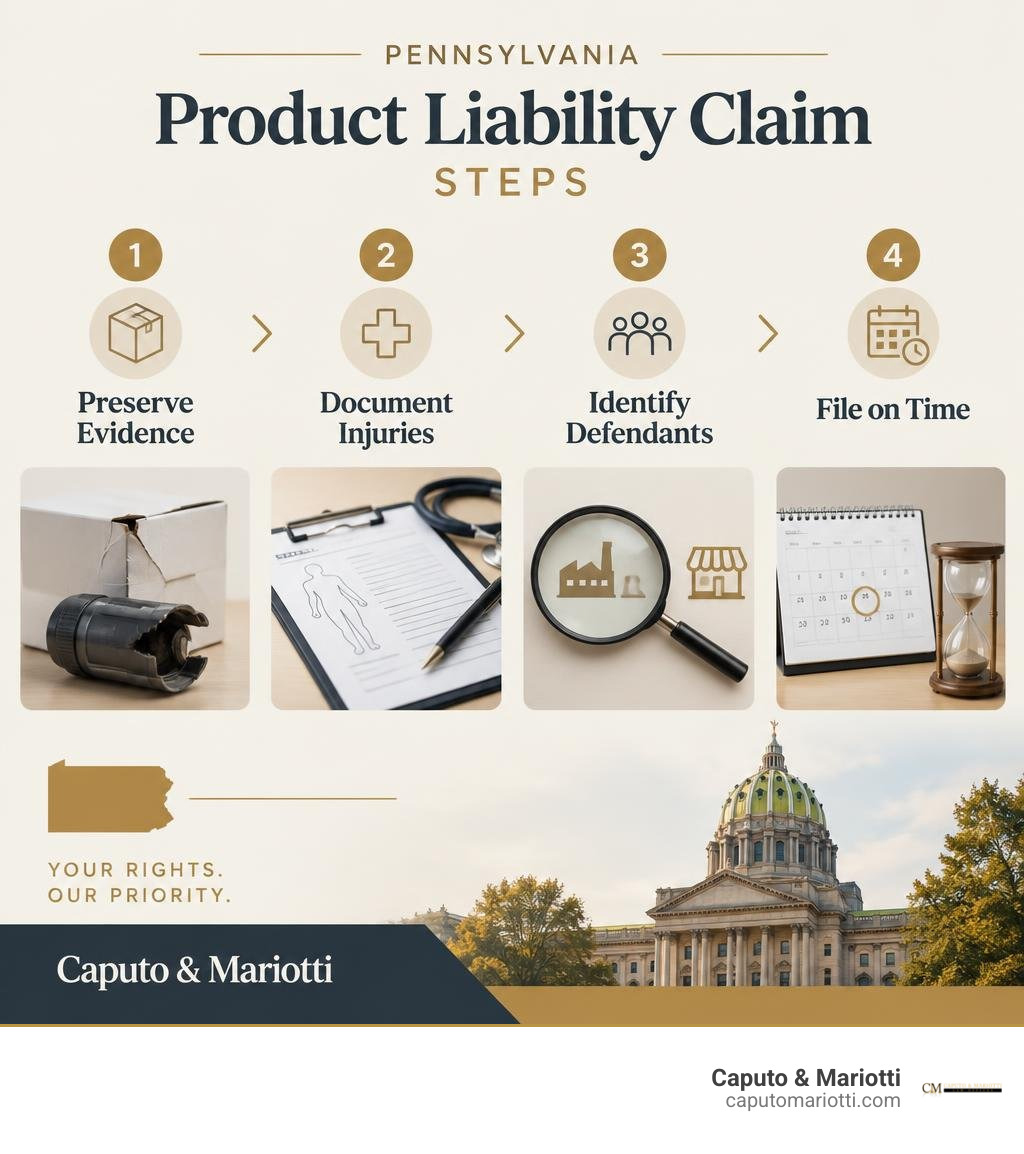
If a defective product injured you, keep the product and its packaging, get medical care, and save photos, receipts, and medical records. Identify the manufacturer and seller, then speak with a Pennsylvania attorney about filing a complaint in the proper court. Most injury claims must be filed within two years, so do not wait for treatment to end before checking your deadline.
I’m Chris Caputo, a Pennsylvania personal injury attorney with decades of litigation experience at Caputo & Mariotti. I’ll explain how to file a product liability claim in Pennsylvania, from preserving evidence to meeting the filing deadline.
Legal Grounds: Understanding Strict Liability and Defect Types in PA
When a dangerous item causes harm, understanding our state’s legal framework helps you seek fair financial recovery. You do not always have to show that a designer or builder acted carelessly to hold them responsible. Our guide to product liability in Pennsylvania explains how state tort laws protect consumers when commercial goods cause severe injuries.
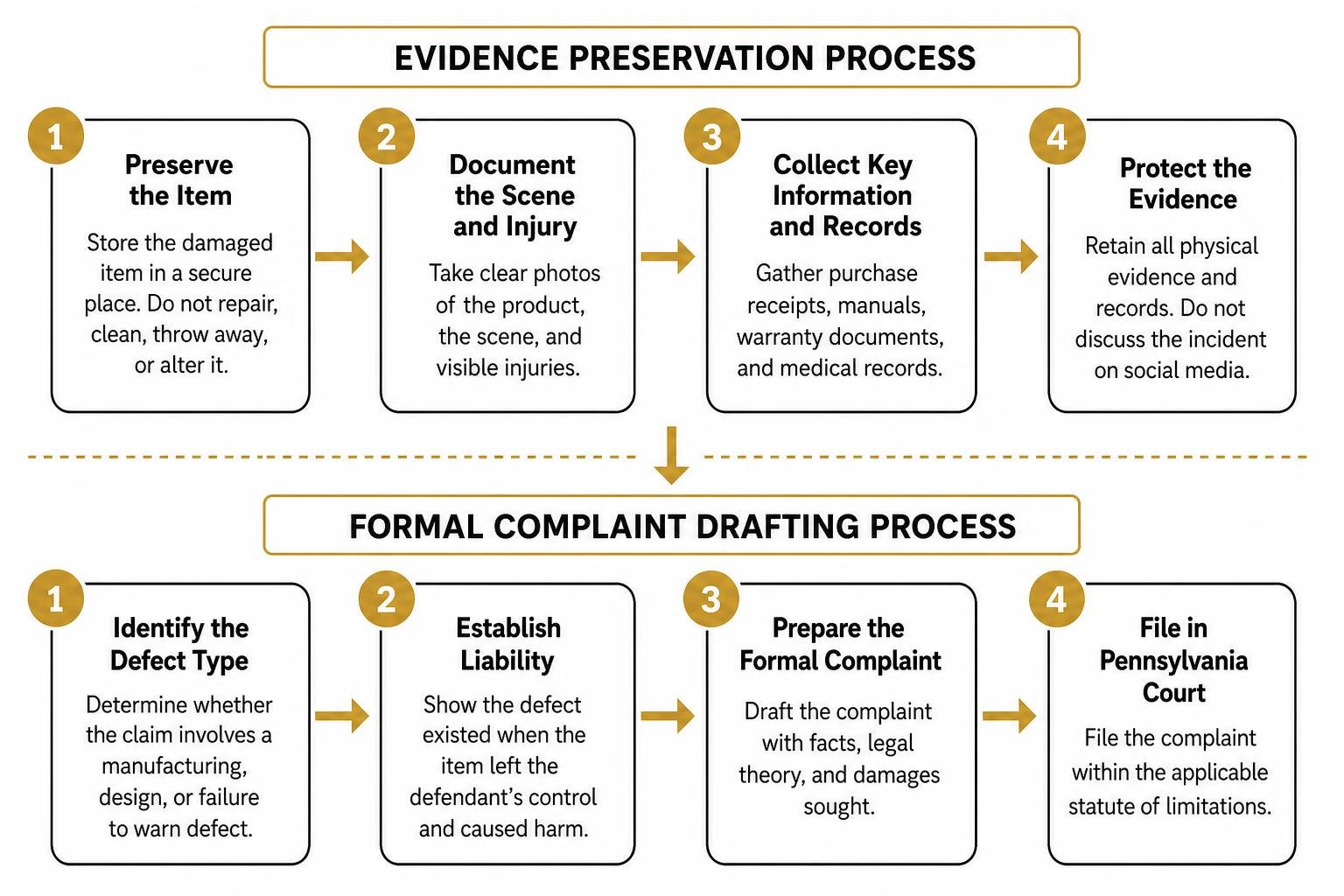
To build a valid claim, we must show that the item was defective, that the defect existed when it left the defendant’s control, and that this flaw directly caused your harm. State courts recognize three main categories of product defects:
| Defect Category | Core Legal Definition | Common Example |
|---|---|---|
| Manufacturing Defect | The item departs from its intended design during assembly or fabrication. | A cracked structural bolt in a power tool caused by improper factory heat treatment. |
| Design Defect | The blueprint or design itself is inherently dangerous, even when assembled perfectly. | An SUV designed with a top-heavy center of gravity that leads to preventable rollovers. |
| Failure to Warn / Marketing | The item lacks adequate instructions, safe usage warnings, or hidden hazard notices. | A medication sold without labeling that warns of severe, known side effects. |
For additional details on state civil filing rules, review the Pennsylvania Statute of Limitations to ensure you remain within statutory limits.
Types of Actionable Product Defects
Every successful case starts by identifying the exact nature of the product’s defect. Our review of the types of defective product liability claims categorizes these actionable flaws into three distinct legal areas:
- Manufacturing Defects: These occur when an error in the manufacturing line creates a finished good that differs from the manufacturer’s design specifications. Even if the manufacturer instituted thorough quality control inspections, they remain accountable if a single defective unit slips past and injures a consumer.
- Design Defects: Here, the product matches its blueprint, but the blueprint itself creates an unreasonable danger during normal or foreseeable use. We evaluate whether a practical, safer alternative design existed that would have prevented the harm without destroying the product’s utility.
- Failure to Warn: Manufacturers and sellers must provide clear instructions and warn about foreseeable dangers that are not obvious to the everyday user. If a product lacks proper warning labels or clear operating guidance, the maker can be held liable for marketing defects.
How Strict Liability Applies Under Pennsylvania Law
Under Section 402A of the Restatement (Second) of Torts, Pennsylvania enforces a strict liability standard against commercial entities that sell defective items. We examine the ins and outs of defective product lawsuits through this consumer-friendly doctrine.
In standard negligence claims, an injured party must prove that a party failed to use reasonable care. In strict liability claims, the focus shifts away from the defendant’s conduct and rests entirely on the condition of the product itself. If the product was defective and unreasonably dangerous when sold, the seller is liable—even if they exercised all possible care in preparing and distributing the item.
How to File a Product Liability Claim in Pennsylvania: Step-by-Step Procedure
Filing a formal claim requires careful preparation, thorough factual investigations, and proper procedural steps within the court system.
Preserving Evidence and Gathering Crucial Documentation
The strength of any legal action depends heavily on the physical evidence you protect immediately following an incident. Following our what to do after a personal injury accident protocol ensures your rights remain secure:
- Preserve the Item: Store the damaged item in a secure place. Do not attempt to repair it, clean it, throw it away, or alter its components.
- Retain Packaging and Manuals: Keep all original boxes, instruction manuals, warranty cards, purchase receipts, and maintenance paperwork.
- Document the Scene: Take clear photographs and video recordings of the failed item, the immediate surroundings where the failure took place, and all visible physical injuries.
- Secure Medical Records: Obtain complete documentation from all emergency room visits, physician consultations, physical therapy sessions, and diagnostic scans.
Understanding the broader role of evidence in personal injury claims allows us to reconstruct how the incident occurred and establish clear causal links between the defect and your injuries.
Identifying Potential Defendants in the Supply Chain
Pennsylvania law allows you to bring a lawsuit against any commercial entity in the distribution chain that placed the dangerous item into commerce. Potential defendants include:
- The primary product manufacturer and its corporate parent entities.
- Component part fabricators and raw material suppliers.
- Wholesale distributors and regional logistics warehouses.
- Retail stores, dealerships, or commercial supply vendors.
When dangerous machinery causes harm in an industrial setting, handling product liability on the job can involve both product liability and workers’ compensation claims. A workplace injury can support a third-party claim against an outside equipment manufacturer alongside an employer claim.
If you were hurt at work, our dedicated workers’ compensation lawyer can guide you through the Pennsylvania no-fault system. This includes adhering to strict reporting requirements (notifying your employer within 21 to 120 days), obtaining care from designated panel physicians during the initial 90-day window, documenting workplace records and witness statements, submitting formal claim petitions, and navigating appeals before Workers’ Compensation Judges.
Drafting the Complaint on How to File a Product Liability Claim in Pennsylvania
Once the investigation identifies all liable parties and collects supporting evidence, your attorney files a formal civil complaint. This pleading outlines the factual background, details the defect theories (strict liability, negligence, and breach of implied warranties), and sets out your financial damages demand.
An experienced product liability lawyer files the complaint in the appropriate court—such as the Lackawanna County Court of Common Pleas in Scranton or the Luzerne County Court of Common Pleas in Wilkes-Barre—and arranges formal service of original process according to the Pennsylvania Rules of Civil Procedure.
Critical Deadlines: Pennsylvania Statute of Limitations and Exceptions
Missing a statutory filing deadline can permanently bar an injured person from recovering compensation, no matter how severe their injuries or clear the product defect.

Our guide to the Pennsylvania personal injury statute of limitations details the strict statutory deadlines that control civil litigation across the Commonwealth.
Navigating Deadlines and the Discovery Rule for How to File a Product Liability Claim in Pennsylvania
Under 42 Pa.C.S. § 5524(2), the standard statute of limitations for personal injury and product liability claims is two years from the date the injury occurs. However, exceptions exist:
- The Discovery Rule: In cases involving latent conditions, such as occupational illness or injuries from hidden chemical exposure, the two-year clock does not run immediately. Instead, it begins when you know—or reasonably should know through reasonable diligence—that you have suffered an injury caused by another party’s conduct. In toxic exposure cases, this often aligns with an official medical diagnosis from a licensed physician.
- Minority Tolling: If an injured party is a minor under the age of 18 at the time of the incident, the two-year statutory clock is paused (tolled) until their 18th birthday, giving them until age 20 to file.
- Incapacity Tolling: If an injured person suffers from a legally recognized mental incapacity at the time the cause of action accrues, the statutory timeframe may be tolled until their capacity is restored.
Statutes of Repose and Government Entity Notice Requirements
A statute of repose sets a firm cutoff date for filing a lawsuit, measured from when a product was first sold or an improvement was completed, regardless of when an injury occurs.
- Defective Construction and Fixtures: Under 42 Pa.C.S. § 5536, civil claims involving defective improvements or construction fixtures must be brought within 12 years from the completion of the construction project. Legislative efforts, including historical measures like Senate Bill 784, have long analyzed how repose periods balance manufacturer liability with consumer safety.
- Claims Involving Government Entities: If a municipal agency, public transit division, or Commonwealth agency is named as a defendant, Pennsylvania law enforces an administrative notice requirement. Under 42 Pa.C.S. § 5522, you must file a formal written notice of your claim within six months of the injury date before you can proceed with a civil lawsuit.
Assessing Damages and Recoverable Compensation in Defective Product Cases
When an unsafe item causes physical harm, Pennsylvania law allows injured plaintiffs to seek financial compensation through economic, non-economic, and punitive damages. Our overview of compensation and damages breaks down the primary categories of recovery:
- Economic Damages: These cover measurable financial losses, including past and future medical expenses, hospital bills, rehabilitation therapy costs, adaptive medical hardware, lost wages, diminished future earning capacity, and property damage.
- Non-Economic Damages: These address intangible impacts, such as physical pain and suffering, mental anguish, loss of life’s pleasures, emotional distress, and permanent disfigurement or physical scarring.
- Punitive Damages: In cases where a corporate defendant showed willful, wanton, or reckless indifference to consumer safety—such as knowingly concealing a dangerous defect—courts and juries may award punitive damages to punish the wrongdoer and deter similar conduct.
Every comprehensive personal injury claim requires detailed documentation of these damages to ensure any settlement or court verdict reflects the full extent of your losses.
Frequently Asked Questions About Pennsylvania Defective Product Claims
What is the time limit for filing a product liability claim in Pennsylvania?
In most cases, you have two years from the date of the injury to file a lawsuit in a Pennsylvania court. If the injury was not immediately discoverable, the discovery rule may begin the two-year period on the date you received an official medical diagnosis or connected your condition to the product.
Who can be held liable for an injury caused by a defective product?
Any commercial entity in the chain of distribution can be held strictly liable. This includes product designers, component manufacturers, finished-goods assemblers, wholesale distributors, logistics suppliers, and retail sellers located throughout Pennsylvania and beyond.
Do I need to prove negligence to win a product liability lawsuit in Pennsylvania?
No. Under Pennsylvania strict liability law (Section 402A), you do not need to prove that the manufacturer or seller was careless. You only need to establish that the product was sold in a defective, unreasonably dangerous condition and that this defect caused your injuries during foreseeable use.
Conclusion
Product liability litigation requires thorough evidence preservation, detailed engineering and medical analysis, and careful adherence to statutory deadlines. For clients across Northeastern Pennsylvania—including Scranton, Wilkes-Barre, Moosic, Pittston, Dickson City, Hazleton, and surrounding areas in Lackawanna County and Luzerne County—our team brings more than 55 years of combined legal experience to holding negligent manufacturers accountable.
If a defective product injured you, reach out to our Scranton product liability team. Schedule a confidential consultation with Caputo & Mariotti today so we can review your case, preserve your evidence, and protect your right to compensation before your statutory deadlines expire.
