

The dedicated legal team of Caputo & Mariotti
In Depth Guide to Pennsylvania Personal Injury Statute of Limitations
October 14, 2026
Pennsylvania Personal Injury Filing Deadline: The Two-Year Rule
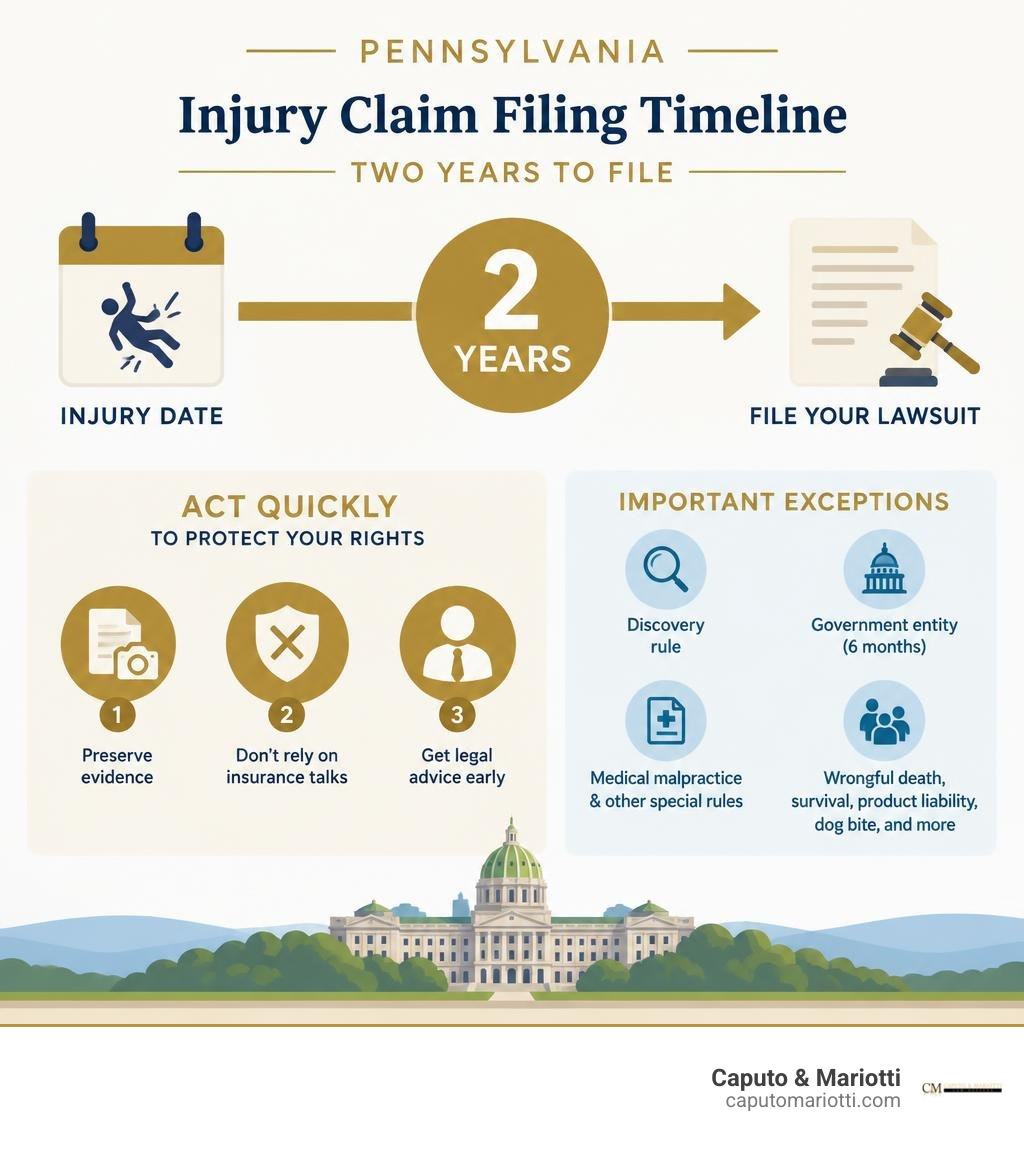
For most injury lawsuits, the personal injury statute of limitations in Pennsylvania is two years. In plain terms, you usually must file your lawsuit within two years of the date you were hurt. Waiting longer can allow the other side to ask the court to dismiss an otherwise valid claim.
Act quickly if you believe you may have a claim:
- Write down the injury date and preserve records, photos, and witness information.
- Do not assume insurance negotiations pause the deadline.
- Get legal advice promptly, especially if the injury was not discovered right away, involves medical malpractice, a minor, or a government agency.
The two-year rule has important exceptions. For example, the discovery rule can affect when the clock starts for an injury that was not immediately known, while a claim involving a Pennsylvania government entity may require written notice within six months. Wrongful death, survival, product liability, dog bite, and medical malpractice claims can also involve special rules.
I am Chris Caputo, a Pennsylvania attorney who has represented injured people and families in personal injury and wrongful-death matters since 2007, following years of courtroom and litigation work. In this guide to the personal injury statute of limitations Pennsylvania, I will explain the key deadlines and exceptions that can affect your right to file.
Related Pennsylvania injury resources:
- Review the steps for filing a personal injury claim in Pennsylvania.
- Learn the basics of personal injury law.
- Know what to do after a personal injury accident in Pennsylvania.
Understanding the Personal Injury Statute of Limitations Pennsylvania Rules
The foundation of Pennsylvania tort law rests on strict statutory timeframes. Codified under 42 Pa. C.S. § 5524, the state legislature establishes an absolute window within which an injured person must initiate a civil action. When a crash, slip and fall, or other act of negligence occurs, the clock begins ticking on the precise “accrual date”—typically the day the physical injury happens.
Our legal team has spent more than 55 combined years helping individuals across Northeastern Pennsylvania, including Scranton, Wilkes-Barre, Lackawanna County, Luzerne County, Moosic, Dickson City, Hazleton, and Pittston. A key part of understanding personal injury claims in Scranton is knowing how these deadlines operate in practice. If you attempt to file a lawsuit even one day after the statutory timeframe expires, the defendant will almost certainly raise the statute of limitations as an affirmative defense, resulting in the dismissal of your case.
Standard Deadlines Under the Personal Injury Statute of Limitations Pennsylvania
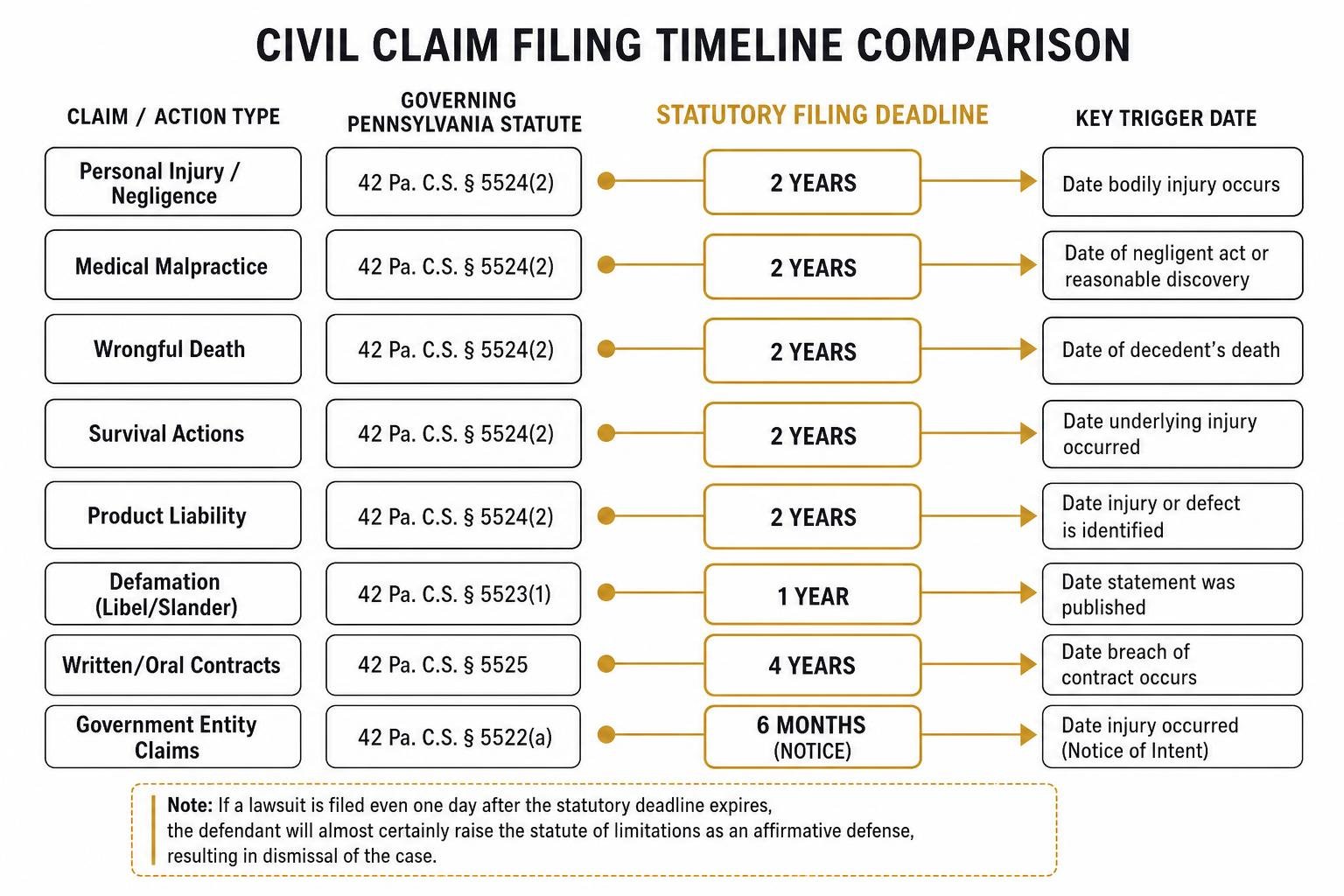
Under Pennsylvania law, different injury-related causes of action can involve distinct statutory limitations. While general bodily injury cases must be initiated within two years, certain claims have special trigger dates or notice requirements.
| Claim / Action Type | Governing Pennsylvania Statute | Statutory Filing Deadline | Key Trigger Date |
|---|---|---|---|
| Personal Injury / Negligence | 42 Pa. C.S. § 5524(2) | 2 Years | Date bodily injury occurs |
| Medical Malpractice | 42 Pa. C.S. § 5524(2) | 2 Years | Date of negligent act or reasonable discovery |
| Wrongful Death | 42 Pa. C.S. § 5524(2) | 2 Years | Date of decedent’s death |
| Survival Actions | 42 Pa. C.S. § 5524(2) | 2 Years | Date underlying injury occurred |
| Product Liability | 42 Pa. C.S. § 5524(2) | 2 Years | Date injury or defect is identified |
| Government Entity Claims | 42 Pa. C.S. § 5522(a) | 6 Months (Notice) | Date injury occurred (Notice of Intent) |
Following the proper procedures for filing a personal injury claim in Pennsylvania ensures you meet all statutory filing mandates while building a well-supported claim for full financial recovery.
Specific Case Types: Medical Malpractice, Wrongful Death, and Strict Liability
Understanding the nuances across types of personal injury cases is essential because statutory rules can apply differently depending on the nature of the claim:
- Medical Malpractice: Governed by the Medical Care Availability and Reduction of Error (MCARE) Act alongside 42 Pa. C.S. § 5524(2), healthcare negligence claims must be brought within two years. When foreign objects are left inside a surgical patient or when injuries are hidden, the discovery rule or fraudulent concealment exceptions may apply.
- Wrongful Death vs. Survival Actions: While both types of claims arise from fatal incidents, they serve distinct legal functions. A wrongful death action belongs to surviving family members (spouse, children, or parents) to compensate for their loss, with the two-year clock starting on the date of death. A survival action belongs to the decedent’s estate for the pain and suffering endured prior to passing, running two years from the initial injury date.
- Strict Liability and Dog Bites: Under Pennsylvania dog bite statutes, owners are held strictly liable for all veterinary and medical damages resulting from a bite. If you pursue non-economic damages such as pain and suffering, negligence must be proven, and the standard two-year filing period applies.
- Product Liability: Dangerous and defective products causing bodily harm follow the two-year negligence and strict liability deadlines, measured from when the defective product caused injury.
- Workplace Injuries: Workplace injuries follow Pennsylvania’s no-fault workers’ compensation system. Injured employees must formally report the incident to their employer within 21 to 120 days and file a formal claim petition within three years. Securing proper medical treatment, gathering evidence such as coworker witness statements and diagnostic records, maintaining detailed documentation, and managing formal filings and legal appeals require prompt attention from a qualified workers’ compensation lawyer.
Critical Exceptions, Tolling Doctrines, and Special Rules

While the statutory calendar is rigid, Pennsylvania provides equitable exceptions called tolling doctrines. Under Title 42 Chapter 55 Judicial Procedure, specific factual scenarios pause or extend the limitation clock.
Exceptions and Tolling Rules for the Personal Injury Statute of Limitations Pennsylvania
The application of statutory tolling depends heavily on specific circumstances:
- The Discovery Rule: In cases where an injury or its negligent cause cannot reasonably be discovered right away, the discovery rule delays the clock until the victim knows, or through reasonable diligence should know, that an injury occurred due to another’s conduct. Pennsylvania courts apply this standard narrowly, requiring proof of diligent inquiry.
- Minority Tolling: Under 42 Pa. C.S. § 5533(b), the clock is completely paused for minors. If an individual is hurt before turning 18, the two-year period does not begin until their 18th birthday, giving them until age 20 to initiate legal action.
- Adult Incapacity Rules: Pennsylvania law does not provide automatic statutory tolling for adults who experience mental incapacity or cognitive limitations after an injury. Adults must rely on appointed guardians or legal representatives to file claims within standard deadlines.
- Fraudulent Concealment and Absent Defendants: If a defendant conceals their identity or leaves the Commonwealth of Pennsylvania to evade service of process, statutory provisions allow the court to toll the countdown during the period of absence or active deception.
Government Entity Notice and Out-of-State Borrowing Statutes
Suing state or local government bodies introduces specialized statutory requirements:
- Six-Month Government Notice Rule: Under 42 Pa. C.S. § 5522(a), anyone intending to file a lawsuit against the Commonwealth of Pennsylvania, local municipalities, school districts, or transit agencies must serve a formal written Notice of Intent to Sue within six months of the injury date. Missing this six-month deadline can permanently bar recovery, even if the general two-year limit has not expired.
- Damage Caps: Commonwealth agencies face statutory liability limits of $250,000 per individual and $1,000,000 per occurrence, while local political subdivisions are capped at $500,000.
- The Pennsylvania Borrowing Statute: Codified at 42 Pa. C.S. § 5521, this statute applies to injuries occurring outside the Commonwealth. Under this rule, Pennsylvania courts will apply either Pennsylvania’s limitation period or the statute of limitations of the state where the injury occurred—whichever is shorter.
How Comparative Fault and Insurance Impact Filing Timelines
Pennsylvania applies a modified comparative negligence standard under 42 Pa. C.S. § 7102. An injured person can recover damages as long as their share of causal negligence is 50 percent or less. If an individual is found 51 percent or more at fault, they are legally barred from financial recovery. If fault is 50 percent or below, recovery is reduced proportionally by that fault percentage.
Understanding this system is critical when navigating insurance claims after an injury. Pennsylvania is also a “choice no-fault” motor vehicle insurance state, requiring drivers to carry Personal Injury Protection (PIP) to cover initial medical expenses regardless of fault.
Do not allow ongoing settlement discussions with insurance adjusters to delay your lawsuit. Insurers have no obligation to settle before the statute expires, and settlement negotiations do not pause the statutory clock unless both sides execute a formal written tolling agreement.
What Happens If You Miss the Filing Deadline in Pennsylvania

Failing to submit your complaint or writ of summons before the statutory expiration date carries severe consequences. Once the limitation period lapses:
- Motion to Dismiss: The defense will file preliminary objections or a motion for summary judgment asserting the affirmative defense of the statute of limitations.
- Permanent Bar on Recovery: Judges in the Court of Common Pleas must grant dismissal for untimely filings, permanently terminating your legal right to compensation.
- Complete Loss of Negotiation Leverage: Insurance adjusters will close claim files immediately once the statute expires because the legal threat of litigation no longer exists.
Understanding the legal process in personal injury cases ensures your legal team preserves crucial evidence, interviews witnesses, and completes formal filings well ahead of all statutory cutoff dates.
Frequently Asked Questions About Pennsylvania Filing Deadlines
Does mental incapacity pause the two-year deadline in Pennsylvania?
Unlike rules in some other jurisdictions, Pennsylvania does not automatically pause the two-year statute of limitations for adults who become mentally incapacitated after an injury. Legal guardians, family representatives, or appointed attorneys must act on the injured person’s behalf within the standard statutory period.
Can the statute of limitations be extended while negotiating with an insurance adjuster?
No. Ongoing settlement talks, adjuster requests for records, and verbal assurances do not pause or extend statutory deadlines. Unless the insurance carrier signs a binding, formal written tolling agreement, your legal team must file a writ of summons or complaint in court before the two-year mark.
What is the deadline for filing a claim against a Pennsylvania city or municipality?
While the formal personal injury lawsuit must be initiated within two years, 42 Pa. C.S. § 5522(a) requires plaintiffs to submit a written Notice of Intent to Sue to the specific municipality, city council, or government agency within six months of the injury date.
Conclusion
Understanding statutory filing rules under Pennsylvania law is essential to protecting your right to fair compensation. Missing a single filing deadline can permanently bar an otherwise valid claim, regardless of its merits. At Caputo & Mariotti, our legal team brings more than 55 combined years of dedicated experience to fighting for injured individuals across Northeastern Pennsylvania. Schedule a free consultation with our personal injury team to ensure your case is thoroughly evaluated, documented, and filed on time.
