

The dedicated legal team of Caputo & Mariotti
Workers’ Comp Settlement vs Ongoing Benefits in PA Explained
October 29, 2026
Workers’ Comp Settlement vs. Ongoing Benefits in Pennsylvania
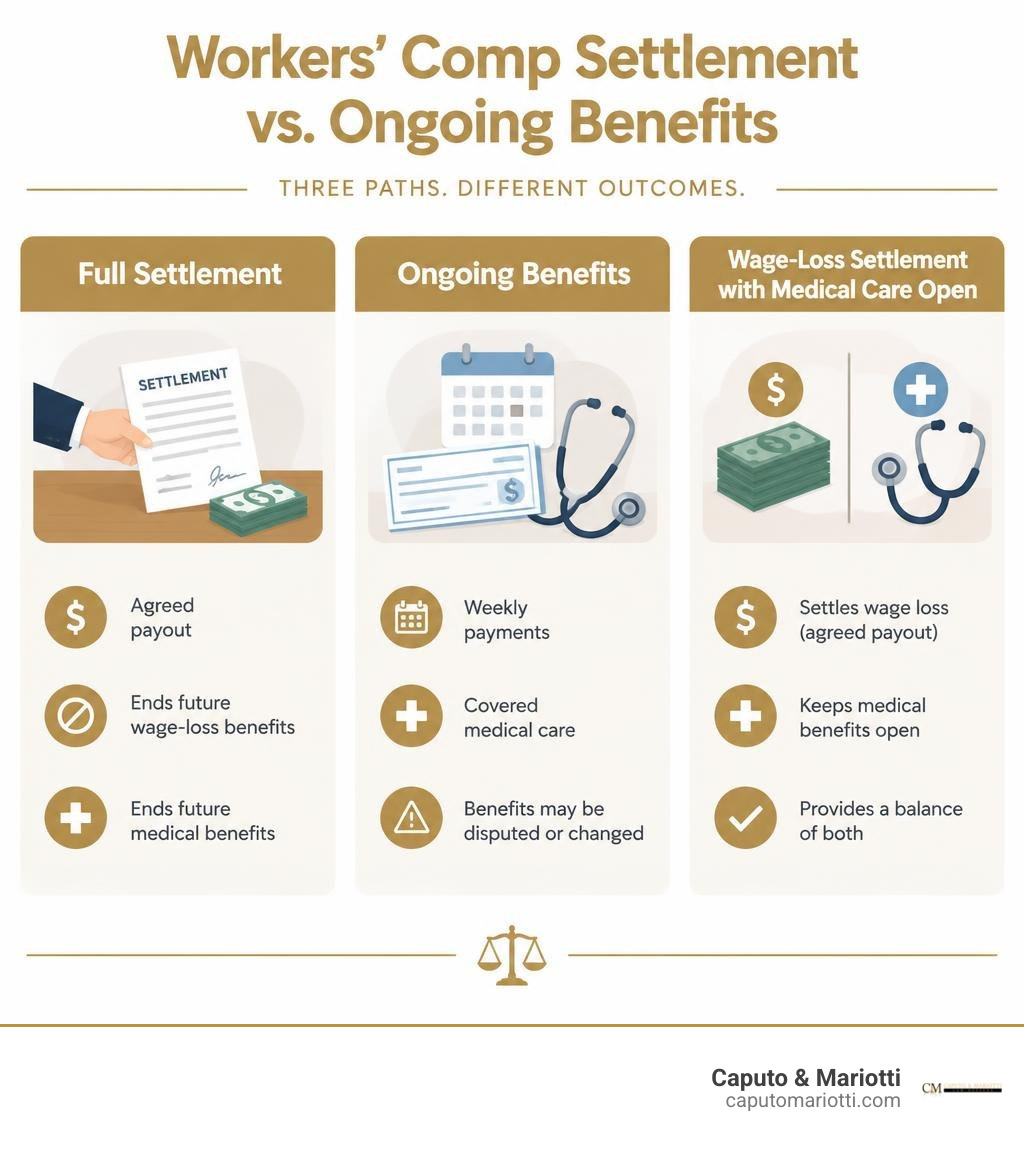
A full workers’ comp settlement gives you an agreed payout but ends your right to future wage-loss and medical benefits for the work injury. Keeping ongoing benefits means weekly payments and covered care can continue while you qualify, though those benefits may be disputed or changed. Pennsylvania also allows some agreements to settle wage loss while leaving medical benefits open. The choice depends on what the agreement actually closes and what care you may need later.
I’m Chris Caputo, a Pennsylvania injury lawyer with decades of experience litigating and settling injury claims, including disputes with insurers. This guide explains how the choice between a workers’ comp settlement vs. ongoing benefits in Pennsylvania can affect the benefits you may give up.
Learn more about related Pennsylvania workers’ compensation issues:
- Can I Sue My Employer in Addition to Workers Comp in PA?
- What Happens if Workers Comp Claim is Denied Pennsylvania
- Most Common Workplace Injuries Pennsylvania
Workers Comp Settlement vs Ongoing Benefits Pennsylvania: Core Concepts

Under the Pennsylvania Workers’ Compensation Act, injured employees enter a mandatory no-fault administrative system. You do not have to prove that your employer acted negligently to receive benefits, but in exchange, you surrender the right to file a standard civil personal injury lawsuit against your employer.
Reporting Requirements and Deadlines
To establish and protect your claim under Pennsylvania law, strict reporting deadlines must be met:
- 21-Day Notice: You should notify your employer within 21 days of the injury to ensure wage-loss benefits are retroactive to your first day of missed work.
- 120-Day Absolute Bar: You must report your injury no later than 120 days from the date of the incident or discovery of the work-related condition. Failing to give notice within 120 days completely bars your right to recover compensation.
Once reported, the employer or their insurer has 21 days to respond by issuing a Notice of Compensation Payable (NCP), a Notice of Temporary Compensation Payable (NTCP), or a formal Notice of Workers’ Compensation Denial.
Medical Treatment and Authorized Care
Workers’ compensation provides payment for reasonable, necessary, and causally related medical care. Under Pennsylvania law, if your employer properly posts a list of at least six designated healthcare providers (a “panel list”), you are required to treat with one of those panel physicians for the first 90 days following your initial visit. After the 90-day period expires, you have the legal right to treat with any healthcare provider of your choice, provided you give notice to the insurer within five days of your first appointment with the new physician.
Evidence Gathering and Documentation
Securing ongoing benefits or negotiating a maximum settlement requires comprehensive evidence gathering. Critical documentation includes:
- Official Incident Reports: Written documentation showing timely notice was provided to supervisors.
- Medical Records and Diagnostic Reports: Detailed notes from treating physicians, MRIs, X-rays, operative reports, and physical therapy logs documenting functional limitations.
- Witness Statements: Firsthand accounts from coworkers who observed the workplace accident or your physical condition immediately following the incident.
- Wage Documentation: Paystubs, W-2 forms, and wage statements used to calculate your accurate average weekly wage (AWW).
The Claim Filing Process and Legal Appeals
If the insurance company denies your claim or attempts to prematurely cut off benefits, you must initiate the formal litigation process by filing a Claim Petition (Form LIBC-362) with the Pennsylvania Bureau of Workers’ Compensation within the three-year statute of limitations. Your case will be assigned to a Workers’ Compensation Judge (WCJ) in your jurisdictional district. During litigation, both parties present medical depositions, witness testimony, and documentary evidence. If the WCJ issues an unfavorable decision, you have 20 days to file an appeal with the Workers’ Compensation Appeal Board (WCAB), with subsequent appellate avenues available before the Commonwealth Court of Pennsylvania and the Pennsylvania Supreme Court.
Voluntary Settlements vs. Statutory Benefits
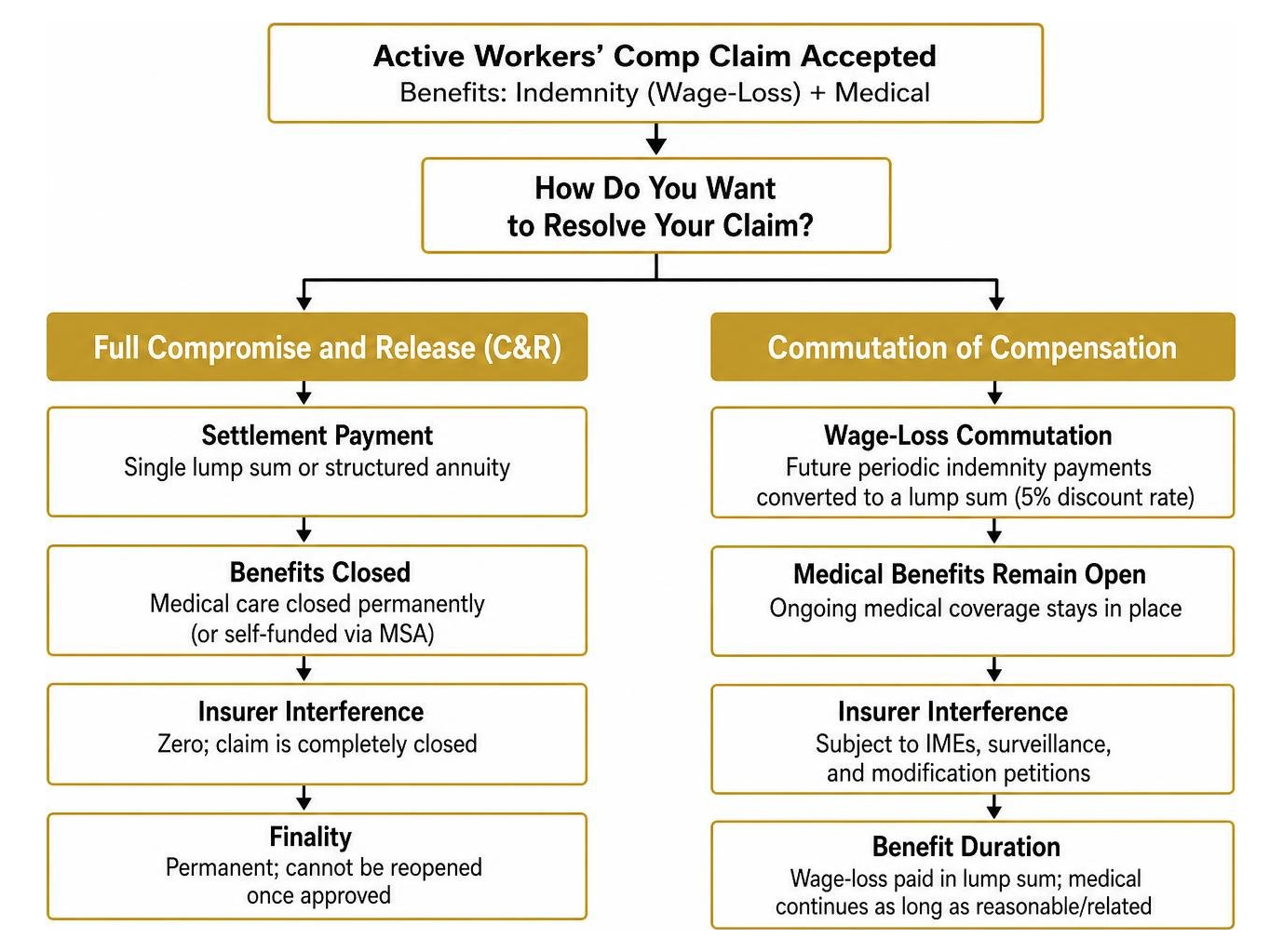
When resolving an active claim, you must understand how a voluntary settlement contrasts with remaining on the statutory benefit system. An insurance carrier may resolve liability through a structured payment or a lump-sum check known as a Compromise and Release (C&R) agreement, as outlined in detailed legal surveys like the COMPENSATION SETTLEMENTS AND STRUCTURED SETTLEMENTS Guide.
| Key Feature | Full Workers’ Comp Settlement (C&R) | Ongoing Statutory Benefits |
|---|---|---|
| Financial Delivery | Single lump sum or structured annuity | Weekly or bi-weekly direct deposit / paper checks |
| Medical Care Coverage | Closed permanently (or self-funded via MSA) | Paid by insurer as long as care is reasonable/related |
| Insurer Interference | Zero; claim is completely closed | Subject to IMEs, surveillance, and modification petitions |
| Benefit Duration | Immediate final payout | Subject to statutory caps, earning power, and medical reviews |
| Finality & Modification | Permanent; cannot be reopened once approved | Adjusts based on recovery status and litigation |
Compromise and Release vs. Weekly Wage Loss Payments
A Compromise and Release is a formal, legally binding contract between you and the workers’ compensation insurance carrier. In a standard C&R, the insurer pays an agreed-upon total amount—either as an immediate single payout or as structured annuity payments distributed over time—in exchange for an absolute release of their ongoing liability.
If you remain on weekly wage-loss checks, your compensation rate is calculated based on your average weekly wage (AWW) prior to the injury. For injuries occurring in 2026, the Pennsylvania Department of Labor & Industry sets the maximum statewide weekly compensation rate at $1,394.00. While ongoing checks provide steady cash flow, they remain vulnerable to insurer litigation. The insurance carrier can file petitions to terminate, modify, or suspend your checks if an independent medical examiner claims you have recovered or if a vocational expert argues that suitable light-duty employment exists within your local labor market. Navigating these tactics often requires actively managing disputes over ongoing compensation to keep weekly checks flowing.
Commutation of Compensation vs. Full Settlement
Pennsylvania law also contains a specific mechanism known as a “commutation of compensation.” A commutation differs fundamentally from a full Compromise and Release. In a commutation, your future periodic indemnity payments are converted into a lump sum discounted by a statutory 5% present-value rate.
The primary distinction is that a pure wage-loss commutation allows an injured worker to cash out their wage-loss entitlement while leaving ongoing medical coverage open and intact. Choosing between a full C&R buyout and a limited wage-loss agreement requires weighing future healthcare risks, as explained in the Settle Vs Keep Medical Open Guide.
Evaluating Your Settlement and Benefit Options

Choosing between a workers’ comp settlement and continuing with weekly benefits requires evaluating your physical recovery, earning capacity, and personal financial needs. Every claim has distinct trade-offs under Pennsylvania law, and knowing your legal rights helps prevent an insurance adjuster from pressuring you into an undervaluation.
Weighing Pros and Cons: Workers’ Comp Settlement vs Ongoing Benefits in Pennsylvania
Accepting a lump sum provides immediate financial control and eliminates the emotional stress of dealing with an insurance company. You no longer have to worry about private investigators conducting video surveillance outside your home, and you will never be forced to attend another adverse medical evaluation arranged by the insurer’s legal team.
However, accepting a full buyout carries inherent risks. If your physical condition deteriorates later or you require an unexpected revision surgery, you cannot demand additional money from your former employer or their insurance carrier once the settlement is finalized.
Advantages of a Lump-Sum Settlement:
- Total freedom from insurance company oversight, petitions, and nurse case managers.
- Complete control over your medical choices without requiring insurer pre-approvals or utilization reviews.
- Capital flexibility to pay off high-interest debts, pursue education, or relocate.
- Elimination of the risk that a judge might reduce or terminate your weekly checks during litigation.
Advantages of Ongoing Benefits:
- Guaranteed, predictable wage replacement checks for the statutory duration of your temporary total or partial disability.
- Insurer remains legally responsible for all reasonable, necessary, and related surgical, therapeutic, and prescription costs.
- Safety net protection if your injury worsens and prevents you from working indefinitely.
- Coverage for durable medical equipment and long-term physical therapy without draining your personal savings.
Understanding these trade-offs is especially important when calculating the duration limits for wage loss benefits, where partial disability benefits are capped at 500 weeks under Section 306(b) of the Act.
Key Factors in Choosing a Workers Comp Settlement vs Ongoing Benefits in Pennsylvania
When comparing paths, several practical elements should shape your decision:
- Severity of the Work Injury: Catastrophic injuries involving spinal trauma, severe joint damage, or neurological impairment carry uncertain lifetime medical costs. Closing medical benefits on such claims requires substantial financial allocations.
- Current Employment Status: If you have successfully transitioned into a new light-duty job or a different career that accommodates your physical restrictions, settling your old claim provides a clean financial break.
- Future Surgical Needs: If your treating orthopedic surgeon recommends a joint replacement or spinal fusion within the next two to five years, settling medical benefits prematurely can leave you with severe out-of-pocket expenses.
- Litigation Risk and Evidence Strength: If the insurer has filed a petition backed by an adverse medical report, you must evaluate the strength of your clinical records and the role of independent medical evaluations before deciding whether to take your case before a judge or negotiate a resolution.
Settlement Timing, MMI, and Claim Valuation
Timing is everything in workers’ compensation negotiations. Settling too early can shortchange your recovery, while waiting too long might allow the insurance carrier to build a medical case to reduce your weekly checks.
Reaching Maximum Medical Improvement (MMI) and the 4-Month Rule
Under the Pennsylvania Workers’ Compensation Act, the absolute earliest you can settle your claim via a Compromise and Release is four months from your date of injury. However, settling at the four-month mark is rarely advisable for serious injuries.
In most situations, you should wait until reaching maximum medical improvement. MMI is the clinical point where your treating physician determines that your condition has plateaued and is unlikely to improve further with additional surgical or rehabilitative treatment. Once you reach MMI, your doctor can establish permanent functional restrictions, outline future maintenance care, and provide an accurate prognosis. This stability gives you the factual foundation needed to calculate a fair settlement, as highlighted in standard legal guides on Settling Your Workers’ Comp Case in Pennsylvania.
How Settlements Are Calculated and Common Deductions
A workers’ compensation settlement does not compensate for pain, suffering, or emotional distress. Instead, settlement valuation is an economic projection based on:
- Your pre-injury average weekly wage and compensation rate.
- The estimated duration of your remaining wage-loss exposure.
- Projected future medical treatments, surgeries, physical therapy, and prescription medications.
- The legal and evidentiary strength of any pending petitions before the Workers’ Compensation Judge (WCJ).
Once a gross settlement amount is agreed upon, specific statutory and contractual deductions are subtracted from the total before you receive the net proceeds:
- Attorney’s Fees and Litigation Costs: In Pennsylvania, claimant attorney fees are capped by law at a maximum of 20% of the settlement amount and must be approved by the WCJ. Approved litigation expenses (such as expert medical deposition fees and record retrieval charges) are also reimbursed from the gross proceeds.
- Outstanding Medical Bills: Any unpaid, related medical bills incurred prior to the settlement hearing date must be resolved or explicitly addressed in the agreement paperwork.
- Child Support Liens: Under Pennsylvania law, the Department of Human Services maintains an automated lien system. Any overdue child support arrears must be deducted directly from your net settlement proceeds.
- Medicare Set-Aside (MSA) Accounts: If you are a current Medicare beneficiary or reasonably expected to become one shortly, federal law requires Medicare’s financial interests to be protected. An MSA allocates a designated portion of the settlement funds into a separate account to pay for future injury-related care that would otherwise be covered by Medicare.
The Legal Process: Judge Approval and Finality
A workers’ compensation settlement in Pennsylvania cannot be completed in an insurance adjuster’s office over a simple signature. It requires formal judicial review and a recorded hearing to become legally effective.
The Compromise and Release Hearing and Judge’s Role
To finalize a settlement, the parties must submit a formal Compromise and Release Agreement (Form LIBC-733) to the Pennsylvania Bureau of Workers’ Compensation. A hearing is then scheduled before a Workers’ Compensation Judge (WCJ).
During this hearing, the WCJ places you under oath and conducts a detailed “colloquy”—a formal series of questions on the record. The judge does not evaluate whether you are receiving the maximum possible dollar amount; rather, the judge’s legal duty is to ensure that:
- You have read, reviewed, and fully understand every paragraph of the settlement agreement.
- You understand that the settlement is completely voluntary and that you are not being forced to sign.
- You recognize that you are permanently releasing your rights to future indemnity payments and (if applicable) medical payments for this injury.
- You understand that once approved, the agreement is final, binding, and can never be reopened.
If you appear at this hearing without representation (known as a pro se claimant), the judge will scrutinize the transaction even more intensely, warning you repeatedly of the rights you are giving up.
Future Medical Rights and Post-Settlement Healthcare
If your C&R includes a full release of medical benefits, your former employer’s workers’ comp insurance will never pay another dollar for your care after the judge signs the approval order. You must plan carefully for your future healthcare needs:
- Private Health Insurance Limitations: Standard private health insurance policies, as well as Affordable Care Act plans, routinely contain explicit exclusion clauses for treatments related to work injuries. If they discover a claim stems from a closed workers’ comp injury, they may deny coverage.
- Medicare and Conditional Payments: If an injury-related medical bill is improperly submitted to Medicare, Medicare may issue a conditional payment and subsequently assert a recovery claim against you if funds were allocated for that treatment in your settlement.
- Self-Administered Medical Accounts: If settlement funds include money for future medical care, you must maintain those funds in an interest-bearing account, pay providers directly according to official fee schedules, and keep itemized receipts and records of all expenditures.
Frequently Asked Questions About PA Workers’ Comp Decisions
Can I change my mind after a workers’ comp judge approves my settlement in Pennsylvania?
No. Once a Pennsylvania Workers’ Compensation Judge issues a formal Circulated Decision and Order approving your Compromise and Release agreement, it is full, final, and legally binding. There is no statutory “buyer’s remorse” or cooling-off period. You cannot reopen your claim, petition for more money, or request renewed medical treatment if your condition unexpectedly worsens or if you exhaust your settlement funds faster than anticipated.
What is a Medicare Set-Aside (MSA) and when is it required in a PA settlement?
A Medicare Set-Aside is a designated financial allocation within a settlement agreement created to pay for future medical and prescription expenses that would normally be covered by Medicare. The federal government, through the Centers for Medicare & Medicaid Services (CMS), enforces strict rules to ensure Medicare remains a secondary payer.
CMS review thresholds generally apply if you are currently enrolled in Medicare and your total settlement exceeds $25,000, or if you have a reasonable expectation of Medicare enrollment within 30 months (such as having applied for Social Security Disability) and your settlement exceeds $250,000. The funds in an approved MSA can only be spent on medical care directly linked to your accepted work injury.
Can I settle my wage loss claim while keeping my medical benefits open in PA?
Yes. Pennsylvania law permits an “indemnity-only” Compromise and Release. In this arrangement, you negotiate a lump sum to extinguish your right to present and future wage-loss checks, but the insurance company remains legally obligated to pay for reasonable, necessary, and causally related medical treatment. This strategy is valuable when an injured worker has returned to an alternative job but still requires expensive prescription maintenance or anticipates future surgery.
Conclusion
Choosing whether to take a lump-sum buyout or remain on ongoing workers’ compensation checks is one of the most critical financial decisions an injured worker will ever face. Every work injury involves distinct medical needs, unique wage calculations, and varying degrees of litigation risk. Giving up lifetime rights without an accurate projection of your future care can leave you vulnerable to unexpected healthcare bills and financial hardship.
At Caputo & Mariotti, our dedicated legal team has over 55 combined years of experience protecting injured workers and their families throughout Scranton, Wilkes-Barre, Lackawanna County, Luzerne County, and all of Northeastern Pennsylvania. We understand the tactics insurance carriers use to minimize settlements, and we fight tirelessly to ensure our clients obtain the full compensation and medical security they deserve.
Before you sign any settlement paperwork or agree to close your medical benefits, consult a qualified workers’ compensation lawyer from our firm to review your options. Contact us today to schedule a free legal consultation and let our experienced team help you make the right choice for your future.