

The dedicated legal team of Caputo & Mariotti
How to Handle a Denied Workers Comp Claim in Pennsylvania
October 16, 2026
A Denied Pennsylvania Workers’ Comp Claim Is Not the End
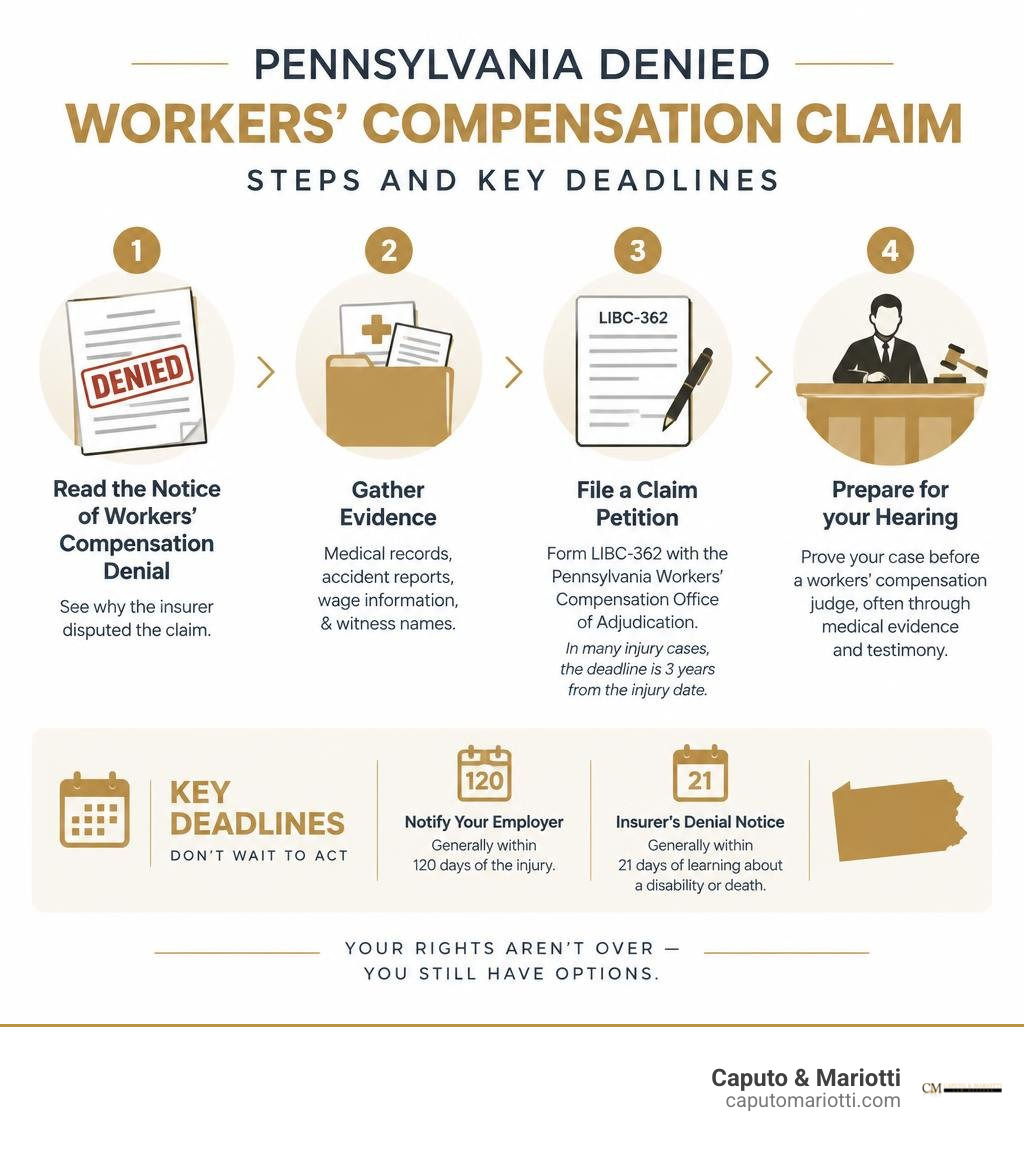
If your workers’ compensation claim is denied in Pennsylvania, review the denial notice, preserve your medical and work records, and file a Claim Petition to challenge the decision. A denial can stop wage-loss payments and medical coverage for now, but it does not automatically end your right to benefits.
Here is the basic path:
- Read the Notice of Workers’ Compensation Denial to see why the insurer disputed the claim.
- Gather evidence such as medical records, accident reports, wage information, and witness names.
- File a Claim Petition, Form LIBC-362, with the Pennsylvania Workers’ Compensation Office of Adjudication. In many injury cases, the filing deadline is three years from the injury date.
- Prepare to prove your case before a workers’ compensation judge, often through medical evidence and testimony.
Do not wait to act. Pennsylvania law generally requires workers to notify an employer about an injury within 120 days. Insurers also generally have 21 days after learning of a disability or death to issue a denial notice. A missed deadline can put benefits at risk.
I am Chris Caputo, a Pennsylvania attorney with decades of litigation experience representing people facing denied insurance claims and serious injury cases. If you are researching what happens if workers comp claim is denied pennsylvania, the next sections explain the deadlines, petition process, hearings, and appeal options in plain English.
Related injury law resources:
- Can I sue my employer in addition to workers comp in PA?
- Filing a construction worker injury claim in Pennsylvania
Understanding What Happens If Workers Comp Claim Is Denied Pennsylvania
Pennsylvania operates under a no-fault workers’ compensation system, which is intended to provide prompt medical treatment and wage-loss compensation without requiring injured employees to prove employer negligence. Despite this no-fault framework, insurance carriers frequently deny legitimate claims to protect their bottom line.
When an employer’s insurance carrier decides not to accept a workplace injury claim, they issue a formal document known as a Notice of Workers’ Compensation Denial (Form LIBC-496). Under the Pennsylvania Workers’ Compensation Act, the insurer must investigate the reported incident and send this determination within 21 days of receiving notice or knowledge of your injury.
Receiving this notice is frustrating, especially while dealing with pain and time away from your job. However, a denial simply means the insurance carrier has chosen not to pay voluntarily. Successfully navigating workers compensation challenges and denied claims starts with reading Form LIBC-496 carefully. The carrier must state its legal and factual reasons for the refusal on this form.
| Denial Reason Stated on LIBC-496 | Insurer’s Primary Argument | Required Employee Response Action |
|---|---|---|
| Untimely Notice | Injury not reported within the statutory 120-day notice period. | Gather written notices, emails, text messages, or witness statements proving early report dates. |
| Non-Work-Related Injury | Incident occurred outside the scope of employment or off-premises. | Secure witness statements, surveillance, timecards, and job site logs establishing job duties. |
| Pre-Existing Condition | Symptoms stem entirely from a prior injury or degenerative disease. | Obtain comparative diagnostic scans and formal causation reports from treating physicians. |
| Lack of Medical Causation | Insufficient medical evidence linking disability to the workplace event. | Secure detailed medical opinions and prepare for formal physician depositions. |
| Independent Contractor Defense | Worker is classified as an independent contractor rather than an employee. | Gather employment agreements, tax documents, 1099s/W-2s, and records demonstrating company control. |
Common Reasons Employers and Insurers Deny Claims
Insurance carriers look for procedural flaws or factual disputes to avoid paying costly wage loss and medical compensation. Some of the most frequent reasons include:
- Missing the 120-Day Notice Window: Under Pennsylvania law, you must report your workplace injury to your employer within 120 days. If you fail to provide notice within 21 days, benefits might only begin from the date notice was given; if you fail to give notice within 120 days, compensation is completely barred.
- Pre-Existing Conditions: Insurance companies routinely argue that your current back, neck, or joint pain is just an old injury acting up. Under Pennsylvania law, an aggravation or acceleration of a pre-existing condition is fully compensable if work activities caused the change.
- Disputes Over Causation: The insurance company might claim you were hurt during personal time, off-premises, or while engaged in prohibited conduct outside your job duties.
- Conflicting Medical Evaluations: Understanding the role of medical evaluations in PA workers compensation claims is critical. Insurers frequently rely on brief record reviews or exams performed by their chosen doctors to claim you are not truly disabled.
- Worker Misclassification: Employers sometimes label employees as independent contractors to avoid workers’ compensation obligations, an assertion that can be legally challenged based on how much control the company exerted over your daily work.
What Happens If Workers Comp Claim Is Denied Pennsylvania Regarding Medical Bills and Lost Wages
When a claim is denied, the immediate economic fallout can be severe. The workers’ compensation carrier will refuse to pay your hospital bills, physical therapy, prescription costs, or weekly temporary total disability checks.
While your claim is disputed, healthcare providers may attempt to bill you directly. You can submit these expenses through your private health insurance, Medicaid, or Medicare. In Pennsylvania, private health plans that pay for work injury treatments maintain subrogation rights—meaning they are entitled to reimbursement from the workers’ compensation carrier if your petition succeeds.
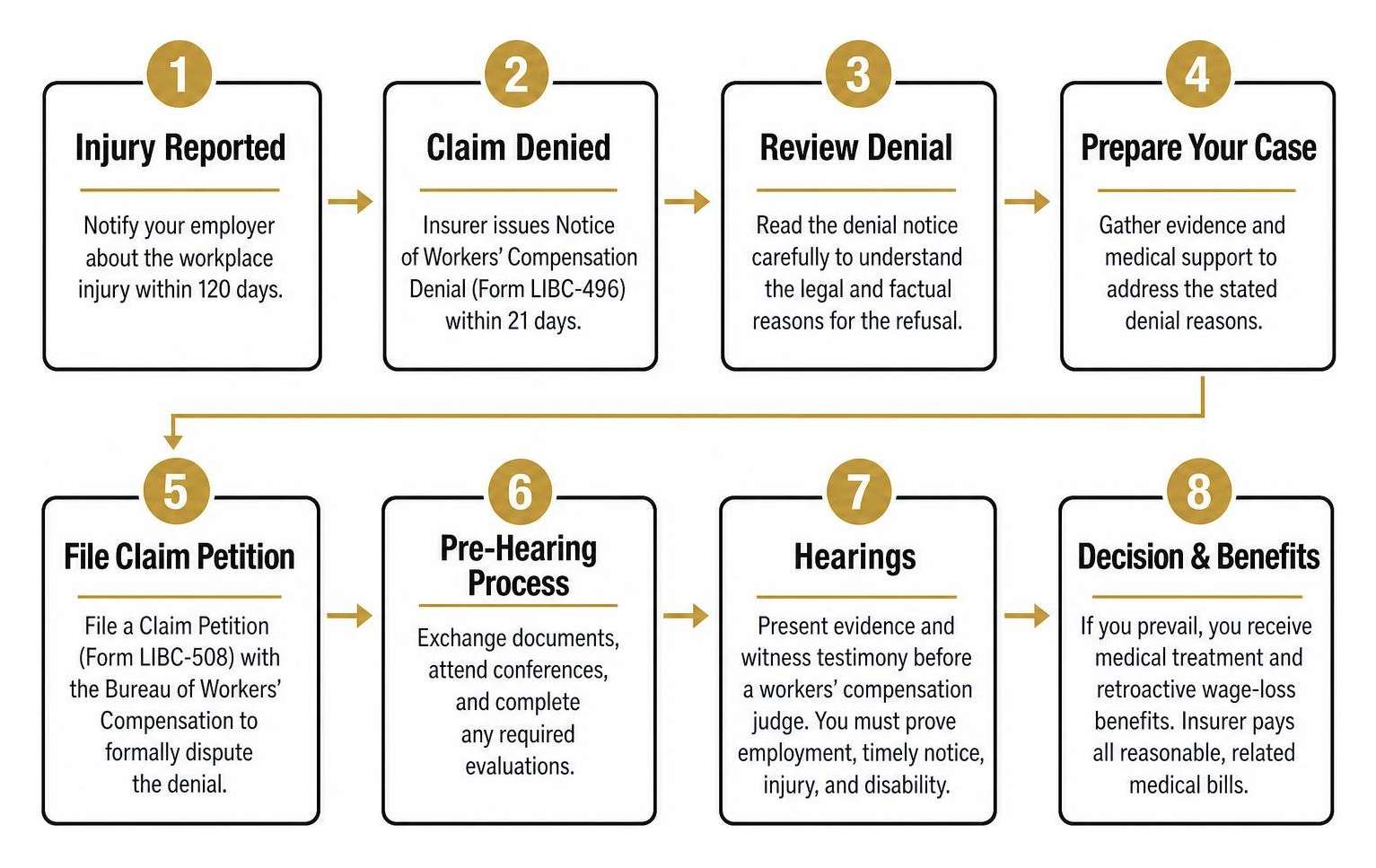
Knowing your options for protecting your rights when medical treatment is denied helps prevent unpaid medical bills from wrecking your credit. If you ultimately prevail at a hearing or secure a settlement, you can recover retroactive wage-loss benefits dating back to when your disability began, and the insurer will be ordered to pay all reasonable, related medical bills.
Step-by-Step Guide to Appealing a Denied Workers’ Comp Claim

Contesting a denied claim in Northeastern Pennsylvania requires entering the state’s formal legal dispute system. The injured employee bears the burden of proving every element of the case: employment status, timely notice, an injury occurring in the course and scope of employment, and disability caused by that injury.
Working with an experienced workers’ compensation lawyer ensures your evidence is compiled, filed, and presented properly throughout this adversarial process. Our comprehensive guide to navigating workers compensation benefits outlines the full landscape of protections available to injured workers under state law.
Filing the Claim Petition (Form LIBC-362)
The formal appeal begins by filing a Claim Petition (Form LIBC-362) with the Pennsylvania Bureau of Workers’ Compensation. Most petitions are filed electronically through the state’s Workers’ Compensation Automation and Integration System (WCAIS).
Key procedural considerations include:
- Accurate Filing Guidelines: Petitions must match state filing standards, referencing the initial denial details under 496 0311 form guidelines.
- Statute of Limitations: You have three years from the date of the injury to file a Claim Petition. Missing this cutoff results in a permanent forfeiture of your rights.
- Occupational Disease Rules: For occupational illnesses (like repetitive strain injuries, respiratory illnesses, or toxic exposure), the condition must result in disability within 300 weeks after your last workplace exposure.
Following our strategy for navigating workers compensation claims step by step ensures your petition is submitted accurately without fatal procedural mistakes.
The Hearing and Mandatory Mediation Before a Workers’ Compensation Judge
Once Form LIBC-362 is processed, the case is assigned to a Workers’ Compensation Judge (WCJ) at a local Office of Adjudication, such as those serving Lackawanna and Luzerne Counties. The litigation process involves several stages:
- Initial Hearings: The judge establishes litigation schedules, identifies key disputes, and hears your initial testimony regarding the accident and your symptoms.
- Evidence Gathering & Depositions: Because written medical notes are generally considered hearsay for long-term disability claims, formal recorded depositions of your treating doctors and the insurer’s medical experts must be taken. Witness statements, timecards, and job descriptions are entered into evidence.
- Independent Medical Examinations (IMEs): The defense will likely send you to an IME doctor of their choosing to argue against your injury’s severity or causation.
- Mandatory Mediation: Pennsylvania requires parties to participate in a formal mediation conference before a different WCJ to explore settlement opportunities before a final ruling is made.
Understanding how workers compensation lawyers help injured workers during cross-examinations and settlement negotiations makes a significant difference in the final outcome.
Navigating the PA Multi-Level Appeals Process

If the Workers’ Compensation Judge issues an unfavorable ruling after evaluating all testimony, depositions, and documentary evidence, the legal fight is still not over. Pennsylvania provides a multi-level appellate structure to correct errors of law or ungrounded factual determinations.
Our team of Scranton workers compensation lawyers frequently guides clients through these upper appellate tiers.
Appealing to the Workers’ Compensation Appeal Board (WCAB)
If the WCJ denies your Claim Petition, you have 20 days from the date of the judge’s written decision to file an appeal with the Workers’ Compensation Appeal Board (WCAB).
The Appeal Board does not conduct new trials or hear live witness testimony. Instead, it reviews the hearing transcripts and evidence to determine whether:
- The judge committed an error of law.
- The judge’s factual findings were supported by “substantial competent evidence.”
- The judge issued a reasoned decision explaining why certain medical experts were deemed more credible than others.
Our approach to resolving claim delays and formal appeals focuses on crafting detailed appellate briefs that point out legal misapplications by the initial judge.
Appealing to Commonwealth Court and Pennsylvania Supreme Court
If the WCAB affirms an unfavorable decision, the next legal step is an appeal to the Commonwealth Court of Pennsylvania.
- Commonwealth Court Filing: You must file a petition for review within 30 days of the WCAB’s decision. The Commonwealth Court evaluates constitutional questions, statutory interpretations, and procedural compliance.
- Pennsylvania Supreme Court: If the Commonwealth Court rules against you, an appeal may be requested through a Petition for Allowance of Appeal within 30 days. The Supreme Court accepts cases on a discretionary basis, typically taking matters that address significant, unresolved legal questions.
A clear understanding of understanding worker rights and employer responsibilities is essential when presenting these complex appellate arguments.
Critical Deadlines: What Happens If Workers Comp Claim Is Denied Pennsylvania After Statutory Windows
Missing statutory deadlines in Pennsylvania workers’ comp litigation is fatal to your claim. The court strictly enforces these timeframes:
- 120-Day Notice Rule: Complete bar to benefits if notice is not provided to the employer within 120 days of the injury.
- 21-Day Insurer Response Window: Insurers must issue an acceptance (Notice of Compensation Payable), temporary acceptance (Notice of Temporary Compensation Payable), or denial (Notice of Workers’ Compensation Denial) within 21 days.
- 3-Year Claim Petition Limitation: Failure to file Form LIBC-362 within three years of the injury date permanently extinguishes your claim.
- 20-Day WCAB Window: Strict deadline to appeal a judge’s decision to the Workers’ Compensation Appeal Board.
- 30-Day Commonwealth Court Window: Strict deadline to appeal a WCAB decision.
Following proper steps for what to do immediately after getting hurt at work protects your claim from being dismissed over avoidable timing technicalities.
Frequently Asked Questions About Denied Workers’ Comp Claims in PA
How long do I have to appeal after my workers’ comp claim is denied in Pennsylvania?
If you receive a Notice of Workers’ Compensation Denial (Form LIBC-496), you have up to three years from the date of your injury to file a Claim Petition (Form LIBC-362). However, you should not wait. Medical evidence becomes harder to assemble over time, and bills accumulate quickly. Working with a Wilkes-Barre workers compensation lawyer early helps preserve critical medical records and witness testimony.
Can I sue my employer in civil court if my workers’ comp claim is denied?
Generally, no. Under the Pennsylvania Workers’ Compensation Act’s “exclusive remedy provision,” employers are immune from civil personal injury lawsuits for workplace accidents, even if the insurer denies your initial claim.
However, there are exceptions:
- If your employer failed to carry mandatory workers’ compensation insurance.
- If your injury was caused by an intentional physical assault by the employer.
- If a negligent third party (such as a separate subcontractor, equipment manufacturer, or negligent driver) caused your injury.
Reviewing the legal rules on suing an employer in addition to workers comp helps determine if a third-party personal injury lawsuit can be filed alongside your workers’ compensation petition.
How much does it cost to hire an attorney to appeal a workers’ comp denial?
Workers’ compensation attorneys in Pennsylvania represent injured workers on a contingency fee basis. You pay no upfront costs, retainers, or hourly rates out of pocket.
Legal fees are strictly regulated by Pennsylvania law and must be reviewed and approved by a Workers’ Compensation Judge. The standard fee is typically 20% of the wage-loss benefits awarded or recovered through a lump-sum settlement. If no compensation is secured, you owe no attorney fees. Learning how a workers compensation lawyer assists your claim helps you seek dedicated legal advocacy with zero financial risk.
Conclusion
A denied workers’ compensation claim in Pennsylvania creates immediate financial and personal stress, but the initial denial notice does not have the final say. By understanding your legal rights, adhering strictly to statutory filing deadlines, and taking your case before a Workers’ Compensation Judge with strong medical and factual evidence, you can overturn claim denials and recover the benefits you need.
At Caputo & Mariotti, we bring combined decades of litigation experience to every case we handle across Scranton, Wilkes-Barre, Hazleton, Pittston, Dickson City, and throughout Northeastern Pennsylvania. We understand the tactics insurance carriers use to delay or deny legitimate workplace injury claims, and we fight to hold them accountable.
If your claim has been disputed or denied, do not navigate the appeals process alone. Take action to protect your income and healthcare benefits:
