

The dedicated legal team of Caputo & Mariotti
In Depth Guide to Personal Injury Compensation Types in PA
November 2, 2026
What Compensation Can You Seek After a Pennsylvania Injury?
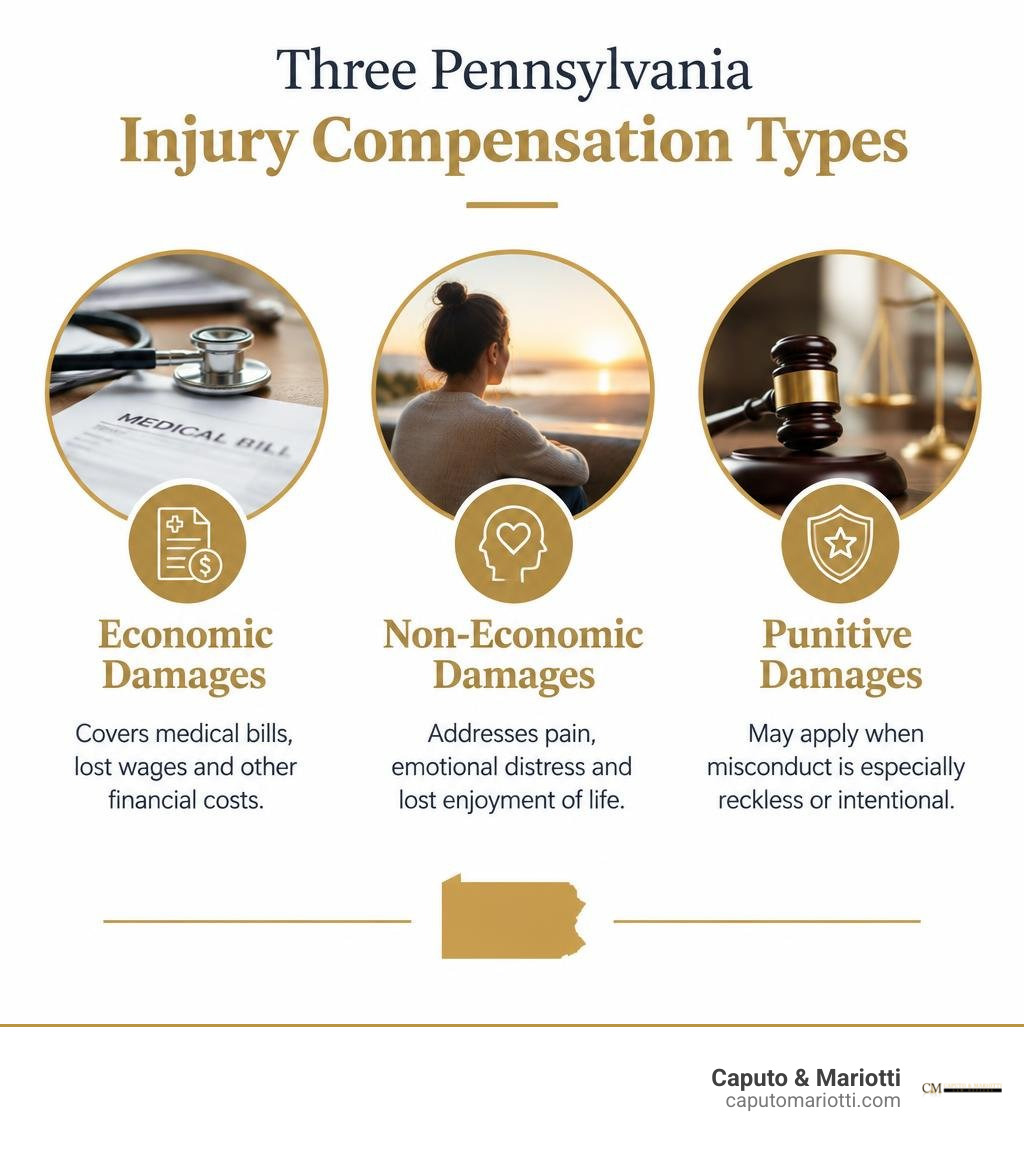
Pennsylvania personal injury compensation falls into three main categories: economic damages for costs such as medical bills and lost wages; non-economic damages for pain, emotional distress, and lost enjoyment of life; and punitive damages, which may apply when misconduct is especially reckless or intentional. Understanding the personal injury compensation types Pennsylvania law recognizes is the first step toward building a strong claim, since what you can recover also depends on fault, available insurance, and, in car accident cases, whether you chose full or limited tort coverage.
I’m Chris Caputo, a Pennsylvania attorney who has represented injured people and families since 2007. I help clients understand the personal injury compensation types Pennsylvania law allows and pursue claims against insurers that dispute them.
Navigating personal injury law begins with understanding the process of filing a personal injury claim in Pennsylvania and knowing what to do after a personal injury accident in Pennsylvania.
Understanding Personal Injury Compensation Types Pennsylvania Accident Victims Can Claim
In Pennsylvania civil practice, monetary recovery serves to make an injured person whole again under the law. When another party’s negligence causes harm, the civil court system provides avenues to recover quantifiable losses as well as compensation for physical and emotional disruption. In specific scenarios involving outrageous conduct, courts may also levy financial punishments against the wrongdoer.
Gaining a clear perspective on understanding damages and compensation in injury cases allows victims to properly account for every financial, physical, and psychological loss resulting from an accident. Identifying the available personal injury compensation types Pennsylvania law provides is critical when seeking maximum recovery.
| Damage Category | Primary Purpose | Examples | Statutory Limits in PA |
|---|---|---|---|
| Economic Damages | Reimburse actual, documented financial losses | Medical bills, future care, lost wages, property damage | No general cap in standard personal injury |
| Non-Economic Damages | Compensate for intangible, quality-of-life losses | Pain and suffering, emotional anguish, loss of life enjoyment | No statutory cap in standard personal injury |
| Punitive Damages | Punish malicious or reckless behavior and deter others | Egregious reckless driving, gross corporate misconduct | Capped at 200% of compensatory damages in medical malpractice |
Understanding how the Commonwealth differentiates between these categories is essential for establishing the true value of any legal claim. Learn more about the general framework in Types of Damages in Pennsylvania Personal Injury Cases.
Economic Personal Injury Compensation Types Pennsylvania Courts Award
Economic damages represent concrete, out-of-pocket expenses resulting directly from an injury. Because these losses involve measurable sums, they are proven using invoices, pay records, tax filings, and expert projections. Key economic components include:
- Past and Future Medical Expenses: Hospital bills, surgical fees, physical therapy, diagnostic imaging, prescription medications, and long-term rehabilitation costs. For catastrophic conditions, future medical expenses are determined using customized life care plans.
- Lost Income and Diminished Earning Capacity: Compensation for the work hours, salary, bonuses, and benefits lost during recovery. If an injury results in permanent impairment preventing you from returning to your former line of work, damages account for lifetime lost earning potential.
- Property Damage and Out-of-Pocket Expenses: Repair or replacement costs for damaged vehicles and personal property, alongside necessary travel costs for medical treatments, home modifications, and assistive medical devices.
Reviewing a comprehensive personal injury law overview provides broader insight into how these financial losses integrate into total case evaluations.
Non-Economic Damages and the Impact of Auto Tort Selection
Non-economic damages address the intangible, human cost of an accident. Although these losses lack a direct paper invoice, they are often the most profound element of a personal injury claim:
- Pain and Suffering: The physical pain, discomfort, and physical limitations caused by the injury and subsequent medical treatments.
- Emotional Distress: Mental anguish, sleep disorders, anxiety, depression, and post-traumatic stress resulting from the incident.
- Loss of Life Enjoyment: The inability to participate in hobbies, family activities, recreational pursuits, or daily routines.
- Loss of Consortium: A claim brought by an uninjured spouse for the loss of companionship, affection, assistance, and intimacy.
In motor vehicle accident claims across Pennsylvania, your ability to recover non-economic damages depends heavily on your auto insurance policy’s tort election:
- Full Tort Coverage: Policyholders and covered household members retain the unrestricted right to seek compensation for non-economic damages (pain and suffering) for any injury caused by a negligent driver, regardless of severity.
- Limited Tort Coverage: In exchange for lower premium costs, policyholders waive the right to seek non-economic damages unless the injury meets the statutory threshold of a “serious injury”—defined under Pennsylvania law as death, serious impairment of a body function, or permanent serious disfigurement—or qualifies for specific statutory exceptions.
Punitive Damages for Reckless and Malicious Conduct
Unlike compensatory damages, which aim to restore the injured party, punitive damages exist solely to punish a defendant for outrageous conduct and deter similar behavior.
Under Pennsylvania law, ordinary negligence does not warrant punitive damages. A plaintiff must prove by clear and convincing evidence that the defendant acted with reckless indifference to the rights of others, intentional malice, or gross misconduct.
In medical malpractice actions governed by the Medical Care Availability and Reduction of Error (MCARE) Act, punitive damages are subject to a statutory cap: they cannot exceed 200% of the total compensatory damages awarded, and 25% of any punitive recovery is directed to the MCARE fund rather than the plaintiff.
Calculating Case Value and Average Settlement Ranges in Pennsylvania

Calculating the value of an injury claim requires synthesizing documented economic losses with reasonable estimates for subjective non-economic harm. For a detailed breakdown of these legal calculations, explore how damages are calculated under Pennsylvania law.
Calculating Non-Economic Personal Injury Compensation Types Pennsylvania Claims Involve
Attorneys and insurance adjusters typically utilize two established approaches when estimating non-economic damages:
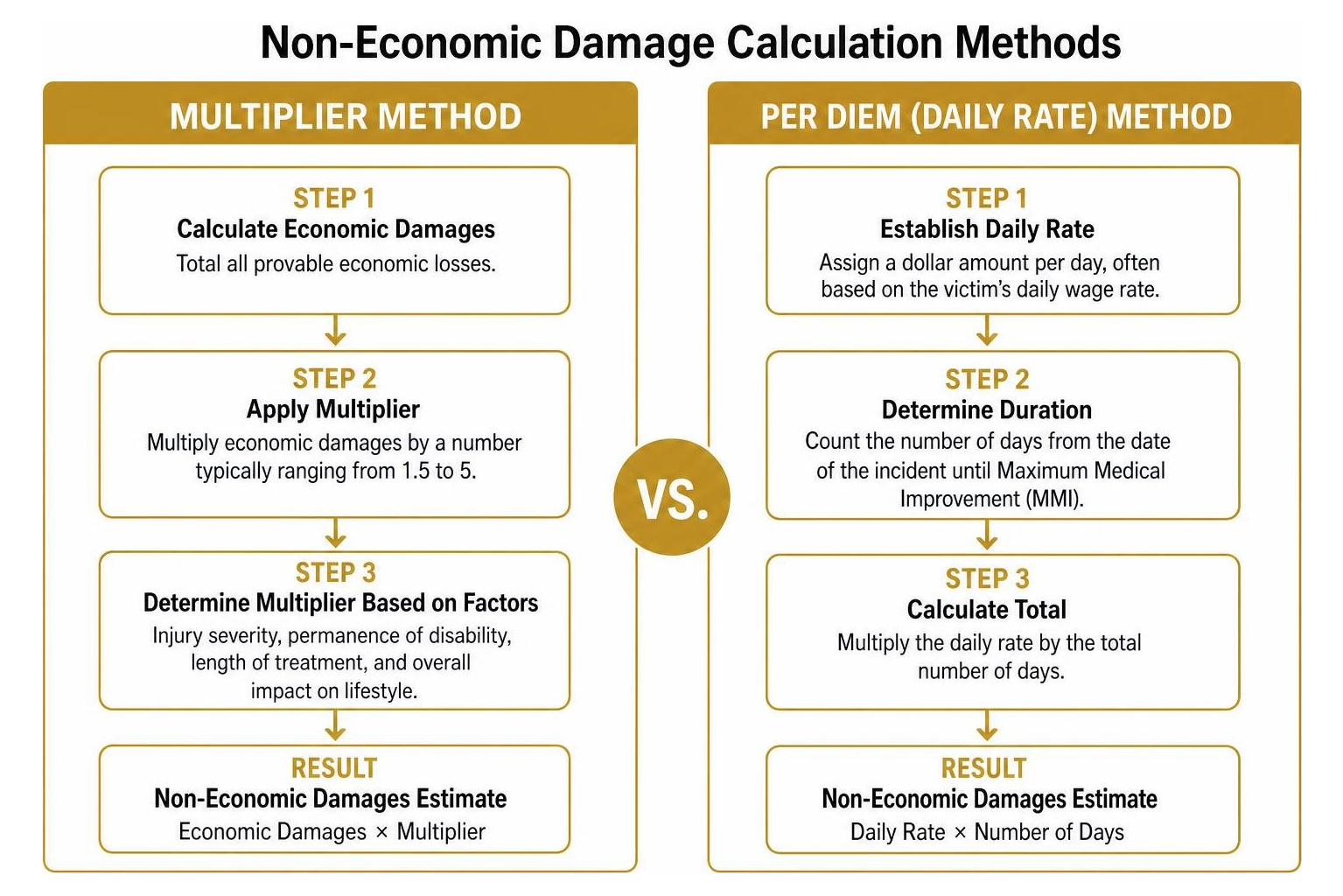
- The Multiplier Method: This formula takes the total sum of economic damages and multiplies it by a chosen number, typically ranging from 1.5 to 5. The selected multiplier depends directly on injury severity, the permanence of the disability, the length of medical treatment, and the overall impact on the individual’s lifestyle. A soft-tissue sprain might warrant a 1.5 multiplier, whereas a severe spinal injury requiring surgery could justify a 4 or 5 multiplier.
- The Per Diem (Daily Rate) Method: This approach assigns a specific dollar figure to each day the victim experiences pain and functional limitation, running from the date of the incident until reaching Maximum Medical Improvement (MMI). The assigned daily rate is frequently tied to the victim’s actual daily wage rate to present a reasonable, justifiable baseline to a jury.
Typical Settlement Ranges Across Accident Categories
Settlement amounts across Pennsylvania vary substantially depending on injury severity, liability clarity, and available insurance policy limits. Nationally, average personal injury settlements range from $52,900 to $55,056, with a median payout near $31,000.
| Accident Type | Average PA Settlement / Range | Primary Case Value Drivers |
|---|---|---|
| Motor Vehicle Accidents | $20,235 average | Tort selection (Full vs. Limited), policy coverage limits, extent of medical care |
| Commercial Truck Accidents | $103,654 average | Catastrophic injuries, higher corporate commercial liability limits, federal safety rule violations |
| Pedestrian Accidents | $67,511 average | High vulnerability, severe trauma, crosswalk laws, shared fault evaluations |
| Premises Liability (Slip & Fall) | $15,000 – $45,000 typical range | Notice of hazardous condition, property maintenance records, severity of fractures or tears |
Our team assists victims facing these challenges across Northeastern Pennsylvania, handling claims covered in detail in our review of handling different accident and injury types.
Legal Rules, Caps, and Statutory Exceptions Affecting Compensation

While Pennsylvania does not place a universal cap on compensatory damages in general tort lawsuits, several statutory frameworks and liability rules directly control total recovery. Proper guidance on personal injury claims ensures these complex statutes do not compromise your right to full compensation.
Pennsylvania’s 51 Percent Modified Comparative Negligence Bar
Pennsylvania operates under a modified comparative negligence standard with a 51 percent bar rule (42 Pa.C.S. § 7102).
Under this framework:
- An injured party can recover damages only if their share of causal negligence is 50% or less.
- The total financial recovery is reduced in direct proportion to the plaintiff’s percentage of fault. For example, if a jury awards $100,000 in damages but determines the plaintiff was 20% responsible, the final payout is reduced by 20%, resulting in a $80,000 recovery.
- If the plaintiff is found to be 51% or more at fault, they are completely barred from recovering any compensation from the defendant.
Sovereign Immunity Caps and Claims Against Government Entities
When pursuing compensation against government entities—such as Commonwealth agencies, regional transit authorities like SEPTA, municipal entities in Luzerne County, or city departments in Scranton and Wilkes-Barre—strict statutory limitations apply:
- Commonwealth Agencies: Total damages are statutorily capped at $250,000 per plaintiff and $1,000,000 in the aggregate per incident.
- Local Government Agencies: Total damages are capped at $500,000 per incident under the Political Subdivision Tort Claims Act.
- Mandatory Notice Requirement: Claimants must provide formal written notice of their intent to file a claim to the relevant government entity within six months of the date of the injury. Failure to meet this six-month deadline can permanently extinguish the right to sue.
Wrongful Death Actions Versus Survival Actions in Pennsylvania
When personal injury results in fatal consequences, Pennsylvania law establishes two distinct statutory claims:
- Wrongful Death Actions (42 Pa.C.S. § 8301): Brought by or on behalf of surviving statutory beneficiaries (spouse, children, or parents) to recover compensation for their direct financial and emotional losses. Recoverable damages include funeral expenses, medical bills, and the value of financial support, services, guidance, and companionship the deceased would have provided.
- Survival Actions (42 Pa.C.S. § 8302): Brought by the personal representative of the decedent’s estate to recover damages the deceased person could have claimed had they survived. This includes the physical pain, suffering, and mental anguish consciously endured between the time of injury and death, as well as the loss of earning power over their working life expectancy.
Workers’ Compensation Disability Caps and IRE Determinations
Workplace injuries in Pennsylvania operate under an exclusive administrative, no-fault framework. Under this system, employees gain prompt medical care and wage-loss benefits without needing to prove employer negligence, but they generally surrender the right to sue their employer for non-economic damages such as pain and suffering.
Key elements of the Pennsylvania workers’ compensation structure include:
- 2026 Benefit Maximums: For injuries occurring in 2026, the maximum weekly compensation rate is $1,394 per week, calculated from the employee’s average weekly wage.
- Reporting Requirements: Injured employees must report their injury to their employer within 21 days to preserve full retroactive benefits, with an absolute outer deadline of 120 days.
- Medical Treatment Rules: If an employer posts a valid list of at least six designated medical providers, the employee must treat with a panel provider for the initial 90 days following the injury.
- 500-Week Partial Disability Cap: If an injured worker returns to work at lower wages or undergoes an Impairment Rating Evaluation (IRE) yielding a whole-body impairment rating below 35%, total disability benefits convert to partial disability benefits, which are subject to a strict 500-week statutory maximum.
- Specific Loss Benefits: Permanent loss of use of specific body parts (such as hands, limbs, or vision) qualifies for scheduled payments independent of wage loss.
- Claim Petitions and Appeals: If an insurer issues a denial, the claim proceeds via a Claim Petition heard before a Workers’ Compensation Judge (WCJ), with subsequent rights of appeal to the Workers’ Compensation Appeal Board (WCAB) and the Commonwealth Court.
Navigating these detailed administrative rules requires meticulous documentation, witness statements, and comprehensive medical records. Injured employees benefit from consulting an experienced workers’ compensation lawyer to protect their statutory wage-loss rights and handle settlement negotiations through Compromise & Release (C&R) agreements. Additional statutory details are outlined in the Pennsylvania Workers’ Comp Guide 2026 · Injured Workers.
Evidence Gathering and Deadlines to Maximize Recovery
Obtaining full financial recovery requires establishing clear liability and proving every dollar of damages claimed. Strategic evidence gathering begins immediately after the incident. Learn more about the critical nature of early documentation in our guide on properly documenting accident injuries in Pennsylvania.
Essential Evidence to Document from Day One
To substantiate both economic and non-economic losses, claimants should systematically collect and preserve:
- Medical Records and Billing Logs: Complete hospital discharge summaries, physical therapy notes, specialist referrals, diagnostic imaging results, and itemized billing statements showing all charges.
- Personal Symptom and Impact Journal: A weekly log detailing daily physical pain levels, sleep interruptions, missed family milestones, and specific tasks that can no longer be performed without assistance.
- Employment and Earnings Documentation: Pay stubs, W-2 forms, tax returns, and written employer verifications detailing lost work hours, missed overtime, and used sick leave.
- Scene Evidence and Incident Reports: Photographs and video recordings of the accident scene, property damage, hazardous conditions, formal police accident reports, and contact information for all eyewitnesses.
A comprehensive look at evidence management is detailed in our overview on the role of evidence in maximizing claims.
Pennsylvania Statute of Limitations and Tolling Exceptions
Under 42 Pa.C.S. § 5524, Pennsylvania enforces a strict two-year statute of limitations for personal injury, medical malpractice, and wrongful death claims. If a formal lawsuit is not filed within two years of the date of the injury or death, the court will dismiss the action permanently.
Statutory tolling exceptions include:
- The Discovery Rule: In limited scenarios where an injury or its causal connection to another party’s negligence was not known and could not reasonably have been discovered through the exercise of due diligence, the two-year clock begins on the date the harm was discovered or reasonably should have been discovered.
- Minor Tolling Exception (42 Pa.C.S. § 5533(b)): When an individual is injured as a minor (under the age of 18), the two-year statute of limitations is tolled until their 18th birthday, giving them until their 20th birthday to file a lawsuit.
Frequently Asked Questions About Pennsylvania Personal Injury Damages
Does Pennsylvania limit or cap pain and suffering compensation?
No. In standard personal injury cases involving motor vehicle accidents, slip and falls, or defective products, Pennsylvania law does not impose statutory caps on non-economic damages, including pain and suffering. Juries possess broad discretion to determine reasonable compensation based on the specific evidence presented.
How does limited tort coverage restrict my damage recovery?
Selecting limited tort on your Pennsylvania auto insurance policy restricts you from seeking compensation for non-economic damages (pain and suffering) unless your injury meets the statutory threshold of a “serious injury”—defined as significant permanent disfigurement, serious impairment of a body function, or death—or meets exceptions like being struck by a drunk driver or an out-of-state registered vehicle. Your right to recover full economic damages (medical bills and lost wages) remains intact under limited tort.
What is the deadline for filing an injury claim against a Pennsylvania government agency?
Under Pennsylvania’s sovereign immunity statutes, you must submit a formal written notice of claim to the responsible state or local government agency within six months of the accident. After this notice is properly filed, the standard two-year statute of limitations applies for filing the underlying lawsuit.
Conclusion
Securing fair compensation across every category of personal injury damages requires an extensive understanding of Pennsylvania liability statutes, insurance frameworks, and courtroom valuation techniques. Whether evaluating economic expenditures, calculating non-economic harm, or managing comparative fault defenses, every detail impacts the final outcome of your claim.
With more than 55 years of combined legal experience, the legal team at Caputo & Mariotti is committed to guiding injured individuals and families across Lackawanna County, Luzerne County, and Northeastern Pennsylvania through every phase of the civil recovery process.
If you or a loved one has suffered an injury due to another party’s negligence, request a comprehensive case consultation to explore your rights, or connect with our trusted legal support across Scranton and Wilkes-Barre today.
