

The dedicated legal team of Caputo & Mariotti
Step-by-Step Guide to What to Do After a Workplace Injury in PA
November 4, 2026
What to Do After a Workplace Injury in Pennsylvania
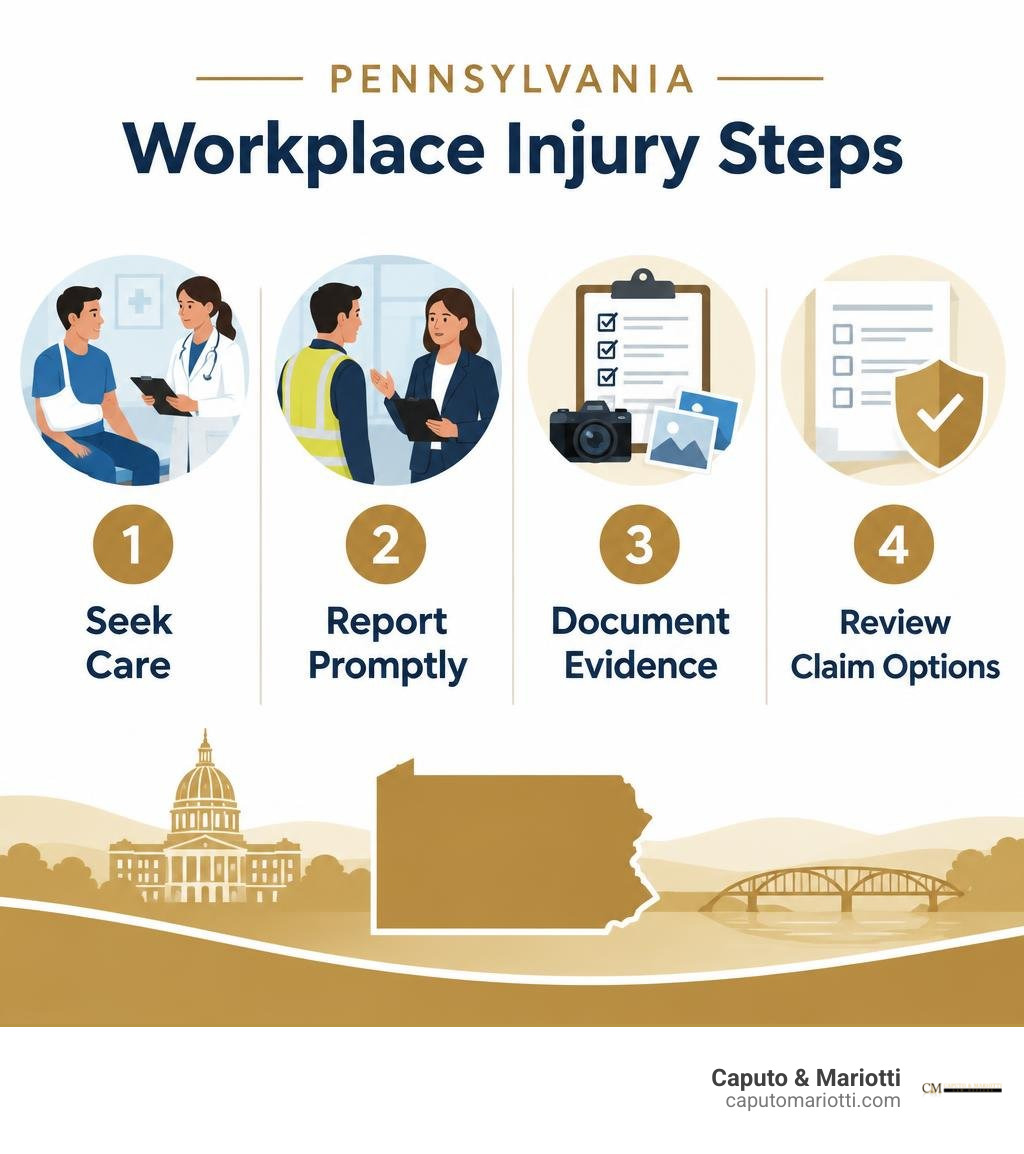
Get medical care, tell your supervisor about the injury right away, and keep copies of your report, medical records, and witness details. In Pennsylvania, notice within 21 days helps protect benefits from the date of injury. Waiting more than 120 days can generally bar workers’ compensation benefits. If someone outside your employer, such as a maintenance contractor, caused the injury, preserve evidence of their role too.
I’m Chris Caputo, a Pennsylvania personal injury lawyer with decades of experience handling negligence claims and disputes with insurers. Whether you want to know if you can sue your employer in addition to workers’ comp in PA, need to file a construction worker injury claim in Pennsylvania, or want to identify the signs your workplace injury is serious in Pennsylvania, this guide will help you protect your claim and recognize when a third-party injury lawsuit may also be an option.
Immediate Steps: What to Do After a Workplace Injury Pennsylvania Employees Must Follow

When an accident happens on the job, the adrenaline rush can easily mask physical pain and cloud clear thinking. Understanding what to do after a workplace injury Pennsylvania workers face is crucial to protecting both your health and your legal rights under the Pennsylvania Workers’ Compensation Act. Knowing what to do if you’re hurt at work immediately after an incident occurs helps you take the right legal and medical steps without delay.
Pennsylvania operates a no-fault workers’ compensation system. This means you do not need to prove your employer was negligent to receive benefits, nor does simple carelessness on your part bar you from coverage. However, the system requires strict procedural compliance. From the moment the incident happens, your actions establish the foundation of your entire claim.
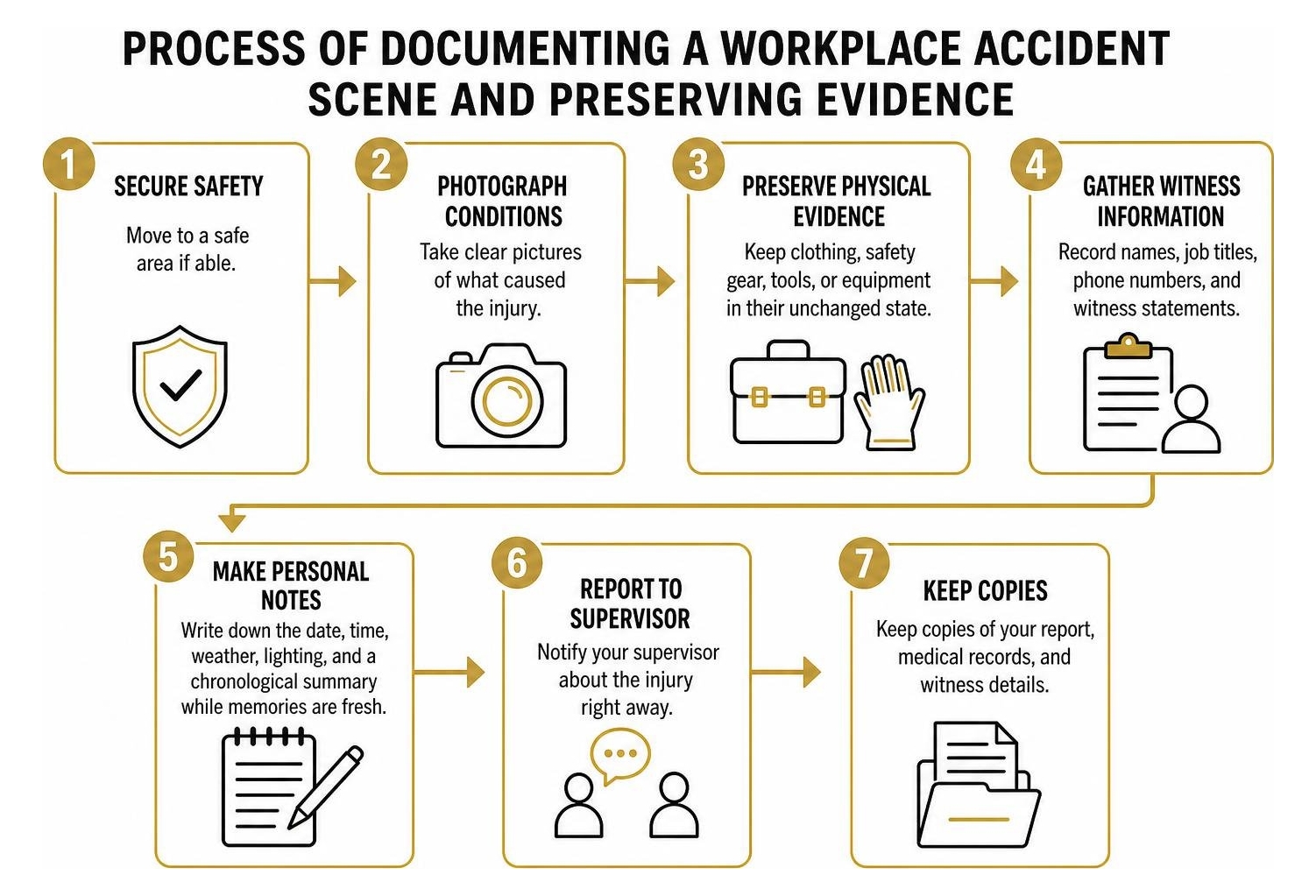
First, secure your immediate physical safety. If you are in a hazardous environment—such as near live electrical equipment, falling debris, or operating machinery—move to a safe area if you are physically able to do so without causing further self-injury. Never attempt to “tough it out” or finish your shift before checking your physical condition. Identifying the key signs your workplace injury is serious in Pennsylvania, such as sudden numbness, sharp joint pain, or severe head trauma, can help you decide whether immediate emergency intervention is required.
Second, document the accident scene thoroughly:
- Photograph physical conditions: Take clear pictures of what caused the injury (e.g., a wet floor, broken scaffolding, malfunctioning equipment, or unlit stairwells).
- Preserve physical evidence: Retain the clothing, safety gear, or damaged tools involved in the incident in their unchanged state.
- Gather witness information: Record the names, job titles, phone numbers, and statements of any coworkers or third-party contractors who saw the event.
- Make personal notes: Write down the exact date, time, weather conditions, lighting, and a chronological summary of what transpired while memories are fresh.
Immediate Medical Steps: What to Do After a Workplace Injury Pennsylvania Guidelines Require
Seeking appropriate medical attention is your highest priority. Under Pennsylvania law, specific rules dictate where you can receive non-emergency medical treatment during the initial phase of your recovery.
If your injury is a medical emergency, you have the legal right to go to the nearest emergency room or urgent care clinic of your choice. Emergency stabilization always supersedes administrative provider rules.
For ongoing or non-emergency care, Pennsylvania law allows employers to establish a designated list of health care providers. To be legally binding, this list must contain at least six qualified healthcare providers, with at least three being designated medical doctors. If your employer has posted this list properly and provided written notice that you signed at hire and post-injury, you must treat with one of these panel providers for the first 90 days following your initial visit.
You can review complete employee rights and medical treatment duties under PA law to understand how these obligations function. If your employer fails to maintain a valid, posted list of six providers, or fails to have you sign the mandatory written acknowledgment, you retain the freedom to treat with your personal physician immediately.
Key medical rights and duties include:
- Changing Panel Doctors: During the initial 90-day window, you are not locked into one specific doctor on the list; you may switch between any of the physicians on your employer’s approved panel.
- Post-90-Day Freedom: After 90 days have elapsed from your first visit, you may transition your ongoing medical care to any physician of your choosing, provided you give your employer or their insurer written notice within five days of your initial visit with the new doctor.
- Second Opinions for Surgery: If a panel doctor recommends invasive surgery, Pennsylvania law guarantees your right to obtain a second medical opinion from any specialist of your choice at your employer’s (or their insurer’s) expense. If the second opinion differs, you have the right to decide which course of treatment to follow.
Reporting Deadlines and What to Do After a Workplace Injury Pennsylvania Employees Face
Timely reporting is often the deciding factor in whether a workers’ compensation claim succeeds. The Pennsylvania Workers’ Compensation Act establishes mandatory statutory deadlines that govern when notice must be delivered to an employer:
- The 21-Day Rule for Full Retroactive Benefits: You should report your injury to a direct supervisor, manager, or human resources department as soon as possible. If you provide notice within 21 days of the injury date, your wage-loss benefits are retroactive to the first day of your disability (subject to the standard waiting period).
- The 120-Day Absolute Deadline: If you provide notice after 21 days but within 120 days of the injury, your wage-loss compensation begins only from the date notice was actually provided. If you fail to notify your employer within 120 days, your claim will almost certainly be barred completely under Pennsylvania law, with very narrow exceptions (such as occupational diseases with delayed symptom onset).
Always report your injury in writing, even if you have already informed your supervisor verbally. Request a signed, dated copy of the internal incident report for your own files. The Pennsylvania Department of Labor and Industry provides official state procedures for reporting an injury or occupational disease to guide workers and employers through this mandatory notification framework.
Understanding Your Pennsylvania Workers’ Compensation Benefits

When an accepted workplace injury prevents you from performing your job duties, the workers’ compensation system provides specific statutory benefits designed to keep you financially stable and cover your rehabilitation. Understanding your rights helps ensure you receive every dollar and service to which you are legally entitled under the LIBC-100 injured worker legal pamphlet.
For an exhaustive analysis of these rights, review our guide on navigating workers’ compensation claims and rights. In Pennsylvania, standard workers’ compensation encompasses several distinct benefit categories:
- Medical Expense Coverage: Your employer’s workers’ comp insurance must pay for all reasonable, necessary, and related medical services. This includes hospital visits, doctor appointments, surgeries, physical therapy, diagnostic imaging (MRIs, X-rays), prescription medications, orthopedic appliances, and travel mileage to and from specialized appointments. Health care providers are strictly prohibited by law from “balance billing” you for amounts exceeding the state-mandated fee schedule.
- Wage-Loss Compensation: If your injury forces you out of work for more than seven calendar days, you become eligible for disability indemnity payments to replace a portion of your lost earnings.
- Specific Loss Benefits: If your work injury results in the permanent loss, amputation, or total loss of use of a specific body part (such as a finger, hand, arm, foot, leg, or eye), or causes permanent and serious disfigurement of the head, face, or neck, you are entitled to a specific loss award regardless of whether you missed any time from work.
- Death and Dependency Benefits: If a work-related accident or occupational disease results in a fatality, surviving dependents (such as a spouse and minor children) are entitled to weekly wage-loss payments, as well as a statutory burial expense allowance up to state limits.
Wage-Loss Calculations and Disability Classifications
Wage-loss payments in Pennsylvania are calculated based on your Average Weekly Wage (AWW) earned prior to the injury. Generally, your indemnity rate equals approximately 66.67% (two-thirds) of your pre-injury AWW, subject to statutory maximum and minimum caps adjusted annually by the Department of Labor and Industry.
Disability benefits follow a specific schedule regarding waiting periods:
- 7-Day Waiting Period: No wage-loss benefits are paid for the first seven calendar days of disability.
- 14-Day Retroactive Rule: If your disability extends beyond 14 calendar days, you receive retroactive compensation for the initial seven-day waiting period.
Pennsylvania classifies wage-loss claims into two primary categories: Total Disability and Partial Disability.
| Benefit Feature | Total Disability | Partial Disability |
|---|---|---|
| Work Capability | Completely unable to perform any gainful employment | Able to work light-duty or part-time at lower wages |
| Payment Rate | Approx. 66.67% of Average Weekly Wage (subject to state max caps) | Approx. 66.67% of the difference between pre- and post-injury wages |
| Time Limits | No statutory maximum cap on weeks while totally disabled | Capped at a strict maximum limit of 500 weeks |
| Medical Requirement | Ongoing medical proof of total incapacity for work | Medical clearance for modified or sedentary duty |
| Status Modification | Subject to Impairment Rating Evaluations (IRE) or earning power reviews | Continues until the 500-week cap is exhausted or earning power is restored |
Filing Claims, Handling Denials, and Exploring Third-Party Lawsuits
Once you report an injury, your employer must submit a First Report of Injury to the Pennsylvania Bureau of Workers’ Compensation. The insurance carrier then has 21 calendar days from the date of notice to investigate and respond with one of three official forms:
- Notice of Compensation Payable (LIBC-495): The insurer fully accepts your injury and your right to wage-loss and medical benefits.
- Notice of Temporary Compensation Payable (LIBC-501): The insurer agrees to pay temporary compensation for up to 90 days while continuing to investigate your claim. This is not a formal acceptance of liability; the insurer may revoke the NTCP and deny the claim within that 90-day window.
- Notice of Workers’ Compensation Denial (LIBC-496): The insurer rejects your claim entirely, refusing to pay medical bills or wage-loss benefits.
For a detailed walkthrough of formal application procedures, read our resource on how to file a workers’ compensation claim in Pennsylvania, as well as the official Workers’ Compensation and the Injured Worker publication.
What to Do If Your Claim Is Denied or Benefits Are Stopped
If your claim is denied, or if your employer attempts to stop or reduce your ongoing checks, you must file a formal Claim Petition (or appropriate penalty/reinstatement petition) with the Bureau of Workers’ Compensation Office of Adjudication.
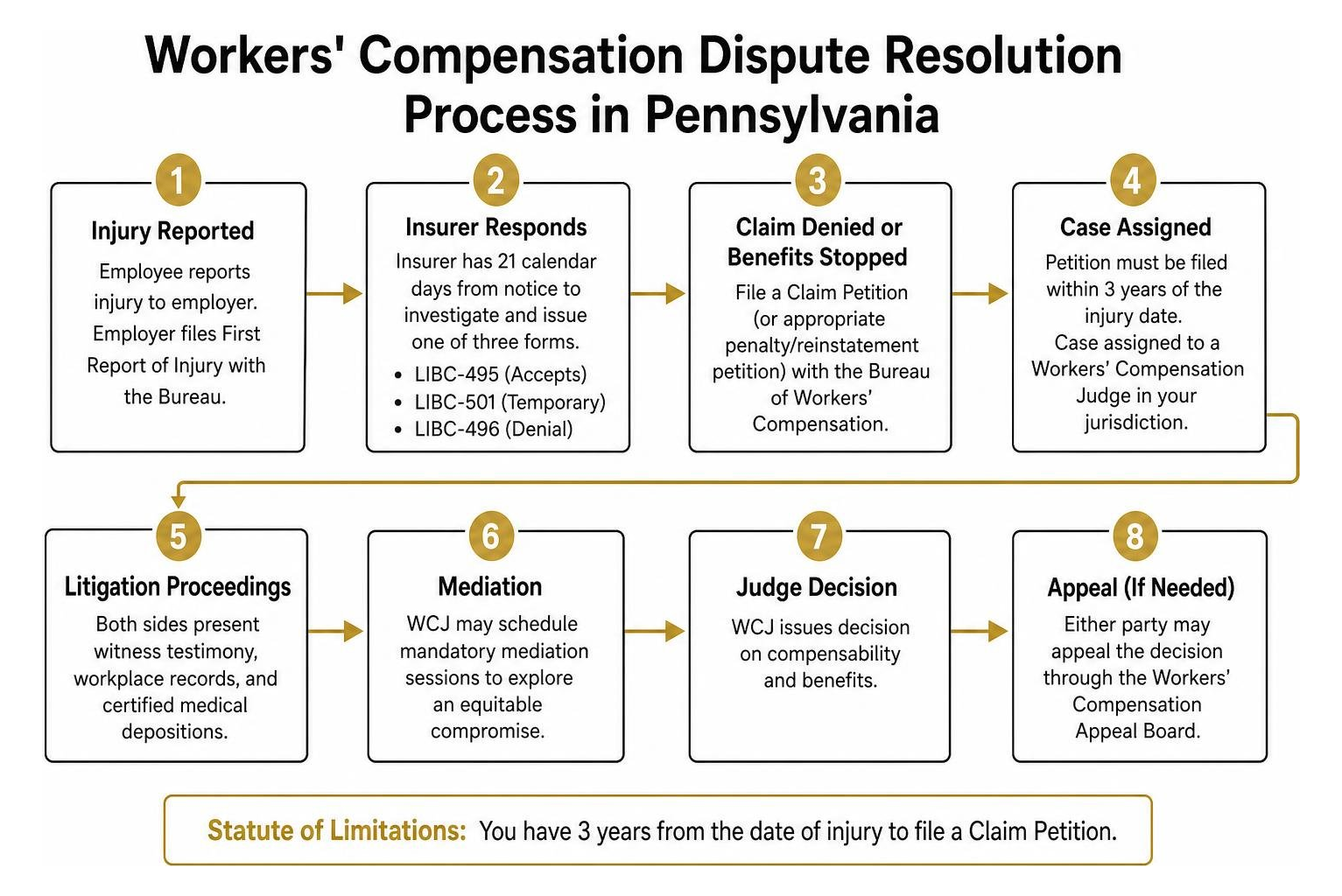
Under Pennsylvania law, you have a three-year statute of limitations from the date of the injury to file a formal Claim Petition. Once filed, your case is assigned to a Workers’ Compensation Judge (WCJ) based in your geographic jurisdiction, such as Scranton or Wilkes-Barre for Northeastern Pennsylvania workers.
During these litigation proceedings:
- Both sides present witness testimony, workplace records, and certified medical depositions.
- The WCJ may schedule mandatory mediation sessions to explore an equitable compromise and release settlement.
- If a settlement is not reached, the WCJ evaluates the evidence and issues a formal binding decision.
Navigating hearings, cross-examining insurance medical examiners, and compiling vocational expert testimony requires skilled legal representation. Knowing how a workers’ compensation lawyer assists injured workers allows you to level the playing field against large commercial insurers and defense firms. Our team of dedicated attorneys provides focused support, leveraging over 55 combined years of legal experience to advocate for injured workers across Lackawanna County, Luzerne County, and all surrounding areas. When facing a complex dispute, working directly with a qualified workers’ compensation lawyer ensures your rights are aggressively defended at every hearing.
Third-Party Personal Injury Claims vs. Workers’ Comp
Under the Pennsylvania Workers’ Compensation Act’s “exclusive remedy” rule, you generally cannot sue your direct employer or a coworker for negligence causing a job injury. In exchange for guaranteed, no-fault medical and wage benefits, workers forfeit the right to bring a civil tort claim against their employers.
However, this immunity does not protect third parties whose independent negligence caused your harm. If an outside entity contributed to your injury, you can pursue a separate third-party personal injury lawsuit alongside your workers’ compensation claim.
Common examples of third-party workplace claims include:
- Subcontractors & General Contractors: A separate contractor on a multi-employer construction job site creates an unsafe condition or causes a structural collapse.
- Defective Machinery & Tool Manufacturers: An industrial machine, power tool, or safety harness fails due to a design or manufacturing defect (product liability).
- Negligent Property Owners & Maintenance Companies: A third-party commercial landlord or cleaning company fails to clear ice, fix broken stair railings, or repair leaking pipes in a shared commercial building.
- Motor Vehicle Accidents: You are hit by a negligent driver while making deliveries, traveling between job sites, or driving for work-related purposes.
Unlike workers’ compensation—which pays only medical costs and partial wage loss—a third-party personal injury lawsuit allows you to recover full damages, including:
- 100% of past and future lost earnings (no statutory caps)
- Full compensation for pain, suffering, and emotional distress
- Loss of life’s pleasures and permanent physical impairment
- Loss of consortium for affected spouses
If your accident involved negligence by someone other than your employer, learn more about taking action after an injury accident in Scranton to protect your right to full civil recovery.
Frequently Asked Questions About Workplace Injuries in PA
Can I choose my own doctor for my workplace injury in PA?
You may choose your own doctor immediately if your injury requires emergency medical treatment or if your employer does not maintain a valid, legally compliant list of at least six designated healthcare providers. If your employer provides a valid panel list and obtained your signed acknowledgment, you must treat with one of those listed providers for the first 90 days following your initial visit. After that 90-day period expires, you have the right to switch your medical care to any doctor of your choosing, as long as you provide written notice to your employer within five days of your first visit with the new physician.
Can I sue my employer directly for a job injury in Pennsylvania?
Under Pennsylvania’s exclusive remedy rule, you cannot sue your direct employer or coworkers for personal injuries in civil court, even if their ordinary negligence caused the accident. Workers’ compensation serves as your sole remedy against your employer. However, if your injury was caused by a negligent third party—such as a property manager, maintenance contractor, outside vendor, equipment manufacturer, or distracted driver—you have the right to file a personal injury lawsuit against that third party while simultaneously receiving workers’ compensation benefits.
How long do I have to file a claim petition if my workers’ comp is denied?
If your workers’ compensation claim is denied by the insurance carrier, you have three years from the date of the injury to file a formal Claim Petition with the Pennsylvania Bureau of Workers’ Compensation. If your injury is an occupational disease, the three-year timeline generally runs from the date you knew, or should have known through reasonable diligence, that your disability was caused by your employment. Missing this strict three-year statute of limitations will permanently bar you from recovering compensation for that injury.
Conclusion
Suffering an injury on the job brings sudden physical, financial, and emotional strain. Taking prompt action—seeking immediate medical evaluation, reporting the accident in writing within statutory deadlines, preserving scene evidence, and securing complete documentation—is essential to protecting your rights under Pennsylvania law.
Insurance companies frequently deny valid claims, miscalculate Average Weekly Wages, or push workers back to heavy duties before they have safely healed. At Caputo & Mariotti, we bring more than 55 years of combined legal experience to personal injury and workplace litigation across Scranton, Wilkes-Barre, Moosic, Pittston, Hazleton, Dickson City, and throughout Northeastern Pennsylvania.
We work tirelessly to secure the maximum compensation you deserve, whether through administrative workers’ comp proceedings or third-party negligence lawsuits. If you or a loved one was hurt on the job, request a free workers’ compensation consultation with our legal team to protect your benefits and discuss your full legal options.
