
The dedicated legal team of Caputo & Mariotti
What to Do When Defective Products Cause Harm in Wilkes-Barre PA
November 13, 2026
What to Do After a Defective Product Injures You in Wilkes-Barre
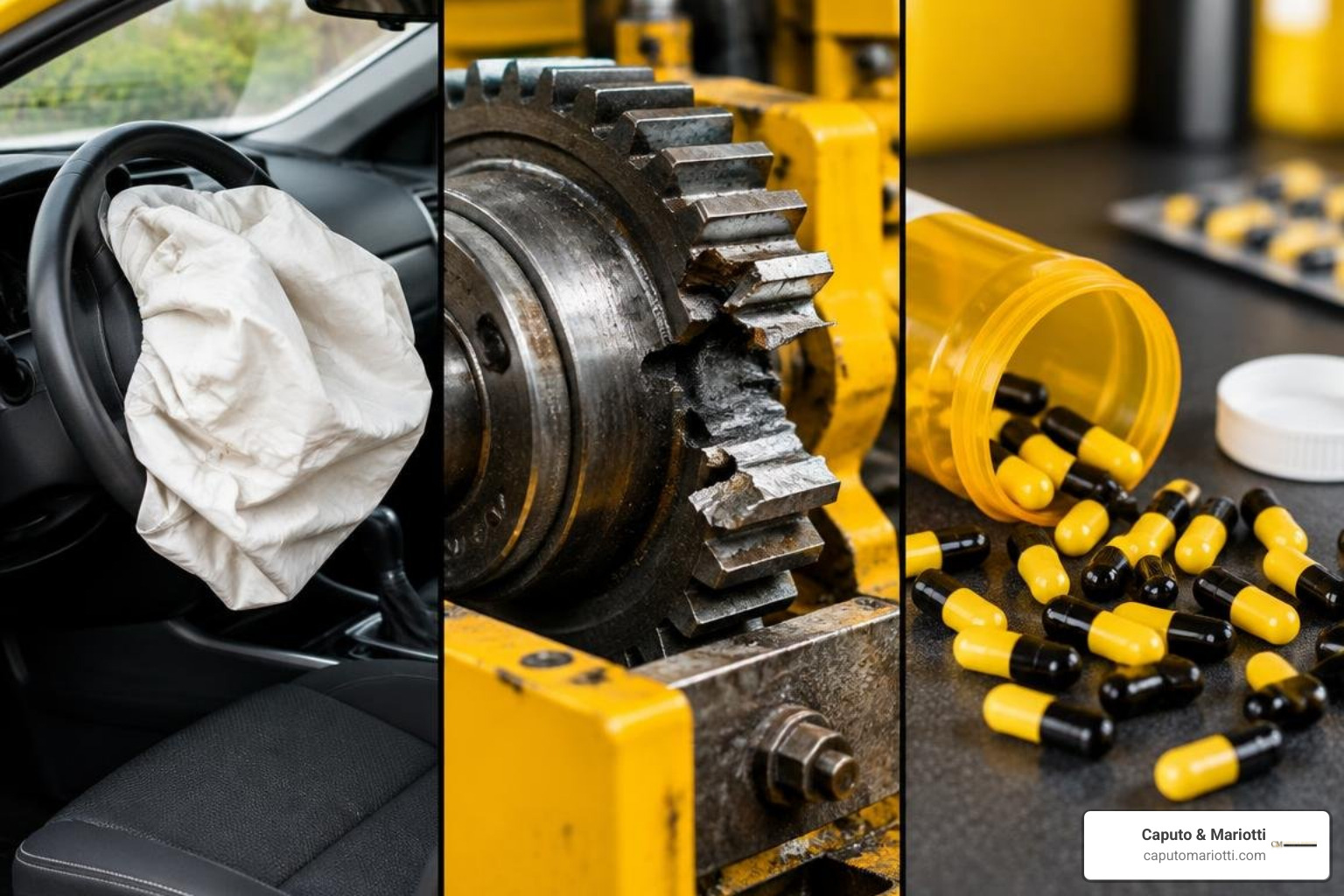
Get medical care first. Then keep the product, its packaging, and any receipts. Take photos and save your medical records. A product liability attorney in Wilkes-Barre, PA can investigate what went wrong, identify who may be responsible, and help you pursue a claim before key evidence is lost.
A defective product claim may involve a manufacturer, distributor, or seller. You may be able to seek payment for medical bills, lost income, and pain and suffering. The next steps depend on how the product failed and how it caused your injury.
I’m Chris Caputo, a product liability attorney in Wilkes-Barre, PA, and I’ve practiced law in Pennsylvania since 1994. My experience with serious injury claims and complex litigation helps me guide clients through the process described below.
Understanding Product Liability Law in Pennsylvania
Product liability is the area of law that holds manufacturers, wholesalers, and retail distributors legally responsible when a dangerous or defective item injures a consumer. When you purchase an item in Luzerne County or anywhere in Northeastern Pennsylvania, you have a reasonable expectation that it is safe for its intended use. When an unexpected hazard leads to severe physical harm, state civil laws provide an avenue to hold every responsible commercial party accountable.
The foundation of modern defective product claims in our state rests heavily on landmark case law, including the Supreme Court decision involving Terrence D. Tincher and Judith R. Tincher. This ruling clarified how plaintiffs prove a product is unreasonably dangerous, relying on two distinct tests: the consumer expectations test (the product failed to perform as safely as an ordinary consumer would expect) and the risk-utility test (the risks of the product’s design outweigh its benefits, and an alternative design could have prevented injury).
Chain of Distribution and Strict Liability Standards
In Pennsylvania, product liability actions typically proceed under the theory of strict liability. Unlike standard negligence lawsuits, strict liability does not require you to prove that the manufacturer or retailer acted carelessly. Instead, you must show that:
- The product had a defect that made it unreasonably dangerous.
- The defect existed when the item left the defendant’s control.
- The defect directly caused your injury and resulting damages.
Crucially, strict liability applies when an item moves through the normal commercial chain of distribution. If you purchased the product new from an authorized seller, every entity that brought that product to market—from the parts supplier to the final retail store—may share legal responsibility. To learn more about how these principles operate across the Commonwealth, consult our product liability guide and review the legal foundation of defective product lawsuits in Pennsylvania.
Defects fall into three primary categories:
- Design Defects: Inherent flaws present in a product before it is ever built, making the entire product line inherently unsafe.
- Manufacturing Defects: Errors that occur during assembly or fabrication, causing a specific unit or batch to deviate from its intended, safe design.
- Marketing Failures (Failure to Warn): Inadequate instructions, missing warning labels, or failure to disclose non-obvious hazards associated with using the item.
Common Categories of Defective Products and Mass Torts
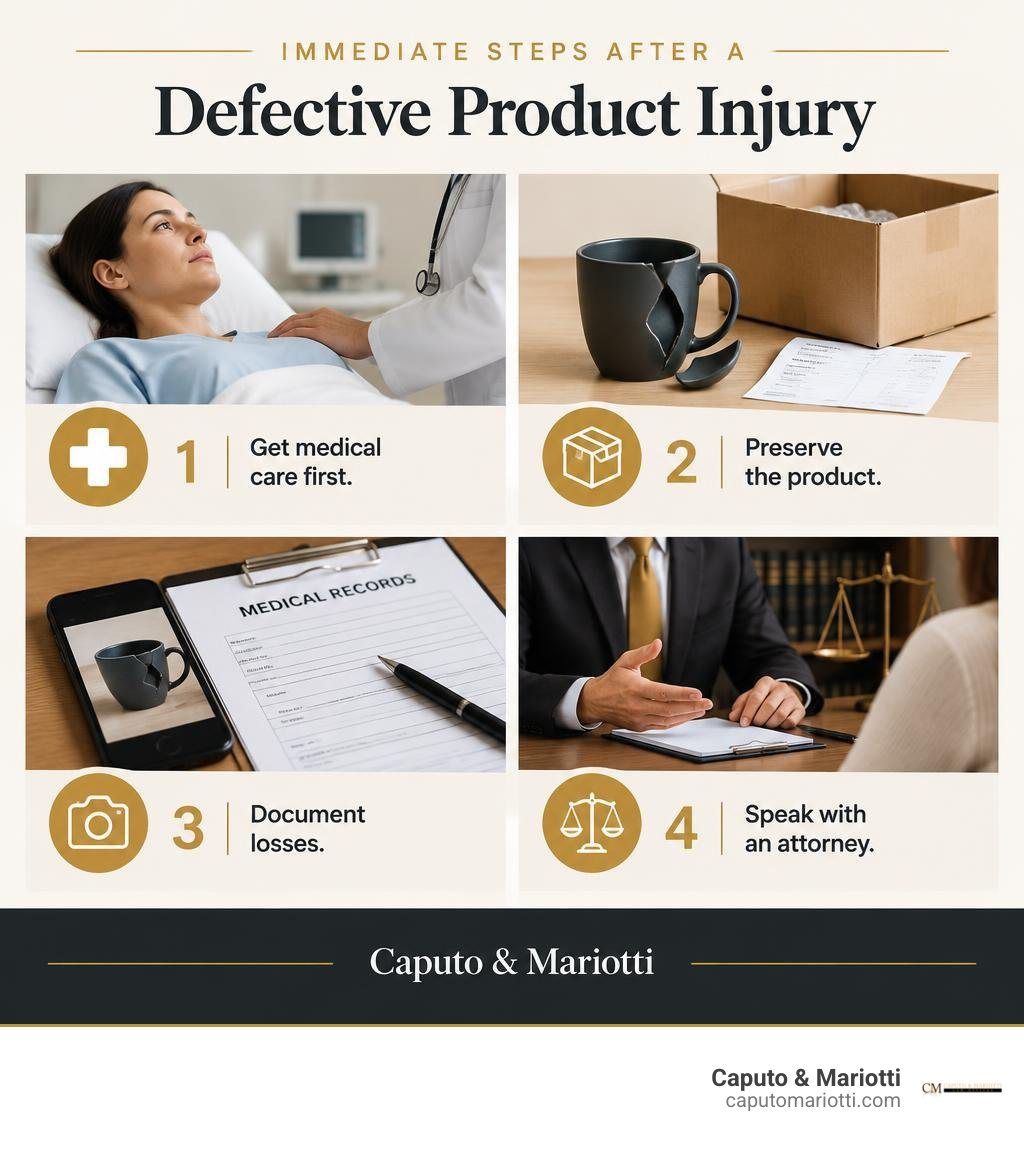
Defective products can appear in every corner of daily life, from industrial job sites across Lackawanna County to your own kitchen. Our firm examines claims involving a vast range of commercial items, outlined thoroughly in our breakdown of types of defective product liability claims.
Notable categories include:
- Automotive Failures: Defective vehicle components can cause catastrophic traffic collisions or worsen occupant injuries during an accident. Examples include examining the dangers of defective airbags and assessing the impact of defective tires.
- Dangerous Pharmaceuticals and Medical Hardware: Contaminated medications, unsafe hip implants, or poorly designed health devices can lead to chronic illness or systemic failure.
- Consumer Goods and Appliances: Power tools without proper safety guards, flammable clothing, or household appliances that pose electrocution or fire hazards.
- Complex Multi-Plaintiff Litigation: When a widespread product causes nationwide harm, cases often proceed as mass tort cases to coordinate discovery against large corporate entities.
Immediate Steps to Take After Suffering an Injury from a Dangerous Product
What you do immediately following an accident has a direct impact on your ability to secure full compensation. The product itself serves as the central piece of physical evidence in your case. If the item is altered, thrown away, or repaired, proving that a defect existed becomes significantly more difficult.
If you are hurt on a job site by faulty industrial equipment, you may also have concurrent claims. Pennsylvania operates a no-fault workers’ compensation system that covers medical treatment and a portion of lost income regardless of fault. Under this system, you must report the injury to your employer within mandatory statutory deadlines (ideally within 21 days, and no later than 120 days). You must treat with an employer-designated medical provider for the first 90 days if a proper panel list was provided. Your claim requires extensive evidence gathering, including witness statements, workplace incident reports, and complete medical records. If an insurer issues a denial, formal filing procedures and legal appeals before a Workers’ Compensation Judge become necessary.
Because workers’ compensation does not cover non-economic damages like pain and suffering, our experienced team investigates third-party liability to hold the equipment manufacturer accountable. For dedicated representation navigating both systems simultaneously, working with a skilled workers’ compensation lawyer ensures your rights are protected under workplace rules and product liability on the job.
| Evidence Category | Critical Action Items | Why It Matters for Your Claim |
|---|---|---|
| Physical Product Evidence | Store the item in a clean, secure container; preserve all broken pieces, packaging, user manuals, and purchase receipts; avoid altering, repairing, or cleaning the item. | Prevents claims of spoliation of evidence and allows engineering experts to examine the unaltered defect. |
| Medical Documentation | Seek emergency or specialized medical evaluation immediately; follow every treatment plan; keep copies of diagnostic scans, hospital discharge papers, and pharmacy bills. | Establishes a direct timeline linking the mechanical failure to your specific physical injuries and financial losses. |
When to Consult a Product Liability Attorney in Wilkes-Barre, PA
Pursuing compensation against corporate manufacturers and their insurance carriers requires deep technical insight and strategic litigation resources.
Why You Need a Product Liability Attorney in Wilkes-Barre, PA for Complex Litigation
Corporate defense teams routinely attempt to shift blame to the user, arguing that you misused the product or failed to read accompanying instructions. A dedicated product liability lawyer manages every aspect of your claim by:
- Retaining qualified mechanical, chemical, and human-factors engineering experts to conduct forensic evaluations.
- Identifying all commercial entities along the distribution chain to maximize available insurance coverage.
- Handling communications and high-stakes settlement negotiations with corporate defense firms.
- Preparing an aggressive trial strategy to present technical findings clearly in court.
Our local focus handling Wilkes-Barre product liability claims gives clients the advantage of localized courtroom experience paired with the resources needed to take on multinational corporations.
Recoverable Damages in Pennsylvania Injury Claims
Under Pennsylvania law, victims injured by defective products may seek both economic and non-economic damages. In cases involving extreme, wanton misconduct or gross negligence, punitive damages may also be awarded to punish the wrongdoing party and deter future reckless behavior.

Victims can pursue financial recovery across several categories of damages in product liability cases:
- Medical Expenses: Coverage for emergency room visits, surgery, hospitalization, prescription medications, rehabilitation, and anticipated future medical procedures.
- Lost Income and Earning Potential: Reimbursement for missed work time and compensation for diminished future earnings if the injury causes lasting disability.
- Pain and Suffering: Compensation for physical pain, emotional distress, loss of enjoyment of life, and physical disfigurement.
- Property Loss: Reimbursement for personal property damaged or destroyed by the malfunctioning device.
Frequently Asked Questions About Defective Product Claims
How does a product liability attorney in Wilkes-Barre, PA prove fault?
Proving fault does not require showing that the manufacturer acted with malicious intent or carelessness if the case is filed under strict liability. Instead, legal counsel proves that the product contained an actionable defect when it left the manufacturer’s hands and that this flaw directly caused your injuries. Our attorneys handling Scranton product liability claims and Luzerne County matters work closely with forensic specialists to test components, recreate failure events, and demonstrate that the product was unreasonably hazardous for its intended use.
What is the deadline to file a defective product lawsuit in Pennsylvania?
In Pennsylvania, the statute of limitations for personal injury actions, including product liability claims, is generally two years from the date the injury occurred or was discovered. Failing to initiate a lawsuit within this two-year window almost always forfeits your right to seek legal damages. Consulting counsel through our Pittston product liability team well before this deadline ensures ample time to preserve physical evidence and secure witness testimony.
Can I file a claim if the product was purchased second-hand?
Strict liability protections in Pennsylvania generally require the product to have been purchased new within the ordinary commercial chain of distribution. If an item was bought second-hand through an informal sale, garage sale, or private individual, strict liability may not apply to that transaction. However, you may still have grounds for a claim based on traditional negligence or breach of warranty depending on the circumstances. Our team handling Hazleton product liability cases can review your purchase history to determine the best legal approach.
Securing Legal Help for Your Product Liability Claim
For more than 55 years, the legal team at Caputo & Mariotti has fought on behalf of injured individuals throughout Wilkes-Barre, Scranton, Moosic, Dickson City, and communities across Northeastern Pennsylvania. When a defective device or dangerous medication causes life-altering harm, you should not carry the resulting financial and physical burdens alone.
If you or a loved one suffered harm because of a product defect, we are prepared to evaluate your situation and guide you toward full justice. To discuss your case with an experienced team, schedule a free consultation or discover how our personal injury attorney in Scranton and Wilkes-Barre, PA can fight for the financial recovery you deserve.
